

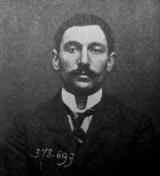
Vincenzo Peruggia

Encyclopedia
Vincenzo Peruggia is a unitary parliamentary republic in South-Central Europe. To the north it borders France, Switzerland, Austria and...
- October 8, 1925, Annemasse
Annemasse
Annemasse is a commune in the Haute-Savoie department in the Rhône-Alpes region in south-eastern France.It lies on the border with Switzerland. It is the second town in the Haute-Savoie department with a population estimated to 29'450 in 2010.-Geography:...
, France
France
The French Republic , The French Republic , The French Republic , (commonly known as France , is a unitary semi-presidential republic in Western Europe with several overseas territories and islands located on other continents and in the Indian, Pacific, and Atlantic oceans. Metropolitan France...
) was the man who stole the Mona Lisa
Mona Lisa
Mona Lisa is a portrait by the Italian artist Leonardo da Vinci. It is a painting in oil on a poplar panel, completed circa 1503–1519...
.
Theft
In 1911 Vincenzo Peruggia perpetrated what has been described as the greatest art theftArt theft
Art theft is usually for the purpose of resale or for ransom . Stolen art is sometimes used by criminals to secure loans.. One must realize that only a small percentage of stolen art is recovered. Estimates range from 5 to 10%. This means that little is known about the scope and characteristics of...
of the 20th century. The former Louvre
Louvre
The Musée du Louvre – in English, the Louvre Museum or simply the Louvre – is one of the world's largest museums, the most visited art museum in the world and a historic monument. A central landmark of Paris, it is located on the Right Bank of the Seine in the 1st arrondissement...
worker hid inside the museum on Sunday, August 20, knowing that the museum would be closed the following day. Emerging from his hiding place on Monday morning, he wore one of the white artists' smocks that museum employees customarily wore and was indistinguishable from the other workers. When the Salon Carre where the Mona Lisa hung was empty, he lifted it from the wall and took it to an enclosed stairwell. There he removed the protective case and frame and concealed the painting (which Leonardo painted on wood) under his smock. He left the Louvre with it, passing a guard station which had been left unattended by a guard who had gone to obtain a pail of water.
Vincenzo hid the painting in his apartment in Paris. Supposedly, when police arrived to search his apartment and question him, they accepted his alibi that he had been working at a different location on the day of the theft.
After keeping the painting hidden in a trunk in his apartment for two years, Peruggia returned to Italy with it. He kept it in his apartment in Florence
Florence
Florence is the capital city of the Italian region of Tuscany and of the province of Florence. It is the most populous city in Tuscany, with approximately 370,000 inhabitants, expanding to over 1.5 million in the metropolitan area....
but grew impatient and was finally caught when he contacted Alfredo Geri, the owner of an art gallery in Florence, Italy. Geri's story conflicts with Peruggia's, but it was clear that Peruggia expected a reward for returning the painting to what he regarded as its "homeland." Geri called in Giovanni Poggi, director of the Uffizi Gallery, who authenticated the painting. Poggi and Geri, after taking the painting for "safekeeping," informed the police, who arrested Peruggia at his hotel.
After its theft, the painting was exhibited all over Italy with banner headlines rejoicing its return and then returned to the Louvre in 1913.
Peruggia was released from jail after a short time and served in the Italian army during World War I
World War I
World War I , which was predominantly called the World War or the Great War from its occurrence until 1939, and the First World War or World War I thereafter, was a major war centred in Europe that began on 28 July 1914 and lasted until 11 November 1918...
. He got married, returned to France and opened a paint store. He died on October 8, 1925 in the town of Annemasse
Annemasse
Annemasse is a commune in the Haute-Savoie department in the Rhône-Alpes region in south-eastern France.It lies on the border with Switzerland. It is the second town in the Haute-Savoie department with a population estimated to 29'450 in 2010.-Geography:...
, France. His death was not widely reported on by the media, with obituaries appearing mistakenly only when another Vincenzo Peruggia died in France in 1947.
Motivations
There are currently two predominant theories regarding the theft of the Mona Lisa.Peruggia said he did it for a patriotic reason: he wanted to bring the painting back for display in Italy
Italy
Italy , officially the Italian Republic languages]] under the European Charter for Regional or Minority Languages. In each of these, Italy's official name is as follows:;;;;;;;;), is a unitary parliamentary republic in South-Central Europe. To the north it borders France, Switzerland, Austria and...
after it was stolen by Napoleon. Although perhaps sincere in his motive, Vincenzo may not have known that Leonardo da Vinci
Leonardo da Vinci
Leonardo di ser Piero da Vinci was an Italian Renaissance polymath: painter, sculptor, architect, musician, scientist, mathematician, engineer, inventor, anatomist, geologist, cartographer, botanist and writer whose genius, perhaps more than that of any other figure, epitomized the Renaissance...
took this painting as a gift for Francis I
Francis I of France
Francis I was King of France from 1515 until his death. During his reign, huge cultural changes took place in France and he has been called France's original Renaissance monarch...
when he moved to France
France
The French Republic , The French Republic , The French Republic , (commonly known as France , is a unitary semi-presidential republic in Western Europe with several overseas territories and islands located on other continents and in the Indian, Pacific, and Atlantic oceans. Metropolitan France...
to become a painter in his court.
Experts have also questioned the "patriotism" motive on the grounds that—were patriotism the true motive—Peruggia would have donated the painting to an Italian museum, rather than attempt to profit from its sale. However it is believed that the "friend" was the one who attempted to profit from the sale since Peruggia never divulged its secret for nearly two years.
Put on trial, the court agreed to some extent that Peruggia committed his crime for patriotic reasons and gave him a lenient sentence. He was sent to jail for one year and fifteen days, but was hailed as a great patriot in Italy and served only a few months in jail.
Another theory emerged later. The theft may have been encouraged or master-minded by Eduardo de Valfierno
Eduardo de Valfierno
Eduardo de Valfierno, who posed as a Marqués , was an Argentine con man who allegedly masterminded the theft of the Mona Lisa. Valfierno paid several men to steal the work of art from the Louvre, including museum employee Vincenzo Peruggia...
, a con-man who had commissioned the French art forger Yves Chaudron
Yves Chaudron
Yves Chaudron was a French art forger who may have copied images of the Mona Lisa in the famous 1911 Mona Lisa painting theft.-External links:*...
to make copies of the painting so he could sell them as the missing original. The copies would have gone up in value if the original was stolen. This theory is based entirely on an article by former Hearst journalist Karl Decker in The Saturday Evening Post in 1932. Decker claimed to have known "Valfierno" and heard the story from him in 1913, promising not to print it until he learned of Valfierno's death. There is no external confirmation for this tale.
In Media
- He was portrayed in an early German soundfilmDer Raub der Mona LisaDer Raub der Mona Lisa is a 1931 German film directed by Géza von Bolváry. It is based on a true story.- Plot :...
by Willi ForstWilli ForstWilli Forst, born Wilhelm Anton Frohs was an Austrian actor, screenwriter, film director, film producer and singer...
in 1931, and in a television-miniseries called The Man Who Stole La Gioconda by Alessandro Preziosi in 2006. - In an April 1956 episode of the TV-show You Are There, called "The Recovery of the Mona Lisa (December 10, 1913)", Peruggia is played by Vito ScottiVito ScottiVito Scotti was a veteran character actor who played many roles, primarily from the late-1940s to the mid-1990s. He was known as a man of a thousand faces, for his ability to assume so many divergent roles in more than 200 screen roles, in a nearly 50 year career. He was known for his resourceful...
, who reprised the role in yet another TV-reconstruction of the famous theft, this time for the TV-show G.E. True. The episode was called The Tenth Mona Lisa and aired in March 1963. - In Season 2, Episode 7 of the American produced television series LeverageLeverage (TV series)Leverage is an American television drama series on TNT that premiered in December 2008. The series is produced by director/executive producer Dean Devlin's production company Electric Television...
, the theft of the Mona Lisa was quoted and the duplicates of the painting that were created are referenced as a story telling device. - A similar con using duplicates painted by Da Vinci himself is portrayed in the 1979 Doctor WhoDoctor WhoDoctor Who is a British science fiction television programme produced by the BBC. The programme depicts the adventures of a time-travelling humanoid alien known as the Doctor who explores the universe in a sentient time machine called the TARDIS that flies through time and space, whose exterior...
story City of DeathCity of Death-Pre-production:Writer David Fisher had contributed two scripts to Doctor Whos sixteenth season – The Stones of Blood and The Androids of Tara – and was asked by producer Graham Williams for further story ideas...
. - On 6 April 2010, the downloadable content pack "Kasumi's Stolen Memories" for the video game Mass Effect 2Mass Effect 2Mass Effect 2 is an action role-playing game developed by BioWare and published by Electronic Arts for Microsoft Windows, Xbox 360 and PlayStation 3. The game was released for Microsoft Windows and Xbox 360 on January 26, 2010 and for PlayStation 3 on January 18, 2011...
, had his name mentioned as the password to a villainous art thief's vault with a subsequent statement to the significance of the name. In the DLC "The Lair of the Shadow Broker", it is revealed that a squad member from the game, Kasumi Goto, is the current owner of the painting in the Mass Effect universe. - The story of Peruggia is recounted at the beginning of Chapter 12 in Daniel Silva's The Rembrandt Affair (Gabriel Allon) which was originally published in July 2010.
- Art Historian Noah Charney's 2011 monograph, "The Theft of the Mona Lisa: On Stealing the Worlds Most Famous Painting" (ARCA Publications) is the most recent full account of the theft and it's ramifications.