


Units of textile measurement

Encyclopedia
Textile is measured in various units, such as: the denier and tex (linear mass density of fibres), super S (fineness of wool fiber), worst count, and yield (the inverse of denier and tex).
Yarn is spun thread used for knitting, weaving, or sewing. Thread is a long, thin strand of cotton, nylon, or other fibers used in sewing or weaving. Both yarn and thread are measured in terms of cotton count and yarn density.
Fabric is cloth, typically produced by weaving or knitting textile fibers, and is measured in units such as mommes (momme is a number that equals the weight in pounds of a piece of silk if it were sized 45 inches by 100 yards), thread count (a measure of the coarseness or fineness of fabric), ends per inch (e.p.i), and picks per inch (p.p.i).
in gram
s per 9,000 meters. In the International System of Units
the tex is used instead (see below). The denier is based on a natural standard: a single strand of silk is one denier. A 9,000 meter strand of silk weighs one gram. The term denier is from a French coin of small value (worth 1/12 of a sou). Applied to yarn, a denier was held to be equal in weight to 1/24 oz (this does not have units of mass per length!).
The term micro-denier is used to describe filaments that weigh less than one gram per 9,000 meter length.
One can distinguish between Filament and Total denier. Both are defined as above but the first only relates to a single filament of fiber (also commonly known as Denier per Filament or D.P.F) whereas the second relates to a yarn
, an agglomeration
of filaments.
The following relationship applies to straight, uniform filaments:
The denier system of measurement is used on two and single filament fibers. Some common calculations are as follows:
In practice measuring 9,000 meters is both time-consuming and wasteful. Usually a sample of 900 meters is weighed and the result multiplied by 10 to obtain the denier weight.
One can calculate the diameter of a filament given its weight in denier with the following formula:

where represents the material's density in grams per cubic centimeter and the diameter is in cm.
, while denier remains more common in the United States and United Kingdom. The unit code is "tex". The most commonly used unit is actually the deci
Tex is used for measuring fiber size in many products, including cigarette filters, optical cable, yarn, and fabric.
One can calculate the diameter of a filament given its weight in dtex with the following formula:

where represents the material's density in grams per cubic centimeter and the diameter is in cm.
) is an indirect measure of the fineness of the fiber in a worsted
wool yarn expressed as the number of 560-yard (1 yard = 0.9144 meters) lengths (hanks) of worsted yarn that a pound (0.45359237 kilograms) of wool yields. The finer the wool, the more yarn and the higher the count. It has been largely replaced by direct measures.
of a roving
of fibers. However, unlike tex and denier, yield is the inverse of linear density
and is usually expressed in yards/lb.
One Lea – 120 yards
English Cotton count (Nec)is an indirect counting system i.e. the higher the number the finer the yarn.
To convert Denier to Cotton Count *5315 – from Tex * 590.5 Tex is 1/9 Denier
of silk
. It is akin to the use of thread count to measure the quality of cotton fabrics, but is calculated in a very different manner. Instead of counting threads, the Momme is a number that equals the weight in pounds
of a piece of silk if it were sized 45 inch
es by 100 yard
s. This is because the standard width of silk is 45" wide, though silk is regularly produced in 55" widths, and, uncommonly, in even larger widths.
Silk can also be measured by weight in grams. 1 momme = 4.340 g/m^2; 8 momme is close to 1 oz per square yard or 34 g/m^2.
The usual range of momme weight for different weaves of silk are:
The higher the momme, the more durable the weave, and the more suitable it is for heavy-duty use. And, the heavier the silk, the more opaque it becomes. This can vary even between the same kind of silk. For example, lightweight charmeuse is translucent when used in clothing, but 30mm charmeuse is opaque.
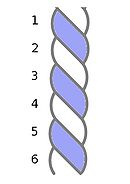 Thread count is a measure of the coarseness or fineness of fabric. It is measured by counting the number of threads contained in one square inch of fabric or one square centimeter, including both the length (warp
) and width (weft
) threads. The thread count is the number of threads counted along two sides (up and across) of the square inch, added together. It is used especially in regard to cotton linen
s such as bed sheet
s, and has been known to be used in the classification of towels.
Thread count is often used as a measure of fabric quality, so that "standard" cotton thread counts are around 150 while good-quality sheets start at 180 and a count of 200 or higher is considered percale
. Some, but not all, of the extremely high thread counts (typically over 500) tend to be misleading as they usually count the individual threads in 'plied
' yarns (a yarn that is made by twisting together multiple finer threads). For marketing purposes, a fabric with 250 two-ply yarns in both the vertical and horizontal direction could have the component threads counted to a 1000 thread count although "according to the National Textile Association
(NTA), which cites the international standards group ASTM
, accepted industry practice is to count each thread as one, even threads spun as two- or three-ply yarn. The Federal Trade Commission
in an August 2005 letter to NTA agreed that consumers 'could be deceived or misled' by inflated thread counts. In 2002, ASTM proposed a definition for "thread count" that has been called "the industry's first formal definition for thread count". A minority on the ASTM committee argued for the higher yarn count number obtained by counting each single yarn in a plied yarn and cited as authority the provision relating to woven fabric in the Harmonized Tariff Schedule of the United States, which states each ply should be counted as one using the "average yarn number."
threads per inch of woven fabric. In general, the higher the ends per inch, the finer the fabric is.
Ends per inch is very commonly used by weavers who must use the number of ends per inch in order to pick the right reed
to weave
with. The number of ends per inch varies on the pattern to be woven and the thickness of the thread. Plain weave
s generally use half the number of wraps per inch for the number of ends per inch, whereas denser weaves like a twill weave will use a higher ratio like two thirds of the number of wraps per inch. Finer threads require more threads per inch than thick ones, and thus result in a higher number of ends per inch.
The number of ends per inch in a piece of woven cloth varies depending on what stage the cloth is at. Before the cloth is woven the warp has a certain number of ends per inch, which is directly related to what size reed
is being used. After weaving the number of ends per inch will increase, and it will increase again after being washed. This increase in the number of ends per inch (and picks per inch) and shrinkage
in the size of the fabric is known as the take-up. The take-up is dependent on many factors, including the material and how tightly the cloth is woven. Tightly woven fabric shrinks more (and thus the number of ends per inch increases more) than loosely woven fabric, as do more elastic yarns and fibers.
threads per inch of woven fabric. A pick is a single weft thread, hence the term. In general, the higher the picks per inch, the finer the fabric is.
Formulas]
Yarn is spun thread used for knitting, weaving, or sewing. Thread is a long, thin strand of cotton, nylon, or other fibers used in sewing or weaving. Both yarn and thread are measured in terms of cotton count and yarn density.
Fabric is cloth, typically produced by weaving or knitting textile fibers, and is measured in units such as mommes (momme is a number that equals the weight in pounds of a piece of silk if it were sized 45 inches by 100 yards), thread count (a measure of the coarseness or fineness of fabric), ends per inch (e.p.i), and picks per inch (p.p.i).
Denier
Denier is a unit of measure for the linear mass density of fibers. It is defined as the massMass
Mass can be defined as a quantitive measure of the resistance an object has to change in its velocity.In physics, mass commonly refers to any of the following three properties of matter, which have been shown experimentally to be equivalent:...
in gram
Gram
The gram is a metric system unit of mass....
s per 9,000 meters. In the International System of Units
International System of Units
The International System of Units is the modern form of the metric system and is generally a system of units of measurement devised around seven base units and the convenience of the number ten. The older metric system included several groups of units...
the tex is used instead (see below). The denier is based on a natural standard: a single strand of silk is one denier. A 9,000 meter strand of silk weighs one gram. The term denier is from a French coin of small value (worth 1/12 of a sou). Applied to yarn, a denier was held to be equal in weight to 1/24 oz (this does not have units of mass per length!).
The term micro-denier is used to describe filaments that weigh less than one gram per 9,000 meter length.
One can distinguish between Filament and Total denier. Both are defined as above but the first only relates to a single filament of fiber (also commonly known as Denier per Filament or D.P.F) whereas the second relates to a yarn
Yarn
Yarn is a long continuous length of interlocked fibres, suitable for use in the production of textiles, sewing, crocheting, knitting, weaving, embroidery and ropemaking. Thread is a type of yarn intended for sewing by hand or machine. Modern manufactured sewing threads may be finished with wax or...
, an agglomeration
Agglomeration
In the study of human settlements, an urban agglomeration is an extended city or town area comprising the built-up area of a central place and any suburbs linked by continuous urban area. In France, INSEE the French Statistical Institute, translate it as "Unité urbaine" which means continuous...
of filaments.
The following relationship applies to straight, uniform filaments:
- D.P.F. = Total Denier / Quantity of Uniform Filaments
The denier system of measurement is used on two and single filament fibers. Some common calculations are as follows:
| 1 denier | = 1 gram per 9 000 meters |
| = 0.05 grams per 450 meters (1/20 of above) | |
| = 0.111 milligrams per meter |
In practice measuring 9,000 meters is both time-consuming and wasteful. Usually a sample of 900 meters is weighed and the result multiplied by 10 to obtain the denier weight.
- A fiber is generally considered a microfiberMicrofiberMicrofiber or microfibre refers to synthetic fibers that measure less than one denier. The most common types of microfibers are made from polyesters, polyamides , and or a conjugation of polyester and polyamide.Microfiber is used to make non-woven, woven and knitted textiles...
if it is 1 denier or less. - A 1-denier polyesterPolyesterPolyester is a category of polymers which contain the ester functional group in their main chain. Although there are many polyesters, the term "polyester" as a specific material most commonly refers to polyethylene terephthalate...
fiber has a diameterDiameterIn geometry, a diameter of a circle is any straight line segment that passes through the center of the circle and whose endpoints are on the circle. The diameters are the longest chords of the circle...
of about 10 micrometers. - Denier is used as the measure of density of weave in tightsTightsTights are a kind of cloth leg garment, most often sheathing the body from about the waist to the feet with a more or less tight fit, hence the name....
and pantyhosePantyhosePantyhose are sheer, close-fitting legwear, covering the wearer's body from the waist to the feet. Mostly considered to be a woman's and girl's garment, pantyhose appeared in the 1960s, and they provided a convenient alternative to stockings...
, which defines their opacity.
One can calculate the diameter of a filament given its weight in denier with the following formula:
where
represents the material's density in grams per cubic centimeter and the diameter is in cm.Tex
Tex is a unit of measure for the linear mass density of fibers and is defined as the mass in grams per 1000 meters. Tex is more likely to be used in Canada and Continental EuropeContinental Europe
Continental Europe, also referred to as mainland Europe or simply the Continent, is the continent of Europe, explicitly excluding European islands....
, while denier remains more common in the United States and United Kingdom. The unit code is "tex". The most commonly used unit is actually the deci
Deci
Deci is a prefix in the metric system denoting a factor of one tenth. Adopted in 1795, the prefix comes from the Latin decimus, meaning tenth. Its most frequent use is in the non-SI unit, the decibel, used to measure sound intensity and many other ratios....
Tex is used for measuring fiber size in many products, including cigarette filters, optical cable, yarn, and fabric.
One can calculate the diameter of a filament given its weight in dtex with the following formula:
where
represents the material's density in grams per cubic centimeter and the diameter is in cm.
| Tex (g/km) | Yield (yards/#) |
|---|---|
| 550 | 900 |
| 735 | 675 |
| 1100 | 450 |
| 1200 | 413 |
| 2000 | 250 |
| 2200 | 225 |
| 2400 | 207 |
| 4400 | 113 |
S or super S number
Super S or S number is a direct measure of the fineness of the wool fiber. It is most commonly seen as a label on wool suits and other tailored wool apparel to indicate the fineness of the wool fiber used in the making of the apparel. The numbers may also be found on wool fabric and yarn.Worsted count
Worsted count (or spinning countSpinning count
Spinning count is a measure of fibre fineness and distribution developed by the English. It is defined as the number of hanks of yarn that can be spun from a pound of wool. A hank of wool is 560 yards long...
) is an indirect measure of the fineness of the fiber in a worsted
Worsted
Worsted , is the name of a yarn, the cloth made from this yarn, and a yarn weight category. The name derives from the village of Worstead in the English county of Norfolk...
wool yarn expressed as the number of 560-yard (1 yard = 0.9144 meters) lengths (hanks) of worsted yarn that a pound (0.45359237 kilograms) of wool yields. The finer the wool, the more yarn and the higher the count. It has been largely replaced by direct measures.
Yield
Similar to tex and denier, yield is a term that helps describe the linear densityLinear density
Linear density, linear mass density or linear mass is a measure of mass per unit of length, and it is a characteristic of strings or other one-dimensional objects. The SI unit of linear density is the kilogram per metre...
of a roving
Roving
A roving is a long and narrow bundle of fibre. It is usually used to spin woollen yarn. A roving can be created by carding the fibre, and it is then drawn into long strips. Because it is carded, the fibres are not parallel, though drawing it into strips may line the fibres up a bit...
of fibers. However, unlike tex and denier, yield is the inverse of linear density
Linear density
Linear density, linear mass density or linear mass is a measure of mass per unit of length, and it is a characteristic of strings or other one-dimensional objects. The SI unit of linear density is the kilogram per metre...
and is usually expressed in yards/lb.
Cotton count
- Cotton Count is another measure of linear density. It is the amount of skein material measured in hanks (840 yards) needed to create one pound. Under this system, the higher the number, the finer the yarn. In the United States a cotton count between one and 20 are referred to as coarse counts. A regular single knit T-Shirt can be between 20 and 40 count, fine bed sheets are usually in the range of 40 to 80 count. The number is now widely used in the staple fiber industry.
- Hank: A length of 7 leas or 840 yards
One Lea – 120 yards
Yarn Length
Yarn Length in meters = Yarn countX1693XYarn Weight in KgsEnglish Cotton count (Nec)is an indirect counting system i.e. the higher the number the finer the yarn.
- Thread: A length of 54 in (the circumference of a warp beam)
- Bundle: Usually 10 lbs
- Lea: A length of 80 threads or 120 yards
- Denier: this is an alternative method. It is defined as a number that is equivalent to the weight in grams of 9000m of a single yarn. 15 denier is finer than 30 denier.
- Tex: is the weight in grams of 1 km of yarn.
To convert Denier to Cotton Count *5315 – from Tex * 590.5 Tex is 1/9 Denier
Yarn density conversion
| Approx. Yarn Measurement Comparison | ||||||
|---|---|---|---|---|---|---|
| Denier | m/g | Tex | Worsted | Cotton | Woolen(Run) | Linen(Lea) |
| 50 | 180 | 5.6 | 160 | 106 | 56 | 298 |
| 75 | 120 | 8.3 | 106 | 72 | 37 | 198 |
| 100 | 90 | 11.1 | 80 | 53 | 28 | 149 |
| 150 | 60 | 16.6 | 53 | 35 | 19 | 99 |
| 200 | 45 | 22.2 | 40 | 27 | 14 | 74 |
| 300 | 30 | 33.4 | 27 | 18 | 9.3 | 50 |
| 400 | 22.5 | 44.4 | 20 | 13 | 7.0 | 37 |
| 500 | 18 | 55.5 | 16 | 11 | 5.6 | 30 |
| 700 | 12.9 | 77.7 | 11.4 | 7.6 | 4.0 | 2 |
| 1000 | 9 | 111 | 8.0 | 5.3 | 2.8 | 15 |
| 1500 | 6 | 166 | 5.3 | 3.5 | 1.9 | 10 |
| 2000 | 4.5 | 222 | 4.0 | 2.7 | 1.4 | 7 |
Mommes
Mommes (mm) are units of weight traditionally used to measure the densityDensity
The mass density or density of a material is defined as its mass per unit volume. The symbol most often used for density is ρ . In some cases , density is also defined as its weight per unit volume; although, this quantity is more properly called specific weight...
of silk
Silk
Silk is a natural protein fiber, some forms of which can be woven into textiles. The best-known type of silk is obtained from the cocoons of the larvae of the mulberry silkworm Bombyx mori reared in captivity...
. It is akin to the use of thread count to measure the quality of cotton fabrics, but is calculated in a very different manner. Instead of counting threads, the Momme is a number that equals the weight in pounds
Pound (mass)
The pound or pound-mass is a unit of mass used in the Imperial, United States customary and other systems of measurement...
of a piece of silk if it were sized 45 inch
Inch
An inch is the name of a unit of length in a number of different systems, including Imperial units, and United States customary units. There are 36 inches in a yard and 12 inches in a foot...
es by 100 yard
Yard
A yard is a unit of length in several different systems including English units, Imperial units and United States customary units. It is equal to 3 feet or 36 inches...
s. This is because the standard width of silk is 45" wide, though silk is regularly produced in 55" widths, and, uncommonly, in even larger widths.
Silk can also be measured by weight in grams. 1 momme = 4.340 g/m^2; 8 momme is close to 1 oz per square yard or 34 g/m^2.
The usual range of momme weight for different weaves of silk are:
- HabutaiHabutaiHabutai or Habotai is one of the most basic plain weaves. While it was traditionally woven in Japan, most Habutai is today woven in China. It is normally a lining silk but can also be used for T-shirts, lampshades, summer blouses or very light lingerie. It is quite easy to dye and can be found...
– 5 to 16 mm - ChiffonChiffon (fabric)Chiffon, , from the French word for a cloth or rag, is a lightweight, balanced plain-woven sheer fabric woven of alternate S- and Z-twist crepe yarns. The twist in the crepe yarns puckers the fabric slightly in both directions after weaving, giving it some stretch and a slightly rough...
– 6 to 8 mm (can be made in double thickness, i.e. 12 to 16 mm) - Crepe de Chine – 12 to 16 mm
- GauzeGauzeGauze is a thin, translucent fabric with a loose open weave.-Uses and types:Gauze was originally made of silk and was used for clothing. It is now used for many different things, including gauze sponges for medical purposes. When used as a medical dressing, gauze is generally made of cotton...
– 3 to 5 mm - Raw silkRaw SilkRaw Silk was an American dance band, originated in New York. Raw Silk is best known for their garage-boogie song "Do It to the Music". The group is consisted of two Crown Heights Affair members, Ron Dean Miller and Bert Reid, and three female vocalists Jessica Cleaves, Sybil Thomas, Tenita Jordan...
– 35 to 40 mm (heavier silks appear more 'wooly') - OrganzaOrganzaOrganza is a thin, plain weave, sheer fabric traditionally made from silk. Many modern organzas are woven with synthetic filament fibers such as polyester or nylon, but the most luxurious organzas are still made of silk. Silk organza is woven by a number of mills along the Yangtze River and in the...
– 4 to 6 mm - CharmeuseCharmeuseCharmeuse is a lightweight fabric woven with a satin weave, where the warp threads cross over three or more of the backing threads. The front side of the fabric has a satin finish - lustrous and reflective - whereas the back has a dull finish. It can be made of silk or a synthetic lookalike...
– 12 to 30 mm –
The higher the momme, the more durable the weave, and the more suitable it is for heavy-duty use. And, the heavier the silk, the more opaque it becomes. This can vary even between the same kind of silk. For example, lightweight charmeuse is translucent when used in clothing, but 30mm charmeuse is opaque.
Thread count
Warp (weaving)
In weaving cloth, the warp is the set of lengthwise yarns that are held in tension on a frame or loom. The yarn that is inserted over-and-under the warp threads is called the weft, woof, or filler. Each individual warp thread in a fabric is called a warp end or end. Warp means "that which is thrown...
) and width (weft
Weft
In weaving, weft or woof is the yarn which is drawn through the warp yarns to create cloth. In North America, it is sometimes referred to as the "fill" or the "filling yarn"....
) threads. The thread count is the number of threads counted along two sides (up and across) of the square inch, added together. It is used especially in regard to cotton linen
Linen
Linen is a textile made from the fibers of the flax plant, Linum usitatissimum. Linen is labor-intensive to manufacture, but when it is made into garments, it is valued for its exceptional coolness and freshness in hot weather....
s such as bed sheet
Bed sheet
A bed sheet is a piece of cloth used to cover a mattress. It is this sheet that one typically lies on.In many areas of the world, a second flat bed sheet is laid on top of the sheet covering the mattress. This is known as a "top sheet" and when a top sheet is used, the sheet covering the mattress...
s, and has been known to be used in the classification of towels.
Thread count is often used as a measure of fabric quality, so that "standard" cotton thread counts are around 150 while good-quality sheets start at 180 and a count of 200 or higher is considered percale
Percale
Percale or Percalcos is a closely woven plain-weave fabric often used for bed covers.The term describes the weave of the fabric, not its content, so percale could be a blend of 50% cotton and 50% polyester, 100% cotton, or a blend of other fabrics in any ratio...
. Some, but not all, of the extremely high thread counts (typically over 500) tend to be misleading as they usually count the individual threads in 'plied
Plying
In the textile arts, plying is a process used to create a strong, balanced yarn. It is done by taking two or more strands of yarn that each have a twist to them and putting them together. The strands are twisted together, in the direction opposite that in which they were spun...
' yarns (a yarn that is made by twisting together multiple finer threads). For marketing purposes, a fabric with 250 two-ply yarns in both the vertical and horizontal direction could have the component threads counted to a 1000 thread count although "according to the National Textile Association
National Textile Association
The National Textile Association is the United States's oldest and largest association of fabric-forming companies. NTA members knit and weave fabric in the U.S.; supply fibers, yarns to the fabric-forming industry; or supply other materials or services to the American textile industry.- History...
(NTA), which cites the international standards group ASTM
ASTM International
ASTM International, known until 2001 as the American Society for Testing and Materials , is an international standards organization that develops and publishes voluntary consensus technical standards for a wide range of materials, products, systems, and services...
, accepted industry practice is to count each thread as one, even threads spun as two- or three-ply yarn. The Federal Trade Commission
Federal Trade Commission
The Federal Trade Commission is an independent agency of the United States government, established in 1914 by the Federal Trade Commission Act...
in an August 2005 letter to NTA agreed that consumers 'could be deceived or misled' by inflated thread counts. In 2002, ASTM proposed a definition for "thread count" that has been called "the industry's first formal definition for thread count". A minority on the ASTM committee argued for the higher yarn count number obtained by counting each single yarn in a plied yarn and cited as authority the provision relating to woven fabric in the Harmonized Tariff Schedule of the United States, which states each ply should be counted as one using the "average yarn number."
Ends per inch
Ends per inch (or e.p.i.) is the number of warpWarp (weaving)
In weaving cloth, the warp is the set of lengthwise yarns that are held in tension on a frame or loom. The yarn that is inserted over-and-under the warp threads is called the weft, woof, or filler. Each individual warp thread in a fabric is called a warp end or end. Warp means "that which is thrown...
threads per inch of woven fabric. In general, the higher the ends per inch, the finer the fabric is.
Ends per inch is very commonly used by weavers who must use the number of ends per inch in order to pick the right reed
Reed (weaving)
A reed is part of a loom, and resembles a comb. It is used to push the weft yarn securely into place as it is woven, separates the threads and keeps them in their positions, keeping them untangled, and guides the shuttle as it moves across the loom. It consists of a frame with lots of vertical...
to weave
Weaving
Weaving is a method of fabric production in which two distinct sets of yarns or threads are interlaced at right angles to form a fabric or cloth. The other methods are knitting, lace making and felting. The longitudinal threads are called the warp and the lateral threads are the weft or filling...
with. The number of ends per inch varies on the pattern to be woven and the thickness of the thread. Plain weave
Plain weave
Plain weave is the most basic of three fundamental types of textile weaves . It is strong and hard-wearing, used for fashion and furnishing fabrics....
s generally use half the number of wraps per inch for the number of ends per inch, whereas denser weaves like a twill weave will use a higher ratio like two thirds of the number of wraps per inch. Finer threads require more threads per inch than thick ones, and thus result in a higher number of ends per inch.
The number of ends per inch in a piece of woven cloth varies depending on what stage the cloth is at. Before the cloth is woven the warp has a certain number of ends per inch, which is directly related to what size reed
Reed (weaving)
A reed is part of a loom, and resembles a comb. It is used to push the weft yarn securely into place as it is woven, separates the threads and keeps them in their positions, keeping them untangled, and guides the shuttle as it moves across the loom. It consists of a frame with lots of vertical...
is being used. After weaving the number of ends per inch will increase, and it will increase again after being washed. This increase in the number of ends per inch (and picks per inch) and shrinkage
Shrinkage (fabric)
Shrinkage is when a fabric becomes smaller than its original size, usually through the process of laundry. Novice users of modern laundry machines sometimes experience accidental shrinkage of garments, especially when applying heat. Others may intentionally try to shrink a garment in their size...
in the size of the fabric is known as the take-up. The take-up is dependent on many factors, including the material and how tightly the cloth is woven. Tightly woven fabric shrinks more (and thus the number of ends per inch increases more) than loosely woven fabric, as do more elastic yarns and fibers.
Picks per inch
Picks per inch (or p.p.i.) is the number of weftWeft
In weaving, weft or woof is the yarn which is drawn through the warp yarns to create cloth. In North America, it is sometimes referred to as the "fill" or the "filling yarn"....
threads per inch of woven fabric. A pick is a single weft thread, hence the term. In general, the higher the picks per inch, the finer the fabric is.
External links
Formulas]