

Ultima III

Encyclopedia
Ultima III: Exodus is the third game in the Ultima series. Exodus is also the name of the game's principal antagonist. Released in 1983, it was the first Ultima game published by Origin Systems
.
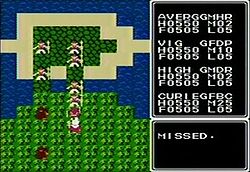
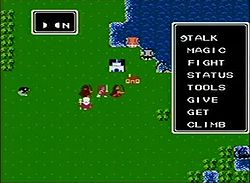 Exodus features revolutionary graphics for its time, being the first computer RPG to display animated characters. Also, Exodus differs from previous games in that players now direct the actions of a party of four characters rather than just one. Players now battle groups of enemies on a separate battle screen, where the player has to understand weapons and magic systems and employ rudimentary tactics in order to overcome each opponent, as opposed to the system in the previous two games, in which the player is simply depicted as trading blows with one opponent on the main map until either is defeated.
Unlike the two previous Ultima games, which had wire-frame first-person dungeons, Exodus dungeon
s are solid-3D in appearance and integrated into the game's plot. Most of the futuristic aspects of the game seen in the previous installments are gone, including flying vehicles, time machines, and spaceships.
By denying the player the ability to see what's behind mountain peaks, forests, and walls, the maps can now contain many small surprises such as hidden treasure, secret paths, and out-of-the-way informants. The look of the game is no longer based on certain characteristics of the Apple II
hardware; it is rather a carefully designed screen layout.
At the beginning of the game, Exodus is terrorizing the land of Sosaria from his stronghold on the Isle of Fire (known as Fire Island in Ultima Online
). The player character is summoned by Lord British to defeat Exodus and embarks on a quest that takes him to the lost land of Ambrosia, to the depths of the dungeons of Sosaria to receive powerful magical branding
marks and to find the mysterious Time Lord, and finally to the Isle of Fire itself to confront Exodus in his lair.
The game ends immediately upon Exodus' defeat; but unlike many games in the genre, Exodus cannot simply be killed in battle by a strong party of adventurers, but only through clever puzzle-solving and by paying attention to the many clues given throughout the game. At the end of the game, players were instructed to "REPORT THY VICTORY!" to Origin. Those who did so received a certificate of completion autographed by Richard Garriott
.
Although this is the last game in the series to take place in Old Sosaria, places in the game such as Ambrosia and the Isle of Fire make cameo appearances in later games, namely Ultima VII
.
and Final Fantasy
. In turn, Exodus was itself influenced by Wizardry
, which Richard Garriot credited as the inspiration behind the party-based combat in his game. Exodus was voted into Computer Gaming World
magazine Hall of Fame by its readers, and over 120,000 copies were sold. It also won the "Adventure Game of the Year" prize in Computer Gaming World' s 1985 reader poll, about which the editors wrote "Although Ultima III has been out well over a year, we feel that it is still the best game of its kind."
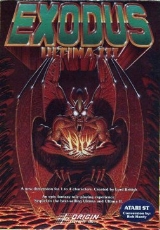
The demon figure that appeared on the front of the box caused fundamental religious extremists to protest. They made accusations that the game was corrupting the youth of America and encouraging Satan worshiping. This, along with other factors, led Richard Garriott to develop his next game (Ultima IV) based on the virtues the Ultima series is now famous for.
Origin Systems
Origin Systems, Inc. was a computer game developer based in Austin, Texas that was active from 1983 to 2004...
.
Gameplay
Unlike the two previous Ultima games, which had wire-frame first-person dungeons, Exodus dungeon
Dungeon
A dungeon is a room or cell in which prisoners are held, especially underground. Dungeons are generally associated with medieval castles, though their association with torture probably belongs more to the Renaissance period...
s are solid-3D in appearance and integrated into the game's plot. Most of the futuristic aspects of the game seen in the previous installments are gone, including flying vehicles, time machines, and spaceships.
By denying the player the ability to see what's behind mountain peaks, forests, and walls, the maps can now contain many small surprises such as hidden treasure, secret paths, and out-of-the-way informants. The look of the game is no longer based on certain characteristics of the Apple II
Apple II
The Apple II is an 8-bit home computer, one of the first highly successful mass-produced microcomputer products, designed primarily by Steve Wozniak, manufactured by Apple Computer and introduced in 1977...
hardware; it is rather a carefully designed screen layout.
Plot
After Ultima II: The Revenge of the Enchantress was set on Earth, the story of Exodus centers on a quest back in Sosaria, the world of Ultima. The player's mission is to destroy the final remnant of the evil Mondain and Minax. The game is named for its chief villain, Exodus, a demonic creation of Minax and Mondain that the series later describes as neither human nor machine.At the beginning of the game, Exodus is terrorizing the land of Sosaria from his stronghold on the Isle of Fire (known as Fire Island in Ultima Online
Ultima Online
Ultima Online is a graphical massively multiplayer online role-playing game , released on September 24, 1997, by Origin Systems. It was instrumental to the development of the genre, and is still running today...
). The player character is summoned by Lord British to defeat Exodus and embarks on a quest that takes him to the lost land of Ambrosia, to the depths of the dungeons of Sosaria to receive powerful magical branding
Human branding
Human branding or stigmatizing is the process in which a mark, usually a symbol or ornamental pattern, is burned into the skin of a living person, with the intention that the resulting scar makes it permanent. This is performed using a hot or very cold branding iron...
marks and to find the mysterious Time Lord, and finally to the Isle of Fire itself to confront Exodus in his lair.
The game ends immediately upon Exodus' defeat; but unlike many games in the genre, Exodus cannot simply be killed in battle by a strong party of adventurers, but only through clever puzzle-solving and by paying attention to the many clues given throughout the game. At the end of the game, players were instructed to "REPORT THY VICTORY!" to Origin. Those who did so received a certificate of completion autographed by Richard Garriott
Richard Garriott
Richard Allen Garriott is a British-American video game developer and entrepreneur.He is also known as his alter egos Lord British in Ultima and General British in Tabula Rasa...
.
Although this is the last game in the series to take place in Old Sosaria, places in the game such as Ambrosia and the Isle of Fire make cameo appearances in later games, namely Ultima VII
Ultima VII
Ultima VII: The Black Gate is the seventh installment of the Ultima series of computer role-playing games. It was released in 1992.The Black Gate was critically and commercially successful, being widely lauded as a high point in the series and as one of the best isometric RPGs ever created...
.
Reception
Exodus is credited as a game that laid the foundation for the computer role-playing game genre, influencing games such as Dragon WarriorDragon Warrior
Dragon Warrior, known as in Japan, is the first role-playing video game in the Dragon Quest media franchise. It was developed by Chunsoft for the Nintendo Entertainment System and published by Enix in Japan in 1986...
and Final Fantasy
Final Fantasy
is a media franchise created by Hironobu Sakaguchi, and is developed and owned by Square Enix . The franchise centers on a series of fantasy and science-fantasy role-playing video games , but includes motion pictures, anime, printed media, and other merchandise...
. In turn, Exodus was itself influenced by Wizardry
Wizardry
Wizardry is a series of computer role-playing games, developed by Sir-Tech, which were highly influential in the development of modern console and computer role playing games. The original Wizardry was a significant influence to early console RPGs, such as Dragon Warrior and Final Fantasy. ...
, which Richard Garriot credited as the inspiration behind the party-based combat in his game. Exodus was voted into Computer Gaming World
Computer Gaming World
Computer Gaming World was a computer game magazine founded in 1981 by Russell Sipe as a bimonthly publication. Early issues were typically 40-50 pages in length, written in a newsletter style, including submissions by game designers such as Joel Billings , Dan Bunten , and Chris Crawford...
magazine Hall of Fame by its readers, and over 120,000 copies were sold. It also won the "Adventure Game of the Year" prize in Computer Gaming World
The demon figure that appeared on the front of the box caused fundamental religious extremists to protest. They made accusations that the game was corrupting the youth of America and encouraging Satan worshiping. This, along with other factors, led Richard Garriott to develop his next game (Ultima IV) based on the virtues the Ultima series is now famous for.
Other versions
Numerous ports of Ultima III appeared on many different systems. Below is a complete list of the various systems Ultima III: Exodus has appeared on along with some differences between them.| System | Release date | Publisher | Notes |
|---|---|---|---|
| Apple II Apple II The Apple II is an 8-bit home computer, one of the first highly successful mass-produced microcomputer products, designed primarily by Steve Wozniak, manufactured by Apple Computer and introduced in 1977... |
1983 | Origin Systems Origin Systems Origin Systems, Inc. was a computer game developer based in Austin, Texas that was active from 1983 to 2004... |
|
| Atari 800 | 1983 | Origin Systems Origin Systems Origin Systems, Inc. was a computer game developer based in Austin, Texas that was active from 1983 to 2004... |
|
| Commodore 64 Commodore 64 The Commodore 64 is an 8-bit home computer introduced by Commodore International in January 1982.Volume production started in the spring of 1982, with machines being released on to the market in August at a price of US$595... |
1983 | Origin Systems Origin Systems Origin Systems, Inc. was a computer game developer based in Austin, Texas that was active from 1983 to 2004... |
|
| IBM PC IBM PC The IBM Personal Computer, commonly known as the IBM PC, is the original version and progenitor of the IBM PC compatible hardware platform. It is IBM model number 5150, and was introduced on August 12, 1981... |
1983 | Origin Systems Origin Systems Origin Systems, Inc. was a computer game developer based in Austin, Texas that was active from 1983 to 2004... |
|
| Amiga Amiga The Amiga is a family of personal computers that was sold by Commodore in the 1980s and 1990s. The first model was launched in 1985 as a high-end home computer and became popular for its graphical, audio and multi-tasking abilities... |
1986 | Origin Systems Origin Systems Origin Systems, Inc. was a computer game developer based in Austin, Texas that was active from 1983 to 2004... |
|
| Atari ST Atari ST The Atari ST is a home/personal computer that was released by Atari Corporation in 1985 and commercially available from that summer into the early 1990s. The "ST" officially stands for "Sixteen/Thirty-two", which referred to the Motorola 68000's 16-bit external bus and 32-bit internals... |
1986 | Origin Systems Origin Systems Origin Systems, Inc. was a computer game developer based in Austin, Texas that was active from 1983 to 2004... |
|
| Macintosh | 1986 | Origin Systems Origin Systems Origin Systems, Inc. was a computer game developer based in Austin, Texas that was active from 1983 to 2004... |
|
| PC-8801 | 1986 | Origin Systems Origin Systems Origin Systems, Inc. was a computer game developer based in Austin, Texas that was active from 1983 to 2004... /Starcraft* |
|
| PC-9801 PC-9801 The NEC PC-9801, part of the PC-98 series, is a Japanese 16-bit microcomputer manufactured by NEC.- History :It first appeared in 1982, and employed an 8086 CPU. It ran at a clock speed of 5 MHz, with two µPD7220 display controllers , and shipped with 128 KB of RAM, expandable to 640 KB... |
1986 | Origin Systems Inc. Origin Systems Origin Systems, Inc. was a computer game developer based in Austin, Texas that was active from 1983 to 2004... /Starcraft* |
|
| FM-7 FM-7 FM-7 is a home computer released in 1982 in Japan.The Fujitsu FM-7 was Fujitsu's first entry into the Japanese home computer market, and for their debut computer, they chose to come out with a 6809-based personal computer very similar to Radio Shack's Color Computer.-Hardware:*Two MC 68B09 CPUs @... |
1986 | Origin Systems Origin Systems Origin Systems, Inc. was a computer game developer based in Austin, Texas that was active from 1983 to 2004... /Starcraft* |
|
| NES/Famicom Nintendo Entertainment System The Nintendo Entertainment System is an 8-bit video game console that was released by Nintendo in North America during 1985, in Europe during 1986 and Australia in 1987... |
1987 | Origin Systems Origin Systems Origin Systems, Inc. was a computer game developer based in Austin, Texas that was active from 1983 to 2004... /FCI Fujisankei Communications International Fujisankei Communications International, Inc. is the American arm of the Fujisankei Communications Group , an important Japanese media conglomerate of television and radio channels, magazine, newspaper, record and video game companies. The Fujisankei Communications Group owns about 100 companies,... /Pony Canyon Pony Canyon is a Japanese company, established on October 1, 1966 , which publishes music, DVD and VHS videos, movies and video games. It is a subsidiary of Japanese Media Group, Fujisankei Communications Group.-History:... |
|
| MSX 2 - Cartridge MSX MSX was the name of a standardized home computer architecture in the 1980s conceived by Kazuhiko Nishi, then Vice-president at Microsoft Japan and Director at ASCII Corporation... |
1988 | Origin Systems Origin Systems Origin Systems, Inc. was a computer game developer based in Austin, Texas that was active from 1983 to 2004... /Pony Canyon Pony Canyon is a Japanese company, established on October 1, 1966 , which publishes music, DVD and VHS videos, movies and video games. It is a subsidiary of Japanese Media Group, Fujisankei Communications Group.-History:... |
|
| MSX 2 - 3.5" Disk MSX MSX was the name of a standardized home computer architecture in the 1980s conceived by Kazuhiko Nishi, then Vice-president at Microsoft Japan and Director at ASCII Corporation... |
1989 | Origin Systems Origin Systems Origin Systems, Inc. was a computer game developer based in Austin, Texas that was active from 1983 to 2004... /Pony Canyon Pony Canyon is a Japanese company, established on October 1, 1966 , which publishes music, DVD and VHS videos, movies and video games. It is a subsidiary of Japanese Media Group, Fujisankei Communications Group.-History:... |
|
| Macintosh Macintosh The Macintosh , or Mac, is a series of several lines of personal computers designed, developed, and marketed by Apple Inc. The first Macintosh was introduced by Apple's then-chairman Steve Jobs on January 24, 1984; it was the first commercially successful personal computer to feature a mouse and a... |
1993 | LairWare |
|
- *The publisher Starcraft has no relation to the popular PC game StarCraftStarCraftStarCraft is a military science fiction real-time strategy video game developed by Blizzard Entertainment. The first game of the StarCraft series was released for Microsoft Windows on 31 March 1998. With more than 11 million copies sold worldwide as of February 2009, it is one of the best-selling...
and went out of business in 1996.