
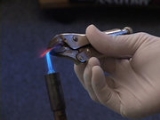
Human branding or stigmatizing is the process in which a mark, usually a symbol or ornamental pattern, is burned into the skin of a living person, with the intention that the resulting scar makes it permanent. This is performed using a hot or very cold
branding ironA branding iron is a tool which uses the process of pressing a heated metal shape against an object or livestock with the intention of leaving a mark....
. It therefore uses the physical techniques of
livestock brandingLivestock branding is a technique for marking livestock so as to identify the owner. Originally, livestock branding only referred to a hot brand for large stock, though the term is now also used to refer to other alternative techniques such as freeze branding...
on a human, either with consent as a form of
body modificationBody modification is the deliberate altering of the human body for any non-medical reason, such as aesthetics, sexual enhancement, a rite of passage, religious reasons, to display group membership or affiliation, to create body art, shock value, or self expression...
; or under coercion, as a
punishmentPunishment is the authoritative imposition of something negative or unpleasant on a person or animal in response to behavior deemed wrong by an individual or group....
or imposing masterly rights over an
enslavedSlavery is a system under which people are treated as property to be bought and sold, and are forced to work. Slaves can be held against their will from the time of their capture, purchase or birth, and deprived of the right to leave, to refuse to work, or to demand compensation...
or otherwise oppressed person. It may also be practiced as a "rite of passage" such as within a tribe, or to signify membership in an organization such as a college fraternity or sorority.
Etymology
The English verb to
burn, attested since the 12th century, is a combination of
Old NorseOld Norse is a North Germanic language that was spoken by inhabitants of Scandinavia and inhabitants of their overseas settlements during the Viking Age, until about 1300....
brenna "to burn, light," and two originally distinct Old English verbs:
bærnan "to kindle" (transitive) and
beornan "to be on fire" (intransitive), both from the Proto-Germanic root
bren(wanan), perhaps from a
Proto-Indo-EuropeanThe Proto-Indo-European language is the reconstructed common ancestor of the Indo-European languages, spoken by the Proto-Indo-Europeans...
root
bhre-n-u, from base root
bhereu- "to boil forth, well up." In
DutchDutch is a West Germanic language and the native language of the majority of the population of the Netherlands, Belgium, and Suriname, the three member states of the Dutch Language Union. Most speakers live in the European Union, where it is a first language for about 23 million and a second...
,
(ver)branden mean "to burn",
brandmerk a branded mark; similarly, in
GermanGerman is a West Germanic language, related to and classified alongside English and Dutch. With an estimated 90 – 98 million native speakers, German is one of the world's major languages and is the most widely-spoken first language in the European Union....
,
Brandzeichen means "brand" and
brandmarken, "to brand."
Sometimes the word
cauterize, known in English since 1541, via Medieval French
cauteriser from
Late LatinLate Latin is the scholarly name for the written Latin of Late Antiquity. The English dictionary definition of Late Latin dates this period from the 3rd to the 6th centuries AD extending in Spain to the 7th. This somewhat ambiguously defined period fits between Classical Latin and Medieval Latin...
cauterizare "to burn or brand with a hot iron", itself from
GreekGreek is an independent branch of the Indo-European family of languages. Native to the southern Balkans, it has the longest documented history of any Indo-European language, spanning 34 centuries of written records. Its writing system has been the Greek alphabet for the majority of its history;...
kauteriazein, from
kauter "burning or branding iron," from
kaiein "to burn" is used. However
cauterizationThe medical practice or technique of cauterization is the burning of part of a body to remove or close off a part of it in a process called cautery, which destroys some tissue, in an attempt to mitigate damage, remove an undesired growth, or minimize other potential medical harmful possibilities...
is now generally understood to mean a medical process – specifically to stop bleeding.
Marking the rightless
The origin may be the ancient treatment of a
slaveSlavery is a system under which people are treated as property to be bought and sold, and are forced to work. Slaves can be held against their will from the time of their capture, purchase or birth, and deprived of the right to leave, to refuse to work, or to demand compensation...
(often legally not a person) as
livestockLivestock refers to one or more domesticated animals raised in an agricultural setting to produce commodities such as food, fiber and labor. The term "livestock" as used in this article does not include poultry or farmed fish; however the inclusion of these, especially poultry, within the meaning...
.
- European
The ethnic groups in Europe are the various ethnic groups that reside in the nations of Europe. European ethnology is the field of anthropology focusing on Europe....
, AmericanThe United States of America is a federal constitutional republic comprising fifty states and a federal district...
and other colonial slavers branded millions of slaves during the period of trans-Atlantic enslavement. Sometimes there were several brandings, e.g. for the Portuguese crown and the (consecutive) private owner(s), an extra cross after baptisement as well as by African slave catchers.
To a slave owner it would be logical to mark such property just like cattle, more so since humans are more able to escape.
- Ancient Romans
Ancient Rome was a thriving civilization that grew on the Italian Peninsula as early as the 8th century BC. Located along the Mediterranean Sea and centered on the city of Rome, it expanded to one of the largest empires in the ancient world....
marked runaway slaves with the letters FUG (for fugitivus).
- An intermediate case between formal slavery and criminal law is when a convict is branded and legally reduced, with or without time limit, to a slave-like status, such as on the galleys (in France branded GAL or TF travaux forcés 'forced labour' until 1832), in a penal colony
A penal colony is a settlement used to exile prisoners and separate them from the general populace by placing them in a remote location, often an island or distant colonial territory...
, or auctioned to a private owner.
As punishment
In
criminal lawCriminal law, is the body of law that relates to crime. It might be defined as the body of rules that defines conduct that is not allowed because it is held to threaten, harm or endanger the safety and welfare of people, and that sets out the punishment to be imposed on people who do not obey...
, branding with a
hot ironA branding iron is a tool which uses the process of pressing a heated metal shape against an object or livestock with the intention of leaving a mark....
was a mode of punishment by which marking the subject as if goods or animals, sometimes concurrently with their reduction of status in like.
Brand marks have also been used as a punishment for convicted criminals, combining
physical punishmentPhysical punishment is any form of penalty in a judicial, educational or domestic setting that takes a physical form, by the infliction on the offender of pain, injury, discomfort or humiliation...
, as burns are very painful, with
public humiliationPublic humiliation was often used by local communities to punish minor and petty criminals before the age of large, modern prisons .- Shameful exposure :...
(greatest if marked on a normally visible part of the body) which is here the more important intention, and with the imposition of an indelible
criminal recordA criminal record is a record of a person's criminal history, generally used by potential employers, lenders etc. to assess his or her trustworthiness. The information included in a criminal record varies between countries and even between jurisdictions within a country...
.
Robbers, like runaway slaves, were marked by the Romans with the letter F (
fur); and the toilers in the mines, and convicts condemned to figure in gladiatorial shows, were branded on the forehead for identification. Under Constantine I the face was not permitted to be so disfigured, the branding being on the hand, arm or calf.
The Acts of Sharbil record it applied between the eyes and on the cheeks in
ParthiaParthia is a region of north-eastern Iran, best known for having been the political and cultural base of the Arsacid dynasty, rulers of the Parthian Empire....
n
EdessaEdessa is the Greek name of an Aramaic town in northern Mesopotamia, as refounded by Seleucus I Nicator. For the modern history of the city, see Şanlıurfa.-Names:...
at the time of the Roman Emperor
TrajanTrajan , was Roman Emperor from 98 to 117 AD. Born into a non-patrician family in the province of Hispania Baetica, in Spain Trajan rose to prominence during the reign of emperor Domitian. Serving as a legatus legionis in Hispania Tarraconensis, in Spain, in 89 Trajan supported the emperor against...
on a judge's order to a Christian for refusal to sacrifice, amongst other tortures.
In the 16th century, German Anabaptists were branded with a cross on their foreheads for refusing to recant their faith and join the Roman Catholic church.
In the North-American
PuritanThe Puritans were a significant grouping of English Protestants in the 16th and 17th centuries. Puritanism in this sense was founded by some Marian exiles from the clergy shortly after the accession of Elizabeth I of England in 1558, as an activist movement within the Church of England...
settlements of the 17th century, men and women sentenced for having committed acts of
adulteryAdultery is sexual infidelity to one's spouse, and is a form of extramarital sex. It originally referred only to sex between a woman who was married and a person other than her spouse. Even in cases of separation from one's spouse, an extramarital affair is still considered adultery.Adultery is...
were branded with an "A" letter on their chest (men) or bosom (women).
The mark in later times was also often chosen as a code for the crime (e.g. in Canadian military prisons D for
DesertionIn military terminology, desertion is the abandonment of a "duty" or post without permission and is done with the intention of not returning...
, BC for Bad Character, most branded men were shipped off to a
penal colonyA penal colony is a settlement used to exile prisoners and separate them from the general populace by placing them in a remote location, often an island or distant colonial territory...
). Branding was used for a time by the
Union ArmyThe Union Army was the land force that fought for the Union during the American Civil War. It was also known as the Federal Army, the U.S. Army, the Northern Army and the National Army...
during the
American Civil WarThe American Civil War was a civil war fought in the United States of America. In response to the election of Abraham Lincoln as President of the United States, 11 southern slave states declared their secession from the United States and formed the Confederate States of America ; the other 25...
. Surgeon and
Oxford English DictionaryThe Oxford English Dictionary , published by the Oxford University Press, is the self-styled premier dictionary of the English language. Two fully bound print editions of the OED have been published under its current name, in 1928 and 1989. The first edition was published in twelve volumes , and...
contributor
William Chester MinorWilliam Chester Minor, also known as W. C. Minor was an American army surgeon who, later, was one of the largest contributors of quotations to the Oxford English Dictionary...
was required to brand deserters at around the time of the
Battle of the WildernessThe Battle of the Wilderness, fought May 5–7, 1864, was the first battle of Lt. Gen. Ulysses S. Grant's 1864 Virginia Overland Campaign against Gen. Robert E. Lee and the Confederate Army of Northern Virginia. Both armies suffered heavy casualties, a harbinger of a bloody war of attrition by...
.
The
canon lawCanon law is the body of laws & regulations made or adopted by ecclesiastical authority, for the government of the Christian organization and its members. It is the internal ecclesiastical law governing the Catholic Church , the Eastern and Oriental Orthodox churches, and the Anglican Communion of...
sanctioned the punishment, and in
FranceThe French Republic , The French Republic , The French Republic , (commonly known as France , is a unitary semi-presidential republic in Western Europe with several overseas territories and islands located on other continents and in the Indian, Pacific, and Atlantic oceans. Metropolitan France...
, in royal times, various offences carried the additional infamy of being branded with a
fleur de lysFleur de Lys is a superheroine from Quebec and an ally of Northguard, created in 1984 by Mark Shainblum and Gabriel Morrissette. The name of the character is inspired by the heraldic symbol of the fleur de lys. It is the official emblem of Quebec and a prominent part of the Flag of Quebec...
, also galley-slaves could be branded
GAL or once the galleys were replaced by the "bagne"s on land
TF (
travaux forcés, 'forced' labor, i.e. hard labour) or
TFP (
travaux forcés à perpetuité, forced labour for life) until 1832. In
GermanyGermany , officially the Federal Republic of Germany , is a federal parliamentary republic in Europe. The country consists of 16 states while the capital and largest city is Berlin. Germany covers an area of 357,021 km2 and has a largely temperate seasonal climate...
however, branding was illegal.
Branding tended to be abolished like other judicial mutilations (with notable exceptions, such as amputation under
shariaSharia law, is the moral code and religious law of Islam. Sharia is derived from two primary sources of Islamic law: the precepts set forth in the Quran, and the example set by the Islamic prophet Muhammad in the Sunnah. Fiqh jurisprudence interprets and extends the application of sharia to...
law), sooner and more widely than flogging,
caningCaning is a form of corporal punishment consisting of a number of hits with a single cane usually made of rattan, generally applied to the offender's bare or clothed buttocks or hand . Application of a cane to the knuckles or the shoulders has been much less common...
and similar corporal punishments, which normally aim 'only' to pain and at worst cause stripe scars, although the most severe lashings (not uncommon in penal colonies) in terms of dosage and instrument (such as the proverbial
knoutA knout is a heavy scourge-like multiple whip, usually made of a bunch of rawhide thongs attached to a long handle, sometimes with metal wire or hooks incorporated....
) can even turn out to be lethal.
Branding in Britain
The punishment was adopted by the
Anglo-SaxonsAnglo-Saxon is a term used by historians to designate the Germanic tribes who invaded and settled the south and east of Great Britain beginning in the early 5th century AD, and the period from their creation of the English nation to the Norman conquest. The Anglo-Saxon Era denotes the period of...
, and the ancient law of England authorized the penalty. By the Statute of Vagabonds (1547) under
King Edward VIEdward VI was the King of England and Ireland from 28 January 1547 until his death. He was crowned on 20 February at the age of nine. The son of Henry VIII and Jane Seymour, Edward was the third monarch of the Tudor dynasty and England's first monarch who was raised as a Protestant...
,
vagabondA vagabond is a drifter and an itinerant wanderer who roams wherever they please, following the whim of the moment. Vagabonds may lack residence, a job, and even citizenship....
s and Gypsies were ordered to be branded with a large
V on the breast, and brawlers with F for "fravmaker"; slaves who ran away were branded with
S on the cheek or forehead. This law was repealed in England in 1550. From the time of
Henry VIIHenry VII was King of England and Lord of Ireland from his seizing the crown on 22 August 1485 until his death on 21 April 1509, as the first monarch of the House of Tudor....
, branding was inflicted for all offences which received
Benefit of clergyIn English law, the benefit of clergy was originally a provision by which clergymen could claim that they were outside the jurisdiction of the secular courts and be tried instead in an ecclesiastical court under canon law...
(branding of the thumbs was used around 1600 at
Old BaileyThe Central Criminal Court in England and Wales, commonly known as the Old Bailey from the street in which it stands, is a court building in central London, one of a number of buildings housing the Crown Court...
to ensure that the accused who had successfully used the Benefit of Clergy defence, by reading a passage from the Bible, could not use it more than once), but it was abolished for such in 1822. In 1698 it was enacted that those convicted of petty theft or
larcenyLarceny is a crime involving the wrongful acquisition of the personal property of another person. It was an offence under the common law of England and became an offence in jurisdictions which incorporated the common law of England into their own law. It has been abolished in England and Wales,...
, who were entitled to benefit of clergy, should be "burnt in the most visible part of the left cheek, nearest the nose." This special ordinance was repealed in 1707.
James NaylerJames Nayler was an English Quaker leader. He is among the members of the Valiant Sixty, a group of early Quaker preachers and missionaries. At the peak of his career, he preached against enclosure and the slave trade....
, a Quaker who in the year 1655 was accused of claiming to be the
MessiahA messiah is a redeemer figure expected or foretold in one form or another by a religion. Slightly more widely, a messiah is any redeemer figure. Messianic beliefs or theories generally relate to eschatological improvement of the state of humanity or the world, in other words the World to...
, convicted of
blasphemyBlasphemy is irreverence towards religious or holy persons or things. Some countries have laws to punish blasphemy, while others have laws to give recourse to those who are offended by blasphemy...
in a highly publicized trial before the Second Protectorate Parliament and had his tongue bored through and his forehead branded B for 'blasphemer'.
In the Lancaster criminal court a branding iron is still preserved in the dock. It is a long bolt with a wooden handle at one end and an
M (malefactor) at the other; close by are two iron loops for firmly securing the hands during the operation. The brander would, after examination, turn to the judge exclaiming "A fair mark, my lord." Criminals were formerly ordered to hold up their hands before sentence to show if they had been previously convicted.
In the 18th century, cold branding or branding with cold irons became the mode of nominally inflicting the punishment on prisoners of higher rank. "When Charles Moritz, a young German, visited England in 1782 he was much surprised at this custom, and in his diary mentioned the case of a clergyman who had fought a
duelA duel is an arranged engagement in combat between two individuals, with matched weapons in accordance with agreed-upon rules.Duels in this form were chiefly practised in Early Modern Europe, with precedents in the medieval code of chivalry, and continued into the modern period especially among...
and killed his man in
Hyde ParkHyde Park is one of the largest parks in central London, United Kingdom, and one of the Royal Parks of London, famous for its Speakers' Corner.The park is divided in two by the Serpentine...
. Found guilty of
manslaughterManslaughter is a legal term for the killing of a human being, in a manner considered by law as less culpable than murder. The distinction between murder and manslaughter is said to have first been made by the Ancient Athenian lawmaker Dracon in the 7th century BC.The law generally differentiates...
he was burnt in the hand, if that could be called burning which was done with a cold iron" (Markham's
Ancient Punishments of NorthantsNorthamptonshire is a landlocked county in the English East Midlands, with a population of 629,676 as at the 2001 census. It has boundaries with the ceremonial counties of Warwickshire to the west, Leicestershire and Rutland to the north, Cambridgeshire to the east, Bedfordshire to the south-east,...
, 1886).
Such cases led to branding becoming obsolete, and it was abolished in 1829 except in the case of deserters from the army, which were marked with the letter
D, not with hot irons but by
tattooA tattoo is made by inserting indelible ink into the dermis layer of the skin to change the pigment. Tattoos on humans are a type of body modification, and tattoos on other animals are most commonly used for identification purposes...
ing with ink or gunpowder. Notoriously bad soldiers were also branded with
BC (bad character). The British Mutiny Act of 1858 provided that the
court-martialA court-martial is a military court. A court-martial is empowered to determine the guilt of members of the armed forces subject to military law, and, if the defendant is found guilty, to decide upon punishment.Most militaries maintain a court-martial system to try cases in which a breach of...
may, in addition to any other penalty, order deserters to be marked on the left side, 2 inch below the armpit, with the letter "D", such letter to be not less than an inch long. In 1879 this was abolished.
Branding in Russia
Prisoners transported to
SiberiaSiberia is an extensive region constituting almost all of Northern Asia. Comprising the central and eastern portion of the Russian Federation, it was part of the Soviet Union from its beginning, as its predecessor states, the Tsardom of Russia and the Russian Empire, conquered it during the 16th...
in the late 19th century were sometimes branded on their foreheads with irons with the letters
VRNK meaning
V thief,
R robber, and
NK punished by the
KnoutA knout is a heavy scourge-like multiple whip, usually made of a bunch of rawhide thongs attached to a long handle, sometimes with metal wire or hooks incorporated....
. This branding lead to the Siberian slang word
Varnok to mean either a settler or deportee.
Persisting practices
- Generally voluntary, though often under severe social pressure, branding may be used as a painful form of initiation, serving both as endurance and motivation test (rite of passage
A rite of passage is a ritual event that marks a person's progress from one status to another. It is a universal phenomenon which can show anthropologists what social hierarchies, values and beliefs are important in specific cultures....
) and a permanent membership mark, seen as male bondingMale bonding is a term that is used in ethology, social science, and in general usage to describe patterns of friendship and/or cooperation in men...
in violent 'macho' circles. Branding is thus practiced:
- By some street gang
A gang is a group of people who, through the organization, formation, and establishment of an assemblage, share a common identity. In current usage it typically denotes a criminal organization or else a criminal affiliation. In early usage, the word gang referred to a group of workmen...
s
- In organized crime as "stripes" to signify a violent crime that the person committed. Typically on the upper arm or upper torso.
- In prison
A prison is a place in which people are physically confined and, usually, deprived of a range of personal freedoms. Imprisonment or incarceration is a legal penalty that may be imposed by the state for the commission of a crime...
s
- Sometimes as an extreme initiation in the increasingly less common tradition of painful hazing
Hazing is a term used to describe various ritual and other activities involving harassment, abuse or humiliation used as a way of initiating a person into a group....
(otherwise mostly paddlingA spanking paddle is an implement used to strike a person on the buttocks. The act of striking a person with a paddle is known as "paddling". A paddling may be for punishment , or as an initiation or hazing ritual, or for erotic purposes.A paddle has two parts: a handle and a blade...
).
- Some members of college fraternities and sororities voluntarily elect to be branded with their fraternity/sorority letters. Usually on the arm or upper back in fraternities and on the hip, lower back, or thigh in sororities.
- Branding can be used as a strictly voluntary body decoration
Body modification is the deliberate altering of the human body for any non-medical reason, such as aesthetics, sexual enhancement, a rite of passage, religious reasons, to display group membership or affiliation, to create body art, shock value, or self expression...
, permanent body artBody art is art made on, with, or consisting of, the human body. The most common forms of body art are tattoos and body piercings, but other types include scarification, branding, scalpelling, shaping , full body tattoo and body painting.More extreme body art can involve things such as mutilation...
rather like many tattooA tattoo is made by inserting indelible ink into the dermis layer of the skin to change the pigment. Tattoos on humans are a type of body modification, and tattoos on other animals are most commonly used for identification purposes...
s.
- In the sadomasochistic
Sadomasochism broadly refers to the receiving of pleasure—often sexual—from acts involving the infliction or reception of pain or humiliation. The name originates from two authors on the subject, Marquis de Sade and Leopold von Sacher-Masoch...
scene, it is practiced as a form of bodily mutilation with consent. See: Branding (BDSM)
- In extreme BDSM dominance and submission relationships, a consensual slave may desire/accept a branding as a mark of belonging and commitment (possibly to slavery rather than to the specific master).
Branding in Vaishnava Sect of Hinduism in South India
Branding is prevalent in the "
VaishnavismVaishnavism is a tradition of Hinduism, distinguished from other schools by its worship of Vishnu, or his associated Avatars such as Rama and Krishna, as the original and supreme God....
" sect of
HinduismHinduism is the predominant and indigenous religious tradition of the Indian Subcontinent. Hinduism is known to its followers as , amongst many other expressions...
since its foundation. Vaishnavism stresses submission to worship of Vishnu or his associated
AvatarIn Hinduism, an avatar is a deliberate descent of a deity to earth, or a descent of the Supreme Being and is mostly translated into English as "incarnation," but more accurately as "appearance" or "manifestation"....
s, principally Rama and Krishna, as the original and supreme God. "Narada Panchratra" The oldest text which describes the fivefold process of initiation to the Vaishnava faith, gives elaborate description of the process of branding the aspirant body with sacred symbols "Panchjanaya Shankha" (conch shell held by Vishnu) and
Sudarshana ChakraThe Sudarshana Chakra is a spinning, disk-like super weapon with 108 serrated edges used by Lord Vishnu. The Sudarshana Chakra is portrayed on the right rear hand of the four hands of Vishnu, who also holds a Shankha in his left rear hand, a Gada in his right fore hand, and a Padma in his left...
(Divine Disk). This process of religious branding of humans is called "Taapa" or "Samasanam", the first among the fivefold
initiationInitiation is a rite of passage ceremony marking entrance or acceptance into a group or society. It could also be a formal admission to adulthood in a community or one of its formal components...
process including of "Taapa" (branding), "Pundhra" (smearing forehead with special V like symbol signifying feet of lord),
naamaNaama is a distinguished Tunisian singer. Born Halima ECheikh in Azmour, she was named "Naama" by the Master Tunisian composer Salah Al Mahdi...
(special naming of person in accordance to principles of canon), "
mantraA mantra is a sound, syllable, word, or group of words that is considered capable of "creating transformation"...
" (sacred syllable for chanting) and "
yogaYoga is a physical, mental, and spiritual discipline, originating in ancient India. The goal of yoga, or of the person practicing yoga, is the attainment of a state of perfect spiritual insight and tranquility while meditating on Supersoul...
" (the mode of meditation and worship). The branding process in religious initiation of Vaishnava sect involves elaborate set of rituals. The aspirant is told to sit beside the sacred fire burning in "Kunda" (the altar to keep sacred religious fire) after ablution with sacred water and mantra-chanting. The spiritual master "Guru" and his aspirant "sishaya" perform "homam" (offering of grains, herbs, wood and clarified butter to lord Vishnu in fire). After completion of this process branding strike shaped as "Chakra" and "Shankha", usually made up of gold, silver and copper alloy, are heated in the sacrificial fire and till it become red hot and the devotee's body is marked with these strikes at shoulders along with chanting of mantra. This process is believed to purify body, mind and soul, essential for evoking divine grace in the devotee.
In film
- In Pirates of the Caribbean: The Curse of the Black Pearl
Pirates of the Caribbean: The Curse of the Black Pearl is a 2003 adventure fantasy film based on the Pirates of the Caribbean ride at Disney theme parks. It was directed by Gore Verbinski and produced by Jerry Bruckheimer...
, Jack Sparrow is shown as having a P branded on his right forearm, for "pirate".
- In the film and books of Harry Potter, Death Eaters (Lord Voldemort's followers) were branded with the Dark Mark, and snake slithering out of the mouth of a skull
- In the TV show LOST
-In cinema or television:*Lost , an ABC drama about people who become stranded on a mysterious island*Lost , a short-lived reality television program*Lost , an American thriller starring Dean Cain...
, Juliet BurkeDr. Juliet Burke is a fictional character on the ABC television series Lost played by Elizabeth Mitchell. Her character was introduced in the third season premiere.- Prior to arrival on the island :...
is branded with four inter-crossing lines as punishment for killing one of her people.
- In the movie Angels and Demons
Angels & Demons is a 2009 American mystery-thriller film directed by Ron Howard and based on Dan Brown's novel by the same name. It is the Interquel or third film, although the book was published first in series chronology. Filming of Angels & Demons took place in Rome, Italy, and the Sony Pictures...
the four cardinalsA cardinal is a senior ecclesiastical official, usually an ordained bishop, and ecclesiastical prince of the Catholic Church. They are collectively known as the College of Cardinals, which as a body elects a new pope. The duties of the cardinals include attending the meetings of the College and...
are each branded with a separate ambigramAn ambigram is a typographical design or art form that may be read as one or more words not only in its form as presented, but also from another viewpoint, direction, or orientation. The words readable in the other viewpoint, direction or orientation may be the same or different from the original...
, Earth, Air, Fire, and Water, and the Camerlengo brands himself with two crossed upside-down keys to frame the Head of the Swiss Guard. (In the book versionAngels & Demons is a 2000 bestselling mystery-thriller novel written by American author Dan Brown and published by Pocket Books. The novel introduces the character Robert Langdon, who is also the protagonist of Brown's subsequent 2003 novel, The Da Vinci Code, and 2009 novel, The Lost Symbol...
, he brands himself with the "Illuminati Diamond", an amalgamation of all four of the ambigrammatic brands that itself is also ambigrammatic.)
- In Jackass Number Two, Bam Margera
Brandon Cole "Bam" Margera is an American professional skateboarder, television and radio personality, actor and daredevil. He released a series of videos under the CKY banner and came to prominence after being drafted into MTV's Jackass crew...
was branded with a cow brand.
- In the TV show Metalocalypse
Metalocalypse is an American animated television series, created by Brendon Small and Tommy Blacha, which premiered on August 6, 2006 on Adult Swim...
, servants/roadies of the band Dethklok are branded with a gear on the back of their necks.
- In Spartacus TV series Gladiators are branded on their forearm.
- In Criminal Minds the character Emily Prentiss is branded above her bosom with a clover.
- In one of the episodes of Roman Mysteries (TV series), The Assassins of Rome, Jonathan ben Mordecai is branded for helping an assassin attempt to kill the Emperor of Rome, Titus
Titus , was Roman Emperor from 79 to 81. A member of the Flavian dynasty, Titus succeeded his father Vespasian upon his death, thus becoming the first Roman Emperor to come to the throne after his own father....
.
- In the Cecil B. DeMille film The Cheat, Haka Arakau brands the back of Edith Hardy's neck when she refuses to comply with their deal.
Variations
A variation of branding called Cell Popping involves a dot matrix brand made of individual very small circular brands which taken at large form a design.
Sources
External links