
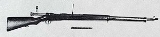
The is a bolt-action rifle. For a time it was the standard rifle of the
JapanJapan is an island nation in East Asia. Located in the Pacific Ocean, it lies to the east of the Sea of Japan, China, North Korea, South Korea and Russia, stretching from the Sea of Okhotsk in the north to the East China Sea and Taiwan in the south...
ese infantry. It was known also as the Type 38 Year Meiji
CarbineA carbine , from French carabine, is a longarm similar to but shorter than a rifle or musket. Many carbines are shortened versions of full rifles, firing the same ammunition at a lower velocity due to a shorter barrel length....
in Japan. An earlier, similar weapon was the
Type 30 Year Meiji RifleThe Type 30 Rifle Arisaka was a bolt-action rifle that was the standard infantry rifle of the Japanese infantry from 1897 to 1905. It was the first rifle in the Arisaka family as well as the first to chamber the 6.5x50mm Arisaka round...
, which was also used alongside it. Both of these weapons were also known as the
ArisakaArisaka is a family of Japanese military bolt action rifles, in production from approximately 1898, when it replaced the Murata rifle, until the end of World War II in 1945...
, after the inventor.
It used the Japanese designed 6.5×50mm Arisaka calibre cartridge. This cartridge produces little recoil when fired. However, while on par with the Norwegian and Italian 6.5mm military cartridges of the time, the 6.5×50mm was not as powerful as several others in use by other nations. The Arisaka Rifle at 1280 mm (50 inches) was the longest rifle of the war, due to the emphasis on bayonet training for the Japanese soldier of the era who stood 160 cm (5 feet, 3 inches on average). The rifle was even longer when the 400 mm (15.75 inch)
Type 30 bayonetThe Type 30 bayonet was designed to be used with the Japanese Type 30 Rifle and later used on the Type 38 Rifle and Type 99 rifle. The weapon was a sword-type bayonet with a 400 mm long blade and an overall length of 514 mm...
was fixed.
These two concerns (among others) led the Japanese Army to adopt the
Type 99 RifleThe was a bolt-action rifle of the Arisaka design used by the Imperial Japanese Army during World War II.-History:During the Second Sino-Japanese War in the 1930s, the Japanese soon found that the 8×57mm IS cartridge the Chinese used was superior to the 6.5×50mm cartridge of the Type 38 rifle,...
, a shorter rifle using more powerful ammunition. Japanese authorities also wished to adopt a new long arm that needed fewer machining steps to be produced given Japan's metallurgic capacity.
The
Type 38 Cavalry CarbineThe Japanese was a short barreled version of the bolt-action Type 38 rifle, it was used by the Japanese cavalry, engineers and artillery troops during World War II. It entered service in 1905. The rifle was very accurate. The rifle barrel was 310 mm shorter than the standard rifle...
is a short-barreled version of the Type 38. It was used by cavalry, engineer, quartermaster and other non-frontline troops. It was introduced into service at the same time as the Type 38. The barrel was shorter at 487 mm, giving a length of the rifle of 966 mm and a weight of 3.3 kg.
Another Type 38 variant was the Type 38 Cavalry Rifle which were merely Type 38 Infantry Rifles with their barrels shortened from 31 and a quarter inches to 23 and one half inches. All Cavalry Rifle receivers carry the arsenal and proof-marks of Tokyo Artillery Arsenal—the source of the original infantry rifles.
Other variants of the Type 38 were the
Type 44 Cavalry RifleThe Type 44 Cavalry Rifle is a Japanese bolt-action rifle. This rifle is also often referred to as a Type 44 Carbine. It was a development of the Arisaka Type 38 Cavalry Rifle, the main difference being the bayonet is a needle type and it can be folded backwards and locks underneath the barrel...
,
Type 97 Sniper Rifleis a Japanese bolt-action rifle, based on the Type 38 Rifle. Following the standard practice of the time, it was adapted from an existing infantry rifle. The only difference between this rifle and the original Type 38 is that it had a lightened stock, a single-action hammer, a 2.5 power telescopic...
. The Japanese Imperial Navy also purchased a number of
Type I RifleThe Type I rifle was produced by Italy for the Japanese Empire prior to World War II. After the invasion of China, all Arisaka production was required for use of the Imperial Army, so under the terms of the Anti-Comintern Pact, the Imperial Navy contracted with Italy for this weapon in 1937...
s from Italy at the beginning of
World War IIWorld War II, or the Second World War , was a global conflict lasting from 1939 to 1945, involving most of the world's nations—including all of the great powers—eventually forming two opposing military alliances: the Allies and the Axis...
. The Italian-built rifles were chambered for the same 6.5×50mm cartridge as the Type 38 rifle. The Type I Rifle were similar in appearance and length to the Type 38 rifle, but were based on the Italian
CarcanoCarcano is the frequently used name for a series of Italian bolt-action military rifles and carbines. Introduced in 1891, this rifle was chambered for the rimless 6.5x52mm Mannlicher-Carcano Cartuccia Modello 1895 cartridge. It was developed by the chief technician Salvatore Carcano at the Turin...
action.
Post-war inspection of the Type 38 by both the
U.S. militaryThe United States Armed Forces are the military forces of the United States. They consist of the Army, Navy, Marine Corps, Air Force, and Coast Guard.The United States has a strong tradition of civilian control of the military...
and the
National Rifle AssociationThe National Rifle Association of America is an American non-profit 501 civil rights organization which advocates for the protection of the Second Amendment of the United States Bill of Rights and the promotion of firearm ownership rights as well as marksmanship, firearm safety, and the protection...
showed that the Type 38's receiver was the strongest bolt action of any nation and capable of handling more powerful cartridges.
Users
: Captured Japanese weapons after Japan's World War II surrender and used them in the Indonesian Independence War.: The Mexican government ordered 40,000 rifles chambered for the 7x57mm Mauser cartridge in 1910, but less than 5,000 were delivered before the overthrow of president
Porfirio DiazJosé de la Cruz Porfirio Díaz Mori was a Mexican-American War volunteer and French intervention hero, an accomplished general and the President of Mexico continuously from 1876 to 1911, with the exception of a brief term in 1876 when he left Juan N...
in 1911 canceled the order.: During World War I, bought the 35,400 7x57mm Mauser rifles originally intended for Mexico. Also received 128,000 Type 30 and 38 rifles from Britain in 1916. : Bought a mixed batch of 150,000 Type 30 and Type 38 rifles from Japan at the start of World War I. Most were used by training battalions and the rifles were declared obsolete in 1921.
External links