

Tuscania

Encyclopedia
Tuscania is a town and comune
in the province of Viterbo
, Lazio Region, Italy
. Until the late 19th century the town was known as Toscanella.
' son, Ascanius
, where he had found twelve dog pups (whence the Etruscan
name Tus-Cana, cana begin similar to Latin canis for "dog"). Another legend attributes the foundation to one Tusco, son of Hercules
and Araxes.
Evidence of human presence in the area dates from the Neolithic
age, but probably the city proper was built around the 7th century BCE when the acropolis
on St. Peter Hill was surrounded by a line of walls. Villages existed in the neighbourhood. In the following years the strategical position granted Tuscania a leader role in the Etruscan world. After the defeat of the coastal cities by the Greeks (4th century BCE), Tuscania became also a maritime trade center through the port of Regas (next today's Montalto di Castro
).
There are no record of Tuscania being involved in the battles that led to the Roman conquest of the Etruscan northern Lazio (280 BCE), as the city probably entered into the Roman orbit in a Pacific way. The agricultural development and construction of the Via Clodia
, further boosted the economic situation of the city. It became a municipium
in 88 BCE.
After the fall of the Western Roman Empire
, it fell to the Lombards
in 569 or 574. In 781 it became part of the Papal States
. In 967-1066 it was a fief of the Anguillara
family and then of the marquises of Tuscany. In 1081 it was besieged by Emperor Henry IV
.
In the following century it became a free commune
with authority over a wide territory including numerous castles. The inner struggles within Tuscania led to a loss of prestige, in favour of the nearby Viterbo
, which was elevated as diocese in 1192. In 1222 St. Francis of Assisi
soujourned to the city. During the struggle between the Guelphs and Ghibellines, it was captured by Frederick II of Hohenstaufen
on March 2, 1240, and provided with a line of walls.
A failed military expedition against Pope Boniface VIII
(early 14th century), led to the submission to Rome, with the pejorative name of Tuscanella. In 1348-49 a bubonic plague struck Tuscania very hard. Shortly thereafter, in 1354, Cardinal Gil Alvarez De Albornoz
definitively returned the town to the Papal States
. In 1421 it became a county under the condottiero Angelo Broglio da Lavello.
In 1495 it was ravaged by the French troops of King Charles VIII
during his march towards the Kingdom of Naples
, much thanks to the destruction of the walls ordered by Cardinal Giovanni Vitelleschi in reply to the continue inner struggles and riots of the citizens. The city lived thenceforth a long decline which lasted until the annexation to the new unified Kingdom of Italy in 1870.
In the 19th century the local Campanari family spearheaded the exploration of Etruscan tombs. They organized the first Etruscan exhibition in London. Many of the valuable discoveries ended up in various European museums, as well as Tuscania's own Archeological Museum.
On February 6, 1971 an earthquake
caused 31 deaths. The town has been meticulously restored since, and the historic quarter is substantial, completely surrounded by the medieval city walls that offer excellent views over the surrounding countryside and the church of St Peter.
Other sights include:
Comune
In Italy, the comune is the basic administrative division, and may be properly approximated in casual speech by the English word township or municipality.-Importance and function:...
in the province of Viterbo
Province of Viterbo
The Province of Viterbo is a province in the Lazio region of Italy. Its capital is the city of Viterbo. It is bordered to the north by the Province of Grosseto and Siena, by the north-east with the Province of Terni and Rieti, in the west by the Tyrrhenian Sea and south by the Province of Rome.It...
, Lazio Region, Italy
Italy
Italy , officially the Italian Republic languages]] under the European Charter for Regional or Minority Languages. In each of these, Italy's official name is as follows:;;;;;;;;), is a unitary parliamentary republic in South-Central Europe. To the north it borders France, Switzerland, Austria and...
. Until the late 19th century the town was known as Toscanella.
Ancient times
According to the legend, Tuscania was founded by AeneasAeneas
Aeneas , in Greco-Roman mythology, was a Trojan hero, the son of the prince Anchises and the goddess Aphrodite. His father was the second cousin of King Priam of Troy, making Aeneas Priam's second cousin, once removed. The journey of Aeneas from Troy , which led to the founding a hamlet south of...
' son, Ascanius
Ascanius
Ascanius is the son of the Trojan hero Aeneas and a legendary king of Alba Longa. He is a character of Roman mythology, and has a divine lineage, being the son of Aeneas, who is son of Venus and the hero Anchises, a relative of Priam; thus Ascanius has divine ascendents by both parents, being...
, where he had found twelve dog pups (whence the Etruscan
Etruscan language
The Etruscan language was spoken and written by the Etruscan civilization, in what is present-day Italy, in the ancient region of Etruria and in parts of Lombardy, Veneto, and Emilia-Romagna...
name Tus-Cana, cana begin similar to Latin canis for "dog"). Another legend attributes the foundation to one Tusco, son of Hercules
Hercules
Hercules is the Roman name for Greek demigod Heracles, son of Zeus , and the mortal Alcmene...
and Araxes.
Evidence of human presence in the area dates from the Neolithic
Neolithic
The Neolithic Age, Era, or Period, or New Stone Age, was a period in the development of human technology, beginning about 9500 BC in some parts of the Middle East, and later in other parts of the world. It is traditionally considered as the last part of the Stone Age...
age, but probably the city proper was built around the 7th century BCE when the acropolis
Acropolis
Acropolis means "high city" in Greek, literally city on the extremity and is usually translated into English as Citadel . For purposes of defense, early people naturally chose elevated ground to build a new settlement, frequently a hill with precipitous sides...
on St. Peter Hill was surrounded by a line of walls. Villages existed in the neighbourhood. In the following years the strategical position granted Tuscania a leader role in the Etruscan world. After the defeat of the coastal cities by the Greeks (4th century BCE), Tuscania became also a maritime trade center through the port of Regas (next today's Montalto di Castro
Montalto di Castro
Montalto di Castro is a comune in the Province of Viterbo in the Italian region Lazio, located about 90 km northwest of Rome and about 40 km west of Viterbo.It is home to a large power plant managed by ENEL.-External links:*...
).
There are no record of Tuscania being involved in the battles that led to the Roman conquest of the Etruscan northern Lazio (280 BCE), as the city probably entered into the Roman orbit in a Pacific way. The agricultural development and construction of the Via Clodia
Via Clodia
Via Clodia was an ancient high-road of Italy. Its course, for the first 11 miles, was the same as that of the Via Cassia; it then diverged to the north in a northwest direction and ran on the west side of the Lacus Sabatinus, past Forum Clodii and Blera...
, further boosted the economic situation of the city. It became a municipium
Municipium
Municipium , the prototype of English municipality, was the Latin term for a town or city. Etymologically the municipium was a social contract between municipes, the "duty holders," or citizens of the town. The duties, or munera, were a communal obligation assumed by the municipes in exchange for...
in 88 BCE.
Middle Ages
In the 5th century CE Tuscania became one of the first bishopric seat in Italy, maintaining it until 1653.After the fall of the Western Roman Empire
Western Roman Empire
The Western Roman Empire was the western half of the Roman Empire after its division by Diocletian in 285; the other half of the Roman Empire was the Eastern Roman Empire, commonly referred to today as the Byzantine Empire....
, it fell to the Lombards
Lombards
The Lombards , also referred to as Longobards, were a Germanic tribe of Scandinavian origin, who from 568 to 774 ruled a Kingdom in Italy...
in 569 or 574. In 781 it became part of the Papal States
Papal States
The Papal State, State of the Church, or Pontifical States were among the major historical states of Italy from roughly the 6th century until the Italian peninsula was unified in 1861 by the Kingdom of Piedmont-Sardinia .The Papal States comprised territories under...
. In 967-1066 it was a fief of the Anguillara
Anguillara
Anguillara were a baronal family of Latium, especially powerful in Rome and in the current province of Viterbo during the Middle Ages and the early Renaissance....
family and then of the marquises of Tuscany. In 1081 it was besieged by Emperor Henry IV
Henry IV, Holy Roman Emperor
Henry IV was King of the Romans from 1056 and Holy Roman Emperor from 1084 until his forced abdication in 1105. He was the third emperor of the Salian dynasty and one of the most powerful and important figures of the 11th century...
.
In the following century it became a free commune
Medieval commune
Medieval communes in the European Middle Ages had sworn allegiances of mutual defense among the citizens of a town or city. They took many forms, and varied widely in organization and makeup. Communes are first recorded in the late 11th and early 12th centuries, thereafter becoming a widespread...
with authority over a wide territory including numerous castles. The inner struggles within Tuscania led to a loss of prestige, in favour of the nearby Viterbo
Viterbo
See also Viterbo, Texas and Viterbo UniversityViterbo is an ancient city and comune in the Lazio region of central Italy, the capital of the province of Viterbo. It is approximately 80 driving / 80 walking kilometers north of GRA on the Via Cassia, and it is surrounded by the Monti Cimini and...
, which was elevated as diocese in 1192. In 1222 St. Francis of Assisi
Francis of Assisi
Saint Francis of Assisi was an Italian Catholic friar and preacher. He founded the men's Franciscan Order, the women’s Order of St. Clare, and the lay Third Order of Saint Francis. St...
soujourned to the city. During the struggle between the Guelphs and Ghibellines, it was captured by Frederick II of Hohenstaufen
Frederick II, Holy Roman Emperor
Frederick II , was one of the most powerful Holy Roman Emperors of the Middle Ages and head of the House of Hohenstaufen. His political and cultural ambitions, based in Sicily and stretching through Italy to Germany, and even to Jerusalem, were enormous...
on March 2, 1240, and provided with a line of walls.
A failed military expedition against Pope Boniface VIII
Pope Boniface VIII
Pope Boniface VIII , born Benedetto Gaetani, was Pope of the Catholic Church from 1294 to 1303. Today, Boniface VIII is probably best remembered for his feuds with Dante, who placed him in the Eighth circle of Hell in his Divina Commedia, among the Simonists.- Biography :Gaetani was born in 1235 in...
(early 14th century), led to the submission to Rome, with the pejorative name of Tuscanella. In 1348-49 a bubonic plague struck Tuscania very hard. Shortly thereafter, in 1354, Cardinal Gil Alvarez De Albornoz
Gil Alvarez De Albornoz
Gil Álvarez Carrillo de Albornoz was a Spanish cardinal and ecclesiastical leader.-Early years:Albornoz was born at Carrascosa del Campo, early in the 14th century. He was the son of Gil Állvarez de Albornoz and of Doña Teresa de Luna, sister of Jimeno de Luna, archbishop of Toledo and a member...
definitively returned the town to the Papal States
Papal States
The Papal State, State of the Church, or Pontifical States were among the major historical states of Italy from roughly the 6th century until the Italian peninsula was unified in 1861 by the Kingdom of Piedmont-Sardinia .The Papal States comprised territories under...
. In 1421 it became a county under the condottiero Angelo Broglio da Lavello.
In 1495 it was ravaged by the French troops of King Charles VIII
Charles VIII of France
Charles VIII, called the Affable, , was King of France from 1483 to his death in 1498. Charles was a member of the House of Valois...
during his march towards the Kingdom of Naples
Kingdom of Naples
The Kingdom of Naples, comprising the southern part of the Italian peninsula, was the remainder of the old Kingdom of Sicily after secession of the island of Sicily as a result of the Sicilian Vespers rebellion of 1282. Known to contemporaries as the Kingdom of Sicily, it is dubbed Kingdom of...
, much thanks to the destruction of the walls ordered by Cardinal Giovanni Vitelleschi in reply to the continue inner struggles and riots of the citizens. The city lived thenceforth a long decline which lasted until the annexation to the new unified Kingdom of Italy in 1870.
In the 19th century the local Campanari family spearheaded the exploration of Etruscan tombs. They organized the first Etruscan exhibition in London. Many of the valuable discoveries ended up in various European museums, as well as Tuscania's own Archeological Museum.
On February 6, 1971 an earthquake
Earthquake
An earthquake is the result of a sudden release of energy in the Earth's crust that creates seismic waves. The seismicity, seismism or seismic activity of an area refers to the frequency, type and size of earthquakes experienced over a period of time...
caused 31 deaths. The town has been meticulously restored since, and the historic quarter is substantial, completely surrounded by the medieval city walls that offer excellent views over the surrounding countryside and the church of St Peter.
Main sights
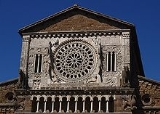
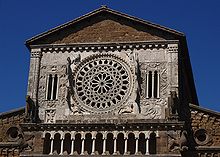
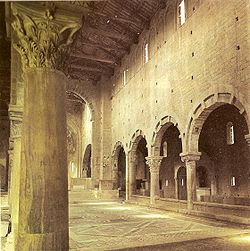
The main monument of the city is the church of Saint Peter (San Pietro in Italian), in Lombard-Romanesque style, begun in the 8th century and renovated in the 11th-12th centuries. The interior has a nave and two aisles divided by low columns and pilasters incorporating half-columns, with antique and mediaeval capitals.Other sights include:
- The Etruscan Museum, with sarcophagi from nearby tombs, as well as other objects from the tombs.
- The Romanesque Church of Santa Maria Maggiore. It has a façade with three finely decorated portals. The interior is on a nave and two aisles, divided by columns with sculpted capitals. The recessed entrance is flanked by a pair of free standing columns intended to evoke the Boaz and JachinBoaz and JachinBoaz and Jachin were two copper, brass or bronze pillars which stood in the porch of Solomon's Temple, the first Temple in Jerusalem.-Description:...
of the Temple of Solomon at Jerusalem. - The Tower of Lavello
- Fontana delle Sette Cannelle a Medieval fountain made with Roman materials
- Etruscan necropolisNecropolisA necropolis is a large cemetery or burial ground, usually including structural tombs. The word comes from the Greek νεκρόπολις - nekropolis, literally meaning "city of the dead"...
es, including the Tomb of the Queen and Pian di Mola.
External links
- ViterboLive.it
- History of Tuscania
- Tuscia 360 about Tuscania with VR panoramas
- Tuscania, the Natural Park of Vulci and surroundings