

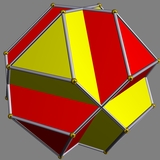
Truncated tetrahedron

Encyclopedia
In geometry
, the truncated tetrahedron is an Archimedean solid
. It has 4 regular hexagonal faces, 4 regular triangular faces, 12 vertices and 18 edges.
V of a truncated tetrahedron of edge length a are:

tetrahedron
centered at the origin, with edge length √8, are all permutations of (±1,±1,±3) with an even number of minus signs:
Another simple construction exists in 4-space as cells of the truncated 16-cell, with vertices as coordinate permutation of:
. They were made of massive girders of steel bolted together in a geometric lattice. The truncated tetrahedrons were interconnected with lattice steel platforms. All of these buildings were demolished after the end of Expo 67, as they had not been built to withstand the severity of the Montreal weather over the years. Their only remnants are in the Montreal city archives, the Public Archives Of Canada and the photo collections of tourists of the times.
Geometry
Geometry arose as the field of knowledge dealing with spatial relationships. Geometry was one of the two fields of pre-modern mathematics, the other being the study of numbers ....
, the truncated tetrahedron is an Archimedean solid
Archimedean solid
In geometry an Archimedean solid is a highly symmetric, semi-regular convex polyhedron composed of two or more types of regular polygons meeting in identical vertices...
. It has 4 regular hexagonal faces, 4 regular triangular faces, 12 vertices and 18 edges.
Area and volume
The area A and the volumeVolume
Volume is the quantity of three-dimensional space enclosed by some closed boundary, for example, the space that a substance or shape occupies or contains....
V of a truncated tetrahedron of edge length a are:
Cartesian coordinates
Cartesian coordinates for the 12 vertices of a truncatedTruncation (geometry)
In geometry, a truncation is an operation in any dimension that cuts polytope vertices, creating a new facet in place of each vertex.- Uniform truncation :...
tetrahedron
Tetrahedron
In geometry, a tetrahedron is a polyhedron composed of four triangular faces, three of which meet at each vertex. A regular tetrahedron is one in which the four triangles are regular, or "equilateral", and is one of the Platonic solids...
centered at the origin, with edge length √8, are all permutations of (±1,±1,±3) with an even number of minus signs:
- (+3,+1,+1), (+1,+3,+1), (+1,+1,+3)
- (−3,−1,+1), (−1,−3,+1), (−1,−1,+3)
- (−3,+1,−1), (−1,+3,−1), (−1,+1,−3)
- (+3,−1,−1), (+1,−3,−1), (+1,−1,−3)
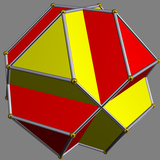 The set of vertex permutations (±1,±1,±3) with an odd number of minus signs forms a complementary truncated tetrahedron, and combined they form a uniform compound polyhedron. |
Orthogonal projection |
Another simple construction exists in 4-space as cells of the truncated 16-cell, with vertices as coordinate permutation of:
- (0,0,1,2)
Use in architecture
Giant truncated tetrahedrons were used for the "Man the Explorer" and "Man the Producer" theme pavilions in Expo 67Expo 67
The 1967 International and Universal Exposition or Expo 67, as it was commonly known, was the general exhibition, Category One World's Fair held in Montreal, Quebec, Canada, from April 27 to October 29, 1967. It is considered to be the most successful World's Fair of the 20th century, with the...
. They were made of massive girders of steel bolted together in a geometric lattice. The truncated tetrahedrons were interconnected with lattice steel platforms. All of these buildings were demolished after the end of Expo 67, as they had not been built to withstand the severity of the Montreal weather over the years. Their only remnants are in the Montreal city archives, the Public Archives Of Canada and the photo collections of tourists of the times.
External links
- Editable printable net of a truncated tetrahedron with interactive 3D view
- The Uniform Polyhedra
- Virtual Reality Polyhedra The Encyclopedia of Polyhedra