

Transport in Tel Aviv

Encyclopedia
Seen as the hub of the Israeli transportation system in terms of road, rail, and air transport. The Israeli road network
partly centers around the city with some of the country's largest highways passing through or running to the city. The city forms a major part of the country's rail network, whilst Ben Gurion International Airport
located near the city is the country's largest airport. There is also a strong transportation system within the city which is based around bus transportation.
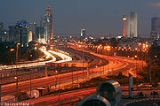
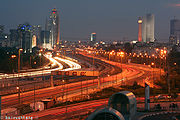 Many major routes of the national road network pass through or end in Tel Aviv, a transportation hub. The main road access route to Tel Aviv is the Ayalon Highway (Highway 20), which runs along the eastern side of the city from north to south along the Ayalon River riverbed, dividing for the most part Tel Aviv and Ramat Gan. Driving south on the Ayalon gives access to Highway 1
, leading to Ben Gurion International Airport
and Jerusalem. Within the city, the main routes are King George Street, Allenby Street
, Ibn Gabirol Street
, Dizengoff Street
, Rothschild Boulevard
, and in Jaffa the main route is Jerusalem Boulevard. Namir Road connects the city to Highway 2
, Israel's main north–south highway, and Begin/Jabotinsky Road, which provides access from the east through Ramat Gan, Bnei Brak and Petah Tikva. Tel Aviv, accommodating about 500,000 commuter cars daily, suffers from increasing congestion. In 2007, the Sadan Report recommended the introduction of a congestion charge
similar to that of London
in Tel Aviv as well as other Israeli cities. Under this plan, road users travelling into the city would pay a fixed fee.
 Tel Aviv has four train stations
along the Ayalon Highway. The stops are from north to south: Tel Aviv University
, Tel Aviv Savidor Central, Tel Aviv HaShalom
(near Azrieli Center
shopping mall) and Tel Aviv HaHagana
(near the central bus station
). It is estimated that more than a million people travel by train from the surrounding cities to Tel Aviv each month.
Since the completion of the Ayalon Highway railway section in 1995, Tel Aviv has been the central hub for rail transport in Israel. The Savidor Central Railway Station alone handled approximately 38,000 passengers a day in summer 2009. Railway lines from Tel Aviv include Israel Railways
's main line, running from Beersheba
to Nahariya
, as well as lines to Ashkelon
, Modi'in, Rishon LeTziyon, Kfar Sava and Jerusalem
. A faster line to Ashkelon via Bat Yam/Holon is under construction. Most trains stop at all stations in Tel Aviv, except for some trains to and from Be'er Sheva that do not reach Tel Aviv University and night trains that only stop at Tel Aviv Savidor Central. All stations of Israel Railways, other than Dimona, are directly reachable from Tel Aviv.
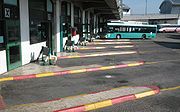 The new Tel Aviv Central Bus Station
is the biggest bus terminal in Israel, 400 meters from the old station. In the past, Tel Aviv had an older central bus station
, which was demolished.
The main bus network in Tel Aviv is operated by Dan Bus Company
, with some metropolitan lines operated by Egged and Kavim
. Few lines are dedicated to Tel Aviv, most lines serving Tel Aviv have their terminus in one of the neighboring cities. The Egged Bus Cooperative
, the world's second-largest bus company, provides most intercity transportation. Intercity transportation to certain destinations is offered by other companies, including Kavim
, Dan
, Metropoline
, Superbus, Connex and Egged Ta'avura
.
Following is a partial list of destinations for every bus company:
Most intercity lines use the central bus station or the 2000 Terminal
(Arlozorov Terminal) located next to the Tel Aviv Central railway station. The 2000 Terminal is the second most important terminal in Tel Aviv, and all lines from the central bus station heading North stop there.
Other important terminals include:
/subway system is planned for the Tel Aviv metropolitan area. The Red Line
of the project is expected to be operation in 2013 and will pass through south-central Tel Aviv and Jaffa. A second line, the Green Line, will pass through the heart of Tel Aviv and in January 2008, it was decided that most of its route will be underground.
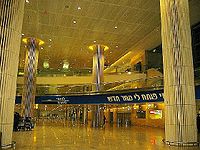 Tel Aviv's domestic airport is Sde Dov in the northwestern part of the city. Sde Dov is slated to close because it occupies prime coastal real estate near the upscale Ramat Aviv neighborhood. In the future all services to Sde Dov will transfer to Ben Gurion International Airport
, Israel's main international airport, close to the city of Lod
and 15 kilometres (9 mi) southeast of Tel Aviv. Because it is close to Tel Aviv, Ben Gurion International Airport is often referred to as Tel Aviv International Airport even though it is not part of any municipal jurisdiction.
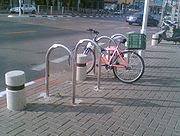 Tel Aviv Municipality is trying to encourage the use of bicycles in the city, and has opened in April 2011 150 bicycle-rental stations to serve 74 kilometres (46 mi) of bicycle paths. Plans call for expansion of the paths to 100 kilometres (62.1 mi) by 2009.
In early 2008, Tel Aviv Municipality announced a pilot scheme to build charging stations for electric cars. Initially, five charging points will be built, and eventually 150 points will be set up across the city as part of the Israeli electric car project, Project Better Place
. Furthermore, battery replacement points will be located at the city's entrances.
There is an effort to create a system of bus priority
for certain lines that are heavily used and that run through congested areas. This effort is being led by transportation professionals and environmental groups, such as Transport Today and Tomorrow, which seeks to improve sustainable transportation in Israel. Buses are currently subject to the same traffic as cars and creating specific lanes and other forms of prioritization would help to alleviate this problem.
Roads in Israel
Israel has a well-developed road network spanning the entire country. Due to the rising number of vehicles on its roadways, this network is undergoing constant improvement and expansion.- The National Roads Authority of Israel :...
partly centers around the city with some of the country's largest highways passing through or running to the city. The city forms a major part of the country's rail network, whilst Ben Gurion International Airport
Ben Gurion International Airport
Ben Gurion International Airport , also referred to by its Hebrew acronym Natbag , is the largest and busiest international airport in Israel, handling 12,160,339 passengers in 2010...
located near the city is the country's largest airport. There is also a strong transportation system within the city which is based around bus transportation.
Road transport
Highway 1 (Israel)
Highway 1 , is the main highway connecting Tel Aviv with Jerusalem.-History:The section between Latrun and Jerusalem roughly follows an ancient path connecting Jaffa and Jerusalem...
, leading to Ben Gurion International Airport
Ben Gurion International Airport
Ben Gurion International Airport , also referred to by its Hebrew acronym Natbag , is the largest and busiest international airport in Israel, handling 12,160,339 passengers in 2010...
and Jerusalem. Within the city, the main routes are King George Street, Allenby Street
Allenby Street
Allenby Street is a major street in Tel Aviv, Israel. It was named in honor of Field Marshal Viscount Allenby.Allenby Street stretches from the Mediterranean sea in the northwest to HaAliya Street in the southeast. It was first paved with concrete in 1914. During the day, it is a commercial street...
, Ibn Gabirol Street
Ibn Gabirol Street
Ibn Gabirol Street is a major street in Tel Aviv, Israel.Ibn Gabirol Street is named after the medieval Hebrew poet and philosopher Solomon ibn Gabirol...
, Dizengoff Street
Dizengoff Street
Dizengoff Street is a major street in central Tel Aviv, named after Tel Aviv's first mayor, Meir Dizengoff.The street runs from the corner of Ibn Gabirol Street in its southernmost point to the port area of Tel Aviv in its northwestern point...
, Rothschild Boulevard
Rothschild Boulevard
Rothschild Boulevard is one of the principal streets in the center of Tel Aviv, Israel, beginning in Neve Tzedek at its southwestern edge and running north to Habima Theatre. It is one of the busiest and most expensive streets in the city, being one of the city's main tourist attractions...
, and in Jaffa the main route is Jerusalem Boulevard. Namir Road connects the city to Highway 2
Highway 2 (Israel)
Highway 2 is an Israeli highway located on the coastal plain of the Mediterranean Sea. It stretches from Tel Aviv to Haifa. The highway is also called The Coastal Highway or The New Haifa - Tel Aviv Highway ....
, Israel's main north–south highway, and Begin/Jabotinsky Road, which provides access from the east through Ramat Gan, Bnei Brak and Petah Tikva. Tel Aviv, accommodating about 500,000 commuter cars daily, suffers from increasing congestion. In 2007, the Sadan Report recommended the introduction of a congestion charge
Road pricing
Road pricing is an economic concept regarding the various direct charges applied for the use of roads. The road charges includes fuel taxes, licence fees, parking taxes, tolls, and congestion charges, including those which may vary by time of day, by the specific road, or by the specific vehicle...
similar to that of London
London
London is the capital city of :England and the :United Kingdom, the largest metropolitan area in the United Kingdom, and the largest urban zone in the European Union by most measures. Located on the River Thames, London has been a major settlement for two millennia, its history going back to its...
in Tel Aviv as well as other Israeli cities. Under this plan, road users travelling into the city would pay a fixed fee.
Rail transport
Israel Railways
Israel Railways is the principal passenger railway operating company in Israel, and is responsible for all inter-city and suburban rail way passenger and freight traffic in the country. All its lines are standard gauge. The network is centered in Israel's densely populated coastal plain, from...
along the Ayalon Highway. The stops are from north to south: Tel Aviv University
Tel Aviv University Railway Station
Tel Aviv University Railway Station is an Israel Railways station in northern Tel Aviv, Israel. It is officially named Tel Aviv Universita – Merkaz HaYeridim in Hebrew , due to its proximity to Tel Aviv University and the Israel Trade Fairs & Convention Center.The station has four platforms...
, Tel Aviv Savidor Central, Tel Aviv HaShalom
Tel Aviv HaShalom Railway Station
Tel Aviv HaShalom Railway Station is one of the busiest railway stations in Israel, serving most lines of Israel Railways. It is located on HaShalom Interchange over Ayalon Highway in Tel Aviv...
(near Azrieli Center
Azrieli Center
Azrieli Center is a complex of skyscrapers in Tel Aviv. At the base of the center lies a large shopping mall. The center was originally designed by Israeli-American architect Eli Attia, and after he fell out with the developer of the center David Azrieli , completion of the design was passed on to...
shopping mall) and Tel Aviv HaHagana
Tel Aviv HaHagana Railway Station
Tel Aviv HaHagana Railway Station is an Israel Railways station in Tel Aviv. It is Tel Aviv's southernmost railway station, located some 400 meters to the east of Tel Aviv Central Bus Station. It is located between the lanes of the Ayalon Highway, just north of where Highway 1 splits from it...
(near the central bus station
Tel Aviv Central Bus Station
Tel Aviv Central Bus Station, known as the New Central Bus Station , is the main bus station of Tel Aviv, Israel...
). It is estimated that more than a million people travel by train from the surrounding cities to Tel Aviv each month.
Since the completion of the Ayalon Highway railway section in 1995, Tel Aviv has been the central hub for rail transport in Israel. The Savidor Central Railway Station alone handled approximately 38,000 passengers a day in summer 2009. Railway lines from Tel Aviv include Israel Railways
Israel Railways
Israel Railways is the principal passenger railway operating company in Israel, and is responsible for all inter-city and suburban rail way passenger and freight traffic in the country. All its lines are standard gauge. The network is centered in Israel's densely populated coastal plain, from...
's main line, running from Beersheba
Beersheba
Beersheba is the largest city in the Negev desert of southern Israel. Often referred to as the "Capital of the Negev", it is the seventh-largest city in Israel with a population of 194,300....
to Nahariya
Nahariya
Nahariya is the northernmost coastal city in Israel, with an estimated population of 51,200.-History:Nahariya was founded by German Jewish immigrants from the Fifth Aliyah in the 1930s...
, as well as lines to Ashkelon
Ashkelon
Ashkelon is a coastal city in the South District of Israel on the Mediterranean coast, south of Tel Aviv, and north of the border with the Gaza Strip. The ancient seaport of Ashkelon dates back to the Neolithic Age...
, Modi'in, Rishon LeTziyon, Kfar Sava and Jerusalem
Jaffa–Jerusalem railway
The Jaffa–Jerusalem railway is a railroad that connected Jaffa and Jerusalem. The line was built in Ottoman Palestine by the French company Société du Chemin de Fer Ottoman de Jaffa à Jérusalem et Prolongements and inaugurated in 1892, after previous attempts by the Jewish philanthropist Moses...
. A faster line to Ashkelon via Bat Yam/Holon is under construction. Most trains stop at all stations in Tel Aviv, except for some trains to and from Be'er Sheva that do not reach Tel Aviv University and night trains that only stop at Tel Aviv Savidor Central. All stations of Israel Railways, other than Dimona, are directly reachable from Tel Aviv.
Bus transport
Tel Aviv Central Bus Station
Tel Aviv Central Bus Station, known as the New Central Bus Station , is the main bus station of Tel Aviv, Israel...
is the biggest bus terminal in Israel, 400 meters from the old station. In the past, Tel Aviv had an older central bus station
Old Tel Aviv Central Bus Station
The Old Tel Aviv Central Bus Station was the main bus station of Tel Aviv between the years 1941 until 1993. The station served intercity bus routes as well as local city and suburban buses...
, which was demolished.
The main bus network in Tel Aviv is operated by Dan Bus Company
Dan Bus Company
Dan Bus Company is an Israeli bus company based in Tel Aviv. It operates local bus service in the Tel Aviv Metropolitan Area as well as some intercity bus services between the Gush Dan area and nearby regions such as Samaria, and a connection between Bne Brak and Jerusalem. Dan operates 1,200...
, with some metropolitan lines operated by Egged and Kavim
Kavim
Kavim is an Israeli bus company. It was founded in 2000 and provided lines in the eastern Gush Dan region - the towns/cities Kiryat Ono, Petah Tikva, Or Yehuda, Giv'atayim and others. In February 2005, Kavim expanded to the north, where it started providing bus lines in Afula, Bet She'an and the...
. Few lines are dedicated to Tel Aviv, most lines serving Tel Aviv have their terminus in one of the neighboring cities. The Egged Bus Cooperative
Egged Bus Cooperative
Egged Israel Transport Cooperative Society Ltd , a cooperative owned by its members is the largest transit bus company in Israel. It provides about 55 % of public transport services throughout the country, employs 6,227 workers and has 2,861 buses for more than 928 service routes and 3,103...
, the world's second-largest bus company, provides most intercity transportation. Intercity transportation to certain destinations is offered by other companies, including Kavim
Kavim
Kavim is an Israeli bus company. It was founded in 2000 and provided lines in the eastern Gush Dan region - the towns/cities Kiryat Ono, Petah Tikva, Or Yehuda, Giv'atayim and others. In February 2005, Kavim expanded to the north, where it started providing bus lines in Afula, Bet She'an and the...
, Dan
Dan Bus Company
Dan Bus Company is an Israeli bus company based in Tel Aviv. It operates local bus service in the Tel Aviv Metropolitan Area as well as some intercity bus services between the Gush Dan area and nearby regions such as Samaria, and a connection between Bne Brak and Jerusalem. Dan operates 1,200...
, Metropoline
Metropoline
Metropoline is an Israeli bus company, which provides bus routes from Beersheba to Tel Aviv and other destinations, mainly in the Southern District...
, Superbus, Connex and Egged Ta'avura
Egged Ta'avura
Egged Ta'avura is an Israeli bus company. It is a subsidiary of the Egged Bus Cooperative and the Ta'avura Group, and was founded by the two in 2006 from 2 other subsidiaries of Egged, following the public transportation reform and privatization in Israel in the 2000s...
.
Following is a partial list of destinations for every bus company:
| Company name | Major destinations in Gush Dan Gush Dan The Tel Aviv Metropolitan Area , or Gush Dan , is a metropolitan area including areas from both the Tel Aviv and the Central Districts of Israel. The area is closely linked to the city of Tel Aviv through social, economic, and cultural ties. It is located along the Israeli Mediterranean coastline... | Major large distance destinations |
|---|---|---|
| Egged | Herzliya Herzliya Herzliya is a city in the central coast of Israel, at the western part of the Tel Aviv District. It has a population of 87,000 residents. Named after Theodor Herzl, the founder of modern Zionism, Herzliya covers an area of 26 km²... , Raanana, Kfar Sava, Ramat Hasharon Ramat Hasharon Ramat HaSharon is a city located on Israel's central coastal strip in the south of the Sharon region, bordering Tel Aviv to the south and Herzliya and Kibbutz Glil Yam to the north. It is part of the Tel Aviv District, within Gush Dan metropolitan area... , Holon, Rishon LeTziyon, Rehovot Rehovot Rehovot is a city in the Center District of Israel, about south of Tel Aviv. According to the Israel Central Bureau of Statistics , at the end of 2009 the city had a total population of 112,700. Rehovot's official website estimates the population at 114,000.Rehovot was built on the site of Doron,... , Lod Lod Lod is a city located on the Sharon Plain southeast of Tel Aviv in the Center District of Israel. At the end of 2010, it had a population of 70,000, roughly 75 percent Jewish and 25 percent Arab.The name is derived from the Biblical city of Lod... , Yehud Yehud Yehud is a city in the Center District in Israel that is part of the joint municipality of Yehud-Monosson. In 2007, Yehud's population was approximately 25,600 .- History :... , Bat Yam |
Jerusalem, Haifa Haifa Haifa is the largest city in northern Israel, and the third-largest city in the country, with a population of over 268,000. Another 300,000 people live in towns directly adjacent to the city including the cities of the Krayot, as well as, Tirat Carmel, Daliyat al-Karmel and Nesher... , all destinations in the North North District (Israel) The Northern District is one of Israel's six administrative districts. The Northern District has a land area of 4,478 km², which increases to 4,638 km² when both land and water are included... , Hadera Hadera Hadera is a city located in the Haifa District of Israel approximately from the major cities of Tel Aviv and Haifa. The city is located along of the Israeli Mediterranean Coastal Plain... , Bet Shemesh Bet Shemesh Beit Shemesh is a city in Israel's Jerusalem District, with a population of 80,000. The history of Beit Shemesh goes back to pre-biblical times... , Ashkelon Ashkelon Ashkelon is a coastal city in the South District of Israel on the Mediterranean coast, south of Tel Aviv, and north of the border with the Gaza Strip. The ancient seaport of Ashkelon dates back to the Neolithic Age... , Eilat |
| Dan Dan Bus Company Dan Bus Company is an Israeli bus company based in Tel Aviv. It operates local bus service in the Tel Aviv Metropolitan Area as well as some intercity bus services between the Gush Dan area and nearby regions such as Samaria, and a connection between Bne Brak and Jerusalem. Dan operates 1,200... |
Ramat Gan, Bnei Brak, Givatayim, Petah Tikva Petah Tikva Petah Tikva known as Em HaMoshavot , is a city in the Center District of Israel, east of Tel Aviv.According to the Central Bureau of Statistics, at the end of 2009, the city's population stood at 209,600. The population density is approximately... , Bat Yam, Holon, Rishon LeTziyon, Ramat Hasharon Ramat Hasharon Ramat HaSharon is a city located on Israel's central coastal strip in the south of the Sharon region, bordering Tel Aviv to the south and Herzliya and Kibbutz Glil Yam to the north. It is part of the Tel Aviv District, within Gush Dan metropolitan area... |
Ariel Ariel (city) Ariel is an Israeli settlement and a city in the West Bank. Ariel was established in 1978. Its population at the end of 2009 was 17,600, including 7,000 immigrants who came to Israel after 1990. It is the fourth largest Jewish settlement city in the West Bank., after Modi'in Illit, Beitar Illit,... and other Samaria Samaria Samaria, or the Shomron is a term used for a mountainous region roughly corresponding to the northern part of the West Bank.- Etymology :... settlements |
| Superbus | Ramla Ramla Ramla , is a city in central Israel. The city is predominantly Jewish with a significant Arab minority. Ramla was founded circa 705–715 AD by the Umayyad Caliph Suleiman ibn Abed al-Malik after the Arab conquest of the region... , Lod Lod Lod is a city located on the Sharon Plain southeast of Tel Aviv in the Center District of Israel. At the end of 2010, it had a population of 70,000, roughly 75 percent Jewish and 25 percent Arab.The name is derived from the Biblical city of Lod... |
Shoham Shoham Shoham is a town in the Center District of Israel.According to the Israel Central Bureau of Statistics , Shoham's population in the end of 2007 was 19,400. Its jurisdiction is 5,889 dunams .... |
| Kavim Kavim Kavim is an Israeli bus company. It was founded in 2000 and provided lines in the eastern Gush Dan region - the towns/cities Kiryat Ono, Petah Tikva, Or Yehuda, Giv'atayim and others. In February 2005, Kavim expanded to the north, where it started providing bus lines in Afula, Bet She'an and the... |
Kiryat Ono, Yehud Yehud Yehud is a city in the Center District in Israel that is part of the joint municipality of Yehud-Monosson. In 2007, Yehud's population was approximately 25,600 .- History :... , Or Yehuda Or Yehuda Or Yehuda is a city in the Tel Aviv District in Israel. According to the Israel Central Bureau of Statistics , the city had a population of 32,200 at the end of 2007.-History:Or Yehuda is located where the biblical city of Kefar Ono used to stand.... |
N/A |
| Metropoline Metropoline Metropoline is an Israeli bus company, which provides bus routes from Beersheba to Tel Aviv and other destinations, mainly in the Southern District... |
Herzliya Herzliya Herzliya is a city in the central coast of Israel, at the western part of the Tel Aviv District. It has a population of 87,000 residents. Named after Theodor Herzl, the founder of modern Zionism, Herzliya covers an area of 26 km²... , Raanana, Kfar Sava, Ramat Hasharon Ramat Hasharon Ramat HaSharon is a city located on Israel's central coastal strip in the south of the Sharon region, bordering Tel Aviv to the south and Herzliya and Kibbutz Glil Yam to the north. It is part of the Tel Aviv District, within Gush Dan metropolitan area... |
Be'er Sheva, Kiryat Gat, Sderot Sderot Sderot is a western Negev city in the Southern District of Israel. According to the Israel Central Bureau of Statistics , at the end of 2009 the city had a total population of 20,700. The city has been an ongoing target of Qassam rocket attacks from the Gaza Strip... , Netivot Netivot Netivot is a city in the Southern District of Israel in Israel. At the end of 2009 the city had a total population of 26,700. It was founded in 1956 as a development town along with Sderot to the north, and Ofakim to the south... |
| Connex | N/A | Ashdod, Yavne Yavne Yavne is a city in the Central District of Israel. According to the Israel Central Bureau of Statistics , at the end of 2009 the city had a population of 33,000.-History:... , Modi'in |
| Egged Ta'avura Egged Ta'avura Egged Ta'avura is an Israeli bus company. It is a subsidiary of the Egged Bus Cooperative and the Ta'avura Group, and was founded by the two in 2006 from 2 other subsidiaries of Egged, following the public transportation reform and privatization in Israel in the 2000s... |
N/A | Be'er Sheva, El'ad El'ad El'ad, also spelled Elad , is a city in the Center District of Israel. Located about east of Tel Aviv on Route 444 between Rosh HaAyin and Shoham.In 2007 the town had a total population of 31,300. Its current population is estimated at over 32,000... , Eshkol Regional Council Eshkol Regional Council The Eshcol Regional Council is a regional council in the north-western Negev, in Israel's Southern District. The regional council's territory lies midway between Ashkelon and Beersheba, bounded on the west by the Gaza Strip while the eastern border abuts the territory of the Bnei Shimon Regional... |
| Nateev Express | N/A | Netanya Netanya Netanya is a city in the Northern Centre District of Israel, and is the capital of the surrounding Sharon plain. It is located north of Tel Aviv, and south of Haifa between the 'Poleg' stream and Wingate Institute in the south and the 'Avichail' stream in the north.Its of beaches have made the... |
Most intercity lines use the central bus station or the 2000 Terminal
Tel Aviv 2000 Terminal
2000 Terminal, more commonly known as Arlozorov Terminal, is a bus terminal in Tel Aviv, Israel. It is located near the border of Tel Aviv and Ramat Gan, next to Ayalon Highway and the junction of several traffic arteries - Jabotinsky Road that leads to Ramat Gan, Bnei Brak and Petah Tikva, Begin...
(Arlozorov Terminal) located next to the Tel Aviv Central railway station. The 2000 Terminal is the second most important terminal in Tel Aviv, and all lines from the central bus station heading North stop there.
Other important terminals include:
- The Carmelit Terminal near the Carmel MarketCarmel MarketThe Carmel Market is the largest bazaar market in Tel Aviv. The market is bordered by Allenby Street and Magen David Square and the market is principally located along Carmel Street , but has expanded over time to streets such as Nahalat Binyamin Street...
, used by many Dan lines and a few Kavim and Egged metropolitan lines to various parts of Gush Dan - The Reading Terminal near the power station by the same name, used by Dan lines to other parts of Tel Aviv, Holon, Rishon LeTziyon and Bat Yam, Kavim lines to Or Yehuda and Kiryat Ono, and Egged lines to Holon and Rishon LeTziyon
- The Atidim Terminal, a terminus of several urban Dan lines on the northeastern outskirts of the city
Tel Aviv Light Rail
A light railLight rail
Light rail or light rail transit is a form of urban rail public transportation that generally has a lower capacity and lower speed than heavy rail and metro systems, but higher capacity and higher speed than traditional street-running tram systems...
/subway system is planned for the Tel Aviv metropolitan area. The Red Line
Red Line (Tel Aviv Light Rail)
-External links:****...
of the project is expected to be operation in 2013 and will pass through south-central Tel Aviv and Jaffa. A second line, the Green Line, will pass through the heart of Tel Aviv and in January 2008, it was decided that most of its route will be underground.
Air transport
Ben Gurion International Airport
Ben Gurion International Airport , also referred to by its Hebrew acronym Natbag , is the largest and busiest international airport in Israel, handling 12,160,339 passengers in 2010...
, Israel's main international airport, close to the city of Lod
Lod
Lod is a city located on the Sharon Plain southeast of Tel Aviv in the Center District of Israel. At the end of 2010, it had a population of 70,000, roughly 75 percent Jewish and 25 percent Arab.The name is derived from the Biblical city of Lod...
and 15 kilometres (9 mi) southeast of Tel Aviv. Because it is close to Tel Aviv, Ben Gurion International Airport is often referred to as Tel Aviv International Airport even though it is not part of any municipal jurisdiction.
Future plans
In early 2008, Tel Aviv Municipality announced a pilot scheme to build charging stations for electric cars. Initially, five charging points will be built, and eventually 150 points will be set up across the city as part of the Israeli electric car project, Project Better Place
Project Better Place
Better Place is a venture-backed American-Israeli company based in Palo Alto, California that aims to reduce global dependency on petroleum through the creation of a market-based transportation infrastructure that supports electric vehicles....
. Furthermore, battery replacement points will be located at the city's entrances.
There is an effort to create a system of bus priority
Bus priority
Bus priority or transit signal priority is a name for various techniques to speed up bus public transport services at intersections with traffic signals amongst other methods. Trams and light rail vehicles can also be given priority...
for certain lines that are heavily used and that run through congested areas. This effort is being led by transportation professionals and environmental groups, such as Transport Today and Tomorrow, which seeks to improve sustainable transportation in Israel. Buses are currently subject to the same traffic as cars and creating specific lanes and other forms of prioritization would help to alleviate this problem.