


Transit of Mercury

Encyclopedia
Astronomical transit
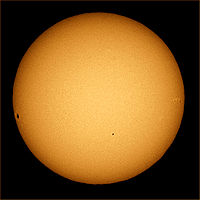
The term transit or astronomical transit has three meanings in astronomy:* A transit is the astronomical event that occurs when one celestial body appears to move across the face of another celestial body, hiding a small part of it, as seen by an observer at some particular vantage point...
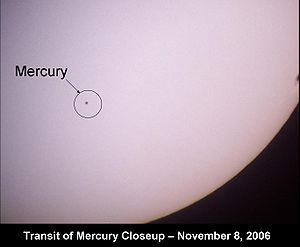
of Mercury across the Sun takes place when the planet
Planet
A planet is a celestial body orbiting a star or stellar remnant that is massive enough to be rounded by its own gravity, is not massive enough to cause thermonuclear fusion, and has cleared its neighbouring region of planetesimals.The term planet is ancient, with ties to history, science,...
Mercury
Mercury (planet)
Mercury is the innermost and smallest planet in the Solar System, orbiting the Sun once every 87.969 Earth days. The orbit of Mercury has the highest eccentricity of all the Solar System planets, and it has the smallest axial tilt. It completes three rotations about its axis for every two orbits...
comes between the Sun
Sun
The Sun is the star at the center of the Solar System. It is almost perfectly spherical and consists of hot plasma interwoven with magnetic fields...
and the Earth
Earth
Earth is the third planet from the Sun, and the densest and fifth-largest of the eight planets in the Solar System. It is also the largest of the Solar System's four terrestrial planets...
, and Mercury is seen as a small black dot moving across the face of the Sun.
Transits of Mercury
Mercury (planet)
Mercury is the innermost and smallest planet in the Solar System, orbiting the Sun once every 87.969 Earth days. The orbit of Mercury has the highest eccentricity of all the Solar System planets, and it has the smallest axial tilt. It completes three rotations about its axis for every two orbits...
with respect to Earth are much more frequent than transits of Venus
Transit of Venus
A transit of Venus across the Sun takes place when the planet Venus passes directly between the Sun and Earth, becoming visible against the solar disk. During a transit, Venus can be seen from Earth as a small black disk moving across the face of the Sun...
, with about 13 or 14 per century, in part because Mercury is closer to the Sun
Sun
The Sun is the star at the center of the Solar System. It is almost perfectly spherical and consists of hot plasma interwoven with magnetic fields...
and orbits it more rapidly.
Transits of Mercury can happen in May or November. November transits occur at intervals of 7, 13, or 33 years ; May transits only occur at intervals of 13 or 33 years. The last three transits occurred in 1999, 2003 and 2006 ; the next will occur in 2016.
During a May transit, Mercury is near aphelion and has an angular diameter
Angular diameter
The angular diameter or apparent size of an object as seen from a given position is the “visual diameter” of the object measured as an angle. In the vision sciences it is called the visual angle. The visual diameter is the diameter of the perspective projection of the object on a plane through its...
of 12"; during a November transit, it is near perihelion and has an angular diameter of 10".
Grazing transits of Mercury
Sometimes Mercury only grazes the Sun during a transit. In this case it is possible that in some areas of the Earth a full transit can be seen while in other regions there is only a partial transit (no second or third contact). The transit of November 15, 1999 was such a transit, and the previous one before that was on October 28, 743. The next such transit will occur on May 11, 2391.It is also possible that a transit of Mercury can be seen in some parts of the world as a partial transit, while in others Mercury misses the Sun. Such a transit last occurred on May 11, 1937, and the previous one was on October 21, 1342. The next such transit will occur on May 13, 2608.
Simultaneous transits
The simultaneous occurrence of a transit of Mercury and a transit of VenusTransit of Venus
A transit of Venus across the Sun takes place when the planet Venus passes directly between the Sun and Earth, becoming visible against the solar disk. During a transit, Venus can be seen from Earth as a small black disk moving across the face of the Sun...
is extremely rare, and will next occur only in the years and . The last simultaneous transit occurred in BC. On September 13, an almost identical event is predicted: a transit of Mercury and a transit of Venus will follow one after the other, in an interval of only 16 hours.
The simultaneous occurrence of a solar eclipse
Solar eclipse
As seen from the Earth, a solar eclipse occurs when the Moon passes between the Sun and the Earth, and the Moon fully or partially blocks the Sun as viewed from a location on Earth. This can happen only during a new moon, when the Sun and the Moon are in conjunction as seen from Earth. At least...
and a transit of Mercury is very rare. The last time this happened was September 20, 6945 BC. The next solar eclipse occurring during a transit of Mercury will be on July 5, 6757
7th millennium
The 7th millennium is a period of time that will begin on January 1, 6001, and will end on December 31, 7000.-Astronomical events:These are astronomical dates, so they are given in the astronomical format of Year Month Day, which allows them to be ordered....
. This solar eclipse will be visible from the South Pacific Ocean.
Past and future transits
A spot on the Sun observed as early as 807 is believed by some experts to have been a transit of Mercury. The first observation of a transit of Mercury was on November 7, 1631 by Pierre GassendiPierre Gassendi
Pierre Gassendi was a French philosopher, priest, scientist, astronomer, and mathematician. With a church position in south-east France, he also spent much time in Paris, where he was a leader of a group of free-thinking intellectuals. He was also an active observational scientist, publishing the...
. Johannes Kepler
Johannes Kepler
Johannes Kepler was a German mathematician, astronomer and astrologer. A key figure in the 17th century scientific revolution, he is best known for his eponymous laws of planetary motion, codified by later astronomers, based on his works Astronomia nova, Harmonices Mundi, and Epitome of Copernican...
had however predicted the occurrence of transits of Mercury and Venus some time before that. He unsuccessfully attempted to observe the transit of Venus
Transit of Venus
A transit of Venus across the Sun takes place when the planet Venus passes directly between the Sun and Earth, becoming visible against the solar disk. During a transit, Venus can be seen from Earth as a small black disk moving across the face of the Sun...
just one month later, but due to inaccurate astronomical tables he did not realize that it was not visible from most of Europe, including Paris
Paris
Paris is the capital and largest city in France, situated on the river Seine, in northern France, at the heart of the Île-de-France region...
. A transit of Venus was not observed until 1639, by Jeremiah Horrocks
Jeremiah Horrocks
Jeremiah Horrocks , sometimes given as Jeremiah Horrox , was an English astronomer who was the only person to predict, and one of only two people to observe and record, the transit of Venus of 1639.- Life and work :Horrocks was born in Lower Lodge, in...
.
| Transits of Mercury | ||||
|---|---|---|---|---|
| Date of mid-transit | | Time (UTC) | |Notes | ||
| Start | | Mid | | End | ||
| 1631 Nov 7 | Observed by Pierre Gassendi Pierre Gassendi Pierre Gassendi was a French philosopher, priest, scientist, astronomer, and mathematician. With a church position in south-east France, he also spent much time in Paris, where he was a leader of a group of free-thinking intellectuals. He was also an active observational scientist, publishing the... . |
|||
| 1651 Nov 3 | Observed by Jeremy Shakerly in Surat Surat Surat , also known as Suryapur, is the commercial capital city of the Indian state of Gujarat. Surat is India's Eighth most populous city and Ninth-most populous urban agglomeration. It is also administrative capital of Surat district and one of the fastest growing cities in India. The city proper... , reported in letter to Henry Osbourne, January 1652, he is thought to have died in India around 1655. |
|||
| 1661 May 3 | Occurred on the day of the Coronation of King Charles II of England. Observed by Christiaan Huygens in London London London is the capital city of :England and the :United Kingdom, the largest metropolitan area in the United Kingdom, and the largest urban zone in the European Union by most measures. Located on the River Thames, London has been a major settlement for two millennia, its history going back to its... . |
|||
| 1677 Nov 7 | Observed by Edmund Halley in St Helena, Richard Towneley Richard Towneley Richard Towneley was an English mathematician and astronomer from Towneley near Burnley, Lancashire. He was one of a group of seventeenth century astronomers in the north of England, which included Jeremiah Horrocks, William Crabtree and William Gascoigne, the pioneer astronomers who laid the... in Lancashire, Jean Charles Gallet in Avignon; as reported in letter from John Flamsteed to Johannes Hevelius 23 May 1678 |
|||
| 1743 Nov 5 | Coordinated scientific observations were organized by Joseph-Nicolas Delisle Joseph-Nicolas Delisle Joseph-Nicolas Delisle was a French astronomer.-Life:He was one of the 11 sons of Claude Delisle . Like many of his brothers, among them Guillaume Delisle, he initially followed classical studies. Soon however, he moved to astronomy under the supervision of Joseph Lieutaud and Jacques Cassini... worldwide. |
|||
| 1753 May 6 | ||||
| 1769 Nov 9 | 23:09 | Observed by Charles Green Charles Green (astronomer) Charles Green was a British astronomer, noted for his assignment by the Royal Society in 1768 to the expedition sent to the Pacific Ocean in order to observe the transit of Venus and the transit of Mercury, aboard James Cook's Endeavour.A farmer's son, he became assistant to the Astronomer Royal... and James Cook James Cook Captain James Cook, FRS, RN was a British explorer, navigator and cartographer who ultimately rose to the rank of captain in the Royal Navy... from Mercury Bay Mercury Bay Mercury Bay is a large V-shaped bay on the eastern coast of the Coromandel Peninsula on the North Island of New Zealand. This bay was named by the English navigator Captain James Cook during his exploratory expeditions. By the Māori it was named Te-Whanganui-o-Hei, the great bay of Hei.On November... in New Zealand. Noted that Mercury had little or no atmosphere. |
||
| 1802 Nov 9 | 06:16 | 08:58 | 11:41 | |
| 1815 Nov 12 | 00:20 | 02:33 | 04:46 | |
| 1822 Nov 5 | 01:04 | 02:25 | 03:45 | |
| 1832 May 5 | 09:04 | 12:25 | 15:47 | |
| 1835 Nov 7 | 17:35 | 20:08 | 22:41 | |
| 1845 May 8 | 16:24 | 19:37 | 22:49 | |
| 1848 Nov 9 | 11:07 | 13:48 | 16:28 | |
| 1861 Nov 12 | 05:21 | 07:19 | 09:18 | |
| 1868 Nov 5 | 05:28 | 07:14 | 09:00 | |
| 1878 May 6 | 15:16 | 19:00 | 22:44 | |
| 1881 Nov 7 | 22:19 | 00:57 | 03:36 | |
| 1891 May 9 | 23:57 | 02:22 | 04:47 | |
| 1894 Nov 10 | 15:58 | 18:35 | 21:11 | |
| 1907 Nov 14 | 10:24 | 12:07 | 13:50 | |
| 1914 Nov 7 | 09:57 | 12:03 | 14:09 | |
| 1924 May 8 | 21:44 | 01:41 | 05:38 | |
| 1927 Nov 10 | 03:02 | 05:46 | 08:29 | |
| 1937 May 11 | 08:53 | 08:59 | 09:06 | Only visible as partial transit in Southern Africa, Southern Arabia, South Asia and Western Australia. |
| 1940 Nov 11 | 20:49 | 23:21 | 01:53 | |
| 1953 Nov 14 | 15:37 | 16:54 | 18:11 | |
| 1957 May 6 | 23:59 | 01:14 | 02:30 | |
| 1960 Nov 7 | 14:34 | 16:53 | 19:12 | http://www.nao.rl.ac.uk/nao/transit/M_1960/ |
| 1970 May 9 | 04:19 | 08:16 | 12:13 | http://www.nao.rl.ac.uk/nao/transit/M_1970/ |
| 1973 Nov 10 | 07:47 | 10:32 | 13:17 | http://www.nao.rl.ac.uk/nao/transit/M_1973/ |
| 1986 Nov 13 | 01:43 | 04:07 | 06:31 | http://www.nao.rl.ac.uk/nao/transit/M_1986/ |
| 1993 Nov 6 | 03:06 | 03:57 | 04:47 | http://www.nao.rl.ac.uk/nao/transit/M_1993/ |
| 1999 Nov 15 | 21:15 | 21:41 | 22:07 | http://www.nao.rl.ac.uk/nao/transit/M_1999/ Partial transit in Australia, Antarctica and New Zealand's South Island |
| 2003 May 7 | 05:13 | 07:52 | 10:32 | http://www.nao.rl.ac.uk/nao/transit/M_2003/ |
| 2006 Nov 8 | 19:12 | 21:41 | 00:10 | http://www.nao.rl.ac.uk/nao/transit/M_2006/ |
| Transits of Mercury | ||||
|---|---|---|---|---|
| Date of mid-transit | | Time (UTC) | |Notes | ||
| Start | | Mid | | End | ||
| 2016 May 9 | 11:12 | 14:57 | 18:42 | |
| 2019 Nov 11 | 12:35 | 15:20 | 18:04 | |
| 2032 Nov 13 | 06:41 | 08:54 | 11:07 | |
| 2039 Nov 7 | 07:17 | 08:46 | 10:15 | |
| 2049 May 7 | 11:03 | 14:24 | 17:44 | |
| 2052 Nov 9 | 23:53 | 02:29 | 05:06 | |
| 2062 May 10 | 18:16 | 21:36 | 00:57 | |
| 2065 Nov 11 | 17:24 | 20:06 | 22:48 | |
| 2078 Nov 14 | 11:42 | 13:41 | 15:39 | |
| 2085 Nov 7 | 11:42 | 13:34 | 15:26 | |
| 2095 May 8 | 17:20 | 21:05 | 00:50 | |
| 2098 Nov 10 | 04:35 | 07:16 | 09:57 | |
| 2108 May 12 | 01:40 | 04:16 | 06:52 |
External links
- NASA: Transits of Mercury, Seven Century Catalog: 1601 CE to 2300 CE
- NASA: Image from the transit of Mercury in 2003
- Shadow & Substance.com: Transit of Mercury Animated for November 8, 2006
- Transits of Mercury - Fourteen century catalog: 1 601 AD - 3 000 AD
- Transits of Mercury on Earth - Fifteen millennium catalog: 5 000 BC - 10 000 AD