


Astronomical transit

Encyclopedia
The term transit or astronomical transit has three meanings in astronomy:
The rest of this article refers to the first kind of transit.
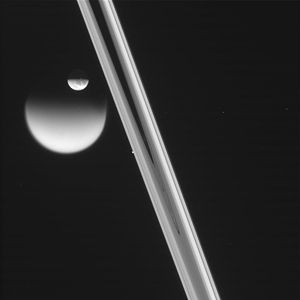
 The word "transit" refers to cases where the nearer object appears considerably smaller than the more distant object. Cases where the nearer object appears larger and completely hides the more distant object are known as occultation
s.
One example of a transit involves the motion of a planet
between a terrestrial
observer and the Sun
. This can happen only with inferior planets
, namely Mercury
and Venus
(see transit of Mercury
and transit of Venus
). However, as seen from outer planets such as Mars
, the Earth itself transits the Sun
on occasion.
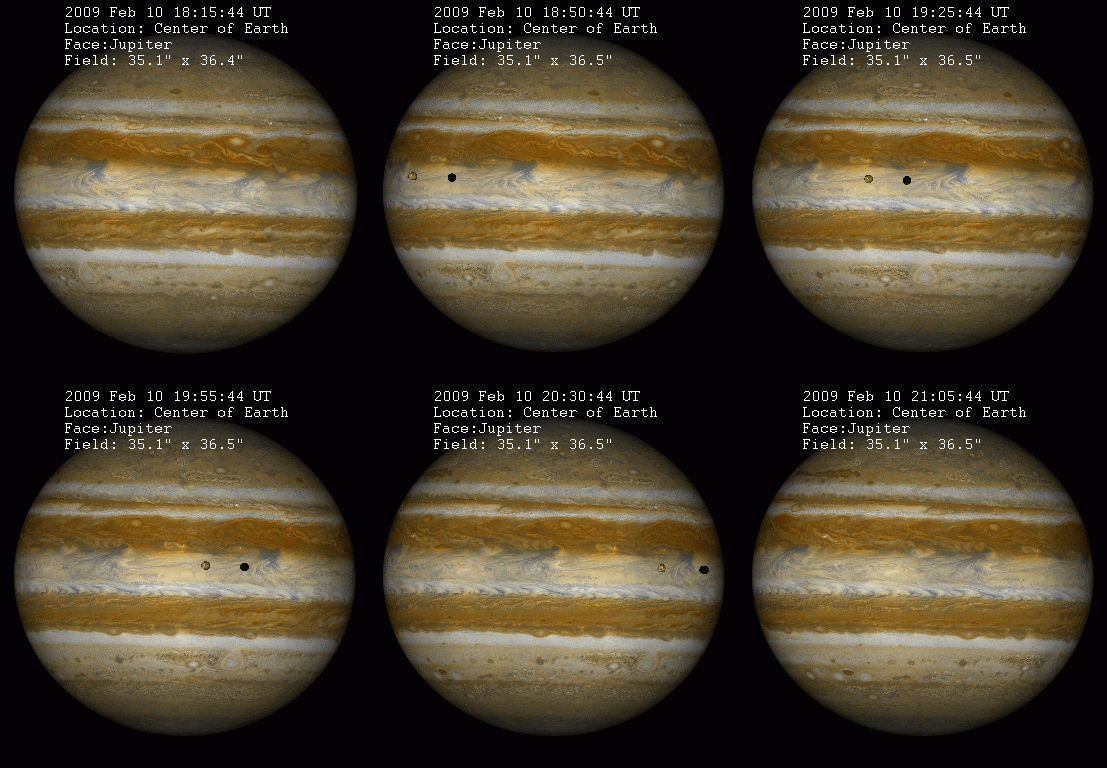
 The term can also be used to describe the motion of a satellite
across its parent planet, for instance one of the Galilean satellites (Io
, Europa
, Ganymede
, Callisto
) across Jupiter
, as seen from Earth
.
A transit requires three bodies to be lined up in a single line. More rare are cases where four bodies are lined up. The one closest to the present occurred on 27 April 1586, when Mercury transited the Sun as seen from Venus
at the same time as a transit of Mercury from Saturn
and a transit of Venus from Saturn
.
In recent years the discovery of extrasolar planet
s has excited interest in the possibility of detecting their transits across their own stellar
primaries. HD 209458b is the first such transiting planet to be discovered.
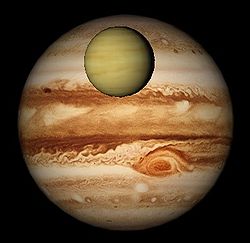 In rare cases, one planet can transit in front of another. The next time this will happen (as seen from Earth) will be on 22 November 2065 at about 12:43 UTC
, when Venus near superior conjunction (with an angular diameter
of 10.6") will transit in front of Jupiter
(with an angular diameter of 30.9"); however, this will take place only 8° west of the Sun, and will therefore not be visible to the unaided/unprotected eye. When the nearer object has a larger angular diameter
than the farther object, thus covering it completely, the event is not a transit but an occultation
. Before transiting Jupiter, Venus will occult Jupiter's moon
Ganymede
at around 11:24 UTC as seen from some southernmost parts of Earth. Parallax
will cause actual observed times to vary by a few minutes, depending on the precise location of the observer.
There are only 18 mutual planetary transits and occultations as seen from Earth between 1700 and 2200. Note the long break of events between 1818 and 2065.
Occultations after 2200 include:
The 1737 event was observed by John Bevis
at Greenwich Observatory – it is the only detailed account of a mutual planetary occultation. A transit of Mars across Jupiter on 12 Sep 1170 was observed by the monk Gervase at Canterbury
, and by Chinese astronomers. In addition, an occultation of Mars by Venus was observed by Michael Maestlin
at Heidelberg on 3 October 1590.
Future transits that can be seen from planets other than Earth include:
of the small circle (small body disk) touches the circumference of the large circle (large body disk) at a single point
. Historically, measuring the precise time of each point of contact during a transit, was one of the most accurate ways to determine the positions of astronomical bodies. The contacts happen in the following order:
For transit of planets in front of others, see also occultation
.
- A transit is the astronomicalAstronomyAstronomy is a natural science that deals with the study of celestial objects and phenomena that originate outside the atmosphere of Earth...
event that occurs when one celestial bodyCelestial BodyCelestial Body is a Croatian film directed by Lukas Nola. It was released in 2000....
appears to move across the face of another celestial body, hiding a small part of it, as seen by an observer at some particular vantage point. If the first celestial body hides a major part, or all of, the second celestial body, then it is an occultationOccultationAn occultation is an event that occurs when one object is hidden by another object that passes between it and the observer. The word is used in astronomy . It can also refer to any situation wherein an object in the foreground blocks from view an object in the background...
rather than a transit. - A transit occurs when a celestial body crosses the meridianMeridian (astronomy)This article is about the astronomical concept. For other uses of the word, see Meridian.In the sky, a meridian is an imaginary great circle on the celestial sphere. It passes through the north point on the horizon, through the celestial pole, up to the zenith, through the south point on the...
due to the Earth's rotation, about halfway between rising and setting. For instance, the SunSunThe Sun is the star at the center of the Solar System. It is almost perfectly spherical and consists of hot plasma interwoven with magnetic fields...
transits the meridian at solar noonNoonNoon is usually defined as 12 o'clock in the daytime. The word noon is also used informally to mean midday regarding the location of the sun not the middle of a persons day. Although this is a time around the middle of the day when people in many countries take a lunch break...
. Observation of meridian transits was once very important for timekeeping purposes (see transit instrumentTransit instrumentIn astronomy, transit instruments are used for the precise observation of star positions. The instruments can be divided into three groups:- Meridian instruments :for observation of star transits in the exact direction of South or North:...
). - The term star transitStar transitA Star transit is the passage of a star through the eyepiece of an telescope.The precise observation of star transits is the basis of many methods in Astronomy and in Geodesy...
is used for the passage of a star through the eyepiece of a telescopeTelescopeA telescope is an instrument that aids in the observation of remote objects by collecting electromagnetic radiation . The first known practical telescopes were invented in the Netherlands at the beginning of the 1600s , using glass lenses...
. Precise observations of elevation or time are carried out to determine star positionStar positionStar position in the sky is defined by a pair of angles. These two angles - which refer to the celestial equator - are called declination and right ascension ....
s or the local vertical (geographic latitude/longitude).
The rest of this article refers to the first kind of transit.
Definition
Occultation
An occultation is an event that occurs when one object is hidden by another object that passes between it and the observer. The word is used in astronomy . It can also refer to any situation wherein an object in the foreground blocks from view an object in the background...
s.
One example of a transit involves the motion of a planet
Planet
A planet is a celestial body orbiting a star or stellar remnant that is massive enough to be rounded by its own gravity, is not massive enough to cause thermonuclear fusion, and has cleared its neighbouring region of planetesimals.The term planet is ancient, with ties to history, science,...
between a terrestrial
Earth
Earth is the third planet from the Sun, and the densest and fifth-largest of the eight planets in the Solar System. It is also the largest of the Solar System's four terrestrial planets...
observer and the Sun
Sun
The Sun is the star at the center of the Solar System. It is almost perfectly spherical and consists of hot plasma interwoven with magnetic fields...
. This can happen only with inferior planets
Inferior and superior planets
The terms "inferior planet" and "superior planet" were originally used in the geocentric cosmology of Claudius Ptolemy to differentiate as 'inferior' those planets whose epicycle remained collinear with the Earth and Sun, compared to the 'superior' planets that did not.In the 16th century, the...
, namely Mercury
Mercury (planet)
Mercury is the innermost and smallest planet in the Solar System, orbiting the Sun once every 87.969 Earth days. The orbit of Mercury has the highest eccentricity of all the Solar System planets, and it has the smallest axial tilt. It completes three rotations about its axis for every two orbits...
and Venus
Venus
Venus is the second planet from the Sun, orbiting it every 224.7 Earth days. The planet is named after Venus, the Roman goddess of love and beauty. After the Moon, it is the brightest natural object in the night sky, reaching an apparent magnitude of −4.6, bright enough to cast shadows...
(see transit of Mercury
Transit of Mercury
A transit of Mercury across the Sun takes place when the planet Mercury comes between the Sun and the Earth, and Mercury is seen as a small black dot moving across the face of the Sun....
and transit of Venus
Transit of Venus
A transit of Venus across the Sun takes place when the planet Venus passes directly between the Sun and Earth, becoming visible against the solar disk. During a transit, Venus can be seen from Earth as a small black disk moving across the face of the Sun...
). However, as seen from outer planets such as Mars
Mars
Mars is the fourth planet from the Sun in the Solar System. The planet is named after the Roman god of war, Mars. It is often described as the "Red Planet", as the iron oxide prevalent on its surface gives it a reddish appearance...
, the Earth itself transits the Sun
Transit of Earth from Mars
A transit of Earth across the Sun as seen from Mars takes place when the planet Earth passes directly between the Sun and Mars, obscuring a small part of the Sun's disc for an observer on Mars. During a transit, Earth can be seen from Mars as a small black disc moving across the face of the Sun...
on occasion.
Natural satellite
A natural satellite or moon is a celestial body that orbits a planet or smaller body, which is called its primary. The two terms are used synonymously for non-artificial satellites of planets, of dwarf planets, and of minor planets....
across its parent planet, for instance one of the Galilean satellites (Io
Io (moon)
Io ) is the innermost of the four Galilean moons of the planet Jupiter and, with a diameter of , the fourth-largest moon in the Solar System. It was named after the mythological character of Io, a priestess of Hera who became one of the lovers of Zeus....
, Europa
Europa (moon)
Europa Slightly smaller than Earth's Moon, Europa is primarily made of silicate rock and probably has an iron core. It has a tenuous atmosphere composed primarily of oxygen. Its surface is composed of ice and is one of the smoothest in the Solar System. This surface is striated by cracks and...
, Ganymede
Ganymede (moon)
Ganymede is a satellite of Jupiter and the largest moon in the Solar System. It is the seventh moon and third Galilean satellite outward from Jupiter. Completing an orbit in roughly seven days, Ganymede participates in a 1:2:4 orbital resonance with the moons Europa and Io, respectively...
, Callisto
Callisto (moon)
Callisto named after the Greek mythological figure of Callisto) is a moon of the planet Jupiter. It was discovered in 1610 by Galileo Galilei. It is the third-largest moon in the Solar System and the second largest in the Jovian system, after Ganymede. Callisto has about 99% the diameter of the...
) across Jupiter
Jupiter
Jupiter is the fifth planet from the Sun and the largest planet within the Solar System. It is a gas giant with mass one-thousandth that of the Sun but is two and a half times the mass of all the other planets in our Solar System combined. Jupiter is classified as a gas giant along with Saturn,...
, as seen from Earth
Earth
Earth is the third planet from the Sun, and the densest and fifth-largest of the eight planets in the Solar System. It is also the largest of the Solar System's four terrestrial planets...
.
A transit requires three bodies to be lined up in a single line. More rare are cases where four bodies are lined up. The one closest to the present occurred on 27 April 1586, when Mercury transited the Sun as seen from Venus
Transit of Mercury from Venus
A transit of Mercury across the Sun as seen from Venus takes place when the planet Mercury passes directly between the Sun and Venus, obscuring a small part of the Sun's disc for an observer on Venus. During a transit, Mercury can be seen from Venus as a small black disc moving across the face of...
at the same time as a transit of Mercury from Saturn
Transit of Mercury from Saturn
A transit of Mercury across the Sun as seen from Saturn takes place when the planet Mercury passes directly between the Sun and Saturn, obscuring a small part of the Sun's disc for an observer on Saturn...
and a transit of Venus from Saturn
Transit of Venus from Saturn
A transit of Venus across the Sun as seen from Saturn takes place when the planet Venus passes directly between the Sun and Saturn, obscuring a small part of the Sun's disc for an observer on Saturn...
.
In recent years the discovery of extrasolar planet
Extrasolar planet
An extrasolar planet, or exoplanet, is a planet outside the Solar System. A total of such planets have been identified as of . It is now known that a substantial fraction of stars have planets, including perhaps half of all Sun-like stars...
s has excited interest in the possibility of detecting their transits across their own stellar
Star
A star is a massive, luminous sphere of plasma held together by gravity. At the end of its lifetime, a star can also contain a proportion of degenerate matter. The nearest star to Earth is the Sun, which is the source of most of the energy on Earth...
primaries. HD 209458b is the first such transiting planet to be discovered.
Mutual planetary transits and occultations
Coordinated Universal Time
Coordinated Universal Time is the primary time standard by which the world regulates clocks and time. It is one of several closely related successors to Greenwich Mean Time. Computer servers, online services and other entities that rely on having a universally accepted time use UTC for that purpose...
, when Venus near superior conjunction (with an angular diameter
Angular diameter
The angular diameter or apparent size of an object as seen from a given position is the “visual diameter” of the object measured as an angle. In the vision sciences it is called the visual angle. The visual diameter is the diameter of the perspective projection of the object on a plane through its...
of 10.6") will transit in front of Jupiter
Jupiter
Jupiter is the fifth planet from the Sun and the largest planet within the Solar System. It is a gas giant with mass one-thousandth that of the Sun but is two and a half times the mass of all the other planets in our Solar System combined. Jupiter is classified as a gas giant along with Saturn,...
(with an angular diameter of 30.9"); however, this will take place only 8° west of the Sun, and will therefore not be visible to the unaided/unprotected eye. When the nearer object has a larger angular diameter
Angular diameter
The angular diameter or apparent size of an object as seen from a given position is the “visual diameter” of the object measured as an angle. In the vision sciences it is called the visual angle. The visual diameter is the diameter of the perspective projection of the object on a plane through its...
than the farther object, thus covering it completely, the event is not a transit but an occultation
Occultation
An occultation is an event that occurs when one object is hidden by another object that passes between it and the observer. The word is used in astronomy . It can also refer to any situation wherein an object in the foreground blocks from view an object in the background...
. Before transiting Jupiter, Venus will occult Jupiter's moon
Natural satellite
A natural satellite or moon is a celestial body that orbits a planet or smaller body, which is called its primary. The two terms are used synonymously for non-artificial satellites of planets, of dwarf planets, and of minor planets....
Ganymede
Ganymede (moon)
Ganymede is a satellite of Jupiter and the largest moon in the Solar System. It is the seventh moon and third Galilean satellite outward from Jupiter. Completing an orbit in roughly seven days, Ganymede participates in a 1:2:4 orbital resonance with the moons Europa and Io, respectively...
at around 11:24 UTC as seen from some southernmost parts of Earth. Parallax
Parallax
Parallax is a displacement or difference in the apparent position of an object viewed along two different lines of sight, and is measured by the angle or semi-angle of inclination between those two lines. The term is derived from the Greek παράλλαξις , meaning "alteration"...
will cause actual observed times to vary by a few minutes, depending on the precise location of the observer.
There are only 18 mutual planetary transits and occultations as seen from Earth between 1700 and 2200. Note the long break of events between 1818 and 2065.
- 19 Sep 1702 – Jupiter occults Neptune
- 20 Jul 1705 – Mercury transits Jupiter
- 14 Jul 1708 – Mercury occults Uranus
- 4 Oct 1708 – Mercury transits Jupiter
- 28 May 1737 – Venus occults Mercury
- 29 Aug 1771 – Venus transits Saturn
- 21 Jul 1793 – Mercury occults Uranus
- 9 Dec 1808 – Mercury transits Saturn
- 3 Jan 1818 – Venus transits Jupiter
- 22 Nov 2065 – Venus transits Jupiter
- 15 Jul 2067 – Mercury occults Neptune
- 11 Aug 2079 – Mercury occults Mars
- 27 Oct 2088 – Mercury transits Jupiter
- 7 Apr 2094 – Mercury transits Jupiter
- 21 Aug 2104 – Venus occults Neptune
- 14 Sep 2123 – Venus transits Jupiter
- 29 Jul 2126 – Mercury occults Mars
- 3 Dec 2133 – Venus occults Mercury
Occultations after 2200 include:
- 1 Dec 40396 TTTerrestrial TimeTerrestrial Time is a modern astronomical time standard defined by the International Astronomical Union, primarily for time-measurements of astronomical observations made from the surface of the Earth....
– Uranus transits Neptune
The 1737 event was observed by John Bevis
John Bevis
John Bevis was an English doctor and astronomer. He is best known for discovering the Crab Nebula in 1731....
at Greenwich Observatory – it is the only detailed account of a mutual planetary occultation. A transit of Mars across Jupiter on 12 Sep 1170 was observed by the monk Gervase at Canterbury
Canterbury
Canterbury is a historic English cathedral city, which lies at the heart of the City of Canterbury, a district of Kent in South East England. It lies on the River Stour....
, and by Chinese astronomers. In addition, an occultation of Mars by Venus was observed by Michael Maestlin
Michael Maestlin
Michael Maestlin was a German astronomer and mathematician, known for being the mentor of Johannes Kepler.-Career:...
at Heidelberg on 3 October 1590.
Future transits that can be seen from planets other than Earth include:
- 23 Jun 2021 – Earth occults Pluto as seen from Venus http://space.jpl.nasa.gov/cgi-bin/wspace?tbody=399&vbody=299&month=6&day=23&year=2021&hour=23&minute=24&fovmul=1&rfov=0.01&bfov=30&porbs=1&showsc=1
- 29 Nov 2022 – Earth occults Mercury as seen from Mars http://space.jpl.nasa.gov/cgi-bin/wspace?tbody=399&vbody=499&month=11&day=29&year=2022&hour=20&minute=16&fovmul=-1&bfov=30&porbs=1
- 12 Jan 2032 – Earth transits Saturn as seen from Venus (south pole)
- 11 Sep 2032 – Mercury transits Jupiter as seen from Mars
- 2 Sep 2064 – Venus occults Uranus as seen from Mercury
- 22 Nov 2065 – Venus occults Earth as seen from Jupiter
- 11 Aug 2079 – Mercury transits Earth as seen from Mars
- 4 Nov 2079 – Jupiter occults Uranus as seen from Mars
- 27 Oct 2088 – Mercury transits Earth as seen from Jupiter
- 7 Apr 2094 – Mercury transits Earth as seen from Jupiter
- 20 Apr 2100 – Venus transits Saturn as seen from Mercury
Contacts
During a transit there are four "contacts", when the circumferenceCircumference
The circumference is the distance around a closed curve. Circumference is a special perimeter.-Circumference of a circle:The circumference of a circle is the length around it....
of the small circle (small body disk) touches the circumference of the large circle (large body disk) at a single point
Tangent
In geometry, the tangent line to a plane curve at a given point is the straight line that "just touches" the curve at that point. More precisely, a straight line is said to be a tangent of a curve at a point on the curve if the line passes through the point on the curve and has slope where f...
. Historically, measuring the precise time of each point of contact during a transit, was one of the most accurate ways to determine the positions of astronomical bodies. The contacts happen in the following order:
- First contact: the smaller body is entirely outside the larger body, moving inward ("exterior ingress")
- Second contact: the smaller body is entirely inside the larger body, moving further inward ("interior ingress")
- Third contact: the smaller body is entirely inside the larger body, moving outward ("interior egress")
- Fourth contact: the smaller body is entirely outside the larger body, moving outward ("exterior egress")
See also
- Transit of asteroids
- Transit of Vulcan
- Transit of Phobos from MarsTransit of Phobos from MarsA transit of Phobos across the Sun as seen from Mars takes place when Phobos passes directly between the Sun and a point on the surface of Mars, obscuring a large part of the Sun's disc for an observer on Mars. During a transit, Phobos can be seen from Mars as a large black disc rapidly moving...
- Transit of Deimos from MarsTransit of Deimos from MarsA transit of Deimos across the Sun as seen from Mars takes place when Deimos passes directly between the Sun and a point on the surface of Mars, obscuring a small part of the Sun's disc for an observer on Mars...
- Kepler MissionKepler MissionThe Kepler spacecraft is an American space observatory, the space-based portion of NASA's Kepler Mission to discover Earth-like planets orbiting other stars. The spacecraft is named in honor of the 17th-century German astronomer Johannes Kepler...
- Astrological aspects
For transit of planets in front of others, see also occultation
Occultation
An occultation is an event that occurs when one object is hidden by another object that passes between it and the observer. The word is used in astronomy . It can also refer to any situation wherein an object in the foreground blocks from view an object in the background...
.
External references
- Chasing Venus, Observing the Transits of Venus Smithsonian Institution Libraries
- Jean MeeusJean MeeusJean Meeus is a Belgian astronomer specializing in celestial mechanics. The asteroid 2213 Meeus is named after him.Jean Meeus studied mathematics at the University of Leuven in Belgium, where he received the Degree of Licentiate in 1953...
: Transits. Richmond, Virginia: Willmann-Bell, Inc., 1989, ISBN 0-943396-25-5 - Jean Meeus: Astronomical Tables of the Sun, Moon and Planets. Richmond, Virginia: Willmann-Bell, Inc., 1995, ISBN 0-943396-45-X
- Karl RamsayerKarl RamsayerKarl Ramsayer was a German geodesist and is well known as one of the most important scientists in geodetic astronomy and in electronic navigation....
: Geodätische AstronomieGeodetic astronomyGeodetic astronomy is the application of astronomical methods into networks and technical projects of geodesy.The most important topics are:* Establishment of geodetic datum systems Geodetic astronomy is the application of astronomical methods into networks and technical projects of geodesy.The...
, Vol.2a of Handbuch der Vermessungskunde, 900 p., J.B.Metzler, Stuttgart 1969.