

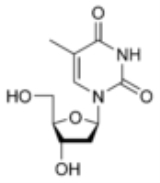
Thymidine

Encyclopedia
Thymidine is a chemical compound
, more precisely a pyrimidine
deoxynucleoside
. Deoxythymidine is the DNA
nucleoside
T, which pairs with deoxyadenosine
(A) in double-stranded DNA. In cell biology it is used to synchronize
the cells in S phase.
Before the boom in thymidine use caused by the need for thymidine for the production of the antiretroviral drug
azidothymidine
(AZT), much of the world's thymidine production came from herring
sperm. Thymidine occurs almost exclusively in DNA but also occurs in the T-loop
of tRNA.
composed of deoxyribose
(a pentose sugar
) joined to the pyrimidine
base thymine
.
Deoxythymidine can be phosphorylated with one, two or three phosphoric acid groups, creating respectively dTMP, dTDP or dTTP (deoxythymidine mono- di- or triphosphate).
It exists in solid
form as small white crystals or white crystalline powder
, has a molecular weight of 242.229 u, and has a melting point
of 185 °C. The stability of deoxythymidine under standard temperature and pressure (STP) is very high.
Deoxythymidine is non-toxic and as part of one of the four nucleotides in DNA it is a naturally occurring compound that exists in all living organisms and DNA viruses. RNA has uridine
(uracil joined to ribose) instead. Uracil is chemically very similar to thymine, the latter being 5-methyluracil. Since thymine nucleotides are precursors of DNA, not RNA, the prefix "deoxy" is often left out, i.e., deoxythymidine is often just called thymidine.
Thymidine is listed as a chemical teratogen.
Azidothymidine
(AZT) - used in the treatment of HIV
infection. AZT inhibits the process of reverse transcription
, a critical step in the viral life cycle.
Tritiated
thymidine is commonly used in cell proliferation assays. The thymidine is incorporated into dividing cells and the level of this incorporation, measured using a liquid scintillation counter
, is proportional to the amount of cell proliferation.
Bromodeoxyuridine
(BrdU) is another thymidine analog that is often used for the detection of proliferating cells in living tissues.
Chemical compound
A chemical compound is a pure chemical substance consisting of two or more different chemical elements that can be separated into simpler substances by chemical reactions. Chemical compounds have a unique and defined chemical structure; they consist of a fixed ratio of atoms that are held together...
, more precisely a pyrimidine
Pyrimidine
Pyrimidine is a heterocyclic aromatic organic compound similar to benzene and pyridine, containing two nitrogen atoms at positions 1 and 3 of the six-member ring...
deoxynucleoside
Nucleoside
Nucleosides are glycosylamines consisting of a nucleobase bound to a ribose or deoxyribose sugar via a beta-glycosidic linkage...
. Deoxythymidine is the DNA
DNA
Deoxyribonucleic acid is a nucleic acid that contains the genetic instructions used in the development and functioning of all known living organisms . The DNA segments that carry this genetic information are called genes, but other DNA sequences have structural purposes, or are involved in...
nucleoside
Nucleoside
Nucleosides are glycosylamines consisting of a nucleobase bound to a ribose or deoxyribose sugar via a beta-glycosidic linkage...
T, which pairs with deoxyadenosine
Deoxyadenosine
Deoxyadenosine is a deoxyribonucleoside. It is a derivative of the nucleoside adenosine, differing from the latter by the replacement of a hydroxyl group by hydrogen at the 2' position of its ribose sugar moiety. Deoxyadenosine is the DNA nucleoside A, which pairs with deoxythymidine in...
(A) in double-stranded DNA. In cell biology it is used to synchronize
Cell synchronization
Cell Synchronization is a process by which cells at different stages of the cell cycle in a culture are brought to the same phase. "Cell synchrony" is required to study the progression of cells through the cell cycle...
the cells in S phase.
Before the boom in thymidine use caused by the need for thymidine for the production of the antiretroviral drug
Antiretroviral drug
Antiretroviral drugs are medications for the treatment of infection by retroviruses, primarily HIV. When several such drugs, typically three or four, are taken in combination, the approach is known as Highly Active Antiretroviral Therapy, or HAART...
azidothymidine
Zidovudine
Zidovudine or azidothymidine is a nucleoside analog reverse-transcriptase inhibitor , a type of antiretroviral drug used for the treatment of HIV/AIDS. It is an analog of thymidine....
(AZT), much of the world's thymidine production came from herring
Herring
Herring is an oily fish of the genus Clupea, found in the shallow, temperate waters of the North Pacific and the North Atlantic oceans, including the Baltic Sea. Three species of Clupea are recognized. The main taxa, the Atlantic herring and the Pacific herring may each be divided into subspecies...
sperm. Thymidine occurs almost exclusively in DNA but also occurs in the T-loop
T arm
The T-arm or T-loop is a specialized region on the tRNA molecule which acts as a special recognition site for the ribosome to allow a tRNA-ribosome complex to form during the process of protein biosynthesis....
of tRNA.
Structure and properties
In its composition, deoxythymidine is a nucleosideNucleoside
Nucleosides are glycosylamines consisting of a nucleobase bound to a ribose or deoxyribose sugar via a beta-glycosidic linkage...
composed of deoxyribose
Deoxyribose
Deoxyribose, more, precisely 2-deoxyribose, is a monosaccharide with idealized formula H---3-H. Its name indicates that it is a deoxy sugar, meaning that it is derived from the sugar ribose by loss of an oxygen atom...
(a pentose sugar
Sugar
Sugar is a class of edible crystalline carbohydrates, mainly sucrose, lactose, and fructose, characterized by a sweet flavor.Sucrose in its refined form primarily comes from sugar cane and sugar beet...
) joined to the pyrimidine
Pyrimidine
Pyrimidine is a heterocyclic aromatic organic compound similar to benzene and pyridine, containing two nitrogen atoms at positions 1 and 3 of the six-member ring...
base thymine
Thymine
Thymine is one of the four nucleobases in the nucleic acid of DNA that are represented by the letters G–C–A–T. The others are adenine, guanine, and cytosine. Thymine is also known as 5-methyluracil, a pyrimidine nucleobase. As the name suggests, thymine may be derived by methylation of uracil at...
.
Deoxythymidine can be phosphorylated with one, two or three phosphoric acid groups, creating respectively dTMP, dTDP or dTTP (deoxythymidine mono- di- or triphosphate).
It exists in solid
Solid
Solid is one of the three classical states of matter . It is characterized by structural rigidity and resistance to changes of shape or volume. Unlike a liquid, a solid object does not flow to take on the shape of its container, nor does it expand to fill the entire volume available to it like a...
form as small white crystals or white crystalline powder
Powder (substance)
A powder is a dry,thick bulk solid composed of a large number of very fine particles that may flow freely when shaken or tilted. Powders are a special sub-class of granular materials, although the terms powder and granular are sometimes used to distinguish separate classes of material...
, has a molecular weight of 242.229 u, and has a melting point
Melting point
The melting point of a solid is the temperature at which it changes state from solid to liquid. At the melting point the solid and liquid phase exist in equilibrium. The melting point of a substance depends on pressure and is usually specified at standard atmospheric pressure...
of 185 °C. The stability of deoxythymidine under standard temperature and pressure (STP) is very high.
Deoxythymidine is non-toxic and as part of one of the four nucleotides in DNA it is a naturally occurring compound that exists in all living organisms and DNA viruses. RNA has uridine
Uridine
Uridine is a molecule that is formed when uracil is attached to a ribose ring via a β-N1-glycosidic bond.If uracil is attached to a deoxyribose ring, it is known as a deoxyuridine....
(uracil joined to ribose) instead. Uracil is chemically very similar to thymine, the latter being 5-methyluracil. Since thymine nucleotides are precursors of DNA, not RNA, the prefix "deoxy" is often left out, i.e., deoxythymidine is often just called thymidine.
Thymidine is listed as a chemical teratogen.
Modified analogs of thymidine
Iododeoxyuridine is a radiosensitizer and increases the amount of DNA damage received from ionizing radiation.Azidothymidine
Zidovudine
Zidovudine or azidothymidine is a nucleoside analog reverse-transcriptase inhibitor , a type of antiretroviral drug used for the treatment of HIV/AIDS. It is an analog of thymidine....
(AZT) - used in the treatment of HIV
HIV
Human immunodeficiency virus is a lentivirus that causes acquired immunodeficiency syndrome , a condition in humans in which progressive failure of the immune system allows life-threatening opportunistic infections and cancers to thrive...
infection. AZT inhibits the process of reverse transcription
Reverse transcriptase inhibitor
Reverse-transcriptase inhibitors are a class of antiretroviral drug used to treat HIV infection, tumors, and cancer. RTIs inhibit activity of reverse transcriptase, a viral DNA polymerase enzyme that retroviruses need to reproduce.-Mechanism:...
, a critical step in the viral life cycle.
Tritiated
Tritium
Tritium is a radioactive isotope of hydrogen. The nucleus of tritium contains one proton and two neutrons, whereas the nucleus of protium contains one proton and no neutrons...
thymidine is commonly used in cell proliferation assays. The thymidine is incorporated into dividing cells and the level of this incorporation, measured using a liquid scintillation counter
Scintillation counter
A scintillation counter measures ionizing radiation. The sensor, called a scintillator, consists of a transparent crystal, usually phosphor, plastic , or organic liquid that fluoresces when struck by ionizing radiation. A sensitive photomultiplier tube measures the light from the crystal...
, is proportional to the amount of cell proliferation.
Bromodeoxyuridine
Bromodeoxyuridine
Bromodeoxyuridine is a synthetic nucleoside that is an analogue of thymidine. BrdU is commonly used in the detection of proliferating cells in living tissues....
(BrdU) is another thymidine analog that is often used for the detection of proliferating cells in living tissues.
External links
- http://money.cnn.com/magazines/fortune/fortune_archive/1990/11/05/74308/index.htm