

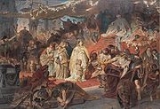
Thusnelda

Encyclopedia
- This article is about the Germanic princess. For the video codec project of the same name, see TheoraTheoraTheora is a free lossy video compression format. It is developed by the Xiph.Org Foundation and distributed without licensing fees alongside their other free and open media projects, including the Vorbis audio format and the Ogg container....
.
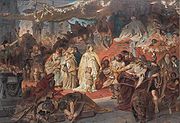
Cherusci
The Cherusci were a Germanic tribe that inhabited parts of the northern Rhine valley and the plains and forests of northwestern Germany, in the area between present-day Osnabrück and Hanover, during the 1st century BC and 1st century AD...
prince Segestes
Segestes
Segestes was a noble of the Germanic tribe of the Cherusci involved in the events surrounding the Roman attempts to conquer northern Germany during the reign of Roman Emperor Augustus....
. Her father had intended her for someone else, but Arminius
Arminius
Arminius , also known as Armin or Hermann was a chieftain of the Germanic Cherusci who defeated a Roman army in the Battle of the Teutoburg Forest...
, who subsequently led a coalition of Germanic tribes to victory over Publius Quinctilius Varus
Publius Quinctilius Varus
Publius Quinctilius Varus was a Roman politician and general under Emperor Augustus, mainly remembered for having lost three Roman legions and his own life when attacked by Germanic leader Arminius in the Battle of the Teutoburg Forest.-Life:His paternal grandfather was senator Sextus Quinctilius...
and his legions in the Battle of Teutoburg Forest in 9 AD, eloped with her and married her instead.
The war between the Roman Empire
Roman Empire
The Roman Empire was the post-Republican period of the ancient Roman civilization, characterised by an autocratic form of government and large territorial holdings in Europe and around the Mediterranean....
and the northern German tribes continued, and in May 15 AD. Thusnelda became the prisoner of Germanicus
Germanicus
Germanicus Julius Caesar , commonly known as Germanicus, was a member of the Julio-Claudian dynasty and a prominent general of the early Roman Empire. He was born in Rome, Italia, and was named either Nero Claudius Drusus after his father or Tiberius Claudius Nero after his uncle...
, the nephew of Emperor Tiberius, who commanded the invasion of Germany. She was pregnant and staying with her father, who was a Roman client and bitterly opposed to Arminius, and it was her father who delivered her to Germanicus, after the latter saved him by driving off Arminius' forces, who had besieged him. Her husband much grieved over her loss and did not marry again.
During her captivity, Thusnelda gave birth to her and Arminius' only child, Thumelicus
Thumelicus
Thumelicus was the son of the Cherusci leader Arminius and of Thusnelda, daughter of the pro-Roman tribal leader Segestes....
. On May 26, 17 AD, Thusnelda and her son were displayed as prized trophies in Germanicus' triumph
Roman triumph
The Roman triumph was a civil ceremony and religious rite of ancient Rome, held to publicly celebrate and sanctify the military achievement of an army commander who had won great military successes, or originally and traditionally, one who had successfully completed a foreign war. In Republican...
ant parade in Rome — with her father watching from the stands. The next year, just prior to the Battle of the Weser River
Battle of the Weser River
The Battle of the Weser River, sometimes known as a first Battle of Minden, was fought in 16 AD between Roman legions commanded by Emperor Tiberius' heir and adopted son Germanicus, and an alliance of Germanic tribes commanded by Arminius...
, Arminius engaged in a famous disputation with his brother Flavus, who was still serving in the Roman army. Flavus informed Arminius that Thusnelda was being well-treated — as, he claimed, was typical of Rome, which was a firm but fair ruler.
Thumelicus was trained at the gladiator
Gladiator
A gladiator was an armed combatant who entertained audiences in the Roman Republic and Roman Empire in violent confrontations with other gladiators, wild animals, and condemned criminals. Some gladiators were volunteers who risked their legal and social standing and their lives by appearing in the...
school in Ravenna
Ravenna
Ravenna is the capital city of the Province of Ravenna in the Emilia-Romagna region of Italy and the second largest comune in Italy by land area, although, at , it is little more than half the size of the largest comune, Rome...
and is believed to have died in a gladiator show at a fairly young age. Tacitus
Tacitus
Publius Cornelius Tacitus was a senator and a historian of the Roman Empire. The surviving portions of his two major works—the Annals and the Histories—examine the reigns of the Roman Emperors Tiberius, Claudius, Nero and those who reigned in the Year of the Four Emperors...
tells us that he will report on Thumelicus' fate "at the proper time" — i.e., when he discusses the year in question in his chronicle. The main gap in his text is for 30 and 31 AD — so it could be that Thumelicus died then, aged 15 or 16.
External links
- Thusnelda, part of the Encyclopædia Romana by James Grout.