

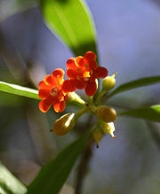
Theophrastaceae

Encyclopedia
Theophrastaceae is a small family of flowering plants. As currently circumscribed, the family consists of seven genera and 95 species of tree
s or shrub
s, native to tropical regions of the Americas
.
The APG II system
places this family in the order Ericales
, a basal group in the asterids
. APG II also includes the additional genus Samolus, with about 15 additional species, and vastly increasing the area of distribution. The APG III system
includes the family within an enlarged Primulaceae
(sensu lato).
Tree
A tree is a perennial woody plant. It is most often defined as a woody plant that has many secondary branches supported clear of the ground on a single main stem or trunk with clear apical dominance. A minimum height specification at maturity is cited by some authors, varying from 3 m to...
s or shrub
Shrub
A shrub or bush is distinguished from a tree by its multiple stems and shorter height, usually under 5–6 m tall. A large number of plants may become either shrubs or trees, depending on the growing conditions they experience...
s, native to tropical regions of the Americas
Americas
The Americas, or America , are lands in the Western hemisphere, also known as the New World. In English, the plural form the Americas is often used to refer to the landmasses of North America and South America with their associated islands and regions, while the singular form America is primarily...
.
The APG II system
APG II system
The APG II system of plant classification is the second, now obsolete, version of a modern, mostly molecular-based, system of plant taxonomy that was published in April 2003 by the Angiosperm Phylogeny Group. It was a revision of the first APG system, published in 1998, and was superseded in 2009...
places this family in the order Ericales
Ericales
The Ericales are a large and diverse order of dicotyledons, including for example tea, persimmon, blueberry, Brazil nut, and azalea. The order includes trees and bushes, lianas and herbaceous plants. Together with ordinary autophytic plants, the Ericales include chlorophyll-deficient...
, a basal group in the asterids
Asterids
In the APG II system for the classification of flowering plants, the name asterids refers to a clade .Most of the taxa belonging to this clade had been referred to the Asteridae in the Cronquist system and to the Sympetalae in earlier systems...
. APG II also includes the additional genus Samolus, with about 15 additional species, and vastly increasing the area of distribution. The APG III system
APG III system
The APG III system of flowering plant classification is the third version of a modern, mostly molecular-based, system of plant taxonomy...
includes the family within an enlarged Primulaceae
Primulaceae
Primulaceae is a family of flowering plants with about 24 genera, including some favorite garden plants and wildflowers. It is also known as the primrose family.- Genera :...
(sensu lato).