

Blue Network

Encyclopedia
The Blue Network, and its immediate predecessor, the NBC Blue Network, were the on-air names of an American radio production and distribution service from 1927 to 1945. Tracing its formal origins back to 1927 as one of the two radio networks owned by the National Broadcasting Company
, the Blue Network was born of a divestiture in 1942, arising from anti-trust litigation, and is the direct predecessor of the American Broadcasting Company
.
acquired WJZ
, Newark from Westinghouse (which had created the station in 1921) and moved it to New York City in May of that year. When RCA commenced operations of WRC
, Washington on August 1, 1923, the root of a network was born, though it did not operate under the name by which it would later become known. Radio historian Elizabeth McLeod states that it would not be until 1924 that the "Radio Group" formally began network operations.
The core stations of the "Radio Group" were RCA's stations WJZ and WRC; the Westinghouse
station WBZ
, then in Springfield, Massachusetts
; and WGY, the General Electric
station in Schenectady, New York
.
RCA's principal rival prior to 1926 was the radio broadcasting department of the American Telephone & Telegraph Company. AT&T, starting in 1921, had been using this department as a test-bed for equipment being designed and manufactured by its Western Electric
subsidiary.
The RCA stations operated at a significant disadvantage to their rival chain; AT&T used its own high-quality transmission lines, and declined to lease them out to competing entities, forcing RCA to use the telegraph lines of Western Union
, which were not as well calibrated to voice transmission as the AT&T lines.
Nevertheless, the WJZ network sought to compete toe-to-toe with the AT&T network, which was built around WEAF (today's WFAN
). For example, both stations sent announcer teams to cover the 1924 Democratic National Convention
, which was held in Madison Square Garden
in New York City. Promotional material produced in 1943 claimed certain "firsts" in broadcasting by WJZ, such as the first educational music program in April 1922, the first World Series
broadcasts in 1922, and the first complete opera broadcast, The Flying Dutchman
, from the Manhattan Opera House.
(as well as its consortium partners General Electric
and Westinghouse
) were to receive a break in 1926, when AT&T made a corporate decision to exit the broadcasting business and focus on its telecommunications business.
The first step by AT&T was to create the Broadcasting Company of America
on May 15, 1926, to hold its broadcasting assets. As reported in the press, this move was due to the growth in the radio broadcasting activities of AT&T and the special issues related thereto, though it would appear that subsequent activities in disposing of the assets of BCA may have also played a role in the decision. AT&T did in fact subsequently sell WEAF
to RCA for $1 million in July 1926, a price that newspaper reports indicated was a substantial premium over what other stations were commanding in the marketplace, and represented a recognition of the status of WEAF in broadcasting, as well as its access to AT&T's lines. Indeed, the negotiations for the sale may have taken place very shortly after the creation of BCA, as Folder 129 in the NBC History Files at the Library of Congress contains a contract of sale for WEAF dated July 1, 1926. The Oakland Tribune
stated that 4/5ths of the purchase price of WEAF could be attributed to good-will and the line access. On July 28, 1926, the Washington Post reported in a front-page story that RCA had acquired WCAP. The Oakland Tribune reported the same day that WCAP had departed the field, and WRC
would be operating on the frequency that they had shared, which was 640 AM.
As part of the reorganization of the broadcasting assets in the wake of the acquisitions, on September 13, 1926, the formation of the National Broadcasting Company was announced via newspaper advertisements, and on November 15, 1926 NBC's first broadcast was made. This first broadcast on November 15, 1926 marked the de facto formation by NBC of the Red Network
from the WEAF network assets, using WEAF as the "key station"; this network in eventual popular image tended to broadcast the most popular entertainment programming. RCA merged its former radio operations into NBC, and on January 1, 1927, WJZ
became the "key station" of the Blue Network when its network switch operations began; this network, again in eventual popular image, tended to place its focus more on news and public affairs programming, as well as the "sustaining", or non-sponsored shows.
The Decatur Review (Illinois
) for Sunday, December 12, 1926 reported the following in an article describing a broadcast to be sponsored by the Victor Talking Machine Company
and aired the following New Year's Day, January 1, 1927, which is a description of this first Blue Network broadcast—note that it makes it clear that January 1, 1927 marked the debut of the Blue Network:
Allegedly, the color designations came from the way the networks were represented on maps, with red lines (or pushpins) denoting the WEAF network circuits, and blue the WJZ circuits.
to America from his trans-Atlantic flight, star announcer Graham McNamee
doing the honors. Three months later, a combined hookup of 67 stations on the two networks presented the second Dempsey
–Tunney
fight, broadcast by McNamee and NBC colleague Phillips Carlin. See Elizabeth McLeod's discussion of surviving NBC broadcast material from this era
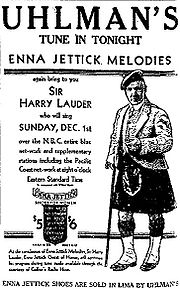 A slightly later example of cooperation came on the evening of Sunday, December 1, 1929, when the famed "Laird of the Music Halls", Sir Harry Lauder, appeared on a coast-to-coast hookup that originated from KFI
in Los Angeles
(later an NBC Red station, but at this time part of NBC's West Coast "Orange Network"), but was distributed by WJZ
, which, as noted, was the key station of the Blue Network; advertisements suggest that certain NBC Red stations, as well as stations in the Orange Network, supplemented the network. A description of this broadcast is contained in a 1930 pamphlet put out by the Enna Jettick Shoe Company; Enna Jettick sponsored the first of Lauder's performances that night on its "Enna Jettick Melodies" show, which was followed later by another performance during the time ordinarily used by The Collier Hour
.
At least as late as January 1939, in spite of the fact that by this time NBC was seeking to differentiate the images of its NBC Red and NBC Blue networks (see below), it would still arrange for special, joint broadcasts, such as a special two-hour presentation of the "The Magic Key of RCA
" musical program (normally an NBC Blue program, sponsored by RCA's Victor records division) entitled "Salute to 1939."
) sponsored an unusual program, the Five-Star Theater, which each weeknight presented a show in a different format. The marquee show in this cycle was Flywheel, Shyster, and Flywheel, which starred Groucho Marx
and Chico Marx
. Considering the show's relatively early (7:30 p.m. ET) time slot, it did rather well in the ratings, but it could not compete with the much stronger ratings produced by Esso's arch-rival Texaco
, which sponsored Ed Wynn
on NBC Red, and the show ended after one year.
More commonly, the Blue Network would operate as a quasi-"farm team" for the Red Network, in terms of entertainment programs. Bob Hope
(in 1935 and again in 1937), Jack Benny
(in 1932), Fibber McGee and Molly
(in 1935), and Information, Please! (in 1938) are all examples of shows that debuted on the Blue Network before eventually transitioning over to larger audiences on the Red Network.
On occasion, shows would make brief stops at NBC Blue before moving elsewhere, such as the Lux Radio Theatre (1934–5) and Will Rogers' program (1933), both of which would move to CBS.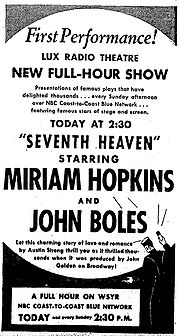 At some level, the Blue Network was known in the late 1920s and early 1930s for its children's programming. There are at least two volumes extant, from an Akron-based publishing house, which are collections of stories which purport to have been part of Blue Network programs. A copy of one, in the collection of E.O. Costello, shows a cover with two children listening to a late 1920s-style radio, from which shimmering images of fairy-tale characters are emerging. Other than the title (and the radio on the cover), the precise nature of the ties to the Blue Network is not known; the book does not even make direct reference to the National Broadcasting Company. It can also be said that this is an indication that the Blue Network had a well-established identity of its own by 1929.
appear to indicate that at some level, there was discontent with the way NBC was managing the Blue Network vis-à-vis the Red Network. For example, one folder in the NBC History Files contains a three-page letter dated June 28, 1934 from station WSYR
in Syracuse, New York
, which complains of the neglect of the Blue Network in favor of the Red Network. This point can said to be reinforced firstly by a memorandum dated September 18, 1935, in which the Blue complained about its lack of access to broadcasts of the World Series
, and secondly by a letter dated shortly after that, on October 5, 1935, which is a communication from Hearst Radio complaining that Amos 'n Andy and the Al Pearce
programs had been moved from the Blue Network to the Red Network, and complaining in general about the weakness of the Blue's programming. Indeed, the NBC History Files contain a February 1937 in-house memorandum so caustic of the performance of the Blue Network that the author's name was redacted from the document.
A significant issue with the NBC Blue Network may have been its size. It started, in January 1927, with 7 stations, had grown to 17 by the end of 1929, but still had only 33 stations by 1937. This would have made it significantly smaller than its rivals. In 1938, Mutual had 107 affiliates, and CBS had 114; the Blue Network, by contrast, was not able to blanket the United States when NBC Red sold out its time, with the result that during 1937–1938, the Blue Network's revenues were generally falling, while NBC Red's increased. Radio historian Elizabeth McLeod has noted that as of 1938, NBC had 23 stations in its core "Basic Red" group, and 24 in its "Basic Blue" group, with 107 stations that could be Red or Blue depending on the needs of a sponsor; the relative ratings (and thus revenues) for NBC Red programs versus NBC Blue counterparts suggests that sponsors chose to use Red more often than Blue.
broadcasts, led by Maestro Arturo Toscanini
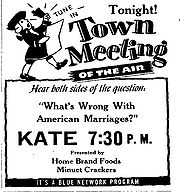
. In a similar vein, one of the Blue Network's longest running programs was America's Town Meeting of the Air
, a current-affairs discussion program. Both Lowell Thomas
and Walter Winchell
's news programs were also broadcast over the Blue Network. Both of these shows were the Blue's highest rated programs in the late 1930s and early 1940s. In an interesting variation on the talent shows hosted by Major Bowes
, the Sherwin-Williams paint company sponsored the Metropolitan Opera
Auditions of the Air for a number of years on Sunday afternoons in the 1930s and 1940s, in which singers competed for a chance to win contracts with the famed opera troupe. The National Farm and Home Hour
, a show backed for many years by the U.S. Department of Agriculture, was one of the Blue Network's standout daytime programs, and would be a part of its lineup from 1929 until March 1945, when the program shifted to NBC.
Along with the NBC Symphony Orchestra
broadcasts, the Metropolitan Opera radio broadcasts
were part of the "crown jewels" of NBC Blue. A sober, dignified pamphlet issued by the network in 1937 stated that the broadcasts were under RCA
sponsorship, and "[t]hrough the medium of nationwide NBC Network broadcasting, Grand Opera has been given to the entire nation. No longer is it reserved for the privileged few – now even the most isolated listeners throughout the United States are able to enjoy the world's finest music at their own firesides. The National Broadcasting Company (...) is proud to be the means of bringing the Metropolitan Opera to American radio listeners." The pamphlet notes that 78 stations broadcast these opera performances in 1937, and that reception for the program was "nationwide", something moderately unusual for an NBC Blue broadcast.
Radio historian Elizabeth McLeod has suggested, aside from a brief period where NBC Red and NBC Blue had different chime-sequences in the late 1920s and early 1930s, the two networks were *not* differentiated for many years, which would certainly be consistent with the roster of shows described above. She points out, with some justice, that NBC Red also broadcast a number of high-brow programs such as The Voice of Firestone
, The Atwater Kent Hour
, and the Cities Service Concerts
. Furthermore, she points out that until the 1936–1937 period, the "back office" support for the networks was the same, and often stations would shift from one network to another, depending on sponsor needs. It was only when the Federal Communications Commission
began investigating network practices, McLeod believes, that efforts were made by RCA
to differentiate the two networks, and to fully position NBC Blue as a high-brow/public affairs network. (In the same light, it has been suggested that the congressional pressure was the real reason the NBC Symphony Orchestra was created.)
The NBC History Files at the Library of Congress
lend support to the notion that NBC was gradually groping for a way to differentiate the Red Network from the Blue Network. For example, they contain a confidential memorandum, dated May 13, 1936, which sets forth a network policy against mixing the Red and Blue network stations. (Compare and contrast this with the way the Harry Lauder broadcast of 1929 was handled, above.) There also exists an October 1938 sales force memorandum, which contains talking points on how to differentiate the Blue Network from the Red Network and CBS
. Even as far back as December 1932, NBC had set forth a policy banning specific references not only to CBS, but even to the Red Network.
Of note is the fact that NBC began to step up efforts to expand the network; while it had 33 stations in 1937, this total had nearly tripled by January 1941, when the network had 92 stations coast to coast.
In the months leading up to the January 1942 spinoff of the Blue Network, NBC undertook vigorous steps to create separate brand images for the Red and Blue Networks. To a certain extent, this had been going on since at least the summer of 1939, when Time magazine indicated that NBC was undertaking an extensive build-up of NBC Blue. In both the fall of 1937, and the fall of 1941, NBC would specifically identify a program as being broadcast on the "Red Network of the National Broadcasting Company", and at least in the fall of 1941, would have a similar tag for the Blue Network. An example of this buildup comes in "Alice in Sponsor-Land", a publication put out by RCA
some time in mid-1941 to market that network's shows. This book focuses squarely on the Red Network, describing its entertainment programming, without any reference to the Blue Network. Above the lineup of stations in the back of the volume is the tag-line: "This is the Red Network of the National Broadcasting Company." In addition, throughout the book are slogans such as "Any time is Good Time on NBC Red!" This book, in part, demonstrates exactly how NBC differentiated the Red Network from the Blue Network in the fall of 1941, when, as noted, the Blue Network was still a part of NBC.
The official website for Helen Hayes
shows a number of programs that she did for NBC Blue during this time, including a Eugene O'Neill
play cycle in August 1937, two different dramatic series of her own in 1935–1936 (one sponsored by General Foods
), and an appearance on a Blue series in 1940, one which brought famous people who would explain why a particular book has been their favorite.
The "preview" section of the November 28, 1938 edition of Time
gives some idea of the kind of programming that the Blue Network carried. On Friday, November 25 at 4 p.m., it carried a speech by then-Secretary of State
Cordell Hull
. Later that night, it carried the welterweight championship fight from Madison Square Garden
, followed by Wagnerian opera from Chicago's Lyric Opera. Saturday, November 26 shows that the Blue carried both the Army–Navy football game and the NBC Symphony Orchestra. The Town Meeting of the Air
on Thursday night carried a debate among economists as to whether an economic plan for world peace was possible.
For one season in the early 1940s, a high-profile sponsored program on the Blue was The Cavalcade of America
, a show dramatizing historical events which was sponsored by DuPont
. The show, which debuted in 1935 on CBS and moved to the Blue in January 1940, was created at a time when the firm was under attack for being, in effect, a "merchant of death", and this show, which focused on American historical figures, was one way DuPont tried to burnish its image. Certainly, the show had high production values, as can be witnessed by its use of Raymond Massey
for a show in February 1940 on Abraham Lincoln
, as described in the February 26, 1940 issue of Time. It was also known for the use of university professors to vet the historical accuracy of the stories, as well as scripts by future Pulitzer Prize-winner Arthur Miller
. (This show would eventually stay with NBC Red and NBC, starting in 1941, and the network would continue to broadcast the show even into the age of television).
A poignant example of the Blue Network's counterprogramming comes on the night of Sunday, May 4, 1941. The network carried an address by exiled Lithuania
n president Antanas Smetona
at 7:45 p.m., where he was addressing a mass rally in Chicago
. Given that NBC Red was, at the same time, broadcasting the popular Fitch Bandwagon radio program (on right after Jack Benny
), one wonders how many people tuned in to hear this statesman speak of the tragic fate of his nation.
An interesting perspective can be seen on one of the most dramatic days in the history of network radio. On the morning/afternoon of the Japanese attack on Pearl Harbor
on December 7, 1941, while the first attack wave was over Oahu
, NBC Blue was broadcasting The Inspector General, as part of its Great Plays program, while NBC Red was broadcasting a program with popular bandleader Sammy Kaye
. At 4 p.m., ET, the Blue's broadcasts of the National Vespers was interrupted by various news reports. Later on in the evening, at 6:30 p.m. and 6:45 p.m., Drew Pearson
's and Eleanor Roosevelt
's regular broadcasts are heard, followed at 7 p.m. by a news roundup show that competed with Jack Benny, and later on Bible Week opposite the Chase and Sanborn Hour with Edgar Bergen
. (The Blue did have the popular Inner Sanctum
mystery anthology series later that night at 8:30, followed in turn by its number one show with Walter Winchell
.) Lastly, of interest to those who may recall the satiric references in Warner Bros.
cartoons of the era, at 10 p.m., the Blue carried The Goodwill Hour with John J. Anthony, dispensing advice to those who sought it, and who presumably were not tuned into Phil Spitalny
's orchestra on the Red network.
on this point. The fact that David Sarnoff
, the head of RCA
, was involved in these discussions indicates the high level at which this proposal was given consideration. A plain reading of the finding guide at the Library of Congress on the NBC History Files does not disclose the precise nature of these discussions, though the fact that these discussions existed is of interest. In 1943, after the Blue Network had been spun off (but before its eventual sale), a promotional publication noted that:
, in part by their rival Mutual
, that the two senior network systems engaged in a series of anticompetitive activities, by locking up talent through in-house talent bureaus, and tightly tying together the system of affiliated stations through onerous contracts.
In May 1940, after a three-year investigation, the Federal Communications Commission
(which had had oversight over radio broadcasting since 1934) issued a scathing report (the "Report on Chain Broadcasting") attacking the affiliation policies of NBC and CBS, as well as the talent booking agency practices. The report proposed limiting each network to one affiliated station per city, which would have had a direct impact on NBC's dual-network ownership. In May 1941, the FCC went a step further and issued formal rules to break up what it perceived to be monopolies in radio; one of these rules specifically barred a network from operating more than one hookup, which would have been aimed directly at NBC's ownership of its two networks, in a manner even more explicit than the June 1940 report.
watering down the rules, but the reprieve was short-lived, as the antitrust division of the Department of Justice, on December 31, 1941, filed an antitrust action against NBC and CBS
, seeking to break up the networks' methods of operation. Mutual
, at the same time, filed an antitrust suit of its own, in the amount of $10.275 million, according to the January 12, 1942 edition of Time
.
This account by Time describes at least one of the accusations leveled against NBC by Mutual, from an affidavit by Mutual's general manager. In the fall of 1941, Mutual debuted a comedy-variety series sponsored by Ballantine Ale, called Three Ring Time, starring Milton Berle
and Charles Laughton
. The show was set to debut on a 77-station network, but 14 of these stations were under contract to NBC, which had the power to exercise options on the most desirable time, in cities where there was limited competition. NBC eventually exercised options for six of these stations, with the result that Three Ring Time was being carried simultaneously on NBC Blue and Mutual.
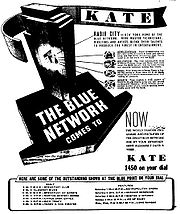
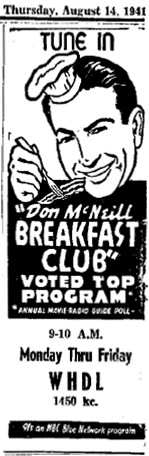 While the antitrust suits were pending, NBC and CBS had appealed to the courts regarding the ability of the FCC to regulate the operations of radio networks. While these appeals were in progress, NBC started the process of formally separating the operations of the Red Network and the Blue Network, a process which had begun in 1939 with the formation of a separate sales department for the Blue Network and which continued into 1940 and 1941 with the formation of other departments for the Blue Network. NBC began to specifically identify the networks, contrary to its general practice, and began to divide personnel and facilities; eventually, it formed a separate corporate entity for the Blue Network on January 8, 1942, "Blue Network Company, Inc." From this date on, while NBC still maintained ownership of the Blue Network, it was for most purposes an entirely separate network. NBC Red at this point became known as simply NBC.
 In June 1942 the United States Supreme Court
upheld the jurisdiction of the FCC over the issuance of rules relating to chain broadcasting. While the FCC litigation continued in the wake of this ruling, the public and private antitrust litigation was held in abeyance.
On May 10, 1943 the Supreme Court (National Broadcasting Co. v. United States, 319 U.S. 190) upheld the right of the FCC to regulate practically everything that was radio, by sustaining the jurisdiction of the FCC to regulate the contractual relations of the major networks with affiliated stations. Efforts in late 1943 before the Senate Interstate Commerce Committee to obtain legislation to, in effect, reverse the decision went nowhere.
, NBC was now spurred to take vigorous action to sell the Blue Network. The bidding came down to three groups, with an initial bid of $6 million, which was raised in sequence by rivals to $6.5 and then $7 million. In late July, 1943, the investment banking firm of Dillon, Read & Co. made a bid of $7.8 million.
On July 30, 1943, just over two months after the court's ruling, RCA
announced the sale of the network to American Broadcasting System, Inc., a firm controlled by Edward J. Noble, a former undersecretary of commerce who was better known as the chairman of Life Savers Corp. The price was announced as $8 million. This was followed by a petition to the FCC
to approve the sale, which was filed on August 13.
, declined to sell time to labor organizations, cooperatives, and other organizations advocating "controversial topics", but did give them free air time, provided there was an opportunity for the other side to be heard. On August 27, 1943, the Congress of Industrial Organizations
filed a brief in a petition to intervene in the FCC
proceedings on the network sale. The CIO complained that the NAB code regarding "controversial" broadcasts inhibited its ability to buy airtime. While the FCC denied the CIO's petition to intervene, it did invite the CIO to give testimony in the hearings.
At the hearings held on September 10, 1943, FCC Chairman James L. Fly roundly denounced the policy of the Blue Network in refusing to sell airtime, but granting air time for free, to proponents of controversial broadcasts. He colorfully described the policy as chasing would-be purchasers from the front of the shop, but "directing them to the back door for a handout." Mark Woods, the head of the Blue Network, defended the policy, stating that it was in compliance with the NAB code. When Edward J. Noble testified at the hearings held on September 20, 1943, he was questioned closely by Chairman Fly as to the policies regarding the refusal to sell air time to labor organizations, cooperatives and other special interest groups. Noble was directed by Chairman Fly at this hearing to submit a statement as to what the policy would be of the Blue Network in terms of "the expansion of the mechanisms of free speech." On October 3, 1943, Noble released a letter to the FCC in which it was stated that the Blue Network would meet "with an open mind" all requests for broadcasting time, "considering each on the merits", and excluding none on the basis of ideas or personality. Certainly, not all were pleased by Chairman Fly's stance. Columnist David Lawrence, in his October 7, 1943 column, thought that the FCC had overstepped its authority in attempting to force the Blue Network to change its policies regarding the sale of airtime.
Noble's written response seems to have been sufficient. The sale was approved by the FCC on October 12, 1943. Noble was forced to divest himself of New York
station WMCA
, which he had owned since 1940, but his American Broadcasting System, Inc.
, the entity formed to be the parent of the Blue Network, acquired WJZ
, additional stations in Chicago
and San Francisco
, as well as land-line leases, certain studio facilities and leased studio facilities, and the affiliation system.
 Following the sale, the Department of Justice
dropped its antitrust proceedings against NBC on October 17, 1943, having previously dropped proceedings against CBS
on October 11, and the federal courts, upon its motion, dismissed Mutual
's antitrust claims against CBS and NBC.
, Mark Woods called the Blue Network of 1942 (that is, just before the sale) "a dump." The article describes the then-116 station network as the home of cast-off speeches and classical music, which had only generated $14 million in revenue. It could, perhaps, be argued that Woods was denigrating the state of the Blue Network at that time, to contrast with the relative success of the network later in the 1940s; this is possible in light of the fact that the Blue Network had been profitable in 1942. Woods and the rest of the management team, after the sale to Noble, began to take steps to make the Blue Network more competitive with NBC and CBS.
).
Of obvious import were steps taken to preserve the best programming the network had, and make improvements; these were happening in the period immediately prior to, and following, the sale of the network. While the Blue Network did lose a few programs to NBC, such as Quiz Kids
and Duffy's Tavern
(more shows that debuted or had a previous run on the Blue; see Lackmann, op. cit.) and the NBC Symphony Orchestra
(Lackmann, op. cit.), it did retain one highly-rated show, the Jergen's Journal with Walter Winchell
, which managed to compete successfully with NBC's powerhouse Sunday night lineup (it was the 11th-ranked program for all of 1943–1944, and Blue's only program in the top 20). The Blue Network also retained the rights to broadcast the Metropolitan Opera radio broadcasts
; Milton Cross
was the host for NBC, Blue, ABC
, CBS
, and the opera's own broadcasts from 1931 through 1975. This was in spite of the fact that NBC did not want to assign the rights to either the Town Meeting of the Air
or the Metropolitan Opera broadcasts to the Blue Network.
In an interview with Time
published on January 11, 1943, Woods noted that the Blue Network was seeking to differentiate itself from NBC and CBS by the aggressive use of transcriptions, contrary to the practice of the larger networks. This would have its full fruition when Bing Crosby
started transcribing his prime-time shows later in the decade.
In certain respects, the Blue made attempts to grab the spotlight with unusual broadcasts. On December 25, 1942, the Coca-Cola Company
sponsored an all-day broadcast on the network, a "Victory Parade's Christmas Party of Spotlight Bands". The hiring, in 1943, of noted bandleader Paul Whiteman
as Director of Music was an attempt by the network, in its own words, to strengthen the entire musical schedule, as well as obtain a prominent figure. The "Metropolitan Auditions of the Air", discussed above, had moved to the Blue Network by 1943 as well, joining the Metropolitan Opera broadcasts and the Boston Symphony Orchestra.
.jpg)
 News continued to be a priority for the network; indeed, Raymond Swing would win a Peabody Award
for the network in 1944 for his news commentary. A 1943 promotional pamphlet listed Martin Agronsky, Drew Pearson, Swing, Lowell Thomas, Dorothy Thompson and Walter Winchell, among others, as part of "the most impressive roster of news analysts and commentators on the air today." Newsman George Hicks
was on a landing craft heading to the Normandy invasion beaches on D-Day when it was strafed by enemy planes, the sound of the combat being broadcast. The network did have some difficulty with its news commentators during the war, however. The February 22, 1943 edition of Time notes that Woods had to clamp down on both Winchell and Drew Pearson
for over-aggressive name calling in their broadcasts, much to the dismay of Winchell, for one.
One ambitious broadcast, copies of which are generally available to collectors of old-time radio broadcasts, was a special two-hour program broadcast on Christmas Day, 1944. Entitled "Christmas on the Blue", the show was emceed by Gracie Fields
, and featured, among other stars, Joe E. Brown
, The Andrews Sisters
, Ed Wynn
, Paul Whiteman
and others. The show also featured broadcasts of overseas servicemen talking to their loved ones at home, something slightly unusual for the era.
One of the pairings on this special program involved Wendell Niles
, a long-time announcer on many radio shows, including Bob Hope's. The Blue Network gave him and partner Don Prindle a comedy series, Niles and Prindle, which is referenced in the special as being scheduled for a debut the following month. Little can be found regarding this show, other than it involved two friends "who argued about everything", and had a brief life in 1945. It was certainly most unusual for the Blue to attempt to convert a long-time announcer into a featured comedy star, and in this sense, "Niles and Prindle", if not unique (given that Graham McNamee
was the "Perfect Foil" to Ed Wynn
), it must be said to be at least quite singular.
Of some interest to animation fans is the existence of a show called Nitwit Court, which sought to do to John J. Anthony's The Goodwill Hour what It Pays to Be Ignorant
did to Information, Please!. Host Ransom Sherman would pose problems to a jury consisting of Arthur Q. Bryan
, as "Willow", a man with a lisp, Mel Blanc
, as "Hornblower", a fumbling motorboat owner, and Sara Berner as "Bubbles Lowbridge", a not terribly bright woman.
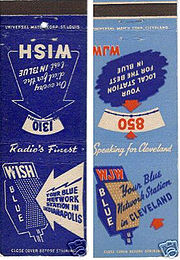
 Strengthening the affiliate station group was a third matter of importance to the network. While the network had 116 stations in January 1942 and 155 stations as of June 1943, this still meant that it could only offer to advertisers coverage of approximately 76% of the radio homes in the United States. In this sense, the moves by the FCC
to loosen the provisions of the contracts binding affiliated stations to networks helped the Blue. This allowed the Blue Network to pick up a few additional stations in 1944, including (ironically) a few from Mutual
This was one of its priorities, as in general the Blue Network had inherited smaller and less powerful stations than the group of stations that had made up its former twin sister network.
, having initially sought permission from the FCC
for this action in October 1944; prior to this time, some broadcasts would refer to the network as being "The Blue Network of the American Broadcasting Company." They were not alone in desiring this catchy acronym. Two prior claimants were bought out prior to June 1945, and in negotiations with the Associated Broadcasting Corp. in December 1945, it acquired the rights to the name "ABC" from yet a third party. From June 1945 forward, the entity has been known generally as the American Broadcasting Company, and reference should be made to that entry for its subsequent history.
Of course, things are never all that simple. The souvenir program for the Maurice B. Sachs Amateur Hour broadcast of Sunday, September 30, 1945 refers to the broadcast as coming from "Blue Network Studio A." Even into 1947, in some markets, ABC would promote its shows with the tag-line "It's a Blue Network Program!"
was generally slow to move into television broadcasting. It did not acquire a television station until WJZ-TV (now WABC-TV
), Channel 7 in New York was completed in the summer of 1948, followed by four other Channel 7 stations which signed on in 1948 and 1949 in Detroit, Chicago, San Francisco and Los Angeles. Until those stations were built, ABC had to lease time and studio facilities from other stations including DuMont
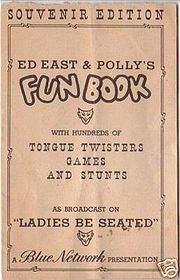
network New York flagship WABD, as well as other stations in Philadelphia and Washington which eventually helped form the core of the ABC television network. It might be supposed that the Blue Network never existed in television, but as noted above, the Blue Network did make at least a few known forays into television prior to the June 1945 name change. For example, the Blue Network applied for a construction permit for a TV station in the upper VHF band, but all such applications were shelved during the war years. Experiments were also conducted by the Blue Network in television program production before it permanently became ABC and formally opened a network under the ABC name in 1948. The script for a February 25, 1945 broadcast of Ladies Be Seated, which was a relatively popular audience-participation/stunt game show
on Blue Network radio, still exists, and is reprinted in full in Ritchie; it is, in fact, the script for the first broadcast. It was hosted by Johnny Olson
, who would later become the long-running announcer on CBS's The Price Is Right
. Technically, this was not a network broadcast, as it was broadcast locally on WRGB
, the General Electric television station in Schenectady, New York. However, the opening title card, according to the script, was for "The Blue Network of the American Broadcasting Company." No video copy of this broadcast is known to exist.
and portions of the Upper Midwest
, around the Great Lakes
area. The Southern Blue Network covered the Deep South
, the Mountain Blue Group the Mountain states
, the Pacific Coast Blue Network the Pacific Coast states
, and the Southwestern
Blue Group the Oklahoma-Texas region.
A pamphlet published by the American Rolling Mill Co. in connection with a radio talk on "The Miracle of Steel" given on the Blue Network on April 9, 1939 has a listing of the Blue Network stations participating in this broadcast. They are as follows:
Other Blue Network basic stations in 1939 were WABY
(Albany, New York); WJTN
(Jamestown, New York); WRTD
(Richmond, Virginia); WLEU
(Erie, Pennsylvania); CFCF (Montreal, Quebec) and WMFF
in Plattsburgh, New York.
NBC
The National Broadcasting Company is an American commercial broadcasting television network and former radio network headquartered in the GE Building in New York City's Rockefeller Center with additional major offices near Los Angeles and in Chicago...
, the Blue Network was born of a divestiture in 1942, arising from anti-trust litigation, and is the direct predecessor of the American Broadcasting Company
American Broadcasting Company
The American Broadcasting Company is an American commercial broadcasting television network. Created in 1943 from the former NBC Blue radio network, ABC is owned by The Walt Disney Company and is part of Disney-ABC Television Group. Its first broadcast on television was in 1948...
.
Early history
The Blue Network can be dated to 1923, when the Radio Corporation of AmericaRCA
RCA Corporation, founded as the Radio Corporation of America, was an American electronics company in existence from 1919 to 1986. The RCA trademark is currently owned by the French conglomerate Technicolor SA through RCA Trademark Management S.A., a company owned by Technicolor...
acquired WJZ
WABC (AM)
WABC , known as "NewsTalkRadio 77 WABC" is a radio station in New York City. Owned by the broadcasting division of Cumulus Media, the station broadcasts on a clear channel and is the flagship station of Cumulus Media Networks...
, Newark from Westinghouse (which had created the station in 1921) and moved it to New York City in May of that year. When RCA commenced operations of WRC
WRC-TV
WRC-TV, channel 4, is an owned and operated television station of the NBC television network, located in the American capital city of Washington, D.C...
, Washington on August 1, 1923, the root of a network was born, though it did not operate under the name by which it would later become known. Radio historian Elizabeth McLeod states that it would not be until 1924 that the "Radio Group" formally began network operations.
The core stations of the "Radio Group" were RCA's stations WJZ and WRC; the Westinghouse
Westinghouse Electric (1886)
Westinghouse Electric was an American manufacturing company. It was founded in 1886 as Westinghouse Electric Company and later renamed Westinghouse Electric Corporation by George Westinghouse. The company purchased CBS in 1995 and became CBS Corporation in 1997...
station WBZ
WBZ (AM)
WBZ is the call sign for an AM radio station in Boston, Massachusetts owned by CBS Radio, itself owned by the CBS Corporation. Originally based in and broadcast from Springfield, Massachusetts, WBZ was the first commercial radio station in the United States...
, then in Springfield, Massachusetts
Springfield, Massachusetts
Springfield is the most populous city in Western New England, and the seat of Hampden County, Massachusetts, United States. Springfield sits on the eastern bank of the Connecticut River near its confluence with three rivers; the western Westfield River, the eastern Chicopee River, and the eastern...
; and WGY, the General Electric
General Electric
General Electric Company , or GE, is an American multinational conglomerate corporation incorporated in Schenectady, New York and headquartered in Fairfield, Connecticut, United States...
station in Schenectady, New York
Schenectady, New York
Schenectady is a city in Schenectady County, New York, United States, of which it is the county seat. As of the 2010 census, the city had a population of 66,135...
.
RCA's principal rival prior to 1926 was the radio broadcasting department of the American Telephone & Telegraph Company. AT&T, starting in 1921, had been using this department as a test-bed for equipment being designed and manufactured by its Western Electric
Western Electric
Western Electric Company was an American electrical engineering company, the manufacturing arm of AT&T from 1881 to 1995. It was the scene of a number of technological innovations and also some seminal developments in industrial management...
subsidiary.
The RCA stations operated at a significant disadvantage to their rival chain; AT&T used its own high-quality transmission lines, and declined to lease them out to competing entities, forcing RCA to use the telegraph lines of Western Union
Western Union
The Western Union Company is a financial services and communications company based in the United States. Its North American headquarters is in Englewood, Colorado. Up until 2006, Western Union was the best-known U.S...
, which were not as well calibrated to voice transmission as the AT&T lines.
Nevertheless, the WJZ network sought to compete toe-to-toe with the AT&T network, which was built around WEAF (today's WFAN
WFAN
WFAN , also known as "Sports Radio 66" or "The FAN", is a radio station in New York City. The station broadcasts on a clear channel and is owned by CBS Radio...
). For example, both stations sent announcer teams to cover the 1924 Democratic National Convention
1924 Democratic National Convention
The 1924 Democratic National Convention, also called the Klanbake, held at the Madison Square Garden in New York City from June 24 to July 9, took a record 103 ballots to nominate a presidential candidate. It was the longest continuously running convention in United States political history...
, which was held in Madison Square Garden
Madison Square Garden
Madison Square Garden, often abbreviated as MSG and known colloquially as The Garden, is a multi-purpose indoor arena in the New York City borough of Manhattan and located at 8th Avenue, between 31st and 33rd Streets, situated on top of Pennsylvania Station.Opened on February 11, 1968, it is the...
in New York City. Promotional material produced in 1943 claimed certain "firsts" in broadcasting by WJZ, such as the first educational music program in April 1922, the first World Series
World Series
The World Series is the annual championship series of Major League Baseball, played between the American League and National League champions since 1903. The winner of the World Series championship is determined through a best-of-seven playoff and awarded the Commissioner's Trophy...
broadcasts in 1922, and the first complete opera broadcast, The Flying Dutchman
The Flying Dutchman (opera)
Der fliegende Holländer is an opera, with music and libretto by Richard Wagner.Wagner claimed in his 1870 autobiography Mein Leben that he had been inspired to write "The Flying Dutchman" following a stormy sea crossing he made from Riga to London in July and August 1839, but in his 1843...
, from the Manhattan Opera House.
Creation
RCARCA
RCA Corporation, founded as the Radio Corporation of America, was an American electronics company in existence from 1919 to 1986. The RCA trademark is currently owned by the French conglomerate Technicolor SA through RCA Trademark Management S.A., a company owned by Technicolor...
(as well as its consortium partners General Electric
General Electric
General Electric Company , or GE, is an American multinational conglomerate corporation incorporated in Schenectady, New York and headquartered in Fairfield, Connecticut, United States...
and Westinghouse
Westinghouse Electric (1886)
Westinghouse Electric was an American manufacturing company. It was founded in 1886 as Westinghouse Electric Company and later renamed Westinghouse Electric Corporation by George Westinghouse. The company purchased CBS in 1995 and became CBS Corporation in 1997...
) were to receive a break in 1926, when AT&T made a corporate decision to exit the broadcasting business and focus on its telecommunications business.
The first step by AT&T was to create the Broadcasting Company of America
Broadcasting Company of America
The Broadcasting Company of America was a former, short-lived broadcasting subsidiary of AT&T.When AT&T employees, notably Lee DeForest, developed advances in vacuum tube technologies in the 1910s, the telephone giant entered the radio business. Throughout the 1920s, AT&T was involved in patent...
on May 15, 1926, to hold its broadcasting assets. As reported in the press, this move was due to the growth in the radio broadcasting activities of AT&T and the special issues related thereto, though it would appear that subsequent activities in disposing of the assets of BCA may have also played a role in the decision. AT&T did in fact subsequently sell WEAF
WFAN
WFAN , also known as "Sports Radio 66" or "The FAN", is a radio station in New York City. The station broadcasts on a clear channel and is owned by CBS Radio...
to RCA for $1 million in July 1926, a price that newspaper reports indicated was a substantial premium over what other stations were commanding in the marketplace, and represented a recognition of the status of WEAF in broadcasting, as well as its access to AT&T's lines. Indeed, the negotiations for the sale may have taken place very shortly after the creation of BCA, as Folder 129 in the NBC History Files at the Library of Congress contains a contract of sale for WEAF dated July 1, 1926. The Oakland Tribune
The Oakland Tribune
The Oakland Tribune is a daily newspaper published in Oakland, California, by the Bay Area News Group , a subsidiary of MediaNews Group...
stated that 4/5ths of the purchase price of WEAF could be attributed to good-will and the line access. On July 28, 1926, the Washington Post reported in a front-page story that RCA had acquired WCAP. The Oakland Tribune reported the same day that WCAP had departed the field, and WRC
WRC-TV
WRC-TV, channel 4, is an owned and operated television station of the NBC television network, located in the American capital city of Washington, D.C...
would be operating on the frequency that they had shared, which was 640 AM.
As part of the reorganization of the broadcasting assets in the wake of the acquisitions, on September 13, 1926, the formation of the National Broadcasting Company was announced via newspaper advertisements, and on November 15, 1926 NBC's first broadcast was made. This first broadcast on November 15, 1926 marked the de facto formation by NBC of the Red Network
NBC Red Network
The NBC Red Network was one of the two original radio networks of the National Broadcasting Company. After NBC was required to divest itself of its Blue Network , the Red Network continued as the NBC Radio Network.It, along with the Blue Network, were the first two commercial radio networks in the...
from the WEAF network assets, using WEAF as the "key station"; this network in eventual popular image tended to broadcast the most popular entertainment programming. RCA merged its former radio operations into NBC, and on January 1, 1927, WJZ
WABC (AM)
WABC , known as "NewsTalkRadio 77 WABC" is a radio station in New York City. Owned by the broadcasting division of Cumulus Media, the station broadcasts on a clear channel and is the flagship station of Cumulus Media Networks...
became the "key station" of the Blue Network when its network switch operations began; this network, again in eventual popular image, tended to place its focus more on news and public affairs programming, as well as the "sustaining", or non-sponsored shows.
The Decatur Review (Illinois
Illinois
Illinois is the fifth-most populous state of the United States of America, and is often noted for being a microcosm of the entire country. With Chicago in the northeast, small industrial cities and great agricultural productivity in central and northern Illinois, and natural resources like coal,...
) for Sunday, December 12, 1926 reported the following in an article describing a broadcast to be sponsored by the Victor Talking Machine Company
Victor Talking Machine Company
The Victor Talking Machine Company was an American corporation, the leading American producer of phonographs and phonograph records and one of the leading phonograph companies in the world at the time. It was headquartered in Camden, New Jersey....
and aired the following New Year's Day, January 1, 1927, which is a description of this first Blue Network broadcast—note that it makes it clear that January 1, 1927 marked the debut of the Blue Network:
"TWO BIG NETWORKS: The network to be used for the first concert will consist of a combination of chains of stations affiliated with WEAF and WJZWABC (AM)WABC , known as "NewsTalkRadio 77 WABC" is a radio station in New York City. Owned by the broadcasting division of Cumulus Media, the station broadcasts on a clear channel and is the flagship station of Cumulus Media Networks...
, New YorkNew York CityNew York is the most populous city in the United States and the center of the New York Metropolitan Area, one of the most populous metropolitan areas in the world. New York exerts a significant impact upon global commerce, finance, media, art, fashion, research, technology, education, and...
. It is also announced that this opening Victor program inaugurates a new chain system to be operated by the National Broadcasting Company, with WJZ as the "key" station. This new chain, which will be known as the "blue" network, will allow simultaneous broadcasting from WJZ through WBZWBZ (AM)WBZ is the call sign for an AM radio station in Boston, Massachusetts owned by CBS Radio, itself owned by the CBS Corporation. Originally based in and broadcast from Springfield, Massachusetts, WBZ was the first commercial radio station in the United States...
, Springfield and Boston, KDKAKDKA (AM)KDKA is a radio station licensed to Pittsburgh, Pennsylvania, USA. Created by the Westinghouse Electric Corporation on November 2, 1920, it is one of the world's first modern radio stations , a distinction that has also been challenged by other stations, although it has claimed to be the first in...
, PittsburghPittsburgh, PennsylvaniaPittsburgh is the second-largest city in the US Commonwealth of Pennsylvania and the county seat of Allegheny County. Regionally, it anchors the largest urban area of Appalachia and the Ohio River Valley, and nationally, it is the 22nd-largest urban area in the United States...
, and KYWKYW (AM)KYW is a class A AM radio station on 1060 kHz licensed to Philadelphia, Pennsylvania, USA. KYW is owned by the CBS Radio unit of CBS Corporation, and has broadcasted an all-news format since 1965. The station's studios are located on Market Street in Center City Philadelphia, and it transmitters...
, ChicagoChicagoChicago is the largest city in the US state of Illinois. With nearly 2.7 million residents, it is the most populous city in the Midwestern United States and the third most populous in the US, after New York City and Los Angeles...
. For broadcasting of the first program, therefore, the "blue" network will be joined with the "red" network, as the WEAF chain is designated, as well as other stations in various cities. Following the New Year's night program, the concerts will be given bi-monthly, through the "blue" nework (...)"
Allegedly, the color designations came from the way the networks were represented on maps, with red lines (or pushpins) denoting the WEAF network circuits, and blue the WJZ circuits.
Cooperation with the Red Network
The Red and Blue Networks shared a common pool of engineers and facilities, and would, on occasion, broadcast the same events. There are two early examples, from the biggest news events of 1927. On June 20, 1927, both of the NBC networks covered the return of Charles LindberghCharles Lindbergh
Charles Augustus Lindbergh was an American aviator, author, inventor, explorer, and social activist.Lindbergh, a 25-year-old U.S...
to America from his trans-Atlantic flight, star announcer Graham McNamee
Graham McNamee
Graham McNamee was a pioneering broadcaster in American radio, the medium's most recognized national personality in its first international decade....
doing the honors. Three months later, a combined hookup of 67 stations on the two networks presented the second Dempsey
Jack Dempsey
William Harrison "Jack" Dempsey was an American boxer who held the world heavyweight title from 1919 to 1926. Dempsey's aggressive style and exceptional punching power made him one of the most popular boxers in history. Many of his fights set financial and attendance records, including the first...
–Tunney
Gene Tunney
James Joseph "Gene" Tunney was the world heavyweight boxing champion from 1926-1928 who defeated Jack Dempsey twice, first in 1926 and then in 1927. Tunney's successful title defense against Dempsey is one of the most famous bouts in boxing history and is known as The Long Count Fight...
fight, broadcast by McNamee and NBC colleague Phillips Carlin. See Elizabeth McLeod's discussion of surviving NBC broadcast material from this era
KFI
KFI is an AM radio station in Los Angeles, California. It received its license to operate on March 31, 1922 and began operating on April 16, 1922 as one of the United States' first high-powered, "clear-channel" stations...
in Los Angeles
Los Angeles, California
Los Angeles , with a population at the 2010 United States Census of 3,792,621, is the most populous city in California, USA and the second most populous in the United States, after New York City. It has an area of , and is located in Southern California...
(later an NBC Red station, but at this time part of NBC's West Coast "Orange Network"), but was distributed by WJZ
WABC (AM)
WABC , known as "NewsTalkRadio 77 WABC" is a radio station in New York City. Owned by the broadcasting division of Cumulus Media, the station broadcasts on a clear channel and is the flagship station of Cumulus Media Networks...
, which, as noted, was the key station of the Blue Network; advertisements suggest that certain NBC Red stations, as well as stations in the Orange Network, supplemented the network. A description of this broadcast is contained in a 1930 pamphlet put out by the Enna Jettick Shoe Company; Enna Jettick sponsored the first of Lauder's performances that night on its "Enna Jettick Melodies" show, which was followed later by another performance during the time ordinarily used by The Collier Hour
The Collier Hour
The Collier Hour, broadcast on the NBC Blue Network from 1927 to 1932, was radio's first major dramatic anthology, aka Collier's Radio Hour. It offered adaptations of stories and serials from Collier's in a calculated move to increase subscriptions and compete with The Saturday Evening Post...
.
At least as late as January 1939, in spite of the fact that by this time NBC was seeking to differentiate the images of its NBC Red and NBC Blue networks (see below), it would still arrange for special, joint broadcasts, such as a special two-hour presentation of the "The Magic Key of RCA
The Magic Key of RCA
The Magic Key of RCA was an American variety radio show that featured an unusually large and broad range of entertainment stars and other noted personalities...
" musical program (normally an NBC Blue program, sponsored by RCA's Victor records division) entitled "Salute to 1939."
Blue Network function through the mid-1930s
Ironically, even though the Blue Network generally was not given the more popular programs, it was the network that broadcast Amos 'n Andy at the height of its popularity in the early 1930s, when on average over half of the nation's radio audience would tune into the show. During the 1932–1933 season, Standard Oil of New Jersey (EssoEsso
Esso is an international trade name for ExxonMobil and its related companies. Pronounced , it is derived from the initials of the pre-1911 Standard Oil, and as such became the focus of much litigation and regulatory restriction in the United States. In 1972, it was largely replaced in the U.S. by...
) sponsored an unusual program, the Five-Star Theater, which each weeknight presented a show in a different format. The marquee show in this cycle was Flywheel, Shyster, and Flywheel, which starred Groucho Marx
Groucho Marx
Julius Henry "Groucho" Marx was an American comedian and film star famed as a master of wit. His rapid-fire delivery of innuendo-laden patter earned him many admirers. He made 13 feature films with his siblings the Marx Brothers, of whom he was the third-born...
and Chico Marx
Chico Marx
Leonard "Chico" Marx was an American comedian and film star as part of the Marx Brothers. His persona in the act was that of a dim-witted albeit crafty con artist, seemingly of rural Italian origin, who wore shabby clothes, and sported a curly-haired wig and Tyrolean hat.As the first-born of the...
. Considering the show's relatively early (7:30 p.m. ET) time slot, it did rather well in the ratings, but it could not compete with the much stronger ratings produced by Esso's arch-rival Texaco
Texaco
Texaco is the name of an American oil retail brand. Its flagship product is its fuel "Texaco with Techron". It also owns the Havoline motor oil brand....
, which sponsored Ed Wynn
Ed Wynn
Ed Wynn was a popular American comedian and actor noted for his Perfect Fool comedy character, his pioneering radio show of the 1930s, and his later career as a dramatic actor....
on NBC Red, and the show ended after one year.
More commonly, the Blue Network would operate as a quasi-"farm team" for the Red Network, in terms of entertainment programs. Bob Hope
Bob Hope
Bob Hope, KBE, KCSG, KSS was a British-born American comedian and actor who appeared in vaudeville, on Broadway, and in radio, television and movies. He was also noted for his work with the US Armed Forces and his numerous USO shows entertaining American military personnel...
(in 1935 and again in 1937), Jack Benny
Jack Benny
Jack Benny was an American comedian, vaudevillian, and actor for radio, television, and film...
(in 1932), Fibber McGee and Molly
Fibber McGee and Molly
Fibber McGee and Molly was an American radio comedy series which maintained its popularity over decades. It premiered on NBC in 1935 and continued until its demise in 1959, long after radio had ceased to be the dominant form of entertainment in American popular culture.-Husband and wife in real...
(in 1935), and Information, Please! (in 1938) are all examples of shows that debuted on the Blue Network before eventually transitioning over to larger audiences on the Red Network.
On occasion, shows would make brief stops at NBC Blue before moving elsewhere, such as the Lux Radio Theatre (1934–5) and Will Rogers' program (1933), both of which would move to CBS.
Problems
The descriptions of the material contained in the NBC History Files at the Library of CongressLibrary of Congress
The Library of Congress is the research library of the United States Congress, de facto national library of the United States, and the oldest federal cultural institution in the United States. Located in three buildings in Washington, D.C., it is the largest library in the world by shelf space and...
appear to indicate that at some level, there was discontent with the way NBC was managing the Blue Network vis-à-vis the Red Network. For example, one folder in the NBC History Files contains a three-page letter dated June 28, 1934 from station WSYR
WSYR (AM)
WSYR is a 5,000 watt radio station licensed to Syracuse, New York. Owned and operated by Clear Channel Communications, it broadcasts a talk radio format under the moniker "Newsradio 106.9 WSYR." It was previously billed as "Newsradio 570 WSYR" until it became a simulcast with WPHR-FM in January...
in Syracuse, New York
Syracuse, New York
Syracuse is a city in and the county seat of Onondaga County, New York, United States, the largest U.S. city with the name "Syracuse", and the fifth most populous city in the state. At the 2010 census, the city population was 145,170, and its metropolitan area had a population of 742,603...
, which complains of the neglect of the Blue Network in favor of the Red Network. This point can said to be reinforced firstly by a memorandum dated September 18, 1935, in which the Blue complained about its lack of access to broadcasts of the World Series
World Series
The World Series is the annual championship series of Major League Baseball, played between the American League and National League champions since 1903. The winner of the World Series championship is determined through a best-of-seven playoff and awarded the Commissioner's Trophy...
, and secondly by a letter dated shortly after that, on October 5, 1935, which is a communication from Hearst Radio complaining that Amos 'n Andy and the Al Pearce
Al Pearce
Albert Pearce was a comedian, singer and banjoist who was a popular personality on several radio networks from 1928 to 1947....
programs had been moved from the Blue Network to the Red Network, and complaining in general about the weakness of the Blue's programming. Indeed, the NBC History Files contain a February 1937 in-house memorandum so caustic of the performance of the Blue Network that the author's name was redacted from the document.
A significant issue with the NBC Blue Network may have been its size. It started, in January 1927, with 7 stations, had grown to 17 by the end of 1929, but still had only 33 stations by 1937. This would have made it significantly smaller than its rivals. In 1938, Mutual had 107 affiliates, and CBS had 114; the Blue Network, by contrast, was not able to blanket the United States when NBC Red sold out its time, with the result that during 1937–1938, the Blue Network's revenues were generally falling, while NBC Red's increased. Radio historian Elizabeth McLeod has noted that as of 1938, NBC had 23 stations in its core "Basic Red" group, and 24 in its "Basic Blue" group, with 107 stations that could be Red or Blue depending on the needs of a sponsor; the relative ratings (and thus revenues) for NBC Red programs versus NBC Blue counterparts suggests that sponsors chose to use Red more often than Blue.
Image
Perhaps more in line with the common perception of the Blue Network as a smaller, but more high-brow and public affairs-centered network was the fact that it was the original home of the NBC Symphony OrchestraNBC Symphony Orchestra
The NBC Symphony Orchestra was a radio orchestra established by David Sarnoff of the National Broadcasting Company especially for conductor Arturo Toscanini...
broadcasts, led by Maestro Arturo Toscanini
Arturo Toscanini
Arturo Toscanini was an Italian conductor. One of the most acclaimed musicians of the late 19th and 20th century, he was renowned for his intensity, his perfectionism, his ear for orchestral detail and sonority, and his photographic memory...
. In a similar vein, one of the Blue Network's longest running programs was America's Town Meeting of the Air
America's Town Meeting of the Air
America’s Town Meeting of the Air was a public affairs discussion broadcast on radio from 1935 to 1956, mainly on the NBC Blue Network and its successor, ABC Radio...
, a current-affairs discussion program. Both Lowell Thomas
Lowell Thomas
Lowell Jackson Thomas was an American writer, broadcaster, and traveler, best known as the man who made Lawrence of Arabia famous...
and Walter Winchell
Walter Winchell
Walter Winchell was an American newspaper and radio gossip commentator.-Professional career:Born Walter Weinschel in New York City, he left school in the sixth grade and started performing in a vaudeville troupe known as Gus Edwards' "Newsboys Sextet."His career in journalism was begun by posting...
's news programs were also broadcast over the Blue Network. Both of these shows were the Blue's highest rated programs in the late 1930s and early 1940s. In an interesting variation on the talent shows hosted by Major Bowes
Edward Bowes
Edward Bowes was an American radio personality of the 1930s and 40s whose Major Bowes' Amateur Hour was the best-known amateur talent show in radio during its eighteen-year run on NBC Radio and CBS Radio.-Early life and radio career:Bowes made his first business success in real estate, until the...
, the Sherwin-Williams paint company sponsored the Metropolitan Opera
Metropolitan Opera
The Metropolitan Opera is an opera company, located in New York City. Originally founded in 1880, the company gave its first performance on October 22, 1883. The company is operated by the non-profit Metropolitan Opera Association, with Peter Gelb as general manager...
Auditions of the Air for a number of years on Sunday afternoons in the 1930s and 1940s, in which singers competed for a chance to win contracts with the famed opera troupe. The National Farm and Home Hour
The National Farm and Home Hour
The National Farm and Home Hour was a variety show which was broadcast in various formats from 1928 to 1958. Aimed at listeners in rural America, it was known as "the farmer's bulletin board" and was produced by the United States Department of Agriculture with contributions from, and the...
, a show backed for many years by the U.S. Department of Agriculture, was one of the Blue Network's standout daytime programs, and would be a part of its lineup from 1929 until March 1945, when the program shifted to NBC.
Along with the NBC Symphony Orchestra
NBC Symphony Orchestra
The NBC Symphony Orchestra was a radio orchestra established by David Sarnoff of the National Broadcasting Company especially for conductor Arturo Toscanini...
broadcasts, the Metropolitan Opera radio broadcasts
Metropolitan Opera radio broadcasts
The Metropolitan Opera radio broadcasts are a regular series of weekly broadcasts on network radio of full-length opera performances. They are transmitted live from the stage of the Metropolitan Opera in New York City...
were part of the "crown jewels" of NBC Blue. A sober, dignified pamphlet issued by the network in 1937 stated that the broadcasts were under RCA
RCA
RCA Corporation, founded as the Radio Corporation of America, was an American electronics company in existence from 1919 to 1986. The RCA trademark is currently owned by the French conglomerate Technicolor SA through RCA Trademark Management S.A., a company owned by Technicolor...
sponsorship, and "[t]hrough the medium of nationwide NBC Network broadcasting, Grand Opera has been given to the entire nation. No longer is it reserved for the privileged few – now even the most isolated listeners throughout the United States are able to enjoy the world's finest music at their own firesides. The National Broadcasting Company (...) is proud to be the means of bringing the Metropolitan Opera to American radio listeners." The pamphlet notes that 78 stations broadcast these opera performances in 1937, and that reception for the program was "nationwide", something moderately unusual for an NBC Blue broadcast.
Radio historian Elizabeth McLeod has suggested, aside from a brief period where NBC Red and NBC Blue had different chime-sequences in the late 1920s and early 1930s, the two networks were *not* differentiated for many years, which would certainly be consistent with the roster of shows described above. She points out, with some justice, that NBC Red also broadcast a number of high-brow programs such as The Voice of Firestone
The Voice of Firestone
The Voice of Firestone, is a long-running radio and television program of classical music. The show featured leading singers in selections from opera and operetta. Originally titled The Firestone Hour, it was first broadcast on the NBC Radio network December 3, 1928 and was later also shown on...
, The Atwater Kent Hour
The Atwater Kent Hour
The Atwater Kent Hour was a top-rated radio concert music program heard on NBC and CBS from 1926 to 1934 with stars of the Metropolitan Opera often making appearances. Classical music was performed by a large symphony orchestra under the direction of Josef Pasternack...
, and the Cities Service Concerts
Cities Service Concerts
The Cities Service Concerts were musical broadcasts which had a long three-decade run on radio from 1925 to 1956, encompassing a variety of vocalists and musicians.The concerts began with trial broadcasts in the New York area during 1925 and 1926...
. Furthermore, she points out that until the 1936–1937 period, the "back office" support for the networks was the same, and often stations would shift from one network to another, depending on sponsor needs. It was only when the Federal Communications Commission
Federal Communications Commission
The Federal Communications Commission is an independent agency of the United States government, created, Congressional statute , and with the majority of its commissioners appointed by the current President. The FCC works towards six goals in the areas of broadband, competition, the spectrum, the...
began investigating network practices, McLeod believes, that efforts were made by RCA
RCA
RCA Corporation, founded as the Radio Corporation of America, was an American electronics company in existence from 1919 to 1986. The RCA trademark is currently owned by the French conglomerate Technicolor SA through RCA Trademark Management S.A., a company owned by Technicolor...
to differentiate the two networks, and to fully position NBC Blue as a high-brow/public affairs network. (In the same light, it has been suggested that the congressional pressure was the real reason the NBC Symphony Orchestra was created.)
The NBC History Files at the Library of Congress
Library of Congress
The Library of Congress is the research library of the United States Congress, de facto national library of the United States, and the oldest federal cultural institution in the United States. Located in three buildings in Washington, D.C., it is the largest library in the world by shelf space and...
lend support to the notion that NBC was gradually groping for a way to differentiate the Red Network from the Blue Network. For example, they contain a confidential memorandum, dated May 13, 1936, which sets forth a network policy against mixing the Red and Blue network stations. (Compare and contrast this with the way the Harry Lauder broadcast of 1929 was handled, above.) There also exists an October 1938 sales force memorandum, which contains talking points on how to differentiate the Blue Network from the Red Network and CBS
CBS
CBS Broadcasting Inc. is a major US commercial broadcasting television network, which started as a radio network. The name is derived from the initials of the network's former name, Columbia Broadcasting System. The network is sometimes referred to as the "Eye Network" in reference to the shape of...
. Even as far back as December 1932, NBC had set forth a policy banning specific references not only to CBS, but even to the Red Network.
Of note is the fact that NBC began to step up efforts to expand the network; while it had 33 stations in 1937, this total had nearly tripled by January 1941, when the network had 92 stations coast to coast.
In the months leading up to the January 1942 spinoff of the Blue Network, NBC undertook vigorous steps to create separate brand images for the Red and Blue Networks. To a certain extent, this had been going on since at least the summer of 1939, when Time magazine indicated that NBC was undertaking an extensive build-up of NBC Blue. In both the fall of 1937, and the fall of 1941, NBC would specifically identify a program as being broadcast on the "Red Network of the National Broadcasting Company", and at least in the fall of 1941, would have a similar tag for the Blue Network. An example of this buildup comes in "Alice in Sponsor-Land", a publication put out by RCA
RCA
RCA Corporation, founded as the Radio Corporation of America, was an American electronics company in existence from 1919 to 1986. The RCA trademark is currently owned by the French conglomerate Technicolor SA through RCA Trademark Management S.A., a company owned by Technicolor...
some time in mid-1941 to market that network's shows. This book focuses squarely on the Red Network, describing its entertainment programming, without any reference to the Blue Network. Above the lineup of stations in the back of the volume is the tag-line: "This is the Red Network of the National Broadcasting Company." In addition, throughout the book are slogans such as "Any time is Good Time on NBC Red!" This book, in part, demonstrates exactly how NBC differentiated the Red Network from the Blue Network in the fall of 1941, when, as noted, the Blue Network was still a part of NBC.
Programming, 1935–1941
What follows are some examples of the programming on NBC Blue that illustrate the gradual shift in tone.The official website for Helen Hayes
Helen Hayes
Helen Hayes Brown was an American actress whose career spanned almost 70 years. She eventually garnered the nickname "First Lady of the American Theatre" and was one of twelve people who have won an Emmy, a Grammy, an Oscar and a Tony Award...
shows a number of programs that she did for NBC Blue during this time, including a Eugene O'Neill
Eugene O'Neill
Eugene Gladstone O'Neill was an American playwright and Nobel laureate in Literature. His poetically titled plays were among the first to introduce into American drama techniques of realism earlier associated with Russian playwright Anton Chekhov, Norwegian playwright Henrik Ibsen, and Swedish...
play cycle in August 1937, two different dramatic series of her own in 1935–1936 (one sponsored by General Foods
General Foods
General Foods Corporation was a company whose direct predecessor was established in the USA by Charles William Post as the Postum Cereal Company in 1895. The name General Foods was adopted in 1929, after several corporate acquisitions...
), and an appearance on a Blue series in 1940, one which brought famous people who would explain why a particular book has been their favorite.
The "preview" section of the November 28, 1938 edition of Time
Time (magazine)
Time is an American news magazine. A European edition is published from London. Time Europe covers the Middle East, Africa and, since 2003, Latin America. An Asian edition is based in Hong Kong...
gives some idea of the kind of programming that the Blue Network carried. On Friday, November 25 at 4 p.m., it carried a speech by then-Secretary of State
United States Secretary of State
The United States Secretary of State is the head of the United States Department of State, concerned with foreign affairs. The Secretary is a member of the Cabinet and the highest-ranking cabinet secretary both in line of succession and order of precedence...
Cordell Hull
Cordell Hull
Cordell Hull was an American politician from the U.S. state of Tennessee. He is best known as the longest-serving Secretary of State, holding the position for 11 years in the administration of President Franklin Delano Roosevelt during much of World War II...
. Later that night, it carried the welterweight championship fight from Madison Square Garden
Madison Square Garden
Madison Square Garden, often abbreviated as MSG and known colloquially as The Garden, is a multi-purpose indoor arena in the New York City borough of Manhattan and located at 8th Avenue, between 31st and 33rd Streets, situated on top of Pennsylvania Station.Opened on February 11, 1968, it is the...
, followed by Wagnerian opera from Chicago's Lyric Opera. Saturday, November 26 shows that the Blue carried both the Army–Navy football game and the NBC Symphony Orchestra. The Town Meeting of the Air
America's Town Meeting of the Air
America’s Town Meeting of the Air was a public affairs discussion broadcast on radio from 1935 to 1956, mainly on the NBC Blue Network and its successor, ABC Radio...
on Thursday night carried a debate among economists as to whether an economic plan for world peace was possible.
For one season in the early 1940s, a high-profile sponsored program on the Blue was The Cavalcade of America
Cavalcade of America
Cavalcade of America is an anthology drama series that was sponsored by the DuPont Company, although it occasionally presented a musical, such as an adaptation of Show Boat, and condensed biographies of popular composers. It was initially broadcast on radio from 1935 to 1953, and later on...
, a show dramatizing historical events which was sponsored by DuPont
DuPont
E. I. du Pont de Nemours and Company , commonly referred to as DuPont, is an American chemical company that was founded in July 1802 as a gunpowder mill by Eleuthère Irénée du Pont. DuPont was the world's third largest chemical company based on market capitalization and ninth based on revenue in 2009...
. The show, which debuted in 1935 on CBS and moved to the Blue in January 1940, was created at a time when the firm was under attack for being, in effect, a "merchant of death", and this show, which focused on American historical figures, was one way DuPont tried to burnish its image. Certainly, the show had high production values, as can be witnessed by its use of Raymond Massey
Raymond Massey
Raymond Hart Massey was a Canadian/American actor.-Early life:Massey was born in Toronto, Ontario, the son of Anna , who was born in Illinois, and Chester Daniel Massey, the wealthy owner of the Massey-Ferguson Tractor Company. Massey's family could trace their ancestry back to the American...
for a show in February 1940 on Abraham Lincoln
Abraham Lincoln
Abraham Lincoln was the 16th President of the United States, serving from March 1861 until his assassination in April 1865. He successfully led his country through a great constitutional, military and moral crisis – the American Civil War – preserving the Union, while ending slavery, and...
, as described in the February 26, 1940 issue of Time. It was also known for the use of university professors to vet the historical accuracy of the stories, as well as scripts by future Pulitzer Prize-winner Arthur Miller
Arthur Miller
Arthur Asher Miller was an American playwright and essayist. He was a prominent figure in American theatre, writing dramas that include plays such as All My Sons , Death of a Salesman , The Crucible , and A View from the Bridge .Miller was often in the public eye,...
. (This show would eventually stay with NBC Red and NBC, starting in 1941, and the network would continue to broadcast the show even into the age of television).
A poignant example of the Blue Network's counterprogramming comes on the night of Sunday, May 4, 1941. The network carried an address by exiled Lithuania
Lithuania
Lithuania , officially the Republic of Lithuania is a country in Northern Europe, the biggest of the three Baltic states. It is situated along the southeastern shore of the Baltic Sea, whereby to the west lie Sweden and Denmark...
n president Antanas Smetona
Antanas Smetona
Antanas Smetona was one of the most important Lithuanian political figures between World War I and World War II. He served as the first President of Lithuania from April 4, 1919 to June 19, 1920. He again served as the last President of the country from December 19, 1926 to June 15, 1940, before...
at 7:45 p.m., where he was addressing a mass rally in Chicago
Chicago
Chicago is the largest city in the US state of Illinois. With nearly 2.7 million residents, it is the most populous city in the Midwestern United States and the third most populous in the US, after New York City and Los Angeles...
. Given that NBC Red was, at the same time, broadcasting the popular Fitch Bandwagon radio program (on right after Jack Benny
Jack Benny
Jack Benny was an American comedian, vaudevillian, and actor for radio, television, and film...
), one wonders how many people tuned in to hear this statesman speak of the tragic fate of his nation.
An interesting perspective can be seen on one of the most dramatic days in the history of network radio. On the morning/afternoon of the Japanese attack on Pearl Harbor
Pearl Harbor
Pearl Harbor, known to Hawaiians as Puuloa, is a lagoon harbor on the island of Oahu, Hawaii, west of Honolulu. Much of the harbor and surrounding lands is a United States Navy deep-water naval base. It is also the headquarters of the U.S. Pacific Fleet...
on December 7, 1941, while the first attack wave was over Oahu
Oahu
Oahu or Oahu , known as "The Gathering Place", is the third largest of the Hawaiian Islands and most populous of the islands in the U.S. state of Hawaii. The state capital Honolulu is located on the southeast coast...
, NBC Blue was broadcasting The Inspector General, as part of its Great Plays program, while NBC Red was broadcasting a program with popular bandleader Sammy Kaye
Sammy Kaye
Sammy Kaye , born Samuel Zarnocay, Jr., was an American bandleader and songwriter, whose tag line, "Swing and sway with Sammy Kaye", became one of the most famous of the Big Band Era.-Biography:...
. At 4 p.m., ET, the Blue's broadcasts of the National Vespers was interrupted by various news reports. Later on in the evening, at 6:30 p.m. and 6:45 p.m., Drew Pearson
Drew Pearson (journalist)
Andrew Russell Pearson , known professionally as Drew Pearson, was one of the best-known American columnists of his day, noted for his muckraking syndicated newspaper column "Washington Merry-Go-Round," in which he attacked various public persons, sometimes with little or no objective proof for his...
's and Eleanor Roosevelt
Eleanor Roosevelt
Anna Eleanor Roosevelt was the First Lady of the United States from 1933 to 1945. She supported the New Deal policies of her husband, distant cousin Franklin Delano Roosevelt, and became an advocate for civil rights. After her husband's death in 1945, Roosevelt continued to be an international...
's regular broadcasts are heard, followed at 7 p.m. by a news roundup show that competed with Jack Benny, and later on Bible Week opposite the Chase and Sanborn Hour with Edgar Bergen
Edgar Bergen
Edgar John Bergen was an American actor and radio performer, best known as a ventriloquist.-Early life:...
. (The Blue did have the popular Inner Sanctum
Inner Sanctum Mysteries
Inner Sanctum Mysteries, a popular old-time radio program that aired from January 7, 1941 to October 5, 1952, was created by producer Himan Brown. A total of 526 episodes were broadcast.-Horror hosts:...
mystery anthology series later that night at 8:30, followed in turn by its number one show with Walter Winchell
Walter Winchell
Walter Winchell was an American newspaper and radio gossip commentator.-Professional career:Born Walter Weinschel in New York City, he left school in the sixth grade and started performing in a vaudeville troupe known as Gus Edwards' "Newsboys Sextet."His career in journalism was begun by posting...
.) Lastly, of interest to those who may recall the satiric references in Warner Bros.
Warner Bros.
Warner Bros. Entertainment, Inc., also known as Warner Bros. Pictures or simply Warner Bros. , is an American producer of film and television entertainment.One of the major film studios, it is a subsidiary of Time Warner, with its headquarters in Burbank,...
cartoons of the era, at 10 p.m., the Blue carried The Goodwill Hour with John J. Anthony, dispensing advice to those who sought it, and who presumably were not tuned into Phil Spitalny
Phil Spitalny
Phil Spitalny was a musician, music critic, composer and bandleader heard often on radio during the 1930s and 1940s...
's orchestra on the Red network.
Proposed sale
In light of subsequent events, it is most interesting that NBC seriously considered, during the late 1930s, disposing of the Blue Network on its own initiative. There are substantial materials contained in the NBC History Files at the Library of CongressLibrary of Congress
The Library of Congress is the research library of the United States Congress, de facto national library of the United States, and the oldest federal cultural institution in the United States. Located in three buildings in Washington, D.C., it is the largest library in the world by shelf space and...
on this point. The fact that David Sarnoff
David Sarnoff
David Sarnoff was an American businessman and pioneer of American commercial radio and television. He founded the National Broadcasting Company and throughout most of his career he led the Radio Corporation of America in various capacities from shortly after its founding in 1919 until his...
, the head of RCA
RCA
RCA Corporation, founded as the Radio Corporation of America, was an American electronics company in existence from 1919 to 1986. The RCA trademark is currently owned by the French conglomerate Technicolor SA through RCA Trademark Management S.A., a company owned by Technicolor...
, was involved in these discussions indicates the high level at which this proposal was given consideration. A plain reading of the finding guide at the Library of Congress on the NBC History Files does not disclose the precise nature of these discussions, though the fact that these discussions existed is of interest. In 1943, after the Blue Network had been spun off (but before its eventual sale), a promotional publication noted that:
"As far back as 1932, a group of executives of the National Broadcasting Company conceived the idea that The Blue Network could progress faster and serve its stations, its advertisers and the listening public much better if, instead of being a part of NBC it were to become an independent network."
Initial moves by the FCC
During the 1930s, accusations were leveled at both NBC and CBSCBS
CBS Broadcasting Inc. is a major US commercial broadcasting television network, which started as a radio network. The name is derived from the initials of the network's former name, Columbia Broadcasting System. The network is sometimes referred to as the "Eye Network" in reference to the shape of...
, in part by their rival Mutual
Mutual Broadcasting System
The Mutual Broadcasting System was an American radio network, in operation from 1934 to 1999. In the golden age of U.S. radio drama, MBS was best known as the original network home of The Lone Ranger and The Adventures of Superman and as the long-time radio residence of The Shadow...
, that the two senior network systems engaged in a series of anticompetitive activities, by locking up talent through in-house talent bureaus, and tightly tying together the system of affiliated stations through onerous contracts.
In May 1940, after a three-year investigation, the Federal Communications Commission
Federal Communications Commission
The Federal Communications Commission is an independent agency of the United States government, created, Congressional statute , and with the majority of its commissioners appointed by the current President. The FCC works towards six goals in the areas of broadband, competition, the spectrum, the...
(which had had oversight over radio broadcasting since 1934) issued a scathing report (the "Report on Chain Broadcasting") attacking the affiliation policies of NBC and CBS, as well as the talent booking agency practices. The report proposed limiting each network to one affiliated station per city, which would have had a direct impact on NBC's dual-network ownership. In May 1941, the FCC went a step further and issued formal rules to break up what it perceived to be monopolies in radio; one of these rules specifically barred a network from operating more than one hookup, which would have been aimed directly at NBC's ownership of its two networks, in a manner even more explicit than the June 1940 report.
Litigation against NBC
Subsequent congressional hearings in the fall of 1941 resulted in the FCCFederal Communications Commission
The Federal Communications Commission is an independent agency of the United States government, created, Congressional statute , and with the majority of its commissioners appointed by the current President. The FCC works towards six goals in the areas of broadband, competition, the spectrum, the...
watering down the rules, but the reprieve was short-lived, as the antitrust division of the Department of Justice, on December 31, 1941, filed an antitrust action against NBC and CBS
CBS
CBS Broadcasting Inc. is a major US commercial broadcasting television network, which started as a radio network. The name is derived from the initials of the network's former name, Columbia Broadcasting System. The network is sometimes referred to as the "Eye Network" in reference to the shape of...
, seeking to break up the networks' methods of operation. Mutual
Mutual Broadcasting System
The Mutual Broadcasting System was an American radio network, in operation from 1934 to 1999. In the golden age of U.S. radio drama, MBS was best known as the original network home of The Lone Ranger and The Adventures of Superman and as the long-time radio residence of The Shadow...
, at the same time, filed an antitrust suit of its own, in the amount of $10.275 million, according to the January 12, 1942 edition of Time
Time (magazine)
Time is an American news magazine. A European edition is published from London. Time Europe covers the Middle East, Africa and, since 2003, Latin America. An Asian edition is based in Hong Kong...
.
This account by Time describes at least one of the accusations leveled against NBC by Mutual, from an affidavit by Mutual's general manager. In the fall of 1941, Mutual debuted a comedy-variety series sponsored by Ballantine Ale, called Three Ring Time, starring Milton Berle
Milton Berle
Milton Berlinger , better known as Milton Berle, was an American comedian and actor. As the manic host of NBC's Texaco Star Theater , in 1948 he was the first major star of U.S. television and as such became known as Uncle Miltie and Mr...
and Charles Laughton
Charles Laughton
Charles Laughton was an English-American stage and film actor, screenwriter, producer and director.-Early life and career:...
. The show was set to debut on a 77-station network, but 14 of these stations were under contract to NBC, which had the power to exercise options on the most desirable time, in cities where there was limited competition. NBC eventually exercised options for six of these stations, with the result that Three Ring Time was being carried simultaneously on NBC Blue and Mutual.
Supreme Court of the United States
The Supreme Court of the United States is the highest court in the United States. It has ultimate appellate jurisdiction over all state and federal courts, and original jurisdiction over a small range of cases...
upheld the jurisdiction of the FCC over the issuance of rules relating to chain broadcasting. While the FCC litigation continued in the wake of this ruling, the public and private antitrust litigation was held in abeyance.
On May 10, 1943 the Supreme Court (National Broadcasting Co. v. United States, 319 U.S. 190) upheld the right of the FCC to regulate practically everything that was radio, by sustaining the jurisdiction of the FCC to regulate the contractual relations of the major networks with affiliated stations. Efforts in late 1943 before the Senate Interstate Commerce Committee to obtain legislation to, in effect, reverse the decision went nowhere.
Sale
The January 11, 1943 edition of Time states that seven investment houses, three insurance companies, two manufacturers, a daily newspaper, and an industrialist had all taken serious looks at purchasing the network. However, with the ruling from the Supreme CourtSupreme Court of the United States
The Supreme Court of the United States is the highest court in the United States. It has ultimate appellate jurisdiction over all state and federal courts, and original jurisdiction over a small range of cases...
, NBC was now spurred to take vigorous action to sell the Blue Network. The bidding came down to three groups, with an initial bid of $6 million, which was raised in sequence by rivals to $6.5 and then $7 million. In late July, 1943, the investment banking firm of Dillon, Read & Co. made a bid of $7.8 million.
On July 30, 1943, just over two months after the court's ruling, RCA
RCA
RCA Corporation, founded as the Radio Corporation of America, was an American electronics company in existence from 1919 to 1986. The RCA trademark is currently owned by the French conglomerate Technicolor SA through RCA Trademark Management S.A., a company owned by Technicolor...
announced the sale of the network to American Broadcasting System, Inc., a firm controlled by Edward J. Noble, a former undersecretary of commerce who was better known as the chairman of Life Savers Corp. The price was announced as $8 million. This was followed by a petition to the FCC
Federal Communications Commission
The Federal Communications Commission is an independent agency of the United States government, created, Congressional statute , and with the majority of its commissioners appointed by the current President. The FCC works towards six goals in the areas of broadband, competition, the spectrum, the...
to approve the sale, which was filed on August 13.
FCC hearings
One of the significant issues surrounding the sale of the Blue Network involved the network's practices regarding "controversial" topics and proponents. The network, citing the code of the National Association of BroadcastersNational Association of Broadcasters
The National Association of Broadcasters is a trade association, workers union, and lobby group representing the interests of for-profit, over-the-air radio and television broadcasters in the United States...
, declined to sell time to labor organizations, cooperatives, and other organizations advocating "controversial topics", but did give them free air time, provided there was an opportunity for the other side to be heard. On August 27, 1943, the Congress of Industrial Organizations
Congress of Industrial Organizations
The Congress of Industrial Organizations, or CIO, proposed by John L. Lewis in 1932, was a federation of unions that organized workers in industrial unions in the United States and Canada from 1935 to 1955. The Taft-Hartley Act of 1947 required union leaders to swear that they were not...
filed a brief in a petition to intervene in the FCC
Federal Communications Commission
The Federal Communications Commission is an independent agency of the United States government, created, Congressional statute , and with the majority of its commissioners appointed by the current President. The FCC works towards six goals in the areas of broadband, competition, the spectrum, the...
proceedings on the network sale. The CIO complained that the NAB code regarding "controversial" broadcasts inhibited its ability to buy airtime. While the FCC denied the CIO's petition to intervene, it did invite the CIO to give testimony in the hearings.
At the hearings held on September 10, 1943, FCC Chairman James L. Fly roundly denounced the policy of the Blue Network in refusing to sell airtime, but granting air time for free, to proponents of controversial broadcasts. He colorfully described the policy as chasing would-be purchasers from the front of the shop, but "directing them to the back door for a handout." Mark Woods, the head of the Blue Network, defended the policy, stating that it was in compliance with the NAB code. When Edward J. Noble testified at the hearings held on September 20, 1943, he was questioned closely by Chairman Fly as to the policies regarding the refusal to sell air time to labor organizations, cooperatives and other special interest groups. Noble was directed by Chairman Fly at this hearing to submit a statement as to what the policy would be of the Blue Network in terms of "the expansion of the mechanisms of free speech." On October 3, 1943, Noble released a letter to the FCC in which it was stated that the Blue Network would meet "with an open mind" all requests for broadcasting time, "considering each on the merits", and excluding none on the basis of ideas or personality. Certainly, not all were pleased by Chairman Fly's stance. Columnist David Lawrence, in his October 7, 1943 column, thought that the FCC had overstepped its authority in attempting to force the Blue Network to change its policies regarding the sale of airtime.
Noble's written response seems to have been sufficient. The sale was approved by the FCC on October 12, 1943. Noble was forced to divest himself of New York
New York City
New York is the most populous city in the United States and the center of the New York Metropolitan Area, one of the most populous metropolitan areas in the world. New York exerts a significant impact upon global commerce, finance, media, art, fashion, research, technology, education, and...
station WMCA
WMCA
WMCA, 570 AM, is a radio station in New York City, most known for its "Good Guys" Top 40 era in the 1960s. It is currently owned by Salem Communications and plays a Christian radio format...
, which he had owned since 1940, but his American Broadcasting System, Inc.
American Broadcasting System
American Broadcasting System, Inc. was the corporate entity created by Edward J. Noble to purchase the assets of the Blue Network, a radio network that was being divested by the National Broadcasting Company under pressure from anti-trust regulators....
, the entity formed to be the parent of the Blue Network, acquired WJZ
WABC (AM)
WABC , known as "NewsTalkRadio 77 WABC" is a radio station in New York City. Owned by the broadcasting division of Cumulus Media, the station broadcasts on a clear channel and is the flagship station of Cumulus Media Networks...
, additional stations in Chicago
Chicago
Chicago is the largest city in the US state of Illinois. With nearly 2.7 million residents, it is the most populous city in the Midwestern United States and the third most populous in the US, after New York City and Los Angeles...
and San Francisco
San Francisco, California
San Francisco , officially the City and County of San Francisco, is the financial, cultural, and transportation center of the San Francisco Bay Area, a region of 7.15 million people which includes San Jose and Oakland...
, as well as land-line leases, certain studio facilities and leased studio facilities, and the affiliation system.
Anti-trust conclusion
United States Department of Justice
The United States Department of Justice , is the United States federal executive department responsible for the enforcement of the law and administration of justice, equivalent to the justice or interior ministries of other countries.The Department is led by the Attorney General, who is nominated...
dropped its antitrust proceedings against NBC on October 17, 1943, having previously dropped proceedings against CBS
CBS
CBS Broadcasting Inc. is a major US commercial broadcasting television network, which started as a radio network. The name is derived from the initials of the network's former name, Columbia Broadcasting System. The network is sometimes referred to as the "Eye Network" in reference to the shape of...
on October 11, and the federal courts, upon its motion, dismissed Mutual
Mutual Broadcasting System
The Mutual Broadcasting System was an American radio network, in operation from 1934 to 1999. In the golden age of U.S. radio drama, MBS was best known as the original network home of The Lone Ranger and The Adventures of Superman and as the long-time radio residence of The Shadow...
's antitrust claims against CBS and NBC.
Changes, 1943–1945
In the April 21, 1947 issue of TimeTime (magazine)
Time is an American news magazine. A European edition is published from London. Time Europe covers the Middle East, Africa and, since 2003, Latin America. An Asian edition is based in Hong Kong...
, Mark Woods called the Blue Network of 1942 (that is, just before the sale) "a dump." The article describes the then-116 station network as the home of cast-off speeches and classical music, which had only generated $14 million in revenue. It could, perhaps, be argued that Woods was denigrating the state of the Blue Network at that time, to contrast with the relative success of the network later in the 1940s; this is possible in light of the fact that the Blue Network had been profitable in 1942. Woods and the rest of the management team, after the sale to Noble, began to take steps to make the Blue Network more competitive with NBC and CBS.
Finances and ownership
An early step was to obtain a deep pocketed backer. Noble, on December 28, 1943, sold a 12.5% stake to Time, Inc, and a similar stake to advertising executive Chester LaRoche, for $500,000 each. Smaller stakes were taken by Blue Network executives Mark Woods (president) and Edgar Kobak (executive vice-president, who would the next year leave the Blue for MutualMutual Broadcasting System
The Mutual Broadcasting System was an American radio network, in operation from 1934 to 1999. In the golden age of U.S. radio drama, MBS was best known as the original network home of The Lone Ranger and The Adventures of Superman and as the long-time radio residence of The Shadow...
).
Programming
During the 1943–1945 period, the Blue Network used many of the NBC broadcasting facilities, including the Radio City facilities in New York (see the KATE ad, above), as well as studio space in Los Angeles. The back of the ticket for Fun Valley , a show starring veteran comedian Al Pearce, sponsored by Dr. Pepper and broadcast on Sunday afternoons in 1944, makes reference to both Blue Network Company, Inc. and the National Broadcasting Company, Inc. in terms of the rules and regulations audience members had to obey.Of obvious import were steps taken to preserve the best programming the network had, and make improvements; these were happening in the period immediately prior to, and following, the sale of the network. While the Blue Network did lose a few programs to NBC, such as Quiz Kids
Quiz Kids
Quiz Kids, a popular radio-TV series of the 1940s and 1950s, was created by Chicago public relations and advertising man Louis G. Cowan . Originally sponsored by Alka-Seltzer, the series was first broadcast on NBC from Chicago, June 28, 1940, airing as a summer replacement show for Alec Templeton...
and Duffy's Tavern
Duffy's Tavern
Duffy's Tavern was a popular American radio situation comedy which ran for a decade on several networks , concluding with the December 28, 1951 broadcast....
(more shows that debuted or had a previous run on the Blue; see Lackmann, op. cit.) and the NBC Symphony Orchestra
NBC Symphony Orchestra
The NBC Symphony Orchestra was a radio orchestra established by David Sarnoff of the National Broadcasting Company especially for conductor Arturo Toscanini...
(Lackmann, op. cit.), it did retain one highly-rated show, the Jergen's Journal with Walter Winchell
Walter Winchell
Walter Winchell was an American newspaper and radio gossip commentator.-Professional career:Born Walter Weinschel in New York City, he left school in the sixth grade and started performing in a vaudeville troupe known as Gus Edwards' "Newsboys Sextet."His career in journalism was begun by posting...
, which managed to compete successfully with NBC's powerhouse Sunday night lineup (it was the 11th-ranked program for all of 1943–1944, and Blue's only program in the top 20). The Blue Network also retained the rights to broadcast the Metropolitan Opera radio broadcasts
Metropolitan Opera radio broadcasts
The Metropolitan Opera radio broadcasts are a regular series of weekly broadcasts on network radio of full-length opera performances. They are transmitted live from the stage of the Metropolitan Opera in New York City...
; Milton Cross
Milton Cross
Milton John Cross was an American radio announcer famous for his work on the NBC and ABC radio networks.He was best known as the voice of the Metropolitan Opera, hosting its Saturday afternoon radio broadcasts for 43 years, from the time of their inception in 1931 until his death in...
was the host for NBC, Blue, ABC
American Broadcasting Company
The American Broadcasting Company is an American commercial broadcasting television network. Created in 1943 from the former NBC Blue radio network, ABC is owned by The Walt Disney Company and is part of Disney-ABC Television Group. Its first broadcast on television was in 1948...
, CBS
CBS
CBS Broadcasting Inc. is a major US commercial broadcasting television network, which started as a radio network. The name is derived from the initials of the network's former name, Columbia Broadcasting System. The network is sometimes referred to as the "Eye Network" in reference to the shape of...
, and the opera's own broadcasts from 1931 through 1975. This was in spite of the fact that NBC did not want to assign the rights to either the Town Meeting of the Air
America's Town Meeting of the Air
America’s Town Meeting of the Air was a public affairs discussion broadcast on radio from 1935 to 1956, mainly on the NBC Blue Network and its successor, ABC Radio...
or the Metropolitan Opera broadcasts to the Blue Network.
In an interview with Time
Time (magazine)
Time is an American news magazine. A European edition is published from London. Time Europe covers the Middle East, Africa and, since 2003, Latin America. An Asian edition is based in Hong Kong...
published on January 11, 1943, Woods noted that the Blue Network was seeking to differentiate itself from NBC and CBS by the aggressive use of transcriptions, contrary to the practice of the larger networks. This would have its full fruition when Bing Crosby
Bing Crosby
Harry Lillis "Bing" Crosby was an American singer and actor. Crosby's trademark bass-baritone voice made him one of the best-selling recording artists of the 20th century, with over half a billion records in circulation....
started transcribing his prime-time shows later in the decade.
In certain respects, the Blue made attempts to grab the spotlight with unusual broadcasts. On December 25, 1942, the Coca-Cola Company
The Coca-Cola Company
The Coca-Cola Company is an American multinational beverage corporation and manufacturer, retailer and marketer of non-alcoholic beverage concentrates and syrups. The company is best known for its flagship product Coca-Cola, invented in 1886 by pharmacist John Stith Pemberton in Columbus, Georgia...
sponsored an all-day broadcast on the network, a "Victory Parade's Christmas Party of Spotlight Bands". The hiring, in 1943, of noted bandleader Paul Whiteman
Paul Whiteman
Paul Samuel Whiteman was an American bandleader and orchestral director.Leader of the most popular dance bands in the United States during the 1920s, Whiteman's recordings were immensely successful, and press notices often referred to him as the "King of Jazz"...
as Director of Music was an attempt by the network, in its own words, to strengthen the entire musical schedule, as well as obtain a prominent figure. The "Metropolitan Auditions of the Air", discussed above, had moved to the Blue Network by 1943 as well, joining the Metropolitan Opera broadcasts and the Boston Symphony Orchestra.
Peabody Award
The George Foster Peabody Awards recognize distinguished and meritorious public service by radio and television stations, networks, producing organizations and individuals. In 1939, the National Association of Broadcasters formed a committee to recognize outstanding achievement in radio broadcasting...
for the network in 1944 for his news commentary. A 1943 promotional pamphlet listed Martin Agronsky, Drew Pearson, Swing, Lowell Thomas, Dorothy Thompson and Walter Winchell, among others, as part of "the most impressive roster of news analysts and commentators on the air today." Newsman George Hicks
George Hicks (broadcast journalist)
George Hicks was an American broadcast journalist. He was a noted war correspondent, first with NBC and then with the Blue Network....
was on a landing craft heading to the Normandy invasion beaches on D-Day when it was strafed by enemy planes, the sound of the combat being broadcast. The network did have some difficulty with its news commentators during the war, however. The February 22, 1943 edition of Time notes that Woods had to clamp down on both Winchell and Drew Pearson
Drew Pearson (journalist)
Andrew Russell Pearson , known professionally as Drew Pearson, was one of the best-known American columnists of his day, noted for his muckraking syndicated newspaper column "Washington Merry-Go-Round," in which he attacked various public persons, sometimes with little or no objective proof for his...
for over-aggressive name calling in their broadcasts, much to the dismay of Winchell, for one.
Specific Blue Network programs
While space limitations prevent a detailed overview of all of the programming on the Blue Network during its 1943–1945 period, there are a few examples of programming that can be cited to show how the Blue was striving to reach beyond its previous reputation, and compete head-on with CBS and NBC as a stand-alone network.One ambitious broadcast, copies of which are generally available to collectors of old-time radio broadcasts, was a special two-hour program broadcast on Christmas Day, 1944. Entitled "Christmas on the Blue", the show was emceed by Gracie Fields
Gracie Fields
Dame Gracie Fields, DBE , was an English-born, later Italian-based actress, singer and comedienne and star of both cinema and music hall.-Early life:...
, and featured, among other stars, Joe E. Brown
Joe E. Brown (comedian)
Joseph Evans Brown was an American actor and comedian, remembered for his amiable screen persona, comic timing, and enormous smile. In 1902 at the age of nine, he joined a troupe of circus tumblers known as the Five Marvelous Ashtons which toured the country on both the circus and vaudeville...
, The Andrews Sisters
The Andrews Sisters
The Andrews Sisters were a highly successful close harmony singing group of the swing and boogie-woogie eras. The group consisted of three sisters: contralto LaVerne Sophia Andrews , soprano Maxene Angelyn Andrews , and mezzo-soprano Patricia Marie "Patty" Andrews...
, Ed Wynn
Ed Wynn
Ed Wynn was a popular American comedian and actor noted for his Perfect Fool comedy character, his pioneering radio show of the 1930s, and his later career as a dramatic actor....
, Paul Whiteman
Paul Whiteman
Paul Samuel Whiteman was an American bandleader and orchestral director.Leader of the most popular dance bands in the United States during the 1920s, Whiteman's recordings were immensely successful, and press notices often referred to him as the "King of Jazz"...
and others. The show also featured broadcasts of overseas servicemen talking to their loved ones at home, something slightly unusual for the era.
One of the pairings on this special program involved Wendell Niles
Wendell Niles
Wendell Niles was one of the great announcers of the American golden age of radio. He was an announcer on such shows as The Bob Hope Show, The Burns & Allen Show, The Milton Berle Show and The Chase and Sanborn Hour ...
, a long-time announcer on many radio shows, including Bob Hope's. The Blue Network gave him and partner Don Prindle a comedy series, Niles and Prindle, which is referenced in the special as being scheduled for a debut the following month. Little can be found regarding this show, other than it involved two friends "who argued about everything", and had a brief life in 1945. It was certainly most unusual for the Blue to attempt to convert a long-time announcer into a featured comedy star, and in this sense, "Niles and Prindle", if not unique (given that Graham McNamee
Graham McNamee
Graham McNamee was a pioneering broadcaster in American radio, the medium's most recognized national personality in its first international decade....
was the "Perfect Foil" to Ed Wynn
Ed Wynn
Ed Wynn was a popular American comedian and actor noted for his Perfect Fool comedy character, his pioneering radio show of the 1930s, and his later career as a dramatic actor....
), it must be said to be at least quite singular.
Of some interest to animation fans is the existence of a show called Nitwit Court, which sought to do to John J. Anthony's The Goodwill Hour what It Pays to Be Ignorant
It Pays to Be Ignorant
It Pays to Be Ignorant was a radio comedy show which maintained its popularity during a nine-year run on three networks for such sponsors as Philip Morris, Chrysler, and DeSoto....
did to Information, Please!. Host Ransom Sherman would pose problems to a jury consisting of Arthur Q. Bryan
Arthur Q. Bryan
Arthur Quirk Bryan was a United States comedian and voice actor, remembered best for his longtime recurring role as well-spoken, wisecracking Dr...
, as "Willow", a man with a lisp, Mel Blanc
Mel Blanc
Melvin Jerome "Mel" Blanc was an American voice actor and comedian. Although he began his nearly six-decade-long career performing in radio commercials, Blanc is best remembered for his work with Warner Bros...
, as "Hornblower", a fumbling motorboat owner, and Sara Berner as "Bubbles Lowbridge", a not terribly bright woman.
Affiliate growth
Federal Communications Commission
The Federal Communications Commission is an independent agency of the United States government, created, Congressional statute , and with the majority of its commissioners appointed by the current President. The FCC works towards six goals in the areas of broadband, competition, the spectrum, the...
to loosen the provisions of the contracts binding affiliated stations to networks helped the Blue. This allowed the Blue Network to pick up a few additional stations in 1944, including (ironically) a few from Mutual
Mutual Broadcasting System
The Mutual Broadcasting System was an American radio network, in operation from 1934 to 1999. In the golden age of U.S. radio drama, MBS was best known as the original network home of The Lone Ranger and The Adventures of Superman and as the long-time radio residence of The Shadow...
This was one of its priorities, as in general the Blue Network had inherited smaller and less powerful stations than the group of stations that had made up its former twin sister network.
Rebranding
Finally, a major priority of the Blue Network was to form a new identity, one that would mark a break with the past. On June 15, 1945, the Blue Network formally changed its name to the American Broadcasting CompanyAmerican Broadcasting Company
The American Broadcasting Company is an American commercial broadcasting television network. Created in 1943 from the former NBC Blue radio network, ABC is owned by The Walt Disney Company and is part of Disney-ABC Television Group. Its first broadcast on television was in 1948...
, having initially sought permission from the FCC
Federal Communications Commission
The Federal Communications Commission is an independent agency of the United States government, created, Congressional statute , and with the majority of its commissioners appointed by the current President. The FCC works towards six goals in the areas of broadband, competition, the spectrum, the...
for this action in October 1944; prior to this time, some broadcasts would refer to the network as being "The Blue Network of the American Broadcasting Company." They were not alone in desiring this catchy acronym. Two prior claimants were bought out prior to June 1945, and in negotiations with the Associated Broadcasting Corp. in December 1945, it acquired the rights to the name "ABC" from yet a third party. From June 1945 forward, the entity has been known generally as the American Broadcasting Company, and reference should be made to that entry for its subsequent history.
Of course, things are never all that simple. The souvenir program for the Maurice B. Sachs Amateur Hour broadcast of Sunday, September 30, 1945 refers to the broadcast as coming from "Blue Network Studio A." Even into 1947, in some markets, ABC would promote its shows with the tag-line "It's a Blue Network Program!"
Television
As of June 1945, commercial television in the United States had been frozen, owing to the lower level of priorities given to it as compared to war work. Furthermore, ABCAmerican Broadcasting Company
The American Broadcasting Company is an American commercial broadcasting television network. Created in 1943 from the former NBC Blue radio network, ABC is owned by The Walt Disney Company and is part of Disney-ABC Television Group. Its first broadcast on television was in 1948...
was generally slow to move into television broadcasting. It did not acquire a television station until WJZ-TV (now WABC-TV
WABC-TV
WABC-TV, channel 7, is the flagship station of the Disney-owned American Broadcasting Company located in New York City. The station's studios and offices are located on the Upper West Side section of Manhattan, adjacent to ABC's corporate headquarters, and its transmitter is atop the Empire State...
), Channel 7 in New York was completed in the summer of 1948, followed by four other Channel 7 stations which signed on in 1948 and 1949 in Detroit, Chicago, San Francisco and Los Angeles. Until those stations were built, ABC had to lease time and studio facilities from other stations including DuMont
DuMont Television Network
The DuMont Television Network, also known as the DuMont Network, DuMont, Du Mont, or Dumont was one of the world's pioneer commercial television networks, rivalling NBC for the distinction of being first overall. It began operation in the United States in 1946. It was owned by DuMont...
network New York flagship WABD, as well as other stations in Philadelphia and Washington which eventually helped form the core of the ABC television network. It might be supposed that the Blue Network never existed in television, but as noted above, the Blue Network did make at least a few known forays into television prior to the June 1945 name change. For example, the Blue Network applied for a construction permit for a TV station in the upper VHF band, but all such applications were shelved during the war years. Experiments were also conducted by the Blue Network in television program production before it permanently became ABC and formally opened a network under the ABC name in 1948. The script for a February 25, 1945 broadcast of Ladies Be Seated, which was a relatively popular audience-participation/stunt game show
Game show
A game show is a type of radio or television program in which members of the public, television personalities or celebrities, sometimes as part of a team, play a game which involves answering questions or solving puzzles usually for money and/or prizes...
on Blue Network radio, still exists, and is reprinted in full in Ritchie; it is, in fact, the script for the first broadcast. It was hosted by Johnny Olson
Johnny Olson
John Leonard "Johnny" Olson was an American radio personality and television announcer. His work spanned 32 game shows produced by Mark Goodson and Bill Todman from the late 1950s through the mid 1980s...
, who would later become the long-running announcer on CBS's The Price Is Right
The Price Is Right (U.S. game show)
The Price Is Right is an American game show which was created by Mark Goodson and Bill Todman. Contestants compete to identify the pricing of merchandise to win cash and prizes. The show is well-known for its signature line of "Come on down!" when the announcer directs newly selected contestants to...
. Technically, this was not a network broadcast, as it was broadcast locally on WRGB
WRGB
WRGB, channel 6, is a television station located in Schenectady, New York, USA. WRGB is owned by Freedom Communications, and is the CBS affiliate for the Albany-Schenectady-Troy television market...
, the General Electric television station in Schenectady, New York. However, the opening title card, according to the script, was for "The Blue Network of the American Broadcasting Company." No video copy of this broadcast is known to exist.
Blue Network stations
As noted above, during the 1930s and 1940s, the Blue Network was divided into groups of stations. The core group of stations was known as "Basic Blue", and covered the Northeast United States/New EnglandNew England
New England is a region in the northeastern corner of the United States consisting of the six states of Maine, New Hampshire, Vermont, Massachusetts, Rhode Island, and Connecticut...
and portions of the Upper Midwest
Upper Midwest
The Upper Midwest is a region in the northern portion of the U.S. Census Bureau's Midwestern United States. It is largely a sub-region of the midwest. Although there are no uniformly agreed-upon boundaries, the region is most commonly used to refer to the states of Minnesota, Wisconsin, and...
, around the Great Lakes
Great Lakes
The Great Lakes are a collection of freshwater lakes located in northeastern North America, on the Canada – United States border. Consisting of Lakes Superior, Michigan, Huron, Erie, and Ontario, they form the largest group of freshwater lakes on Earth by total surface, coming in second by volume...
area. The Southern Blue Network covered the Deep South
Deep South
The Deep South is a descriptive category of the cultural and geographic subregions in the American South. Historically, it is differentiated from the "Upper South" as being the states which were most dependent on plantation type agriculture during the pre-Civil War period...
, the Mountain Blue Group the Mountain states
Mountain States
thumb|300px|Regional definitions vary from source to source. The states shown in dark red are always included, while the striped states are usually considered part of the same region called the Mountain States....
, the Pacific Coast Blue Network the Pacific Coast states
Pacific States
The Pacific States form one of the nine geographic divisions within the United States that are officially recognized by that country's census bureau. There are five states in this division — Alaska, California, Hawaii, Oregon, Washington — and, as its name suggests, they all have...
, and the Southwestern
Southwestern United States
The Southwestern United States is a region defined in different ways by different sources. Broad definitions include nearly a quarter of the United States, including Arizona, California, Colorado, Nevada, New Mexico, Oklahoma, Texas and Utah...
Blue Group the Oklahoma-Texas region.
A pamphlet published by the American Rolling Mill Co. in connection with a radio talk on "The Miracle of Steel" given on the Blue Network on April 9, 1939 has a listing of the Blue Network stations participating in this broadcast. They are as follows:
Basic Blue
|
|
|
Southern Blue
|
Rocky Mountain Blue
|
|
Pacific Coast Blue
|
Southwestern Blue
|
Other Blue Network basic stations in 1939 were WABY
WAMC
WAMC is a public radio network headquartered in Albany, New York. As of April, 2011, the network comprised 11 transmitters and 11 translators. The organization's legal name is "WAMC" and it is also known as "WAMC Public Radio" or "WAMC Northeast Public Radio Network."In addition, the station...
(Albany, New York); WJTN
WJTN
WJTN is a radio station licensed to Jamestown, New York. The mostly local news/talk outlet is owned by Media One Group. The station signed on on December 31, 1924, making the station the oldest in southwestern New York and fourth-longest lived in all of Western New York-- behind only WGR, WBEN and...
(Jamestown, New York); WRTD
WRNL
WRNL is a Sports formatted broadcast radio station licensed to Richmond, Virginia, serving Metro Richmond. WRNL is owned and operated by Clear Channel Communications.-External links:*...
(Richmond, Virginia); WLEU
WPSE
WPSE is a commercial radio station licensed to serve the community of Erie, Pennsylvania. The station's programming format is business news and talk. WPSE is owned and operated by Penn State Behrend....
(Erie, Pennsylvania); CFCF (Montreal, Quebec) and WMFF
WEAV
WEAV is an English-language American radio station in Plattsburgh, New York, with studios in Colchester, Vermont. The station broadcasts a talk format....
in Plattsburgh, New York.
Newspapers and magazines
- Albert Lea Evening Tribune (MN), via newspaperarchive.com
- Berkshire County (MA) Eagle, via newspaperarchive.com
- Charleston (WV) Daily mail, via newspaperarchive.com
- Decatur (Illinois) Review, via newspaperarchive.com
- Fresno Bee, via newspaperarchive.com
- Galveston News, via newspaperarchive.com
- Iowa City Press-Citizen, via newspaperarchive.com
- Lima (Ohio) Sunday News, via newspaperarchive.com
- McKean County Democrat (PA), via newspaperarchive.com
- New York Times
- Oakland Tribune, via newspaperarchive.com
- Oneonta Star (New York), via newspaperarchive.com
- San Mateo Times, via newspaperarchive.com
- Syracuse Herald, via newspaperarchive.com
- Time Magazine, via time.com
- Wisconsin Rapids Daily Tribune, via newspaperarchive.com
Broadcasts
- Christmas on the Blue, Blue Network, December 25, 1944
- Inner Sanctum Mysteries, December 7, 1941
- Johnson's Wax Program, a/k/a Fibber McGee and Molly, NBC Red, October 11, 1937 and September 30, October 14 and December 23, 1941
- The Chase and Sanborn Hour, NBC Red, September 5, 1937
- The Jergens Journal, Blue Network, May 13, 1945
- Joseph W. Stilwell message to the American people from Burma via the Blue Network [sound recording], circa 1944, in Joseph Warren Stilwell papers, Hoover Institution Archives, Stanford University
Miscellaneous
- Matchbook covers for radio stations WFCI, WJW and WISH, collection of E.O. Costello
- Publicity photo for "The House on Q Street", Blue Network, 1944, collection of E.O. Costello
- Publicity photo of Dorothy Thompson, dated 9/6/39, NBC Blue, collection of E.O. Costello
- NBC publicity photo No. 15538 (Smetana photo)
- Souvenir program, Maurice B. Sachs Amateur Hour, dated September 30, 1945, collection of E.O. Costello
- Ticket for the March 19, 1944 broadcast of "Fun Valley", collection of E.O. Costello, collection of E.O. Costello, collection of E.O. Costello