

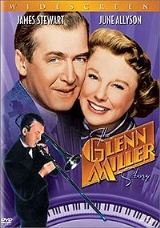
The Glenn Miller Story

Overview
Anthony Mann
Anthony Mann was an American actor and film director, most notably of film noirs and Westerns. As a director, he often collaborated with the cinematographer John Alton and with James Stewart in his Westerns.-Biography:...
and starring James Stewart
James Stewart (actor)
James Maitland Stewart was an American film and stage actor, known for his distinctive voice and his everyman persona. Over the course of his career, he starred in many films widely considered classics and was nominated for five Academy Awards, winning one in competition and receiving one Lifetime...
in their first non-western collaboration.
The film follows big band
Big band
A big band is a type of musical ensemble associated with jazz and the Swing Era typically consisting of rhythm, brass, and woodwind instruments totaling approximately twelve to twenty-five musicians...
leader Glenn Miller
Glenn Miller
Alton Glenn Miller was an American jazz musician , arranger, composer, and bandleader in the swing era. He was one of the best-selling recording artists from 1939 to 1943, leading one of the best known "Big Bands"...
(1904–1944) (James Stewart
James Stewart (actor)
James Maitland Stewart was an American film and stage actor, known for his distinctive voice and his everyman persona. Over the course of his career, he starred in many films widely considered classics and was nominated for five Academy Awards, winning one in competition and receiving one Lifetime...
) from his early days in the music business in 1929 through to his presumed 1944 death when the airplane he was flying in was lost over the English Channel
English Channel
The English Channel , often referred to simply as the Channel, is an arm of the Atlantic Ocean that separates southern England from northern France, and joins the North Sea to the Atlantic. It is about long and varies in width from at its widest to in the Strait of Dover...
during World War II
World War II
World War II, or the Second World War , was a global conflict lasting from 1939 to 1945, involving most of the world's nations—including all of the great powers—eventually forming two opposing military alliances: the Allies and the Axis...
. Prominent placement in the film is given to Miller's courtship and marriage to Helen Burger (June Allyson
June Allyson
June Allyson was an American film and television actress, popular in the 1940s and 1950s. She was a major MGM contract star. Allyson won the Golden Globe Award for Best Actress for her performance in Too Young to Kiss . From 1959–1961, she hosted and occasionally starred in her own CBS anthology...
), and various cameos by actual musicians who were colleagues of Miller.
Several turning points in Miller's career are depicted with varying degrees of verisimilitude, including: the success of an early jazz band
Jazz band
A jazz band is a musical ensemble that plays jazz music. Jazz bands usually consist of a rhythm section and a horn section, in the early days often trumpet, trombone, and clarinet with rhythm section of piano, banjo, bass or tuba, and drums.-Eras:SwingDuring the swing era in the mid-twentieth...
arrangement; his departure from the Broadway
Broadway theatre
Broadway theatre, commonly called simply Broadway, refers to theatrical performances presented in one of the 40 professional theatres with 500 or more seats located in the Theatre District centered along Broadway, and in Lincoln Center, in Manhattan in New York City...
pit and sideman work to front a band of his own; the failure of his first band on the road; and the subsequent reforming of his successful big band and the establishment of the “Miller Sound” as typified by “Moonlight Serenade”.
Unanswered Questions
