


The Fairy-Queen

Encyclopedia
The Fairy-Queen is a masque
or semi-opera
by Henry Purcell
; a "Restoration spectacular
". The libretto
is an anonymous adaptation of William Shakespeare
's wedding comedy A Midsummer Night's Dream
. First performed in 1692, The Fairy-Queen was composed three years before Purcell's death at the age of 35. Following his death, the score was lost and only rediscovered early in the twentieth century.
Purcell did not set any of Shakespeare's
text to music; instead he composed music for short masques in every act but the first. The play itself was also slightly modernised in keeping with seventeenth-century dramatic conventions, but in the main the spoken text is as Shakespeare wrote it. The masques are related to the play metaphorically, rather than literally. Many critics have stated erroneously that they bear no relationship to the play, but recent scholarship has shown that the opera, which ends with a masque featuring Hymen, the God of Marriage, was actually composed for the fifteenth wedding anniversary of William and Mary
.
Growing interest in Baroque music
and the rise of the countertenor
contributed to the work's re-entry into the repertoire. The opera received several full-length recordings in the latter part of the 20th century and several of its arias, including "The Plaint" ("O let me weep"), have become popular recital pieces.
In July 2009, in celebration of the 350th anniversary of Purcell's birth, The Fairy-Queen was performed by Glyndebourne Festival Opera
using a new edition of the score, prepared for The Purcell Society
by Bruce Wood and Andrew Pinnock.
. The author or at least co-author of the libretto
was presumably Thomas Betterton
, the manager of Dorset Garden Theatre, with whom Purcell worked regularly. This belief is based on an analysis of Betterton's stage directions. A collaboration between several playwrights is also feasible. Choreography for the various dances was provided by Josias Priest
, who also worked on Dioclesian
and King Arthur
, and who was associated with Dido and Aeneas
.
A letter describing the original performance shows that the parts of Titania and Oberon
were played by children of eight or nine. Presumably other fairies were also played by children; this affects our perspective on the staging.
(1690) and King Arthur
(1691), Purcell composed The Fairy-Queen in 1692.
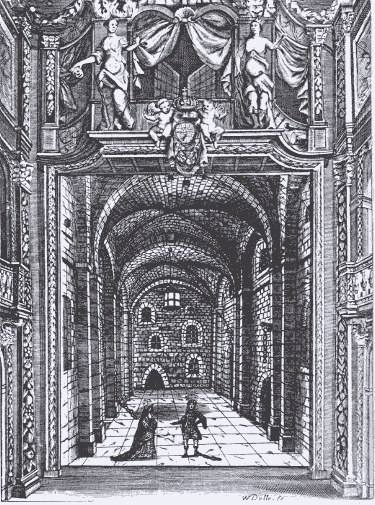
Purcell's "First" and "Second Music" were played while the audience were taking their seats. The "Act Tunes" are played between acts, as the curtain was normally raised at the beginning of a performance and not lowered until the end. After Act I, each act commences with a short symphony
(3–5 minutes).
The English tradition of semi-opera, to which The Fairy-Queen belongs, demanded that most of the music within the play be introduced through the agency of supernatural beings, the exception being pastoral or drunken characters. All the masques in The Fairy-Queen are presented by Titania or Oberon. Originally Act I contained no music, but due to the work's enormous success it was revived in 1693, when Purcell added the scene of the Drunken Poet and two further songs later on in the work; "Ye gentle spirits of the air" and "The Plaint". As said above, each masque is subtly related to the action in the play during that particular act in a metaphorical way. In this manner we have Night and Sleep in Act II, which is apt as that act of the play consists of Oberon's plans to use the power of the "love-in-idleness
" flower to confuse various loves, and it is therefore appropriate for the allegorical figures of Secrecy, Mystery et al. to usher in a night of enchantment. The masque for Bottom in Act III includes metamorphoses, songs of both real and feigned love, and beings who are not what they seem. The Reconciliation masque between Oberon and Titania at the end of Act IV prefigures the final masque. The scene changes to a Garden of Fountains, denoting King William's hobby, just after Oberon says "bless these Lovers' Nuptial Day". The Four Seasons tell us that the marriage here celebrated is a good one all year round and "All Salute the rising Sun"/...The Birthday of King Oberon". The kings of England were traditionally likened to the sun (Oberon = William. Significantly, William and Mary were married on his birthday, 4 November.). The Chinese scene in the final masque is in homage to Queen Mary's famous collection of china. The garden shown above it and the exotic animals bring King William back into the picture and Hymen's song in praise of their marriage, plus the stage direction bringing (Mary's) china vases containing (William's) orange trees to the front of the stage complete the symbolism.
was a great admirer; from it he arranged a suite and in collaboration with Edward Dent arranged the work to form the then new Covent Garden opera company's first postwar production. It shows to excellent effect Purcell's complete mastery of the pungent English style of Baroque counterpoint, as well as displaying his absorption of Italian influences. Several arias such as "The Plaint", "Thrice happy lovers" and "Hark how the echoing air" have entered the discographic repertory of many singers outside their original context.
The orchestra for The Fairy-Queen consists of two recorder
s, two oboe
s, two trumpets, kettledrums, string instruments and harpsichord
continuo
.
. Until the early music revival, the male alto survived mainly in the ecclesiastical tradition of all-male church choirs and twentieth-century American vocal quartets.
However, Purcell's music (and with it The Fairy-Queen) was resuscitated by two related movements: a growing interest in Baroque music and the rise of the countertenor, led by pioneers such as Alfred Deller
and Russell Oberlin
. The former movement led to performances of long-neglected composers such as Purcell, John Dowland
, John Blow
and even George Frideric Handel
, while the latter complemented it by providing a way of making such performances as authentic as possible as regards the original music and the composer's intentions (less true for Handel, where countertenors appear as castrati replacements). This has led to The Fairy-Queen's increased popularity, and numerous recordings have been made, often using period instruments. The format of the work presents problems to modern directors, who must decide whether or not to present Purcell's music as part of the original play, which uncut is rather lengthy. Savage calculated a length of four hours. The decision to curtail the play is usually taken together with the resolution to modernise to such an extent that the cohesion between music, text and action sketched above is entirely lost, a criticism levelled at the English National Opera
's 1995 production directed by David Pountney
. The production was released on video the same year, and revived by the company in 2002.
In July 2009, two months before the 350th anniversary of Purcell's birth, The Fairy-Queen was performed in a new edition, prepared for The Purcell Society by Bruce Wood and Andrew Pinnock, which restored the entire theatrical entertainment as well as the original pitch
used by Purcell. The performance by Glyndebourne Festival Opera
with the Orchestra of the Age of Enlightenment
conducted by William Christie
was repeated later that month at the Royal Albert Hall as part of the BBC Proms.
" means in this context. The record is ambivalent as to whether Purcell (himself a countertenor) used a tenor with a particularly high range (though lighter at the top) and tessitura
(known sometimes as a haute-contre
, the descendants of the contratenors alti of medieval polyphony
) or a falsettist
. It seems that throughout his career he used both. However, purely for reasons of dramatic verisimilitude, it is more likely than not that the travesty
role of Mopsa was taken by a falsettist, and the presence of a duet for two male altos ("Let the fifes and the clarions") makes it seem more probable that for this work falsettists were employed.
For a list of non-singing characters see A Midsummer Night's Dream
, with the exception of Hippolyta. That character was cut by Purcell's librettist.
 For the plot of the play see A Midsummer Night's Dream
. Only a synopsis of scenes provided with music is given here.
poet enters, singing "Fill up the bowl". The stuttering has led many to believe the scene is based on the habits of Thomas d'Urfey
. However, it may also be poking fun at Elkanah Settle
, who stuttered as well and was long thought to be the librettist, due to an error in his 1910 biography.
The fairies mock the drunken poet and drive him away.
to anoint the eyes of Demetrius with the love-juice. Titania and her fairies merrily revel ("Come all ye songsters of the sky"), and Night ("See, even Night"), Mystery ("I am come to lock all fast"), Secrecy ("One charming night") and Sleep ("Hush, no more, be silent all") lull them asleep and leave them to pleasant dreams.
to celebrate Oberon's birthday ("Now the Night", and the abovementioned "Let the fifes and the clarions"), but for the most part it is a masque of the god Phoebus ("When the cruel winter") and the Four Seasons (Spring; "Thus, the ever grateful spring", Summer; "Here's the Summer", Autumn; "See my many coloured fields", and Winter; "Now Winter comes slowly").
, "Thrice happy lovers", followed by a woman who sings the well–known "The Plaint" ("O let me weep"). A Chinese man and woman enter singing several songs about the joys of their world. ("Thus, the gloomy world", "Thus happy and free" and "Yes, Xansi"). Two other Chinese women summon Hymen, who sings in praise of married bliss, thus uniting the wedding theme of A Midsummer Night's Dream, with the celebration of William and Mary's anniversary.
Masque
The masque was a form of festive courtly entertainment which flourished in 16th and early 17th century Europe, though it was developed earlier in Italy, in forms including the intermedio...
or semi-opera
Semi-opera
The terms Semi-opera, dramatic[k] opera and English opera were all applied to Restoration entertainments that combined spoken plays with masque-like episodes employing singing and dancing characters. They usually included machines in the manner of the restoration spectacular...
by Henry Purcell
Henry Purcell
Henry Purcell – 21 November 1695), was an English organist and Baroque composer of secular and sacred music. Although Purcell incorporated Italian and French stylistic elements into his compositions, his legacy was a uniquely English form of Baroque music...
; a "Restoration spectacular
Restoration spectacular
The Restoration spectacular, or elaborately staged "machine play", hit the London public stage in the late 17th-century Restoration period, enthralling audiences with action, music, dance, moveable scenery, baroque illusionistic painting, gorgeous costumes, and special effects such as trapdoor...
". The libretto
Libretto
A libretto is the text used in an extended musical work such as an opera, operetta, masque, oratorio, cantata, or musical. The term "libretto" is also sometimes used to refer to the text of major liturgical works, such as mass, requiem, and sacred cantata, or even the story line of a...
is an anonymous adaptation of William Shakespeare
William Shakespeare
William Shakespeare was an English poet and playwright, widely regarded as the greatest writer in the English language and the world's pre-eminent dramatist. He is often called England's national poet and the "Bard of Avon"...
's wedding comedy A Midsummer Night's Dream
A Midsummer Night's Dream
A Midsummer Night's Dream is a play that was written by William Shakespeare. It is believed to have been written between 1590 and 1596. It portrays the events surrounding the marriage of the Duke of Athens, Theseus, and the Queen of the Amazons, Hippolyta...
. First performed in 1692, The Fairy-Queen was composed three years before Purcell's death at the age of 35. Following his death, the score was lost and only rediscovered early in the twentieth century.
Purcell did not set any of Shakespeare's
William Shakespeare
William Shakespeare was an English poet and playwright, widely regarded as the greatest writer in the English language and the world's pre-eminent dramatist. He is often called England's national poet and the "Bard of Avon"...
text to music; instead he composed music for short masques in every act but the first. The play itself was also slightly modernised in keeping with seventeenth-century dramatic conventions, but in the main the spoken text is as Shakespeare wrote it. The masques are related to the play metaphorically, rather than literally. Many critics have stated erroneously that they bear no relationship to the play, but recent scholarship has shown that the opera, which ends with a masque featuring Hymen, the God of Marriage, was actually composed for the fifteenth wedding anniversary of William and Mary
William and Mary
The phrase William and Mary usually refers to the coregency over the Kingdoms of England, Scotland and Ireland, of King William III & II and Queen Mary II...
.
Growing interest in Baroque music
Baroque music
Baroque music describes a style of Western Classical music approximately extending from 1600 to 1760. This era follows the Renaissance and was followed in turn by the Classical era...
and the rise of the countertenor
Countertenor
A countertenor is a male singing voice whose vocal range is equivalent to that of a contralto, mezzo-soprano, or a soprano, usually through use of falsetto, or far more rarely than normal, modal voice. A pre-pubescent male who has this ability is called a treble...
contributed to the work's re-entry into the repertoire. The opera received several full-length recordings in the latter part of the 20th century and several of its arias, including "The Plaint" ("O let me weep"), have become popular recital pieces.
In July 2009, in celebration of the 350th anniversary of Purcell's birth, The Fairy-Queen was performed by Glyndebourne Festival Opera
Glyndebourne Festival Opera
Glyndebourne Festival Opera is an English opera festival held at Glyndebourne, an English country house near Lewes, in East Sussex, England.-History:...
using a new edition of the score, prepared for The Purcell Society
Purcell Society
The Purcell Society, founded in 1876 is an organization dedicated to making the complete musical works of Henry Purcell available. Between 1876 and 1965, scores of all the known works of Purcell were published, in 32 volumes...
by Bruce Wood and Andrew Pinnock.
Original production
The Fairy-Queen was first performed on 2 May 1692 at the Queen's Theatre, Dorset Garden in London by the United CompanyUnited Company
The United Company was a London theatre company formed in 1682 with the merger of the King's Company and the Duke's Company.Both the Duke's and King's Companies suffered poor attendance during the turmoil of the Popish Plot period, 1678–81...
. The author or at least co-author of the libretto
Libretto
A libretto is the text used in an extended musical work such as an opera, operetta, masque, oratorio, cantata, or musical. The term "libretto" is also sometimes used to refer to the text of major liturgical works, such as mass, requiem, and sacred cantata, or even the story line of a...
was presumably Thomas Betterton
Thomas Betterton
Thomas Patrick Betterton , English actor, son of an under-cook to King Charles I, was born in London.-Apprentice and actor:...
, the manager of Dorset Garden Theatre, with whom Purcell worked regularly. This belief is based on an analysis of Betterton's stage directions. A collaboration between several playwrights is also feasible. Choreography for the various dances was provided by Josias Priest
Josias Priest
Josias Priest was an English dancer, dancing-master and choreographer.- History :In 1669, he was arrested along with four others for dancing and making music without a license. In 1668, he was a dancing-master in Holborn, and in 1675 he moved to Leicester Fields to run a boarding school for...
, who also worked on Dioclesian
Dioclesian
Dioclesian is a tragicomic semi-opera in five acts by Henry Purcell to a libretto by Thomas Betterton based on the play The Prophetess, by John Fletcher and Philip Massinger, which in turn was based very loosely on the life of the Emperor Diocletian. It was premiered in late May 1690 at the...
and King Arthur
King Arthur (opera)
King Arthur or, The British Worthy , is a semi-opera in five acts with music by Henry Purcell and alibretto by John Dryden. It was first performed at the Queen's Theatre, Dorset Garden, London, in late May or early June 1691....
, and who was associated with Dido and Aeneas
Dido and Aeneas
Dido and Aeneas is an opera in a prologue and three acts by the English Baroque composer Henry Purcell to a libretto by Nahum Tate. The first known performance was at Josias Priest's girls' school in London no later than the summer of 1688. The story is based on Book IV of Virgil's Aeneid...
.
A letter describing the original performance shows that the parts of Titania and Oberon
Oberon
Oberon is a legendary king of the fairies.Oberon may also refer to:-People:* Merle Oberon , British actress* Oberon Zell-Ravenheart , Neopagan activist-Media and entertainment:* Oberon...
were played by children of eight or nine. Presumably other fairies were also played by children; this affects our perspective on the staging.
Context and analysis
Following the huge success of his operas DioclesianDioclesian
Dioclesian is a tragicomic semi-opera in five acts by Henry Purcell to a libretto by Thomas Betterton based on the play The Prophetess, by John Fletcher and Philip Massinger, which in turn was based very loosely on the life of the Emperor Diocletian. It was premiered in late May 1690 at the...
(1690) and King Arthur
King Arthur (opera)
King Arthur or, The British Worthy , is a semi-opera in five acts with music by Henry Purcell and alibretto by John Dryden. It was first performed at the Queen's Theatre, Dorset Garden, London, in late May or early June 1691....
(1691), Purcell composed The Fairy-Queen in 1692.
Purcell's "First" and "Second Music" were played while the audience were taking their seats. The "Act Tunes" are played between acts, as the curtain was normally raised at the beginning of a performance and not lowered until the end. After Act I, each act commences with a short symphony
Symphony
A symphony is an extended musical composition in Western classical music, scored almost always for orchestra. A symphony usually contains at least one movement or episode composed according to the sonata principle...
(3–5 minutes).
The English tradition of semi-opera, to which The Fairy-Queen belongs, demanded that most of the music within the play be introduced through the agency of supernatural beings, the exception being pastoral or drunken characters. All the masques in The Fairy-Queen are presented by Titania or Oberon. Originally Act I contained no music, but due to the work's enormous success it was revived in 1693, when Purcell added the scene of the Drunken Poet and two further songs later on in the work; "Ye gentle spirits of the air" and "The Plaint". As said above, each masque is subtly related to the action in the play during that particular act in a metaphorical way. In this manner we have Night and Sleep in Act II, which is apt as that act of the play consists of Oberon's plans to use the power of the "love-in-idleness
Heartsease
Viola tricolor, known as Heartsease, is a common European wild flower, growing as an annual or short-lived perennial. It has been introduced into North America, where it has spread widely, and is known as the Johnny Jump Up...
" flower to confuse various loves, and it is therefore appropriate for the allegorical figures of Secrecy, Mystery et al. to usher in a night of enchantment. The masque for Bottom in Act III includes metamorphoses, songs of both real and feigned love, and beings who are not what they seem. The Reconciliation masque between Oberon and Titania at the end of Act IV prefigures the final masque. The scene changes to a Garden of Fountains, denoting King William's hobby, just after Oberon says "bless these Lovers' Nuptial Day". The Four Seasons tell us that the marriage here celebrated is a good one all year round and "All Salute the rising Sun"/...The Birthday of King Oberon". The kings of England were traditionally likened to the sun (Oberon = William. Significantly, William and Mary were married on his birthday, 4 November.). The Chinese scene in the final masque is in homage to Queen Mary's famous collection of china. The garden shown above it and the exotic animals bring King William back into the picture and Hymen's song in praise of their marriage, plus the stage direction bringing (Mary's) china vases containing (William's) orange trees to the front of the stage complete the symbolism.
The music
Written as he approached the end of his brief career, The Fairy-Queen contains some of Purcell's finest theatre music, as musicologists have agreed for generations. In particular, Constant LambertConstant Lambert
Leonard Constant Lambert was a British composer and conductor.-Early life:Lambert, the son of Russian-born Australian painter George Lambert, was educated at Christ's Hospital and the Royal College of Music...
was a great admirer; from it he arranged a suite and in collaboration with Edward Dent arranged the work to form the then new Covent Garden opera company's first postwar production. It shows to excellent effect Purcell's complete mastery of the pungent English style of Baroque counterpoint, as well as displaying his absorption of Italian influences. Several arias such as "The Plaint", "Thrice happy lovers" and "Hark how the echoing air" have entered the discographic repertory of many singers outside their original context.
The orchestra for The Fairy-Queen consists of two recorder
Recorder
The recorder is a woodwind musical instrument of the family known as fipple flutes or internal duct flutes—whistle-like instruments which include the tin whistle. The recorder is end-blown and the mouth of the instrument is constricted by a wooden plug, known as a block or fipple...
s, two oboe
Oboe
The oboe is a double reed musical instrument of the woodwind family. In English, prior to 1770, the instrument was called "hautbois" , "hoboy", or "French hoboy". The spelling "oboe" was adopted into English ca...
s, two trumpets, kettledrums, string instruments and harpsichord
Harpsichord
A harpsichord is a musical instrument played by means of a keyboard. It produces sound by plucking a string when a key is pressed.In the narrow sense, "harpsichord" designates only the large wing-shaped instruments in which the strings are perpendicular to the keyboard...
continuo
Figured bass
Figured bass, or thoroughbass, is a kind of integer musical notation used to indicate intervals, chords, and non-chord tones, in relation to a bass note...
.
Performance history
Following Purcell's premature death, his opera Dioclesian remained popular until well into the eighteenth century, but the score of The Fairy-Queen was lost and only rediscovered early in the twentieth century. Other works like it fell into obscurity. Changing tastes were not the only reason for this; the voices employed had also become difficult to find. The list of singers below shows the frequent employment of the male alto, or countertenor, in the semi-opera, a voice which, after Purcell, essentially vanished from the stage, probably due to the rise of Italian opera and the attendant castrati. After that Romantic opera emerged, with the attendant predominance of the tenorTenor
The tenor is a type of male singing voice and is the highest male voice within the modal register. The typical tenor voice lies between C3, the C one octave below middle C, to the A above middle C in choral music, and up to high C in solo work. The low extreme for tenors is roughly B2...
. Until the early music revival, the male alto survived mainly in the ecclesiastical tradition of all-male church choirs and twentieth-century American vocal quartets.
However, Purcell's music (and with it The Fairy-Queen) was resuscitated by two related movements: a growing interest in Baroque music and the rise of the countertenor, led by pioneers such as Alfred Deller
Alfred Deller
Alfred George Deller CBE , was an English singer and one of the main figures in popularizing the return of the countertenor voice in Renaissance and Baroque music during the 20th Century....
and Russell Oberlin
Russell Oberlin
Russell Oberlin is an American countertenor who was a founding member of the New York Pro Musica Antiqua ensemble....
. The former movement led to performances of long-neglected composers such as Purcell, John Dowland
John Dowland
John Dowland was an English Renaissance composer, singer, and lutenist. He is best known today for his melancholy songs such as "Come, heavy sleep" , "Come again", "Flow my tears", "I saw my Lady weepe" and "In darkness let me dwell", but his instrumental music has undergone a major revival, and has...
, John Blow
John Blow
John Blow was an English Baroque composer and organist, appointed to Westminster Abbey in 1669. His pupils included William Croft, Jeremiah Clarke and Henry Purcell. In 1685 he was named a private musician to James II. His only stage composition, Venus and Adonis John Blow (baptised 23 February...
and even George Frideric Handel
George Frideric Handel
George Frideric Handel was a German-British Baroque composer, famous for his operas, oratorios, anthems and organ concertos. Handel was born in 1685, in a family indifferent to music...
, while the latter complemented it by providing a way of making such performances as authentic as possible as regards the original music and the composer's intentions (less true for Handel, where countertenors appear as castrati replacements). This has led to The Fairy-Queen's increased popularity, and numerous recordings have been made, often using period instruments. The format of the work presents problems to modern directors, who must decide whether or not to present Purcell's music as part of the original play, which uncut is rather lengthy. Savage calculated a length of four hours. The decision to curtail the play is usually taken together with the resolution to modernise to such an extent that the cohesion between music, text and action sketched above is entirely lost, a criticism levelled at the English National Opera
English National Opera
English National Opera is an opera company based in London, resident at the London Coliseum in St. Martin's Lane. It is one of the two principal opera companies in London, along with the Royal Opera, Covent Garden...
's 1995 production directed by David Pountney
David Pountney
David Pountney is a British theatre and opera director and librettist internationally known for his productions of rarely performed operas and new productions of classic works...
. The production was released on video the same year, and revived by the company in 2002.
In July 2009, two months before the 350th anniversary of Purcell's birth, The Fairy-Queen was performed in a new edition, prepared for The Purcell Society by Bruce Wood and Andrew Pinnock, which restored the entire theatrical entertainment as well as the original pitch
Pitch (music)
Pitch is an auditory perceptual property that allows the ordering of sounds on a frequency-related scale.Pitches are compared as "higher" and "lower" in the sense associated with musical melodies,...
used by Purcell. The performance by Glyndebourne Festival Opera
Glyndebourne Festival Opera
Glyndebourne Festival Opera is an English opera festival held at Glyndebourne, an English country house near Lewes, in East Sussex, England.-History:...
with the Orchestra of the Age of Enlightenment
Orchestra of the Age of Enlightenment
The Orchestra of the Age of Enlightenment is a British period instrument orchestra. The OAE is a resident orchestra of the Southbank Centre, London, associate orchestra at Glyndebourne Festival Opera and has its headquarters at Kings Place...
conducted by William Christie
William Christie (musician)
William Lincoln Christie is an American-born French conductor and harpsichordist. He is noted as a specialist in baroque repertoire and as the founder of the ensemble Les Arts Florissants....
was repeated later that month at the Royal Albert Hall as part of the BBC Proms.
Roles
The role of Mopsa was originally performed by a soprano; however, a later revision by Purcell stated that it was to be performed by "Mr. Pate in woman's habit", presumably to have a grotesque effect and highlight the refrain "No, no, no, no, no; no kissing at all" in the dialogue between Corydon and Mopsa. Also, it is not entirely clear what the word "countertenorCountertenor
A countertenor is a male singing voice whose vocal range is equivalent to that of a contralto, mezzo-soprano, or a soprano, usually through use of falsetto, or far more rarely than normal, modal voice. A pre-pubescent male who has this ability is called a treble...
" means in this context. The record is ambivalent as to whether Purcell (himself a countertenor) used a tenor with a particularly high range (though lighter at the top) and tessitura
Tessitura
In music, the term tessitura generally describes the most musically acceptable and comfortable range for a given singer or, less frequently, musical instrument; the range in which a given type of voice presents its best-sounding texture or timbre...
(known sometimes as a haute-contre
Haute-contre
The haute-contre is a rare type of high tenor voice, predominant in French Baroque and Classical opera until the latter part of the eighteenth century.-History:...
, the descendants of the contratenors alti of medieval polyphony
Polyphony
In music, polyphony is a texture consisting of two or more independent melodic voices, as opposed to music with just one voice or music with one dominant melodic voice accompanied by chords ....
) or a falsettist
Falsetto
Falsetto is the vocal register occupying the frequency range just above the modal voice register and overlapping with it by approximately one octave. It is produced by the vibration of the ligamentous edges of the vocal folds, in whole or in part...
. It seems that throughout his career he used both. However, purely for reasons of dramatic verisimilitude, it is more likely than not that the travesty
En travesti
Travesti is a theatrical term referring to the portrayal of a character in an opera, play, or ballet by a performer of the opposite sex. Some sources regard 'travesti' as an Italian term, some as French. Depending on sources, the term may be given as travesty, travesti, or en travesti...
role of Mopsa was taken by a falsettist, and the presence of a duet for two male altos ("Let the fifes and the clarions") makes it seem more probable that for this work falsettists were employed.
For a list of non-singing characters see A Midsummer Night's Dream
A Midsummer Night's Dream
A Midsummer Night's Dream is a play that was written by William Shakespeare. It is believed to have been written between 1590 and 1596. It portrays the events surrounding the marriage of the Duke of Athens, Theseus, and the Queen of the Amazons, Hippolyta...
, with the exception of Hippolyta. That character was cut by Purcell's librettist.
| Role | Voice type | Premiere cast, 2 May 1692 (Conductor: ) |
|---|---|---|
| Drunken Poet | bass Bass (voice type) A bass is a type of male singing voice and possesses the lowest vocal range of all voice types. According to The New Grove Dictionary of Opera, a bass is typically classified as having a range extending from around the second E below middle C to the E above middle C... |
|
| First Fairy | soprano Soprano A soprano is a voice type with a vocal range from approximately middle C to "high A" in choral music, or to "soprano C" or higher in operatic music. In four-part chorale style harmony, the soprano takes the highest part, which usually encompasses the melody... |
|
| Second Fairy | soprano | |
| Night | soprano | |
| Mystery | soprano | |
| Secrecy | countertenor Countertenor A countertenor is a male singing voice whose vocal range is equivalent to that of a contralto, mezzo-soprano, or a soprano, usually through use of falsetto, or far more rarely than normal, modal voice. A pre-pubescent male who has this ability is called a treble... |
|
| Sleep | bass | |
| Corydon Corydon (character) Corydon is a stock name for a shepherd in ancient Greek pastoral poems and fables, such as the one in Idyll 4 of the Syracusan poet Theocritus . The name was also used by the Latin poets Siculus and, more significantly, Virgil... |
bass | |
| Mopsa | soprano Soprano A soprano is a voice type with a vocal range from approximately middle C to "high A" in choral music, or to "soprano C" or higher in operatic music. In four-part chorale style harmony, the soprano takes the highest part, which usually encompasses the melody... /countertenor |
|
| Nymph Nymph A nymph in Greek mythology is a female minor nature deity typically associated with a particular location or landform. Different from gods, nymphs are generally regarded as divine spirits who animate nature, and are usually depicted as beautiful, young nubile maidens who love to dance and sing;... |
soprano | |
| 3 Attendants to Oberon | 1 soprano, 2 countertenors | |
| Phoebus | tenor Tenor The tenor is a type of male singing voice and is the highest male voice within the modal register. The typical tenor voice lies between C3, the C one octave below middle C, to the A above middle C in choral music, and up to high C in solo work. The low extreme for tenors is roughly B2... |
|
| Spring | soprano | |
| Summer | countertenor | |
| Autumn | tenor | |
| Winter | bass | |
| Juno Juno (mythology) Juno is an ancient Roman goddess, the protector and special counselor of the state. She is a daughter of Saturn and sister of the chief god Jupiter and the mother of Mars and Vulcan. Juno also looked after the women of Rome. Her Greek equivalent is Hera... |
soprano | |
| Chinese Man | countertenor | |
| Chinese Woman, Daphne Daphne Daphne was a female minor nature deity. Pursued by Apollo, she fled and was chased. Daphne begged the gods for help, who then transformed her into Laurel.-Overview:... |
soprano | |
| Hymen | bass | |
| Chorus: Fairies and Attendants. | ||
Synopsis
A Midsummer Night's Dream
A Midsummer Night's Dream is a play that was written by William Shakespeare. It is believed to have been written between 1590 and 1596. It portrays the events surrounding the marriage of the Duke of Athens, Theseus, and the Queen of the Amazons, Hippolyta...
. Only a synopsis of scenes provided with music is given here.
Act 1
The first scene set to music occurs after Titania has left Oberon, following an argument over the ownership of a little Indian boy. Two of her fairies sing of the delights of the countryside ("Come, come, come, come, let us leave the town"). A drunken, stutteringStuttering
Stuttering , also known as stammering , is a speech disorder in which the flow of speech is disrupted by involuntary repetitions and prolongations of sounds, syllables, words or phrases, and involuntary silent pauses or blocks in which the stutterer is unable to produce sounds...
poet enters, singing "Fill up the bowl". The stuttering has led many to believe the scene is based on the habits of Thomas d'Urfey
Thomas d'Urfey
Thomas D'Urfey was an English writer and wit. He composed plays, songs, and poetry, in addition to writing jokes. He was an important innovator and contributor in the evolution of the Ballad opera....
. However, it may also be poking fun at Elkanah Settle
Elkanah Settle
Elkanah Settle was an English poet and playwright.He was born at Dunstable, and entered Trinity College, Oxford, in 1666, but left without taking a degree. His first tragedy, Cambyses, King of Persia, was produced at Lincoln's Inn Fields in 1667...
, who stuttered as well and was long thought to be the librettist, due to an error in his 1910 biography.
The fairies mock the drunken poet and drive him away.
Act 2
It begins after Oberon has ordered PuckPuck (Shakespeare)
Puck, also known as Robin Goodfellow, is a character in William Shakespeare's play A Midsummer Night's Dream that was based on the ancient figure in English mythology, also called Puck. Puck is a clever and mischievous elf and personifies the trickster or the wise knave...
to anoint the eyes of Demetrius with the love-juice. Titania and her fairies merrily revel ("Come all ye songsters of the sky"), and Night ("See, even Night"), Mystery ("I am come to lock all fast"), Secrecy ("One charming night") and Sleep ("Hush, no more, be silent all") lull them asleep and leave them to pleasant dreams.
Act 3
Titania has fallen in love with Bottom (now equipped with his ass' head), much to Oberon's gratification. A Nymph sings of the pleasures and torments of love ("If love's a sweet passion") and after several dances, Titania and Bottom are entertained by the foolish, loving banter of two haymakers, Corydon and Mopsa.Act 4
It begins after Titania has been freed from her enchantment, commencing with a brief divertissementDivertissement
Divertissement is used, in a similar sense to the Italian 'divertimento', for a light piece of music for a small group of players, however the French term has additional meanings....
to celebrate Oberon's birthday ("Now the Night", and the abovementioned "Let the fifes and the clarions"), but for the most part it is a masque of the god Phoebus ("When the cruel winter") and the Four Seasons (Spring; "Thus, the ever grateful spring", Summer; "Here's the Summer", Autumn; "See my many coloured fields", and Winter; "Now Winter comes slowly").
Act 5
After Theseus has been told of the lovers's adventures in the wood, it begins with the goddess Juno singing an epithalamiumEpithalamium
Epithalamium refers to a form of poem that is written specifically for the bride on the way to her marital chamber...
, "Thrice happy lovers", followed by a woman who sings the well–known "The Plaint" ("O let me weep"). A Chinese man and woman enter singing several songs about the joys of their world. ("Thus, the gloomy world", "Thus happy and free" and "Yes, Xansi"). Two other Chinese women summon Hymen, who sings in praise of married bliss, thus uniting the wedding theme of A Midsummer Night's Dream, with the celebration of William and Mary's anniversary.
Recordings
- Alfred DellerAlfred DellerAlfred George Deller CBE , was an English singer and one of the main figures in popularizing the return of the countertenor voice in Renaissance and Baroque music during the 20th Century....
, The Deller Consort, Stour Music Chorus (2 CDs) — (1972) — Harmonia MundiHarmonia MundiHarmonia Mundi is an independent music record label founded in 1958 by Bernard Coutaz in Arles . The Latin phrase means "world harmony".... - John Eliot GardinerJohn Eliot GardinerSir John Eliot Gardiner CBE FKC is an English conductor. He founded the Monteverdi Choir , the English Baroque Soloists and the Orchestre Révolutionnaire et Romantique...
, The English Baroque SoloistsEnglish Baroque SoloistsThe English Baroque Soloists is a chamber orchestra playing on period instruments, formed in 1978 by English conductor Sir John Eliot Gardiner. Its repertoire comprises music from the early Baroque period to the Classical period...
The Monteverdi ChoirMonteverdi ChoirThe Monteverdi Choir was founded in 1964 by Sir John Eliot Gardiner for a performance of the Monteverdi Vespers in King's College Chapel, Cambridge. A specialist Baroque ensemble, the Choir has become famous for its stylistic conviction and extensive repertoire, encompassing music from the early...
, (2 CDs) — 1982 — Archiv ProduktionArchiv ProduktionArchiv Produktion is a subsidiary label of Deutsche Grammophon founded in 1948.The first head of Archiv from 1948–1957, was Fred Hamel, a musicologist who set out the early Archiv releases according to 12 research periods from 1. Gregorian Chant to 12. Mannheim and Vienna...
419 221–2 - William ChristieWilliam Christie (musician)William Lincoln Christie is an American-born French conductor and harpsichordist. He is noted as a specialist in baroque repertoire and as the founder of the ensemble Les Arts Florissants....
, Les Arts FlorissantsLes Arts Florissants (ensemble)Les Arts Florissants is a Baroque musical ensemble in residence at the Théâtre de Caen in Caen, France. The organization was founded by conductor William Christie in 1979. The ensemble derives its name from the 1685 opera by Marc-Antoine Charpentier. The organization consists of a chamber orchestra...
(2 CDs) — 1989 — Harmonia MundiHarmonia MundiHarmonia Mundi is an independent music record label founded in 1958 by Bernard Coutaz in Arles . The Latin phrase means "world harmony"....
HMC 90 1308/0 - Roger NorringtonRoger NorringtonSir Roger Arthur Carver Norrington, CBE is a British conductor. He is the son of Sir Arthur Norrington and his brother is Humphrey Thomas Norrington....
, The London Classical PlayersLondon Classical PlayersThe London Classical Players was a British orchestra that specialized in music following historically informed performance practices and orchestral performances on period musical instruments. Sir Roger Norrington founded the LCP in 1978. From 1978 to 1992, the concertmaster of the London...
, The Schütz Choir of London (2 CDs) — 1994 — EMI ClassicsEMIThe EMI Group, also known as EMI Music or simply EMI, is a multinational music company headquartered in London, United Kingdom. It is the fourth-largest business group and family of record labels in the recording industry and one of the "big four" record companies. EMI Group also has a major...
7243 5 55234 2 6 - Ton KoopmanTon KoopmanTon Koopman is a conductor, organist and harpsichordist.Koopman had a "classical education" and then studied the organ , harpsichord and musicology in Amsterdam...
, Amsterdam Baroque Orchestra & ChoirAmsterdam Baroque Orchestra & ChoirThe Amsterdam Baroque Orchestra & Choir is a Dutch early-music group based in Amsterdam.The Amsterdam Baroque Orchestra & Choir was created in two stages by the conductor, organist and harpsichordist Ton Koopman. He founded the Amsterdam Baroque Orchestra in 1979 and the Amsterdam Baroque Choir in...
, (2 CDs) — 1994 — Erato 98507 - Nikolaus HarnoncourtNikolaus HarnoncourtNikolaus Harnoncourt is an Austrian conductor, particularly known for his historically informed performances of music from the Classical era and earlier. Starting out as a classical cellist, he founded his own period instrument ensemble in the 1950s, and became a pioneer of the Early Music movement...
, Concentus Musicus WienConcentus Musicus WienConcentus Musicus Wien is a baroque music ensemble founded by Nikolaus and Alice Harnoncourt in 1953. It generated the now well-established movement in performance and recordings to play early music on period instruments....
, Arnold Schoenberg Chor (2 CDs) — 1995 — Teldec ClassicsTeldecThe Teldec is a German record label in Hamburg, Germany. Today the label is a property of Warner Music Group.-History:...
4509-97684-2
See also
- List of compositions by Henry Purcell
- A Midsummer Night's DreamA Midsummer Night's Dream (opera)A Midsummer Night's Dream is an opera with music by Benjamin Britten and set to a libretto adapted by the composer and Peter Pears from William Shakespeare's play, A Midsummer Night's Dream...
(opera by Britten)
External links
- The libretto
- A facsimile of the libretto on Early English Books Online (login required)
- Purcell: The Fairy Queen, The Prophetess / Savall, Et Al. http://www.classicalacarte.net/Fiches/9866.htm