


Thatcher effect

Encyclopedia
Face
The face is a central sense organ complex, for those animals that have one, normally on the ventral surface of the head, and can, depending on the definition in the human case, include the hair, forehead, eyebrow, eyelashes, eyes, nose, ears, cheeks, mouth, lips, philtrum, temple, teeth, skin, and...
, despite identical changes being obvious in an upright face. It is named after British
United Kingdom
The United Kingdom of Great Britain and Northern IrelandIn the United Kingdom and Dependencies, other languages have been officially recognised as legitimate autochthonous languages under the European Charter for Regional or Minority Languages...
former Prime Minister
Prime minister
A prime minister is the most senior minister of cabinet in the executive branch of government in a parliamentary system. In many systems, the prime minister selects and may dismiss other members of the cabinet, and allocates posts to members within the government. In most systems, the prime...
Margaret Thatcher
Margaret Thatcher
Margaret Hilda Thatcher, Baroness Thatcher, was Prime Minister of the United Kingdom from 1979 to 1990...
on whose photograph the effect has been most famously demonstrated. This was originally created by Peter Thompson, (Thompson, 1980).
Overview
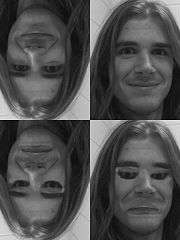
The effect is illustrated by two originally identical photos, which are inverted. The second picture is obviously altered so that the eyes and mouth are vertically flipped, though the changes are not immediately obvious until the image is viewed in normal orientation.This is thought to be due to specific psychological processes involved in face perception
Face perception
Face perception is the process by which the brain and mind understand and interpret the face, particularly the human face.The human face's proportions and expressions are important to identify origin, emotional tendencies, health qualities, and some social information. From birth, faces are...
which are tuned especially to upright faces. Faces seem unique despite the fact that they are very similar. It has been hypothesised that we develop specific processes to differentiate between faces that rely as much on the configuration (the structural relationship between individual features on the face) as the details of individual face features, such as the eye
Human eye
The human eye is an organ which reacts to light for several purposes. As a conscious sense organ, the eye allows vision. Rod and cone cells in the retina allow conscious light perception and vision including color differentiation and the perception of depth...
s, nose
Human nose
The visible part of the human nose is the protruding part of the face that bears the nostrils. The shape of the nose is determined by the ethmoid bone and the nasal septum, which consists mostly of cartilage and which separates the nostrils...
and mouth
Mouth
The mouth is the first portion of the alimentary canal that receives food andsaliva. The oral mucosa is the mucous membrane epithelium lining the inside of the mouth....
. When a face is upside down, the configural processing cannot take place, and so minor differences are more difficult to detect.
This effect is not present in people who have some forms of prosopagnosia
Prosopagnosia
Prosopagnosia is a disorder of face perception where the ability to recognize faces is impaired, while the ability to recognize other objects may be relatively intact...
, a disorder where face processing is impaired, usually acquired after brain injury or illness. This suggests that their specific brain injury may damage the process that analyses facial structures.
Rhesus monkeys also show the Thatcher effect (Adachi, et al., 2009), raising the possibility that some brain mechanisms involved in processing faces may have evolved in a common ancestor 30+ million years ago.
Original article
Recognition times
- Carbon, C. C., & Leder, H. (2005). When feature information comes first! Early processing of inverted faces. Perception, 34(9), 1117-1134.
- Sjoberg, W., & Windes, J. D. (1992). Recognition times for rotated normal and 'Thatcher' faces. Perceptual and Motor Skills, 75(3, Pt 2), 1176-1178.
- Stuerzel, F., & Spillmann, L. (2000). Thatcher illusion: dependence on angle of rotation. Perception, 29(8), 937-942.
Developmental aspects
- Lewis, M. B. (2003). Thatcher's children: Development and the Thatcher illusion. Perception, 32(12), 1415-1421.
- Rouse, H., Donnelly, N., Hadwin, J. A., & Brown, T. (2004). Do children with autism perceive second-order relational features? The case of the Thatcher illusion. J Child Psychol Psychiatry, 45(7), 1246-1257.
Prosopagnosia
- Carbon, C. C., Grüter, T., Weber, J. E., & Lueschow, A. (2007). Faces as objects of non-expertise: Processing of Thatcherised faces in congenital prosopagnosia. Perception, 36(11), 1635-1645.
EEG
- Carbon, C. C., Schweinberger, S. R., Kaufmann, J. M., & Leder, H. (2005). The Thatcher Illusion seen by the brain: An event-related brain potentials study. Cognitive Brain Research, 24(3), 544-555.
Evidence from nonhuman species
- Adachi, I., Chou, D.P., Hampton, R.R., Thatcher Effect in Monkeys Demonstrates Conservation of Face Perception across Primates, Current Biology (2009), doi:10.1016/j.cub.2009.05.067.