

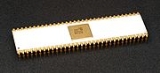
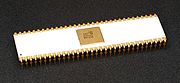
Texas Instruments TMS9900

Encyclopedia
Texas Instruments
Texas Instruments Inc. , widely known as TI, is an American company based in Dallas, Texas, United States, which develops and commercializes semiconductor and computer technology...
990
TI-990
The TI-990 was a series of 16-bit minicomputers sold by Texas Instruments in the 1970s and 1980s. The TI-990 was a replacement for TI's earlier minicomputer systems, the TI-960 and the TI-980...
minicomputer
Minicomputer
A minicomputer is a class of multi-user computers that lies in the middle range of the computing spectrum, in between the largest multi-user systems and the smallest single-user systems...
CPU
Central processing unit
The central processing unit is the portion of a computer system that carries out the instructions of a computer program, to perform the basic arithmetical, logical, and input/output operations of the system. The CPU plays a role somewhat analogous to the brain in the computer. The term has been in...
, the TMS9900 was one of the first true 16-bit
16-bit
-16-bit architecture:The HP BPC, introduced in 1975, was the world's first 16-bit microprocessor. Prominent 16-bit processors include the PDP-11, Intel 8086, Intel 80286 and the WDC 65C816. The Intel 8088 was program-compatible with the Intel 8086, and was 16-bit in that its registers were 16...
microprocessor
Microprocessor
A microprocessor incorporates the functions of a computer's central processing unit on a single integrated circuit, or at most a few integrated circuits. It is a multipurpose, programmable device that accepts digital data as input, processes it according to instructions stored in its memory, and...
s (the first were probably National Semiconductor
National Semiconductor
National Semiconductor was an American semiconductor manufacturer, that specialized in analog devices and subsystems,formerly headquartered in Santa Clara, California, USA. The products of National Semiconductor included power management circuits, display drivers, audio and operational amplifiers,...
IMP-16
IMP-16
The IMP-16, by National Semiconductor, was the first multi-chip 16-bit microprocessor. It consisted of five PMOS integrated circuits: four four-bit RALU chips providing the data path, and one CROM providing control sequencing and microcode storage.The IMP-16 provided four 16-bit accumulators,...
or AMD-2901
AMD Am2900
Am2900 is a family of integrated circuits created in 1975 by Advanced Micro Devices . They were constructed with bipolar devices, in a bit-slice topology, and were designed to be used as modular components each representing a different aspect of a computer control unit...
bit slice processor
Bit slicing
Bit slicing is a technique for constructing a processor from modules of smaller bit width. Each of these components processes one bit field or "slice" of an operand...
s in 16-bit configuration). It was designed as a single chip version of the TI 990
TI-990
The TI-990 was a series of 16-bit minicomputers sold by Texas Instruments in the 1970s and 1980s. The TI-990 was a replacement for TI's earlier minicomputer systems, the TI-960 and the TI-980...
minicomputer
Minicomputer
A minicomputer is a class of multi-user computers that lies in the middle range of the computing spectrum, in between the largest multi-user systems and the smallest single-user systems...
series, much like the Intersil 6100
Intersil 6100
The Intersil 6100 family consisted of a 12-bit microprocessor and a range of peripheral support and memory ICs developed in the mid-1970s.The microprocessor recognised the PDP-8 instruction set....
was a single chip PDP-8
PDP-8
The 12-bit PDP-8 was the first successful commercial minicomputer, produced by Digital Equipment Corporation in the 1960s. DEC introduced it on 22 March 1965, and sold more than 50,000 systems, the most of any computer up to that date. It was the first widely sold computer in the DEC PDP series of...
, and the Fairchild
Fairchild Semiconductor
Fairchild Semiconductor International, Inc. is an American semiconductor company based in San Jose, California. Founded in 1957, it was a pioneer in transistor and integrated circuit manufacturing...
9440 and Data General
Data General
Data General was one of the first minicomputer firms from the late 1960s. Three of the four founders were former employees of Digital Equipment Corporation. Their first product, the Data General Nova, was a 16-bit minicomputer...
mN601 were both one chip versions of Data General
Data General
Data General was one of the first minicomputer firms from the late 1960s. Three of the four founders were former employees of Digital Equipment Corporation. Their first product, the Data General Nova, was a 16-bit minicomputer...
's Nova
Data General Nova
The Data General Nova was a popular 16-bit minicomputer built by the American company Data General starting in 1969. The Nova was packaged into a single rack mount case and had enough power to do most simple computing tasks. The Nova became popular in science laboratories around the world, and...
. It had a 15-bit address bus
Address bus
An address bus is a computer bus that is used to specify a physical address. When a processor or DMA-enabled device needs to read or write to a memory location, it specifies that memory location on the address bus...
, a 16-bit data bus
Computer bus
In computer architecture, a bus is a subsystem that transfers data between components inside a computer, or between computers.Early computer buses were literally parallel electrical wires with multiple connections, but the term is now used for any physical arrangement that provides the same...
, and three internal 16-bit register
Processor register
In computer architecture, a processor register is a small amount of storage available as part of a CPU or other digital processor. Such registers are addressed by mechanisms other than main memory and can be accessed more quickly...
s (PC
Program counter
The program counter , commonly called the instruction pointer in Intel x86 microprocessors, and sometimes called the instruction address register, or just part of the instruction sequencer in some computers, is a processor register that indicates where the computer is in its instruction sequence...
, WP, and ST
Status register
A status register or flag register is a collection of flag bits for a processor. An example is the FLAGS register of the x86 architecture....
). One unique feature, though, was that all general purpose user registers were actually kept in external memory. A single workspace register (WP) pointed to the 16 register set (each register being 16 bits wide) in RAM, so when a subroutine
Subroutine
In computer science, a subroutine is a portion of code within a larger program that performs a specific task and is relatively independent of the remaining code....
was entered or an interrupt
Interrupt
In computing, an interrupt is an asynchronous signal indicating the need for attention or a synchronous event in software indicating the need for a change in execution....
was processed, only the single workspace register had to be changed — unlike some CPUs which required dozens or more register saves before acknowledging a context switch
Context switch
A context switch is the computing process of storing and restoring the state of a CPU so that execution can be resumed from the same point at a later time. This enables multiple processes to share a single CPU. The context switch is an essential feature of a multitasking operating system...
.
This was feasible at the time because RAM was often faster than the CPUs
Central processing unit
The central processing unit is the portion of a computer system that carries out the instructions of a computer program, to perform the basic arithmetical, logical, and input/output operations of the system. The CPU plays a role somewhat analogous to the brain in the computer. The term has been in...
. A few modern designs—such as the INMOS
INMOS
Inmos Limited was a British semiconductor company, founded by Iann Barron, with both the head office and the design office at Aztec West in Bristol, it was incorporated in November 1978.- Products :...
Transputers—use this same design using caches or rotating buffers, for the same reason of improved context switches. Other chips of the time—such as the 65xx series—had a similar philosophy, using index registers, but the TMS9900 went the farthest in this direction.
Processor register
In computer architecture, a processor register is a small amount of storage available as part of a CPU or other digital processor. Such registers are addressed by mechanisms other than main memory and can be accessed more quickly...
s could be indexed
Index (information technology)
In computer science, an index can be:# an integer that identifies an array element# a data structure that enables sublinear-time lookup -Array element identifier:...
although it should be remembered these registers were actually in memory (RAM
Ram
-Animals:*Ram, an uncastrated male sheep*Ram cichlid, a species of freshwater fish endemic to Colombia and Venezuela-Military:*Battering ram*Ramming, a military tactic in which one vehicle runs into another...
). This was in contrast to most other CPUs of its time.
The TMS9900 processor's instruction set was big endian
Endianness
In computing, the term endian or endianness refers to the ordering of individually addressable sub-components within the representation of a larger data item as stored in external memory . Each sub-component in the representation has a unique degree of significance, like the place value of digits...
and was "clean": all illegal opcode
Illegal opcode
An Illegal Opcode, also called an Undocumented Instruction, is an instruction to a CPU that is not mentioned in any official documentation released by the CPU's designer or manufacturer, which nevertheless has an effect. Illegal opcodes were common on older CPUs designed during the 1970s, such as...
s executed as a NOP
NOP
In computer science, NOP or NOOP is an assembly language instruction, sequence of programming language statements, or computer protocol command that effectively does nothing at all....
, and did not produce spurious/unexpected execution results.
Serial I/O was available through address lines.
In typical comparisons with the Intel 8086
Intel 8086
The 8086 is a 16-bit microprocessor chip designed by Intel between early 1976 and mid-1978, when it was released. The 8086 gave rise to the x86 architecture of Intel's future processors...
, the TMS9900 had smaller and faster programs. The only disadvantage was the small address space and need for fast RAM.
The TMS9900 had an uncommon, and rarely used, instruction called 'X' (or eXecute). This instruction was used to execute
Execution (computers)
Execution in computer and software engineering is the process by which a computer or a virtual machine carries out the instructions of a computer program. The instructions in the program trigger sequences of simple actions on the executing machine...
another instruction at an address pointed to by a register
Processor register
In computer architecture, a processor register is a small amount of storage available as part of a CPU or other digital processor. Such registers are addressed by mechanisms other than main memory and can be accessed more quickly...
. Unlike more common jump or branch instructions, execution then continued with the instruction following the X instruction. Similar instructions were found in the IBM System/360 and DEC
Digital Equipment Corporation
Digital Equipment Corporation was a major American company in the computer industry and a leading vendor of computer systems, software and peripherals from the 1960s to the 1990s...
PDP-10
PDP-10
The PDP-10 was a mainframe computer family manufactured by Digital Equipment Corporation from the late 1960s on; the name stands for "Programmed Data Processor model 10". The first model was delivered in 1966...
mainframe computers, but are relatively rare in minicomputers and microprocessors.
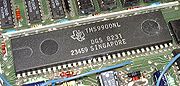
The TMS9900 was used in the TI-99/4 and TI-99/4A
Texas Instruments TI-99/4A
The Texas Instruments TI-99/4A was an early home computer, released in June 1981, originally at a price of USD $525. It was an enhanced version of the less-successful—and quite rare—TI-99/4 model, which was released in late 1979 at a price of $1,150...
home computers. Unfortunately, to reduce the production costs, TI chose to use in these systems just 128 16-bit words of the fast kind of RAM that the TMS9900 could access directly. The rest of the memory was 16kB of 8-bit
8-bit
The first widely adopted 8-bit microprocessor was the Intel 8080, being used in many hobbyist computers of the late 1970s and early 1980s, often running the CP/M operating system. The Zilog Z80 and the Motorola 6800 were also used in similar computers...
DRAM
Dynamic random access memory
Dynamic random-access memory is a type of random-access memory that stores each bit of data in a separate capacitor within an integrated circuit. The capacitor can be either charged or discharged; these two states are taken to represent the two values of a bit, conventionally called 0 and 1...
that was accessible only through the video display controller, which crippled the performance of the TMS9900.
TI later developed the more powerful and more capable TMS99000, which was used as the CPU in the 990/10A minicomputer as a cost reduction. Unfortunately, by the time the 990/10A made it to market, the end of the minicomputer era was already in sight.
External links
- TMS9900 manuals and references from Bitsavers