

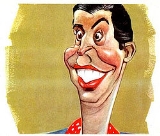
Texaco Star Theater

Encyclopedia
Texaco Star Theater is an American comedy-variety show, broadcast on radio from 1938 to 1949 and telecast from 1948 to 1956. It was one of the first successful examples of American television broadcasting, remembered as the show that gave Milton Berle
the nickname "Mr. Television".
The classic 1940–44 version of the program, hosted by radio's Fred Allen
, was followed by a radio series on ABC
(the former NBC Blue) in the spring of 1948. When Texaco
(now Chevron Corporation
) first took it to television on NBC
on June 8, 1948, the show had a huge cultural impact.
, the Fire Chief, featuring the manic "Perfect Fool" in a half hour of vaudevillian routines interspersed with music. Wynn's ratings began to slide and the comedian lapsed amidst personal and professional crises, and the show ended in June 1935. Texaco sponsored the Jumbo Fire Chief Program in 1935-40 and the Fire Chief Concert in 1936. The first Texaco Star Theatre (spelled Theatre for most of the radio show's run) was on October 5, 1938. The show began as a variety show with dramatizations and songs by guest stars. In 1940, the show became a star vehicle for, with the show re-titled Texaco Star Theatre with Fred Allen and the program airing on October 2, 1940.
Allen's previous sponsor, Bristol-Myers' Ipana toothpaste and Sal Hepatica laxative, decided to cease their tandem sponsorship of Allen's successful hour, first known as Town Hall Tonight and then, for its final season, The Fred Allen Show. He presided over Texaco Star Theatre from 1940–42 as an hour-long show on Wednesday and then Sunday nights, to 1942–1944 as a half-hour show, until Allen withdrew from work for over a year on his doctor's advice. It was during the half-hour version of the show that the more cerebral (if barbed) Allen premiered the continuing comic sketch for which many remember him best: the ensemble, topical takeoffs of "Allen's Alley."
Though some believe the title Texaco
Star Theatre was retired temporarily, in favor of Texaco Time, after Allen scaled the show back to a half-hour, the show retained the Texaco Star Theatre title officially, the confusion likely stemming from the announcers' first words of introduction: "It's Texaco time starring Fred Allen." They customarily continued the introduction, as the opening music continued, by referring to Texaco Star Theatre. Jimmy Wallington became the show's announcer for most of its life with Allen as the feature (he succeeded George Burns
and Gracie Allen
sidekick Harry Von Zell
), though for a brief spell during its second season the announcer was budding radio personality and future television legend Arthur Godfrey
.
Allen was forced to leave the show in 1944 due to hypertension; he returned with a different sponsor on NBC
, while staying with and further refining his half-hour format a year later. Texaco Star Theaters next hosts included James Melton
(1944 - 1947), Tony Martin
(1947 - 1948), Gordon MacRae
(1948) and Milton Berle (1948 - 1949).
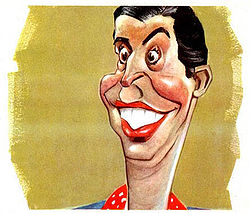 OPENING
"Oh, we're the men of Texaco
We work from Maine to Mexico
There's nothing like this Texaco of ours!
Our show is very powerful
We'll wow you with an hour full
Of howls from a shower full of stars.
We're the merry Texaco men
Tonight we may be showmen
Tomorrow we'll be servicing your cars!
I wipe the pipe
I pump the gas
I rub the hub
I scrub the glass
I touch the clutch
I mop the top
I poke the choke
I sell the pop
I clear the gear
I bop the knock
I jack the back
I set the clock
So join the ranks of those who know
And fill your tanks with Texaco
Sky Chief, fill up with Sky Chief,
And you will smile at the pile of new miles you will add
Fire Chief, fill up with Fire Chief
You'll find that Texaco's the finest friend your car has ever had
...And now, ladies and gentlemen... America's number one television star... MILTON BERLE!..."
CLOSING
The curtain is descending and
We thank you for attending
But before we reach the ending may we add:
Remember to be loyal
To our gasoline and oil
When they save you time and toil you'll be glad
Now the clock is striking nine off
But just before we sign off
CLOSING ANNOUNCE
The best friend your car has ever had!
They didn't settle on Berle—who hosted a freshly revived radio version in spring 1948—as the permanent host right away; he hosted the first television Texaco Star Theater in June 1948 but was originally part of a rotation of hosts (Berle himself had only a four-week contract), until he was named the permanent host that fall.
He was a smash once the new full season began, Texaco Star Theater hitting ratings as high as 80 and owning Tuesday night for NBC
from 8–9 p.m. ET
. And, as the show landed a pair of Emmy Awards in that first year (the show itself, for Best Kinescope Show; and, Berle as Most Outstanding Kinescoped Personality), Uncle Miltie (he first called himself by that name ad-libbing at the end of a 1949 broadcast) joked, preened, pratfell, danced, costumed, and clowned his way to stardom, with Americans discovering television as a technological marvel and entertainment medium seeming to bring the country to a dead stop every Tuesday night, just to see what the madcap Berle might pull next.
With Berle at the helm, Texaco Star Theater was credited heavily with driving American television set sales heavily; the number of TV sets sold during Berle's run on the show was said to have grown from 500,000 his first year on the tube to over 30 million when the show ended in 1956. Texaco Star Theater was also the highest rated television show of the 1950–1951 television season, the first season in which the Nielsen ratings
were used.
Uncle Miltie was far from alone in keeping the show alive and kicking. His support players included Fatso Marco (1948–1952), Ruth Gilbert as "Max", Milton's love-starved secretary (1952–1955), Bobby Sherwood (1952–1953), Arnold Stang
(1953–1955), Jack Collins (1953–1955) and Milton Frome (1953–1955). The show's music was provided by Alan Roth (1948–1955) and Victor Young (1955–1956).
As phenomenally popular as Texaco Star Theater was, it was hardly an undisturbed appeal. "Berle presented himself as one part buffoon and one part consummate, professional entertainer—a kind of veteran of the Borscht Belt trenches," the Museum of Broadcast Communications would observe decades after the show left the air. "Yet even within his shows' sanctioned exhibitionism, some of Berle's behavior could cross the line from affability to effrontery. At its worst, the underlying tone of the Berle programs can appear to be one of contempt should the audience not respond approvingly. In some cases, this led to a surprising degree of self-consciousness about TV itself—Texaco's original commercial spokesman, Sid Stone, would sometimes hawk his products until driven from the stage by a cop. But the uneven balance of excess and decorum proved wildly successful."
became the new sponsor in 1953, prompting the show's name change to The Buick-Berle Show. Two years later, it became, simply, The Milton Berle Show, its title until its run ended at last in June 1956. By then, Berle and his audience had probably burned out on each other, and Buick had even dropped sponsorship of the show at the beginning of the 1955–1956 season (opting to sponsor Jackie Gleason's half-hour filmed edition of The Honeymooners
), after ratings fell dramatically during the 1954–1955 as well (the higher ratings of his 1955–56 competition, The Phil Silvers Show
on CBS, didn't help Berle, either); though Berle would remain one of the nation's beloved entertainers, overall, the show that made him a superstar was clearly spent for steam and fresh ideas, and two subsequent attempts at television comebacks hosting his own show lasted barely a year each. (Berle did, however, contribute his part to the making of a rock and roll
legend: in his final season, he opened his stage to Elvis Presley
amid the beginning of his international popularity.)
Part of the problem was variety shows becoming costlier to produce, compared to the Texaco days when, among other factors, name guest stars didn't mind the low appearance fees they got for appearing, because they could bank the exposure they got from even one appearance on the Berle show; or, with Fred Allen and Ed Wynn in its earlier radio incarnations.
But part of the problem was Berle himself: with competition crowding him more and more as the years went on, as more television performers and creators found their camera legs, and brought new or at least more polished ideas to the air, Berle tried refining his camera persona and evolving from the freewheeling, manic style he cultivated so successfully in the Texaco years. The net result: the balance between excess and decorum now weighted more toward decorum, which wasn't exactly what Berle represented at the height of his popularity. He began losing many of his former fans, who preferred when he kept things more unpredictable, and it would be years before his kind of manic balance would find a television home again.
.
Note: Each U.S. network television season starts in late September and ends in late May, which coincides with the completion of May sweeps.
In the 1954-1955 season, the half-hour Texaco Star Theater offered in alternation The Jimmy Durante Show
and The Donald O'Connor Show
on the NBC Saturday evening schedule.
As often happens those it inspired soon out-performed it, and Berle—once television's biggest single star—also became, as the Museum of Broadcast Communications phrased it, "the first TV personality to suffer from over-exposure and burnout." But for being there at the birth, and cutting the umbilical cord with such immediate and memorable effect, weaning a country from radio as its primary home entertainment medium, Texaco Star Theater earned its legend.
Milton Berle
Milton Berlinger , better known as Milton Berle, was an American comedian and actor. As the manic host of NBC's Texaco Star Theater , in 1948 he was the first major star of U.S. television and as such became known as Uncle Miltie and Mr...
the nickname "Mr. Television".
The classic 1940–44 version of the program, hosted by radio's Fred Allen
Fred Allen
Fred Allen was an American comedian whose absurdist, topically pointed radio show made him one of the most popular and forward-looking humorists in the so-called classic era of American radio.His best-remembered gag was his long-running mock feud with friend and fellow comedian Jack Benny, but it...
, was followed by a radio series on ABC
American Broadcasting Company
The American Broadcasting Company is an American commercial broadcasting television network. Created in 1943 from the former NBC Blue radio network, ABC is owned by The Walt Disney Company and is part of Disney-ABC Television Group. Its first broadcast on television was in 1948...
(the former NBC Blue) in the spring of 1948. When Texaco
Texaco
Texaco is the name of an American oil retail brand. Its flagship product is its fuel "Texaco with Techron". It also owns the Havoline motor oil brand....
(now Chevron Corporation
Chevron Corporation
Chevron Corporation is an American multinational energy corporation headquartered in San Ramon, California, United States and active in more than 180 countries. It is engaged in every aspect of the oil, gas, and geothermal energy industries, including exploration and production; refining,...
) first took it to television on NBC
NBC
The National Broadcasting Company is an American commercial broadcasting television network and former radio network headquartered in the GE Building in New York City's Rockefeller Center with additional major offices near Los Angeles and in Chicago...
on June 8, 1948, the show had a huge cultural impact.
Radio
The roots of Texaco Star Theatre were in a 1930s radio hit, Ed WynnEd Wynn
Ed Wynn was a popular American comedian and actor noted for his Perfect Fool comedy character, his pioneering radio show of the 1930s, and his later career as a dramatic actor....
, the Fire Chief, featuring the manic "Perfect Fool" in a half hour of vaudevillian routines interspersed with music. Wynn's ratings began to slide and the comedian lapsed amidst personal and professional crises, and the show ended in June 1935. Texaco sponsored the Jumbo Fire Chief Program in 1935-40 and the Fire Chief Concert in 1936. The first Texaco Star Theatre (spelled Theatre for most of the radio show's run) was on October 5, 1938. The show began as a variety show with dramatizations and songs by guest stars. In 1940, the show became a star vehicle for, with the show re-titled Texaco Star Theatre with Fred Allen and the program airing on October 2, 1940.
Allen's previous sponsor, Bristol-Myers' Ipana toothpaste and Sal Hepatica laxative, decided to cease their tandem sponsorship of Allen's successful hour, first known as Town Hall Tonight and then, for its final season, The Fred Allen Show. He presided over Texaco Star Theatre from 1940–42 as an hour-long show on Wednesday and then Sunday nights, to 1942–1944 as a half-hour show, until Allen withdrew from work for over a year on his doctor's advice. It was during the half-hour version of the show that the more cerebral (if barbed) Allen premiered the continuing comic sketch for which many remember him best: the ensemble, topical takeoffs of "Allen's Alley."
Though some believe the title Texaco
Texaco
Texaco is the name of an American oil retail brand. Its flagship product is its fuel "Texaco with Techron". It also owns the Havoline motor oil brand....
Star Theatre was retired temporarily, in favor of Texaco Time, after Allen scaled the show back to a half-hour, the show retained the Texaco Star Theatre title officially, the confusion likely stemming from the announcers' first words of introduction: "It's Texaco time starring Fred Allen." They customarily continued the introduction, as the opening music continued, by referring to Texaco Star Theatre. Jimmy Wallington became the show's announcer for most of its life with Allen as the feature (he succeeded George Burns
George Burns
George Burns , born Nathan Birnbaum, was an American comedian, actor, and writer.He was one of the few entertainers whose career successfully spanned vaudeville, film, radio, television and movies, with and without his wife, Gracie Allen. His arched eyebrow and cigar smoke punctuation became...
and Gracie Allen
Gracie Allen
Grace Ethel Cecile Rosalie Allen , known as Gracie Allen, was an American comedian who became internationally famous as the zany partner and comic foil of husband George Burns...
sidekick Harry Von Zell
Harry von Zell
Harry von Zell , born in Indianapolis, made his mark as an announcer of radio programs and an actor in films and television shows....
), though for a brief spell during its second season the announcer was budding radio personality and future television legend Arthur Godfrey
Arthur Godfrey
Arthur Morton Godfrey was an American radio and television broadcaster and entertainer who was sometimes introduced by his nickname, The Old Redhead...
.
Allen was forced to leave the show in 1944 due to hypertension; he returned with a different sponsor on NBC
NBC
The National Broadcasting Company is an American commercial broadcasting television network and former radio network headquartered in the GE Building in New York City's Rockefeller Center with additional major offices near Los Angeles and in Chicago...
, while staying with and further refining his half-hour format a year later. Texaco Star Theaters next hosts included James Melton
James Melton
James Melton , a popular singer in the 1920s and early 1930s, later began a career as an operatic singer when tenor voices went out of style in popular music around 1932-35...
(1944 - 1947), Tony Martin
Tony Martin (entertainer)
Tony Martin is an American actor and singer.-Career:Tony Martin was born on Christmas Day, 1913 as Alvin Morris in San Francisco, California to Jewish immigrant parents. He received a saxophone as a gift from his grandmother at the age of ten. In his grammar school glee club, he became an...
(1947 - 1948), Gordon MacRae
Gordon MacRae
Gordon MacRae was an American actor and singer, best known for his appearances in the film versions of two Rodgers and Hammerstein musicals, Oklahoma! and Carousel and films with Doris Day like Starlift.-Early life:Born Albert Gordon MacRae in East Orange, New Jersey, MacRae graduated from...
(1948) and Milton Berle (1948 - 1949).
Television
On television, continuing a practice long established in radio, Texaco included its brand name in the show title. When the television version launched on June 8, 1948, Texaco also made sure its employees were featured prominently throughout the hour, usually appearing as smiling "guardian angels" performing good deeds of one or another kind, and a quartet of Texaco singers opened each week's show with the following theme song:"Oh, we're the men of Texaco
We work from Maine to Mexico
There's nothing like this Texaco of ours!
Our show is very powerful
We'll wow you with an hour full
Of howls from a shower full of stars.
We're the merry Texaco men
Tonight we may be showmen
Tomorrow we'll be servicing your cars!
I wipe the pipe
I pump the gas
I rub the hub
I scrub the glass
I touch the clutch
I mop the top
I poke the choke
I sell the pop
I clear the gear
I bop the knock
I jack the back
I set the clock
So join the ranks of those who know
And fill your tanks with Texaco
Sky Chief, fill up with Sky Chief,
And you will smile at the pile of new miles you will add
Fire Chief, fill up with Fire Chief
You'll find that Texaco's the finest friend your car has ever had
...And now, ladies and gentlemen... America's number one television star... MILTON BERLE!..."
CLOSING
The curtain is descending and
We thank you for attending
But before we reach the ending may we add:
Remember to be loyal
To our gasoline and oil
When they save you time and toil you'll be glad
Now the clock is striking nine off
But just before we sign off
CLOSING ANNOUNCE
The best friend your car has ever had!
They didn't settle on Berle—who hosted a freshly revived radio version in spring 1948—as the permanent host right away; he hosted the first television Texaco Star Theater in June 1948 but was originally part of a rotation of hosts (Berle himself had only a four-week contract), until he was named the permanent host that fall.
He was a smash once the new full season began, Texaco Star Theater hitting ratings as high as 80 and owning Tuesday night for NBC
NBC
The National Broadcasting Company is an American commercial broadcasting television network and former radio network headquartered in the GE Building in New York City's Rockefeller Center with additional major offices near Los Angeles and in Chicago...
from 8–9 p.m. ET
North American Eastern Time Zone
The Eastern Time Zone of the United States and Canada is a time zone that falls mostly along the east coast of North America. Its UTC time offset is −5 hrs during standard time and −4 hrs during daylight saving time...
. And, as the show landed a pair of Emmy Awards in that first year (the show itself, for Best Kinescope Show; and, Berle as Most Outstanding Kinescoped Personality), Uncle Miltie (he first called himself by that name ad-libbing at the end of a 1949 broadcast) joked, preened, pratfell, danced, costumed, and clowned his way to stardom, with Americans discovering television as a technological marvel and entertainment medium seeming to bring the country to a dead stop every Tuesday night, just to see what the madcap Berle might pull next.
With Berle at the helm, Texaco Star Theater was credited heavily with driving American television set sales heavily; the number of TV sets sold during Berle's run on the show was said to have grown from 500,000 his first year on the tube to over 30 million when the show ended in 1956. Texaco Star Theater was also the highest rated television show of the 1950–1951 television season, the first season in which the Nielsen ratings
Nielsen Ratings
Nielsen ratings are the audience measurement systems developed by Nielsen Media Research, in an effort to determine the audience size and composition of television programming in the United States...
were used.
Uncle Miltie was far from alone in keeping the show alive and kicking. His support players included Fatso Marco (1948–1952), Ruth Gilbert as "Max", Milton's love-starved secretary (1952–1955), Bobby Sherwood (1952–1953), Arnold Stang
Arnold Stang
Arnold Stang was an American comic actor who played a small and bespectacled, yet brash and knowing big-city type.-Career:...
(1953–1955), Jack Collins (1953–1955) and Milton Frome (1953–1955). The show's music was provided by Alan Roth (1948–1955) and Victor Young (1955–1956).
As phenomenally popular as Texaco Star Theater was, it was hardly an undisturbed appeal. "Berle presented himself as one part buffoon and one part consummate, professional entertainer—a kind of veteran of the Borscht Belt trenches," the Museum of Broadcast Communications would observe decades after the show left the air. "Yet even within his shows' sanctioned exhibitionism, some of Berle's behavior could cross the line from affability to effrontery. At its worst, the underlying tone of the Berle programs can appear to be one of contempt should the audience not respond approvingly. In some cases, this led to a surprising degree of self-consciousness about TV itself—Texaco's original commercial spokesman, Sid Stone, would sometimes hawk his products until driven from the stage by a cop. But the uneven balance of excess and decorum proved wildly successful."
Title changes
Texaco dropped its sponsorship of the show and BuickBuick
Buick is a premium brand of General Motors . Buick models are sold in the United States, Canada, Mexico, China, Taiwan, and Israel, with China being its largest market. Buick holds the distinction as the oldest active American make...
became the new sponsor in 1953, prompting the show's name change to The Buick-Berle Show. Two years later, it became, simply, The Milton Berle Show, its title until its run ended at last in June 1956. By then, Berle and his audience had probably burned out on each other, and Buick had even dropped sponsorship of the show at the beginning of the 1955–1956 season (opting to sponsor Jackie Gleason's half-hour filmed edition of The Honeymooners
The Honeymooners
The Honeymooners is an American situation comedy television show, based on a recurring 1951–'55 sketch of the same name. It originally aired on the DuMont network's Cavalcade of Stars and subsequently on the CBS network's The Jackie Gleason Show hosted by Jackie Gleason, and filmed before a live...
), after ratings fell dramatically during the 1954–1955 as well (the higher ratings of his 1955–56 competition, The Phil Silvers Show
The Phil Silvers Show
The Phil Silvers Show is a comedy television series which ran on CBS from 1955 to 1959 for 142 episodes, plus a 1959 special. The series starred Phil Silvers as Master Sergeant Ernest G...
on CBS, didn't help Berle, either); though Berle would remain one of the nation's beloved entertainers, overall, the show that made him a superstar was clearly spent for steam and fresh ideas, and two subsequent attempts at television comebacks hosting his own show lasted barely a year each. (Berle did, however, contribute his part to the making of a rock and roll
Rock and roll
Rock and roll is a genre of popular music that originated and evolved in the United States during the late 1940s and early 1950s, primarily from a combination of African American blues, country, jazz, and gospel music...
legend: in his final season, he opened his stage to Elvis Presley
Elvis Presley
Elvis Aaron Presley was one of the most popular American singers of the 20th century. A cultural icon, he is widely known by the single name Elvis. He is often referred to as the "King of Rock and Roll" or simply "the King"....
amid the beginning of his international popularity.)
Part of the problem was variety shows becoming costlier to produce, compared to the Texaco days when, among other factors, name guest stars didn't mind the low appearance fees they got for appearing, because they could bank the exposure they got from even one appearance on the Berle show; or, with Fred Allen and Ed Wynn in its earlier radio incarnations.
But part of the problem was Berle himself: with competition crowding him more and more as the years went on, as more television performers and creators found their camera legs, and brought new or at least more polished ideas to the air, Berle tried refining his camera persona and evolving from the freewheeling, manic style he cultivated so successfully in the Texaco years. The net result: the balance between excess and decorum now weighted more toward decorum, which wasn't exactly what Berle represented at the height of his popularity. He began losing many of his former fans, who preferred when he kept things more unpredictable, and it would be years before his kind of manic balance would find a television home again.
U.S. television ratings
Seasonal rankings (based on average total viewers per episode) of Fireside Theater on NBCNBC
The National Broadcasting Company is an American commercial broadcasting television network and former radio network headquartered in the GE Building in New York City's Rockefeller Center with additional major offices near Los Angeles and in Chicago...
.
Note: Each U.S. network television season starts in late September and ends in late May, which coincides with the completion of May sweeps.
| Season | TV season | Ranking | Viewers (in millions) |
|---|---|---|---|
| 3rd | 1950–1951 | #1 | 6.283 |
| 4th | 1951–1952 | #2 | 7.956 |
| 5th | 1952–1953 | #5 | 9.526 |
| 6th | 1953–1954 | #5 | 10.452 |
| 7th | 1954–1955 | #11 | 10.622 |
In the 1954-1955 season, the half-hour Texaco Star Theater offered in alternation The Jimmy Durante Show
The Jimmy Durante Show
The Jimmy Durante Show is a 51-episode half-hour comedy/variety program presented live on NBC from October 2, 1954 to June 23, 1956.-Production background:...
and The Donald O'Connor Show
The Donald O'Connor Show
The Donald O'Connor Show is an American musical situation comedy television series starring singer/dancer Donald O'Connor...
on the NBC Saturday evening schedule.
Legacy
As Ed Wynn's hit, the show became bankable, but as Fred Allen's radio hit, Texaco Star Theater was one of the most cleverly cerebral comedy-variety shows of its time. When it moved to television with Milton Berle, it proved a groundbreaker for two decades' worth of television variety programming and, in the cantankerous Berle, gave the medium the first star it could call its own. The television version of Texaco Star Theater allowed him the full spread of his visual and verbal talent, uniting them toward a height he couldn't have achieved even in his legendary vaudeville and silent-screen days.As often happens those it inspired soon out-performed it, and Berle—once television's biggest single star—also became, as the Museum of Broadcast Communications phrased it, "the first TV personality to suffer from over-exposure and burnout." But for being there at the birth, and cutting the umbilical cord with such immediate and memorable effect, weaning a country from radio as its primary home entertainment medium, Texaco Star Theater earned its legend.