


Te Rauparaha

Encyclopedia
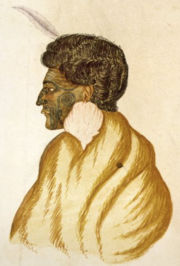
Rangatira
Rangatira are the hereditary Māori leaders of hapū, and were described by ethnologists such as Elsdon Best as chieftains . Ideally, rangatira were people of great practical wisdom who held authority on behalf of the tribe and maintained boundaries between a tribe's land and that of other tribes...
(chief) and war leader of the Ngāti Toa
Ngati Toa
Ngāti Toa , an iwi , traces its descent from the eponymous ancestor Toarangatira. The Ngāti Toa region extends from Miria-te-kakara at Rangitikei to Wellington, and across Cook Strait to Wairau and Nelson....
tribe who took a leading part in the Musket Wars
Musket Wars
The Musket Wars were a series of five hundred or more battles mainly fought between various hapū , sometimes alliances of pan-hapū groups and less often larger iwi of Māori between 1807 and 1842, in New Zealand.Northern tribes such as the rivals Ngāpuhi and Ngāti Whātua were the first to obtain...
. He was influential in the original sale of conquered Rangitane land to the New Zealand Company
New Zealand Company
The New Zealand Company originated in London in 1837 as the New Zealand Association with the aim of promoting the "systematic" colonisation of New Zealand. The association, and later the company, intended to follow the colonising principles of Edward Gibbon Wakefield, who envisaged the creation of...
and was a participant in the Wairau Incident in Marlborough
Marlborough, New Zealand
Marlborough is one of the regions of New Zealand, located in the northeast of the South Island. Marlborough is a unitary authority, both a region and a district, and its council is located at Blenheim. Marlborough is known for its dry climate, the picturesque Marlborough Sounds, and sauvignon blanc...
. He was known as the Napoleon of the South Pacific.
Early days
From 1807, muskets became the weapon of choice and partly changed the character of tribal warfare. In 1819 Te Rauparaha joined with a large war party of Ngā Puhi led by Tāmati Wāka NeneTamati Waka Nene
Tāmati Wāka Nene was a Māori rangatira who fought as an ally of the British in the Flagstaff War.-Origin and mana:...
; they probably reached Cook Strait
Cook Strait
Cook Strait is the strait between the North and South Islands of New Zealand. It connects the Tasman Sea on the west with the South Pacific Ocean on the east....
before turning back.
Migration
Over the next few years the intertribal fighting intensified, and by 1822 Ngāti Toa and related tribes were being forced out of their land around Kawhia after years of fighting with various Waikato tribes often led by Te Whero whero. Led by Te Rauparaha they began a fighting retreat or migration southwards, (this migration was called Te-Heke-Tahu-Tahu-ahi)conquering hapu and iwi as they went south, which ended with them controlling the southern part of the North IslandNorth Island
The North Island is one of the two main islands of New Zealand, separated from the much less populous South Island by Cook Strait. The island is in area, making it the world's 14th-largest island...
and particularly the strategically placed Kapiti Island
Kapiti Island
-External links:* , Department of Conservation* * , Nature Coast Enterprise *...
, which became the tribal stronghold.
In 1824 an estimated 2,000 to 3,000 warriors from a coalition of mainland tribes from Te Wai Pounamu, the East Coast, Whanganui and the Horowhenua assembled at Waikanae
Waikanae
Waikanae is a small town on New Zealand's Kapiti Coast. The name is a Māori word meaning "The waters of the yellow eyed mullet". Another settlement called Waikanae Beach exists near Gisborne on the east coast of the North Island of New Zealand....
, with the object of recovering Kapiti Island. Crossing in a flotilla of war canoes under cover of darkness, they were met as they disembarked by a smaller force of Ngāti Toa fighters led or reinforced by Te Rauparaha. The ensuing Battle of Waiorua ended with the rout and slaughter of the attackers. This decisive victory left Te Rauparaha and the Ngāti Toa able to dominate Kapiti and the adjacent mainland.
Trade and further conquest
PākehāPakeha
Pākehā is a Māori language word for New Zealanders who are "of European descent". They are mostly descended from British and to a lesser extent Irish settlers of the nineteenth and twentieth centuries, although some Pākehā have Dutch, Scandinavian, German, Yugoslav or other ancestry...
whaling
Whaling
Whaling is the hunting of whales mainly for meat and oil. Its earliest forms date to at least 3000 BC. Various coastal communities have long histories of sustenance whaling and harvesting beached whales...
stations became established in the area, and Te Rauparaha encouraged them and many Māori worked in them. Some Māori women married Pākehā whalers, establishing a lucrative trade of supplies for muskets thereby increasing Te Rauparaha's mana
Mana
Mana is an indigenous Pacific islander concept of an impersonal force or quality that resides in people, animals, and inanimate objects. The word is a cognate in many Oceanic languages, including Melanesian, Polynesian, and Micronesian....
and military strength. In 1827 he began the conquest of the South Island
South Island
The South Island is the larger of the two major islands of New Zealand, the other being the more populous North Island. It is bordered to the north by Cook Strait, to the west by the Tasman Sea, to the south and east by the Pacific Ocean...
, and by the early 1830s he had defeated a branch of the Rangitane iwi in the Wairau valley and controlled most of the northern part of it. He married his daughter Te Rongo to an influencial whaling captain,Captain Blenkinsop and sold land to him in the Wairau Valley for a whaling station. It is uncertain if Te Rauparaha understood the full implications of the deed of sale he signed and gave to the captain.
In 1831 he took the major Ngāi Tahu
Ngāi Tahu
Ngāi Tahu, or Kāi Tahu, is the principal Māori iwi of the southern region of New Zealand, with the tribal authority, Te Rūnanga o Ngāi Tahu, being based in Christchurch and Invercargill. The iwi combines three groups, Kāi Tahu itself, and Waitaha and Kāti Mamoe who lived in the South Island prior...
pā
Pa
-Places:* Pâ, a town in Burkina Faso* Pâ Department, a department in Burkina Faso* PA postcode area, in Scotland* Province of Palermo, Italy* Palo Alto, California* Panama, ISO country code** .pa, the country code top level domain for Panama...
at Kaiapoi
Kaiapoi
Kaiapoi is a town in the Canterbury region of the South Island of New Zealand, located close to the mouth of the Waimakariri River, and approximately 17 kilometres north of Christchurch....
after a three month siege http://www.waimakariri.govt.nz/library/history_files/KaiapoiPa.pdfhttp://library.christchurch.org.nz/TiKoukaWhenua/Kaiapoi/, and shortly after took Onawe
Onawe
The Ōnawe Peninsula is inside Akaroa harbour, on Banks Peninsula in Canterbury, New Zealand.It was the site of a Ngāi Tahu pā captured by Te Rauparaha, chief of the Ngāti Toa in 1831. Up to 1,200 people were killed here, and the land is sacred to Ngāi Tahu so "is deemed to be vested in Te Runanga o...
Pā in the Akaroa
Akaroa
Akaroa is a village on Banks Peninsula in the Canterbury region of the South Island of New Zealand, situated within a harbour of the same name—the name Akaroa is Kāi Tahu Māori for 'Long Harbour'.- Overview :...
harbour, but these and other battles in the south were in the nature of revenge (utu) raids rather than for control of territory. Further conquests to the south were bought to a halt by a severe outbreak of measles.
Planned European settlement
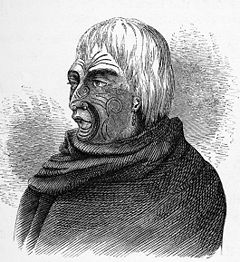
New Zealand Company
The New Zealand Company originated in London in 1837 as the New Zealand Association with the aim of promoting the "systematic" colonisation of New Zealand. The association, and later the company, intended to follow the colonising principles of Edward Gibbon Wakefield, who envisaged the creation of...
expedition commanded by Col William Wakefield
William Wakefield
William Hayward Wakefield was an English colonel, the leader of the first colonizing expedition to New Zealand and one of the founders of Wellington. In 1826, he married Emily Sidney, a daughter of Sir John Sidney.-Early life:...
arrived at Kapiti. They were seeking to buy vast areas of land with a view to forming a permanent European settlement. Te Rauparaha sold them some land in the area that became known later as Nelson
Nelson, New Zealand
Nelson is a city on the eastern shores of Tasman Bay, and is the economic and cultural centre of the Nelson-Tasman region. Established in 1841, it is the second oldest settled city in New Zealand and the oldest in the South Island....
and Golden Bay
Golden Bay
Golden Bay lies at the edge of the junction between the Tasman Sea and Cook Strait. It stretches for 45 kilometres from the long sand spit of Farewell Spit in the north to Separation Point in Abel Tasman National Park at its southern extremity...
. On 14 May 1840 Te Rauparaha signed a copy of the Treaty of Waitangi
Treaty of Waitangi
The Treaty of Waitangi is a treaty first signed on 6 February 1840 by representatives of the British Crown and various Māori chiefs from the North Island of New Zealand....
, believing that the treaty would guarantee him and his allies the possession of territories gained by conquest over the previous 18 years. On 19 June of that year, he signed another copy of the treaty, when Major Thomas Bunbury
Thomas Bunbury
Major Thomas Bunbury , soldier and penal administrator, of the 80th Regiment, was commandant of the second convict settlement at Norfolk Island, from April to July 1839. He joined the army in 1807 and fought in the Peninsular War....
insisted that he do so (Oliver 2007).
Te Rauparaha soon became alarmed at the flood of British settlers and refused to sell any more of his land. This quickly led to tension and the upshot was the Wairau Affray
Wairau Affray
In New Zealand history, the Wairau Affray on 17 June 1843 was the first serious clash of arms between Māori and the British settlers after the signing of the Treaty of Waitangi, and the only one to take place in the South Island...
when a party from Nelson tried to arrest Te Rauparaha, and 22 of them were killed when they fired upon Te Rauparaha and his people out of fear. The subsequent government enquiry exonerated Te Rauparaha which further angered the settlers who began a campaign to have the governor, Robert FitzRoy
Robert FitzRoy
Vice-Admiral Robert FitzRoy RN achieved lasting fame as the captain of HMS Beagle during Charles Darwin's famous voyage, and as a pioneering meteorologist who made accurate weather forecasting a reality...
recalled.
Capture and eventual death
Then in May 1846 fighting broke out in the Hutt ValleyHutt Valley Campaign
The Hutt Valley Campaign of 1846 during the New Zealand land wars could almost be seen as a sequel to the Wairau Affray. The causes were similar and the protagonists almost the same...
between the settlers and Te Rauparaha's nephew, Te Rangihaeata
Te Rangihaeata
Te Rangihaeata , was a Ngāti Toa chief, nephew of Te Rauparaha. He had a leading part in the Wairau Affray and the Hutt Valley Campaign.-Early life:...
. Despite his declared neutrality, Te Rauparaha was arrested after the British captured secret letters from Te Rauparaha which showed he was playing a double game. He was charged with supplying weapons to Maori who were in open insurrection. He was captured near a tribal village Taupo Pa in what would later be called Plimmerton
Plimmerton
The township of Plimmerton is adjacent to one of the more congenial beaches in the northwest part of the Wellington urban area of Porirua in New Zealand...
, by troops acting for the Governor, George Grey
George Edward Grey
Sir George Grey, KCB was a soldier, explorer, Governor of South Australia, twice Governor of New Zealand, Governor of Cape Colony , the 11th Premier of New Zealand and a writer.-Early life and exploration:...
, and held without trial before being exiled to Auckland
Auckland
The Auckland metropolitan area , in the North Island of New Zealand, is the largest and most populous urban area in the country with residents, percent of the country's population. Auckland also has the largest Polynesian population of any city in the world...
where he was held in a ship. At the Kohimaramara peace conference Te Rauaparaha was allowed to attend by Grey. Grey allowed him to speak to restore his mana.Te Wherowhero was soured by this action. Grey spoke to Te Rauaparaha and persuaded him to give up all outstanding claims to land in the Wairau valley which he did.Then, realising he was old and sick he allowed Te Rauparaha to return to his people at Otaki in 1848, where he died the following year, 27 November 1849.
Haka
The most common hakaHaka
Haka is a traditional ancestral war cry, dance or challenge from the Māori people of New Zealand. It is a posture dance performed by a group, with vigorous movements and stamping of the feet with rhythmically shouted accompaniment...
, or challenge, performed by the All Blacks
All Blacks
The New Zealand men's national rugby union team, known as the All Blacks, represent New Zealand in what is regarded as its national sport....
and many other New Zealand sports teams before international matches is "Ka Mate
Ka Mate
"Ka Mate" is a Māori haka composed by Te Rauparaha, war leader of the Ngāti Toa tribe of the North Island of New Zealand.-The creation and composition of Ka Mate:...
" - composed by Te Rauparaha to celebrate his escape from death in a battle in the early 19th century.
External links
- Mention in 1966 An Encyclopaedia of New Zealand