

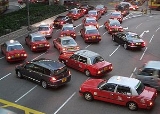
Taxicabs of Hong Kong

Encyclopedia

Taxicab
A taxicab, also taxi or cab, is a type of vehicle for hire with a driver, used by a single passenger or small group of passengers, often for a non-shared ride. A taxicab conveys passengers between locations of their choice...
system. Most taxis are independently owned and operated, but some are owned by taxi companies, and the drivers are employees.
As of 2003, there were 18,138 taxis in Hong Kong, of which 15,250 were urban taxis, 2,838 were New Territories
New Territories
New Territories is one of the three main regions of Hong Kong, alongside Hong Kong Island and the Kowloon Peninsula. It makes up 86.2% of Hong Kong's territory. Historically, it is the region described in The Convention for the Extension of Hong Kong Territory...
taxis, and 50 were Lantau
Lantau Island
Lantau Island , based on the old local name of Lantau Peak , is the largest island in Hong Kong, located at the mouth of the Pearl River. Administratively, most of Lantau Island is part of the Islands District of Hong Kong...
taxis. Every day they serve about 1.1 million, 207,900 and 1,400 people respectively.
19th century

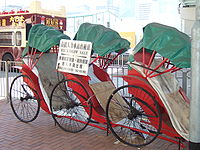
Much the same as motor cars nowadays, private chairs existed, and were an important marker of a person's status. Civil officers' status was denoted by the number of bearers attached to his chair.
Their numbers peaked in about 1920, when 1,215 registered sedan chairs were on the road.
Peak Tram
The Peak Tramway is a funicular railway in Hong Kong, which carries both tourists and residents to the upper levels of Hong Kong Island. Running from Central district to Victoria Peak via the Mid-Levels, it provides the most direct route and offers good views over the harbour and skyscrapers of...
went into service in 1888, wealthy residents of The Peak
Victoria Peak
Victoria Peak is a mountain in Hong Kong. It is also known as Mount Austin, and locally as The Peak. The mountain is located in the western half of Hong Kong Island...
were carried on sedan chairs by coolies up the steep paths to their residence, including former Governor
Governor of Hong Kong
The Governor of Hong Kong was the head of the government of Hong Kong during British rule from 1843 to 1997. The governor's roles were defined in the Hong Kong Letters Patent and Royal Instructions...
Sir Richard MacDonnell's
Richard Graves MacDonnell
Sir Richard Graves MacDonnell KCMG CB was an Anglo-Irish lawyer, judge and colonial governor...
summer home, where they could take advantage of the cooler climate.
However, rickshaws' popularity waned after World War II. No new licenses for rickshaws have been issued since 1975, and licenses became non-transferable. Thus, a dying breed of only a few old men still plied their trade at the Edinburgh Place Ferry Pier
Edinburgh Place Ferry Pier
Edinburgh Place Ferry Pier, often referred to as the "Star Ferry" Pier, was a pier in Edinburgh Place, Central, Hong Kong; the pier, with its clock tower, was a prominent waterfront landmark...
, mainly for tourists. The rickshaw drawers charged HK$300 to go around the block. There were about eight in 1998, and only four left in 2002.
The last Sedan chair was reportedly abandoned in 1965, and since the relocation of the Central Star Ferry pier at the end of 2006 the rickshaws have disappeared.
20th century
The Chinese name for taxi (的士) is a Cantonese transliteration of "Taxi". The earliest pioneer of the modern taxi service may have been Wu zung (胡忠). In 1941, he is believed to have owned 40 taxis including 10 white cardWhite card
White card is a term used to describe citizen-owned automobiles in Hong Kong that are used as illegal unlicensed taxis.-History:...
s, which he leased to the government. When the Japanese occupation of Hong Kong
Japanese occupation of Hong Kong
The Japanese occupation of Hong Kong began after the Governor of Hong Kong, Sir Mark Young, surrendered the territory of Hong Kong to Japan on 25 December 1941 after 18 days of fierce fighting by British and Canadian defenders against overwhelming Japanese Imperial forces. The occupation lasted...
began in December of the same year, he suspended his transport operation. He resumed his business after the war with 100 cars.
The service was first officially recorded by the government in 1947 with 329 cars. By 1960 the service officially covered the New Territories
New Territories
New Territories is one of the three main regions of Hong Kong, alongside Hong Kong Island and the Kowloon Peninsula. It makes up 86.2% of Hong Kong's territory. Historically, it is the region described in The Convention for the Extension of Hong Kong Territory...
, and the service increased to 1,026 cars. The number of taxis would multiply to 10,000 by 1980.
Prior to 1974, livery of taxis in Hong Kong were based on the operator/owners. The standardisation was necessary to weed out illegal taxicabs.
License


The service area of the three types of taxis are defined by the Government in the 1960s. The need for the three different types was to avoid clustering of taxis in the more populated/profitable areas of the territory, and a shortage in others. All three types of taxis serve Hong Kong International Airport
Hong Kong International Airport
Hong Kong International Airport is the main airport in Hong Kong. It is colloquially known as Chek Lap Kok Airport , being built on the island of Chek Lap Kok by land reclamation, and also to distinguish it from its predecessor, the closed Kai Tak Airport.The airport opened for commercial...
and Disneyland
Hong Kong Disneyland
Hong Kong Disneyland is located on reclaimed land in Penny's Bay, Lantau Island. It is the first theme park located inside the Hong Kong Disneyland Resort and is owned and managed by the Hong Kong International Theme Parks. The park opened to visitors on 12 September 2005...
.
Urban taxi
The red taxis have the highest fares among all, and serve all areas of New Territories, Kowloon and Hong Kong Island, . They may also run Tung Chung
Tung Chung
Tung Chung, meaning 'eastern stream', is an area situated on the north-western coast of Lantau Island in Hong Kong. Tung Chung, currently one of the latest generation of new towns, was formerly a rural village around Tung Chung Wan, and along the delta and lower courses of Tung Chung River and Ma...
(Lantau), the Airport
Hong Kong International Airport
Hong Kong International Airport is the main airport in Hong Kong. It is colloquially known as Chek Lap Kok Airport , being built on the island of Chek Lap Kok by land reclamation, and also to distinguish it from its predecessor, the closed Kai Tak Airport.The airport opened for commercial...
at Chek Lap Kok
Chek Lap Kok
Chek Lap Kok was an island in the western waters of Hong Kong. Together with the smaller Lam Chau, it was leveled and merged via land reclamation into the platform for the current Hong Kong International Airport, which opened for commercial operations in 1998...
(Lantau) and Disneyland
Hong Kong Disneyland Resort
The Hong Kong Disneyland Resort is a resort built by the Government of Hong Kong and The Walt Disney Company in Hong Kong on reclaimed land beside Penny's Bay, at the northeastern tip of Lantau Island, approximately two kilometres from Discovery Bay...
, but are not permitted to run the rest of Lantau Island
Lantau Island
Lantau Island , based on the old local name of Lantau Peak , is the largest island in Hong Kong, located at the mouth of the Pearl River. Administratively, most of Lantau Island is part of the Islands District of Hong Kong...
. These taxis can only carry passengers in the Lantau or New Territories areas if the passengers are returning to Kowloon or Hong Kong Island, or must return to their service areas themselves to continue their business.
A taxi will sometimes appear with its roof light on, but with the 'For Hire' flag covered by an 'Out of Service' sign; this means they are attempting to catch a fare back across the harbour tunnel.
There is no legal requirement for drivers to know all the destinations in their allowed area. Commonly, drivers refuse to take passengers wanting to cross the harbour on this basis, although in theory drivers do not have the right to refuse a hire based on destination. On both sides of the harbour, the Government has erected taxi ranks catering for those returning taxis prepared to cross the harbour
Victoria Harbour
Victoria Harbour is a natural landform harbour situated between Hong Kong Island and the Kowloon Peninsula in Hong Kong. The harbour's deep, sheltered waters and strategic location on the South China Sea were instrumental in Hong Kong's establishment as a British colony and its subsequent...
for a single-toll trip.
New Territories taxi
The green taxis, the second most expensive, serve only parts of the New Territories, including Sha Tin, Tuen Mun, Yuen Long, Fanling, Sheung Shui, Pak Tam Chung, Tai Po, West of Ting Kau and North of Chuen Lung, except Lantau Island, Tsang Tai Uk, Sai Kung, Tsuen Wan, Kwai Chung and Tsing Yi. They are allowed to serve the taxi stands at Prince of Wales Hospital, Hin Keng Neighbourhood Community Centre, Chak On Estate, HKUST, Tseung Kwan O Hospital, Hang Hau Station, Tsing Yi Station and Tsuen Wan Station, which are designated interchange with red taxis. Although they serve the Airport and Disneyland, they do not serve Tung Chung and the rest of Lantau.
Lantau taxi
The blue taxis run exclusively on southern Lantau Island, Tung Chung, the Airport and Disneyland, thus they are restricted to a small area. They are not quite as ubiquitous: there are only around 50 of them. There have been reports of some unofficial, unlicensed taxis in blue livery operating around these regions.
Fares
.jpg)
A fare table must be displayed clearly inside the taxi, by law. The same legally-enforceable fare table is also listed on the government's website. Fares are charged according to distance travelled and waiting time, measured by a meter on board. There are surcharges for luggage and tolled tunnels and bridges, as well as surcharges for telephone-arranged ordering. Along some restricted kerb
Curb (road)
A curb, or kerb , is the edge where a raised pavement/sidewalk/footpath, road median, or road shoulder meets an unraised street or other roadway.-Function:...
s, there are designated pick-up and drop-off points exclusively for taxis. Some taxi operators will offer (illegal) discounts in order to attract repeat business.
In July 2007, it was reported that many taxi drivers were engaged in rampant illegal price-cutting in their competition with call-cab drivers for passengers. Rates offered were up to 20% lower than the metered fares on long-distance trips, with competition being particularly fierce on the airport route. The warring factions took turns to blockade Hong Kong International Airport to air their grievances. Andrew Cheng Kar-foo, chairman of the Legislative Council's transport panel, proposed cutting taxi fares to deal with illicit discounting. Representatives of call-cab drivers and taxi owners were opposed to the idea. Urban taxi groups have been lobbying for permission to impose a HK$1 per trip fuel surcharge when the price of liquefied petroleum gas per litre is between HK$3.10 and HK$4. Legislative Councillors
Legislative Council of Hong Kong
The Legislative Council is the unicameral legislature of Hong Kong.-History:The Legislative Council of Hong Kong was set up in 1843 as a colonial legislature under British rule...
unanimously passed a motion urging the government to allow taxis to impose the surcharge. However, the vote was non-binding on the Government. The Transportation Secretary rejected the appeal.
Cars used

Standard Motor Company
The Standard Motor Company was founded in Coventry, England in 1903 by Reginald Walter Maudslay . The Standard name was last used in Britain in 1963, and in India in 1987.-1903–1914:...
, DeSoto Deluxe
DeSoto Deluxe
The DeSoto Deluxe is an automobile produced by the Chrysler Corporation and sold under its DeSoto brand from 1946 through to the 1952 model year. While in production, the Deluxe was DeSoto's entry-level car, and was offered primarily as two and four-door sedans. The Deluxe range also included...
, Morris Oxford
Morris Oxford
After the Second World War the Oxford MO replaced the 10. It was introduced in 1948 and was produced until 1954. The design was shared with Nuffield Organisation stable-mate Wolseley 4/50....
, Hillman Minx
Hillman Minx
The Hillman Minx was a series of middle-sized family cars produced under the Hillman marque by the Rootes Group between 1932 and 1970...
, Austin Cambridge
Austin Cambridge
The Austin Cambridge is a motor car range sold by the Austin Motor Company in several generations from September 1954 through to 1969 as cars and 1971 as light commercials. It replaced the A40 Somerset but was entirely new with modern unibody construction...
, Mercedes
Mercedes-Benz
Mercedes-Benz is a German manufacturer of automobiles, buses, coaches, and trucks. Mercedes-Benz is a division of its parent company, Daimler AG...
W120 Ponton, Ford Anglia
Ford Anglia
The 1949 model, code E494A, was a makeover of the previous model with a rather more 1940s style front-end, including the sloped, twin-lobed radiator grille. Again it was a very spartan vehicle and in 1948 was Britain's lowest priced four wheel car....
and Vauxhall Velox
Vauxhall Velox
The classic four-door saloon boasted a newly developed straight-six-cylinder engine of 2275 cc, with overhead valves. The power output provided for a claimed top speed of...
were used up to the 1960s. Since the 1970s, Japanese cars replaced the various European models used earlier. Among them, the Toyota Crown Comfort YXS10
Toyota Comfort
The Toyota Comfort, released in 1995, was designed for use as a taxicab in Japan. Its primary competitor was the Nissan Crew and its secondary competitor was the Cedric Y31...
and Nissan Cedric Y31 had always been the most popular.
All taxis bear a semi-circular green plate on the front grille, and at the back of the vehicle indicating the number of seats available. Throughout history, most Hong Kong taxis have been 4-door saloons with bench seats in the front, thus allowing it to carry up to 5 passengers (driver excluded). In the early 1980s, 4-passenger taxis were introduced. Smaller saloons such as the Nissan Bluebird 910, Nissan Sunny B12, Toyota Corona
Toyota Corona
The Toyota Corona is an automobile manufactured by the Japanese automaker Toyota between 1957 and 2002. Traditionally, the competitor from Nissan was the Nissan Bluebird. The word Corona is Latin for "crown"...
(CT141) and the Mitsubishi Lancer
Mitsubishi Lancer
The Mitsubishi Lancer is a family car built by Mitsubishi Motors. It has been known as the Colt Lancer, Dodge/Plymouth Colt, Chrysler Valiant Lancer, Chrysler Lancer, Eagle Summit, Hindustan Lancer, Soueast Lioncel, Mitsubishi Carisma, and Mitsubishi Mirage in various countries at different times,...
were used. However, these were all phased out by mid-1990s. Since then and until 2008, all Hong Kong taxis have been 5-passengers vehicles. But from 2008, the new Toyota Comfort is equipped with floor shift automatic instead of column shift automatic, making the new Comfort a 4-passengers taxi again.
Australian Ford Falcon estate cars
Ford Falcon (Australia)
The Ford Falcon is a full-size car which has been manufactured by Ford Australia since 1960. Each model from the XA series of 1972 onward has been designed, developed and built in Australia and/or New Zealand, following the phasing out of the American Falcon of 1960–71 which had been re-engineered...
tried to enter the market in year 2000 but it was never popular.
Today, almost all taxis in Hong Kong are Toyota Comfort
Toyota Comfort
The Toyota Comfort, released in 1995, was designed for use as a taxicab in Japan. Its primary competitor was the Nissan Crew and its secondary competitor was the Cedric Y31...
(YXS10) (over 99%), the minority being Nissan Cedric
Nissan Cedric
The Nissan Cedric is a large automobile produced by Nissan since 1960. It was developed to provide upscale transportation, competing with the Prince Skyline and Gloria which were later merged into the Nissan family...
(Y31) saloons since Nissan Cedric (Y31) was discontinued from the end of 2005.
On 29 May 2007, there were reports that plans are afoot to introduce the LTI-licensed, Chinese Geely
Geely Automobile
Zhejiang Geely Holding Group is a holding company and parent of Geely Automobile Holdings Ltd a private automobile manufacturer. Geely may often round out the top ten Chinese automakers....
-manufactured, LPG
Liquified petroleum gas
Liquefied petroleum gas is a flammable mixture of hydrocarbon gases used as a fuel in heating appliances and vehicles. It is increasingly used as an aerosol propellant and a refrigerant, replacing chlorofluorocarbons in an effort to reduce damage to the ozone layer...
-powered TX4
TX4
The TX4 is a purpose built taxicab manufactured by Manganese Bronze Holdings / LTC The London Taxi Company, formerly LTI London Taxis International. It is the latest in a long line of purpose-built taxis manufactured by LTC...
London Black Cabs
Hackney carriage
A hackney or hackney carriage is a carriage or automobile for hire...
into the Hong Kong taxi service market. A feasibility study is under way between the Hong Kong Productivity Council and Geely.
All taxis are imported new, there is a type approval process for approving the models of cars to be used as taxis (which means unapproved models cannot be used as taxis). However, used parts of Japan are frequently used. So sometimes there are Japanese stickers on the taxis doors.
Most importers just import red color base cars. For green and blue taxis, the owners have to convert the cars into the correct color, and they usually only paint the exterior, and people can still see the original red color from the door gap or engine compartment.
Fuels
Until the late 1990s, all Hong Kong taxis ran on diesel fuel, aside from 4-passenger taxis which ran on petrol. In 1996, a few taxis that ran on LPGLiquified petroleum gas
Liquefied petroleum gas is a flammable mixture of hydrocarbon gases used as a fuel in heating appliances and vehicles. It is increasingly used as an aerosol propellant and a refrigerant, replacing chlorofluorocarbons in an effort to reduce damage to the ozone layer...
appeared as part of the government's test project for alternative fuel. This project proved successful, leading to all new taxis being factory-built LPG since 1999. To speed up the replacement of diesel taxis with LPG ones, from mid 2000 to the end of 2003, the government offered a cash grant to each taxi owner who purchased a new LPG taxi during that period. Since 1 August 2001, no more diesel taxis were allowed to be imported into Hong Kong, and from 1 January 2006, driving a diesel taxi on the streets of Hong Kong became illegal. Therefore all taxis in Hong Kong are currently running on LPG.
Although LPG-powered vehicles are supposed to be relatively non-polluting, and do indeed reduce roadside pollution, a 2007 study by Polytechnic University
Hong Kong Polytechnic University
The Hong Kong Polytechnic University specialises in professional education in Hong Kong. The University’s teaching units are grouped under six faculties and two schools; the Faculty of Applied Science and Textiles, Faculty of Business, Faculty of Construction and Environment, Faculty of...
indicated that older LPG taxis emitted at least double the amount of carbon monoxide and hydrocarbons compared to diesel. But the government still claimed that properly maintained LPG engines reduce pollution by 50% to 200%.
Different modes
A taxi may have an 'Out of Service' sign on whenever the taxi is not available for hire, e.g., shift-changing. Passengers aren't allowed to hire a taxi displaying an 'Out of Service' sign. Taxi drivers may continue to have a lit roof sign and 'For Hire' flag up if they are looking for customers wishing to head to areas in their service (e.g. a Lantau taxicab in Kowloon, looking for fares heading to Lantau).Share taxi
One form of operations is that the taxi is operated as a shared taxi. In late night a taxicab is operated over long distances whilst the driver only drives off when the cab is fully loaded. In turn the cab driver charges a fare that is lower than the prescribed fare that would appear on the taxi meter. The passengers wait aboard the cab until it is fully loaded, and they may not necessarily know each other on the trip.This form of taxi operation is considered illegal under the laws of Hong Kong because the driver charges a fare different from the one on the taxi meter.
See also
- Taxicabs by country
- Transport in Hong KongTransport in Hong KongHong Kong has a highly developed and sophisticated transport network, encompassing both public and private transport. Over 90% of the daily journeys are on public transport, making it the highest rate in the world....