


Japanese occupation of Hong Kong

Encyclopedia
The Japanese occupation of Hong Kong (香港日治時期) began after the Governor of Hong Kong
, Sir Mark Young
, surrendered the territory of Hong Kong to Japan on 25 December 1941 after 18 days of fierce fighting
by British and Canadian defenders against overwhelming Japanese Imperial forces. The occupation lasted for three years and eight months until Japan surrendered
. The length of this period (in Chinese, 三年零八個月) later became a metonym of the occupation.
, a few bombs fell accidentally on Hong Kong, destroying a bridge and a train station.
and were racing towards Moscow in the invasion of the Soviet Union
. Although still officially neutral, United States
was actively supporting Britain, the British Commonwealth and the Soviet Union in their war against Germany, and had imposed a 100% embargo on the sale of oil to Japan after less aggressive forms of economic warfare had failed to bring about changes in Japanese foreign policy in China and French Indo-china (Vietnam). This prompted Japan to launch a sudden attack against the U.S. naval base at Pearl Harbor
on 7 December 1941 (Honolulu time), against American military bases in the Philippines, and against strategic targets elsewhere in the Pacific and East Asia.
. British
, Canadian and Indian
forces, supported by the Hong Kong Volunteer Defence Forces attempted to resist the rapidly advancing Japanese but were heavily outnumbered. After racing down the New Territories
and Kowloon
, Japanese forces crossed Victoria Harbour
on 18 December. After fierce fighting continued on Hong Kong Island
, the only reservoir was lost. Canadian Winnipeg Grenadiers fought at the crucial Wong Nai Chong Gap that secured the passage between Hong Kong proper and secluded southern sections of the island. Finally defeated, on 25 December 1941, British colonial officials headed by the Governor of Hong Kong
Mark Aitchison Young
surrendered at the Japanese headquarters. To the local people, the day was known as "Black Christmas".
The capitulation
of Hong Kong was signed on the 26th at The Peninsula Hotel
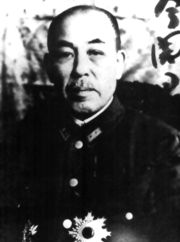
. On 20 February 1942 General Rensuke Isogai
became the first Japanese governor of Hong Kong. Just before the British surrendered, drunken Japanese soldiers entered St. Stephen's College
, which was being used as a hospital. The Japanese then confronted two volunteer doctors and shot both of them when entry was refused. They then burst into the wards and bayoneted all the wounded soldiers who were incapable of hiding in what was known as the St. Stephen's college incident
. This ushered an almost four years of brutal Imperial Japanese administration.
 Throughout the Japanese occupation, Hong Kong was ruled as a detained terrain and was subjected to martial law
. Headed by General Rensuke Isogai
, the Japanese established their administration and commanding post at the Peninsula Hotel in Kowloon
. The military government, composed of the departments of politics, civilian, economy, judiciary, and navy, enacted stringent regulations and established executive bureaus to have power over all residents of Hong Kong. On top of Governor Mark Young, 7,000 British soldiers and civilians were kept in prisoner-of-war or internment camps, such as Sham Shui Po Prisoner Camp and Stanley Internment Camp
. Famine, malnourishment and sickness were pervasive. Severe cases of malnutrition among inmates occurred in the Stanley Internment Camp in 1945. Moreover, the Japanese military government blockaded Victoria Harbour
and controlled warehouses.
Early in January 1942, former members of the Hong Kong Police including the Indians and Chinese were recruited into a reformed police called the Kempeitai
with new uniforms. The police routinely performed executions at King's Park in Kowloon by using Chinese for beheading, shooting and bayonet
practice. The Japanese gendarmerie
took over all police stations and organised the Police in five divisions, namely East Hong Kong, West Hong Kong, Kowloon, New Territories and Water Police. The headquarters was situated in the former Supreme Court
Building. Police in Hong Kong were under the organisation and control of the Japanese government. Japanese experts and administrators were chiefly employed in the Governor's Office and its various bureaus. Two councils of Chinese and Eurasian
leaders were setup to manage the Chinese population.
 Economically, all trading activities were sternly guarded, and the majority of the factories were taken over by the Japanese. Having deprived the vendors and banks of their possessions, the Hong Kong Dollar
was outlawed and replaced by the Japanese Military Yen
. The exchange rate was fixed at 2 Hong Kong dollars to one military yen in January 1942. Later, the yen was re-valued at 4 Hong Kong dollars to a yen in July 1942, which meant local people could exchange fewer military notes than before. While the citizens of Hong Kong became poor in forced exchanges, the Japanese government sold the Hong Kong Dollar to help finance their war-time economy. Later, the yen was made the sole legal tender
for official purposes in June 1943. Prices of commodities for sale had to be marked in yen. Hyper-inflation then disrupted the economy, directly affecting Hong Kong citizens. Enormous devaluation
of the Japanese Military Yen after the war made it almost worthless.
Public transportation and utilities unavoidably failed, owing to the shortage of fuel
and through the augmentation of American air raids
on Hong Kong. Tens of thousands of people became homeless and helpless, and many of them were employed in shipbuilding and construction. In the agricultural field, the Japanese took over the race track
at Fanling
and the air strip at Kam Tin
for their rice-growing experiments.
With the intention of boosting the Japanese influence on Hong Kong, two Japanese banks, the Yokohama Specie Bank
and the Bank of Taiwan
, were re-opened. These two banks replaced the HongKong and Shanghai Bank and two other British banks responsible for issuing the banknotes. They then liquidated
various Allied banks. British, American and Dutch bankers were forced to live in a small hotel, while some bankers who were viewed as the enemy of the Japanese were executed. In May 1942, Japanese companies were encouraged to be set up. A Hong Kong trade syndicate consisting of Japanese firms was set up in October 1942 to manipulate overseas trade.
 The Japanese enforced a repatriation policy throughout the period of occupation because of the scarcity of food and the possible counter-attack of the Allies. As a result, the unemployed were deported to the Mainland
, and the population of Hong Kong had dwindled from 1.6 million in 1941 to 600,000 in 1945. Furthermore, the Japanese reconstructed both government and private facilities for the sake of their own interests and developments. In order to expand the Kai Tak Airport
, for example, the Japanese demolished the Sung Wong Toi Monument in today’s Kowloon City
. Buildings of some prestigious secondary schools such as Jesuits' Wah Yan College Hong Kong
, Diocesan Boys' School
, the Central British School
, the St. Paul's Girls' College
of the Anglican church
and de La Salle brothers' La Salle College
were commandeered as military hospitals by the Japanese. Diocesan Boys' School
was even rumoured to be the execution place of the Japanese.
Life was hard for people under Japanese rule. As there was inadequate food supply, the Japanese rationed necessities such as rice, oil, flour, salt and sugar. Each family was given a rationing license, and every person could only buy 6.4 tael
s (240 g (8.5 oz)), of rice per day. Most people did not have enough food to eat, and many died of starvation. The rationing system was cancelled in 1944. An estimate was put forward by one Chinese physician who actively practised in HK between 1941 and 1942 that at least 10,000 girls and women were raped in the month following Japanese victory.
and Queen Mary Hospital
were occupied by the Japanese army. Despite the lack of medicine and funds, the Tung Wah and Kwong Wah Hospital
continued their social services but in a limited scale. These included provision of food, medicine, clothing, and burial services. Although funds were provided, they still had great financial difficulties. Failure to collect rents and the high reparation costs forced them to promote fundraising activities like musical performances and dramas.
Tung Wah hospital and the charitable organisation Po Leung Kuk
continued to provide charity relief. Substantial donations were given by members of Chinese elite. Po Leung Kuk also took in orphans. However faced with financial problems during the occupation, their bank deposits could not be withdrawn under Japanese control. Their services could only be continued through donations by Aw Boon Haw
, a long-term financier of Po Leung Kuk.
and Kwong Wah Hospital
still continuously offered limited social services to needy persons. In June 1943 the management of water, gas and electricity was transferred into private Japanese hands.
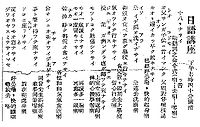
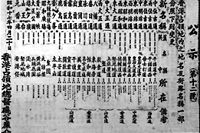
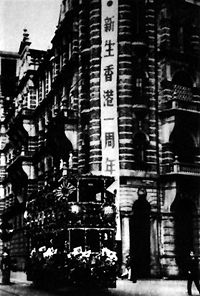 Through schooling, mass media and other means of propaganda, the Japanese tried to control the mindsets of Hong Kong people so as to build up a stronger administration regime. Japanisation was a common means for restricting people's thinking, and it prevailed in different aspects of daily life.
could not be taught nor was it tolerated outside the classroom. Some private Japanese language schools were established to promote oral Japanese. The Military Administration ran the Teachers' Training Course, and those teachers who failed a Japanese bench-mark test would need to take a three-month training course. The Japanese authorities tried to introduce Japanese traditions and customs to Hong Kong students through the Japanese lesson at school. Famous historical stories such as Mori Motonari(毛利元就)'s “Sanbon no ya(Three Arrows)” and Xufu(徐福)’s voyage to Japan were introduced in Japanese language textbook.
The primary aims of this Japanisation of the education system were mainly to facilitate the Japanese control over the local people and to establish the Greater East Asia Co-prosperity Sphere
. Therefore, what it was trying to create was a rush to learn Japanese.
On the other hand, by 1943, only one formal language school, the Bougok School (寳覺學校), had provided Cantonese language course to Japanese people in Hong Kong. According to the instructor of Bougok School, “teaching Cantonese is difficult because there is no system and set pattern in Cantonese grammar; and you have to change the pronunciation as the occasion demands” and “it would be easier for a Cantonese people to learn Japanese than a Japanese people to learn Cantonese.”
became Meiji
-dori and Des Voeux Road
became Shōwa
-dori. Similarly, the Gloucester Hotel became the Matsubara. The Peninsula Hotel, the Matsumoto
; Lane Crawford
, Matsuzakaya
. The Queen's Theatre was renamed first the Nakajima-dori, then the Meiji. Their propaganda also pointed to the pre-eminence of the Japanese way of life, of Japanese spiritual values and the ills of western materialism
.
The commemoration of Japanese festivals, state occasions, victories and anniversaries also strengthened the Japanese influence over Hong Kong. For instance, there was Yasukuri or Shrine Festival honouring the dead. There was also a Japanese Empire Day on 11 February 1943 centred around the worship of the Emperor Jimmu
.
who previously worked for the South China Morning Post
. It became the mouthpiece of the Japanese propaganda. Ten local Chinese newspapers had been reduced to five in May. These newspapers were under press censorship
. Radio sets were used for Japanese propaganda. Amusements still existed, though only for those who could afford them. The cinemas only screened Japanese films, such as The Battle of Hong Kong
, the only film made in Hong Kong during the Japanese occupation. Directed by Tanaka Shigeo and produced by the Dai Nippon Film Company, the film featured an all-Japanese cast but a few Hong Kong film personalities were also involved. This film appeared on the first anniversary of the attack.
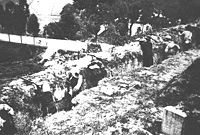
in 1939, this group was mostly comprised peasants, students, and seamen. When the war reached Hong Kong in 1941, the guerilla force grew from 200 to more than 6,000 soldiers. In January 1942, the Guangdong people's anti-Japanese east river guerrillas (廣東人民抗日游擊隊東江縱隊) was established to reinforce anti-Japanese forces in Dongjiang and Zhujiang Pearl River
deltas. The guerillas' most significant contribution to the Allies
, in particular, was their rescue of twenty American pilots who parachuted into Kowloon when their planes were shot down by the Japanese. In the wake of the British retreat
, the guerillas picked up abandoned weapons and established bases in the New Territories
and Kowloon. Applying conventional tactics of guerilla warfare, they killed Chinese traitors and collaborators. They protected traders in Kowloon and Guangzhou
, attacked the police station at Tai Po
, and bombed Kai Tak Airport. During the Japanese occupation the only fortified resistance was mounted by the East river guerillas.
, Sir Douglas Clague, Professor Gordan King, and David Bosanquet. In December 1943 the Guangdong force reformed the East river guerillas, absorbing the HK-Kowloon brigade into the larger unit.
was formed in 1942 at the suggestion of Colonel Lindsay Ride
. The group rescued allied POWs including airmen shot down and workers trapped in occupied HK. It also developed a role in intelligence gathering. In the process, the Group provided protection to the Dongjiang River
which was a source for domestic water in Hong Kong. This was the first organisation in which Britons, Chinese and other nationalities served with no racial divide. Francis Lee Yiu-pui and Paul Tsui Ka-cheung were commissioned as officers.
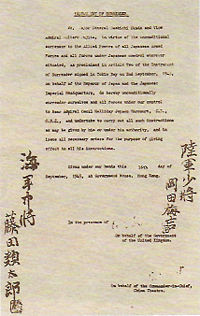
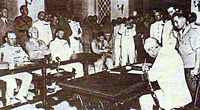
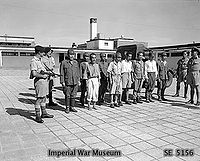
on Hiroshima
on 6 August 1945. Another one was dropped on Nagasaki three days later; at the same day USSR began Manchurian Strategic Offensive Operation, which crippled the last grand Japanese army in China. Japan finally surrendered on 15 August 1945. The British control over Hong Kong thus was restored.
The Sino-Japanese War
"Victory Anniversary Day" (the Saturday preceding the last Monday in August) and "Liberation Day", (the last Monday in August (重光紀念日)) became public holidays. After the transfer of sovereignty of Hong Kong in 1997 Labour Day
(5 May) and PRC National Day (1 Oct.) replaced them as official bank holidays.
General Takashi Sakai
, who led the invasion of Hong Kong and subsequently served as governor for some time, was tried as a war criminal and executed on the afternoon of 30 September 1946.
's Chiang Kai-shek
assumed he would resume the role of controlling the whole of China. Several years earlier, U.S. President Franklin Roosevelt insisted that colonialism would have to end, and promised Soong May-ling
that Hong Kong would be restored to Chinese control. But the British moved quickly to regain control of Hong Kong. As soon as he heard word of the Japanese surrender, Franklin Gimson
, Hong Kong's colonial secretary, left his prison camp and declared himself the territory's acting governor. A government office was setup in Victoria on 1 September 1945. British Rear Admiral Sir Cecil Halliday Jepson Harcourt
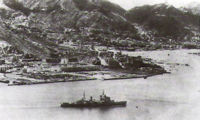
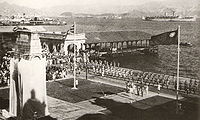
sailed into HK on board the cruiser to re-establish British government's control over the colony. He then formally accepted the Japanese surrender on 16 September 1945.
Hong Kong's post-war recovery was astonishingly swift. By November 1945, the economy had recovered so well that government controls were lifted and free markets restored. The population returned to around one million by early 1946 due to immigration from China. Colonial taboos also broke down in the post-war years as European colonial powers realised that they could not administer its colonies like it did before the war. Chinese people were no longer restricted from certain beaches, or from owning assets on Victoria Peak
.
Governor of Hong Kong
The Governor of Hong Kong was the head of the government of Hong Kong during British rule from 1843 to 1997. The governor's roles were defined in the Hong Kong Letters Patent and Royal Instructions...
, Sir Mark Young
Mark Aitchison Young
Sir Mark Aitchison Young, GCMG was a British administrator who became the Governor of Hong Kong during the years immediately before and after the Japanese occupation of the territory.-Early life, service in war:...
, surrendered the territory of Hong Kong to Japan on 25 December 1941 after 18 days of fierce fighting
Battle of Hong Kong
The Battle of Hong Kong took place during the Pacific campaign of World War II. It began on 8 December 1941 and ended on 25 December 1941 with Hong Kong, then a Crown colony, surrendering to the Empire of Japan.-Background:...
by British and Canadian defenders against overwhelming Japanese Imperial forces. The occupation lasted for three years and eight months until Japan surrendered
Surrender of Japan
The surrender of Japan in 1945 brought hostilities of World War II to a close. By the end of July 1945, the Imperial Japanese Navy was incapable of conducting operations and an Allied invasion of Japan was imminent...
. The length of this period (in Chinese, 三年零八個月) later became a metonym of the occupation.
During Japanese invasion of China
During the Japanese invasion of China in 1937, Hong Kong was not invaded or occupied, being part of the British empire. Nevertheless, its situation was influenced by the war in China due to proximity to the mainland. In early March 1939, during a bombing raid on ShenzhenShenzhen
Shenzhen is a major city in the south of Southern China's Guangdong Province, situated immediately north of Hong Kong. The area became China's first—and one of the most successful—Special Economic Zones...
, a few bombs fell accidentally on Hong Kong, destroying a bridge and a train station.
World War II
In the autumn of 1941, the Third Reich was at its height of power. German forces had overrun much of Western EuropeWestern Europe
Western Europe is a loose term for the collection of countries in the western most region of the European continents, though this definition is context-dependent and carries cultural and political connotations. One definition describes Western Europe as a geographic entity—the region lying in the...
and were racing towards Moscow in the invasion of the Soviet Union
Operation Barbarossa
Operation Barbarossa was the code name for Germany's invasion of the Soviet Union during World War II that began on 22 June 1941. Over 4.5 million troops of the Axis powers invaded the USSR along a front., the largest invasion in the history of warfare...
. Although still officially neutral, United States
United States
The United States of America is a federal constitutional republic comprising fifty states and a federal district...
was actively supporting Britain, the British Commonwealth and the Soviet Union in their war against Germany, and had imposed a 100% embargo on the sale of oil to Japan after less aggressive forms of economic warfare had failed to bring about changes in Japanese foreign policy in China and French Indo-china (Vietnam). This prompted Japan to launch a sudden attack against the U.S. naval base at Pearl Harbor
Attack on Pearl Harbor
The attack on Pearl Harbor was a surprise military strike conducted by the Imperial Japanese Navy against the United States naval base at Pearl Harbor, Hawaii, on the morning of December 7, 1941...
on 7 December 1941 (Honolulu time), against American military bases in the Philippines, and against strategic targets elsewhere in the Pacific and East Asia.
Battle of Hong Kong
As part of a general Pacific campaign, the Japanese launched an assault on Hong Kong on the morning of 8 December 1941 Hong Kong local timeHong Kong Time
Hong Kong Time is the time in Hong Kong, observed at UTC+8 all year round. The Hong Kong Observatory is the official timekeeper of the Hong Kong Time.-Time standards:...
. British
British Army
The British Army is the land warfare branch of Her Majesty's Armed Forces in the United Kingdom. It came into being with the unification of the Kingdom of England and Scotland into the Kingdom of Great Britain in 1707. The new British Army incorporated Regiments that had already existed in England...
, Canadian and Indian
British Indian Army
The British Indian Army, officially simply the Indian Army, was the principal army of the British Raj in India before the partition of India in 1947...
forces, supported by the Hong Kong Volunteer Defence Forces attempted to resist the rapidly advancing Japanese but were heavily outnumbered. After racing down the New Territories
New Territories
New Territories is one of the three main regions of Hong Kong, alongside Hong Kong Island and the Kowloon Peninsula. It makes up 86.2% of Hong Kong's territory. Historically, it is the region described in The Convention for the Extension of Hong Kong Territory...
and Kowloon
Kowloon
Kowloon is an urban area in Hong Kong comprising the Kowloon Peninsula and New Kowloon. It is bordered by the Lei Yue Mun strait in the east, Mei Foo Sun Chuen and Stonecutter's Island in the west, Tate's Cairn and Lion Rock in the north, and Victoria Harbour in the south. It had a population of...
, Japanese forces crossed Victoria Harbour
Victoria Harbour
Victoria Harbour is a natural landform harbour situated between Hong Kong Island and the Kowloon Peninsula in Hong Kong. The harbour's deep, sheltered waters and strategic location on the South China Sea were instrumental in Hong Kong's establishment as a British colony and its subsequent...
on 18 December. After fierce fighting continued on Hong Kong Island
Hong Kong Island
Hong Kong Island is an island in the southern part of the Hong Kong Special Administrative Region. It has a population of 1,289,500 and its population density is 16,390/km², as of 2008...
, the only reservoir was lost. Canadian Winnipeg Grenadiers fought at the crucial Wong Nai Chong Gap that secured the passage between Hong Kong proper and secluded southern sections of the island. Finally defeated, on 25 December 1941, British colonial officials headed by the Governor of Hong Kong
Governor of Hong Kong
The Governor of Hong Kong was the head of the government of Hong Kong during British rule from 1843 to 1997. The governor's roles were defined in the Hong Kong Letters Patent and Royal Instructions...
Mark Aitchison Young
Mark Aitchison Young
Sir Mark Aitchison Young, GCMG was a British administrator who became the Governor of Hong Kong during the years immediately before and after the Japanese occupation of the territory.-Early life, service in war:...
surrendered at the Japanese headquarters. To the local people, the day was known as "Black Christmas".
The capitulation
Capitulation (surrender)
Capitulation , an agreement in time of war for the surrender to a hostile armed force of a particular body of troops, a town or a territory....
of Hong Kong was signed on the 26th at The Peninsula Hotel
The Peninsula Hong Kong
The Peninsula Hong Kong is one of the most internationally recognizable hotels in Hong Kong. Opened in 1928, it is Hong Kong's most historical hotel. It is located at the junction of Nathan Road and Salisbury Road in Tsim Sha Tsui, Hong Kong...
. On 20 February 1942 General Rensuke Isogai
Rensuke Isogai
-External links:...
became the first Japanese governor of Hong Kong. Just before the British surrendered, drunken Japanese soldiers entered St. Stephen's College
St. Stephen's College, Hong Kong
St. Stephen's College is a Christian DSS coeducational secondary school located in Stanley, Hong Kong. With an area of about 150,000 sq. ft., the College is the largest secondary school in Hong Kong, and is also one of the very few boarding schools in the territory, many buildings in the campus...
, which was being used as a hospital. The Japanese then confronted two volunteer doctors and shot both of them when entry was refused. They then burst into the wards and bayoneted all the wounded soldiers who were incapable of hiding in what was known as the St. Stephen's college incident
St. Stephen's college incident
The St Stephen's college incident was a case of acts of extreme cruelty committed by the Imperial Japanese Army on December 25, 1941 during the Japanese occupation of Hong Kong at St. Stephen's College.-Incident:...
. This ushered an almost four years of brutal Imperial Japanese administration.
Politics
Martial law
Martial law is the imposition of military rule by military authorities over designated regions on an emergency basis— only temporary—when the civilian government or civilian authorities fail to function effectively , when there are extensive riots and protests, or when the disobedience of the law...
. Headed by General Rensuke Isogai
Rensuke Isogai
-External links:...
, the Japanese established their administration and commanding post at the Peninsula Hotel in Kowloon
Kowloon
Kowloon is an urban area in Hong Kong comprising the Kowloon Peninsula and New Kowloon. It is bordered by the Lei Yue Mun strait in the east, Mei Foo Sun Chuen and Stonecutter's Island in the west, Tate's Cairn and Lion Rock in the north, and Victoria Harbour in the south. It had a population of...
. The military government, composed of the departments of politics, civilian, economy, judiciary, and navy, enacted stringent regulations and established executive bureaus to have power over all residents of Hong Kong. On top of Governor Mark Young, 7,000 British soldiers and civilians were kept in prisoner-of-war or internment camps, such as Sham Shui Po Prisoner Camp and Stanley Internment Camp
Stanley Internment Camp
Stanley Internment Camp was a civilian internment camp in Hong Kong during World War II. Located in Stanley, on the southern end of Hong Kong Island, it was used by the Japanese imperial forces to hold non-Chinese enemy nationals after their victory in the Battle of Hong Kong, a battle in the...
. Famine, malnourishment and sickness were pervasive. Severe cases of malnutrition among inmates occurred in the Stanley Internment Camp in 1945. Moreover, the Japanese military government blockaded Victoria Harbour
Victoria Harbour
Victoria Harbour is a natural landform harbour situated between Hong Kong Island and the Kowloon Peninsula in Hong Kong. The harbour's deep, sheltered waters and strategic location on the South China Sea were instrumental in Hong Kong's establishment as a British colony and its subsequent...
and controlled warehouses.
Early in January 1942, former members of the Hong Kong Police including the Indians and Chinese were recruited into a reformed police called the Kempeitai
Kempeitai
The was the military police arm of the Imperial Japanese Army from 1881 to 1945. It was not an English-style military police, but a French-style gendarmerie...
with new uniforms. The police routinely performed executions at King's Park in Kowloon by using Chinese for beheading, shooting and bayonet
Bayonet
A bayonet is a knife, dagger, sword, or spike-shaped weapon designed to fit in, on, over or underneath the muzzle of a rifle, musket or similar weapon, effectively turning the gun into a spear...
practice. The Japanese gendarmerie
Gendarmerie
A gendarmerie or gendarmery is a military force charged with police duties among civilian populations. Members of such a force are typically called "gendarmes". The Shorter Oxford English Dictionary describes a gendarme as "a soldier who is employed on police duties" and a "gendarmery, -erie" as...
took over all police stations and organised the Police in five divisions, namely East Hong Kong, West Hong Kong, Kowloon, New Territories and Water Police. The headquarters was situated in the former Supreme Court
Supreme court
A supreme court is the highest court within the hierarchy of many legal jurisdictions. Other descriptions for such courts include court of last resort, instance court, judgment court, high court, or apex court...
Building. Police in Hong Kong were under the organisation and control of the Japanese government. Japanese experts and administrators were chiefly employed in the Governor's Office and its various bureaus. Two councils of Chinese and Eurasian
Eurasian (mixed ancestry)
The word Eurasian refers to people of mixed Asian and European ancestry. It was originally coined in 19th-century British India to refer to Anglo-Indians of mixed British and Indian descent....
leaders were setup to manage the Chinese population.
Economy
Hong Kong dollar
The Hong Kong dollar is the currency of the jurisdiction. It is the eighth most traded currency in the world. In English, it is normally abbreviated with the dollar sign $, or alternatively HK$ to distinguish it from other dollar-denominated currencies...
was outlawed and replaced by the Japanese Military Yen
Japanese military yen
Japanese Military Yen , commonly abbreviated as JMY, was the :currency issued to the soldiers of the Imperial Japanese Army and the Imperial Japanese Navy as a salary. The Imperial Japanese government first started issuing the military yen during the Russo-Japanese War in 1904...
. The exchange rate was fixed at 2 Hong Kong dollars to one military yen in January 1942. Later, the yen was re-valued at 4 Hong Kong dollars to a yen in July 1942, which meant local people could exchange fewer military notes than before. While the citizens of Hong Kong became poor in forced exchanges, the Japanese government sold the Hong Kong Dollar to help finance their war-time economy. Later, the yen was made the sole legal tender
Legal tender
Legal tender is a medium of payment allowed by law or recognized by a legal system to be valid for meeting a financial obligation. Paper currency is a common form of legal tender in many countries....
for official purposes in June 1943. Prices of commodities for sale had to be marked in yen. Hyper-inflation then disrupted the economy, directly affecting Hong Kong citizens. Enormous devaluation
Devaluation
Devaluation is a reduction in the value of a currency with respect to those goods, services or other monetary units with which that currency can be exchanged....
of the Japanese Military Yen after the war made it almost worthless.
Public transportation and utilities unavoidably failed, owing to the shortage of fuel
Fuel
Fuel is any material that stores energy that can later be extracted to perform mechanical work in a controlled manner. Most fuels used by humans undergo combustion, a redox reaction in which a combustible substance releases energy after it ignites and reacts with the oxygen in the air...
and through the augmentation of American air raids
Airstrike
An air strike is an attack on a specific objective by military aircraft during an offensive mission. Air strikes are commonly delivered from aircraft such as fighters, bombers, ground attack aircraft, attack helicopters, and others...
on Hong Kong. Tens of thousands of people became homeless and helpless, and many of them were employed in shipbuilding and construction. In the agricultural field, the Japanese took over the race track
Race track
A race track is a purpose-built facility for racing of animals , automobiles, motorcycles or athletes. A race track may also feature grandstands or concourses. Some motorsport tracks are called speedways.A racetrack is a permanent facility or building...
at Fanling
Fanling
Fanling , also known as Fan Ling and Fan Leng, is an area in the New Territories of Hong Kong. Administratively, it is part of the North District...
and the air strip at Kam Tin
Kam Tin
Kam Tin , or Kam Tin Heung , is an area in the New Territories, Hong Kong. It is north of Tai Mo Shan and east of Yuen Long. It was formerly known as Sham Tin...
for their rice-growing experiments.
With the intention of boosting the Japanese influence on Hong Kong, two Japanese banks, the Yokohama Specie Bank
Yokohama Specie Bank
is a Japanese bank founded in Yokohama, Japan in the year 1880. It later became The Bank of Tokyo, Ltd. in 1947. The bank played a significant role in Japanese trade with China...
and the Bank of Taiwan
Bank of Taiwan
The Bank of Taiwan is a bank headquartered in Taipei, Republic of China . It is administered and owned by the Executive Yuan of the Republic of China.-History:...
, were re-opened. These two banks replaced the HongKong and Shanghai Bank and two other British banks responsible for issuing the banknotes. They then liquidated
Liquidation
In law, liquidation is the process by which a company is brought to an end, and the assets and property of the company redistributed. Liquidation is also sometimes referred to as winding-up or dissolution, although dissolution technically refers to the last stage of liquidation...
various Allied banks. British, American and Dutch bankers were forced to live in a small hotel, while some bankers who were viewed as the enemy of the Japanese were executed. In May 1942, Japanese companies were encouraged to be set up. A Hong Kong trade syndicate consisting of Japanese firms was set up in October 1942 to manipulate overseas trade.
Life in fear
Mainland China
Mainland China, the Chinese mainland or simply the mainland, is a geopolitical term that refers to the area under the jurisdiction of the People's Republic of China . According to the Taipei-based Mainland Affairs Council, the term excludes the PRC Special Administrative Regions of Hong Kong and...
, and the population of Hong Kong had dwindled from 1.6 million in 1941 to 600,000 in 1945. Furthermore, the Japanese reconstructed both government and private facilities for the sake of their own interests and developments. In order to expand the Kai Tak Airport
Kai Tak Airport
Kai Tak Airport was the international airport of Hong Kong from 1925 until 1998. It was officially known as the Hong Kong International Airport from 1954 to 6 July 1998, when it was closed and replaced by the new Hong Kong International Airport at Chek Lap Kok, 30 km to the west...
, for example, the Japanese demolished the Sung Wong Toi Monument in today’s Kowloon City
Kowloon City
Kowloon City is an area in Kowloon, Hong Kong. It is named after the Kowloon Walled City, and is administratively part of Kowloon City District....
. Buildings of some prestigious secondary schools such as Jesuits' Wah Yan College Hong Kong
Wah Yan College, Hong Kong
Wah Yan College, Hong Kong is an eminent grant-in-aid secondary school in Hong Kong. It was founded on 16 December 1919, by Tsui Yan Sau Peter . It is a Roman Catholic secondary school for boys run by the Chinese Province of the Society of Jesus...
, Diocesan Boys' School
Diocesan Boys' School
Diocesan Boys' School is a boys' school located at 131 Argyle Street, Mong Kok, Kowloon, Hong Kong. It was founded in 1869, making it one of the oldest secondary schools in Hong Kong....
, the Central British School
King George V School
King George V School , often shortened to "KGV" is a co-educational international secondary independent school of the English Schools Foundation, located in the Ho Man Tin area of Hong Kong. Currently school 1,700 students in the Kowloon peninsula, it is one of the oldest schools in Hong Kong,...
, the St. Paul's Girls' College
St. Paul's Co-educational College
St. Paul's Co-educational College , is located at 33 MacDonnell Road, Mid-levels, Hong Kong....
of the Anglican church
Sheng Kung Hui
The Hong Kong Sheng Kung Hui , also known as the Hong Kong Anglican Church , is the Anglican Church in Hong Kong and Macau. It is the 38th Province of the Anglican Communion...
and de La Salle brothers' La Salle College
La Salle College
La Salle College is a boys' secondary school in Hong Kong. It was established by the Brothers of the Christian Schools, a Roman Catholic religious teaching order founded by St...
were commandeered as military hospitals by the Japanese. Diocesan Boys' School
Diocesan Boys' School
Diocesan Boys' School is a boys' school located at 131 Argyle Street, Mong Kok, Kowloon, Hong Kong. It was founded in 1869, making it one of the oldest secondary schools in Hong Kong....
was even rumoured to be the execution place of the Japanese.
Life was hard for people under Japanese rule. As there was inadequate food supply, the Japanese rationed necessities such as rice, oil, flour, salt and sugar. Each family was given a rationing license, and every person could only buy 6.4 tael
Tael
Tael can refer to any one of several weight measures of the Far East. Most commonly, it refers to the Chinese tael, a part of the Chinese system of weights and currency....
s (240 g (8.5 oz)), of rice per day. Most people did not have enough food to eat, and many died of starvation. The rationing system was cancelled in 1944. An estimate was put forward by one Chinese physician who actively practised in HK between 1941 and 1942 that at least 10,000 girls and women were raped in the month following Japanese victory.
Charity and social services
During the occupation, hospitals available to the masses were limited. The Kowloon HospitalKowloon Hospital
Kowloon Hospital is a general care hospital at Prince Edward Road in Mong Kok of Kowloon in Hong KongThe hospital used to be an acute hospital with accident and emergency service. It was later converted to a chronic hospital to provide extended supportive care to patients from Queen Elizabeth...
and Queen Mary Hospital
Queen Mary Hospital, Hong Kong
Queen Mary Hospital , located in Pok Fu Lam on Hong Kong Island of Hong Kong, is the flagship teaching hospital of the Faculty of Dentistry and Li Ka Shing Faculty of Medicine of the University of Hong Kong...
were occupied by the Japanese army. Despite the lack of medicine and funds, the Tung Wah and Kwong Wah Hospital
Kwong Wah Hospital
Kwong Wah Hospital is a major hospital in South Kowloon of Hong Kong. It is located at Waterloo Road in Yau Ma Tei.The former Main Hall Building of Kwong Wah Hospital is preserved and houses the Tung Wah Group of Hospitals Museum.-History:...
continued their social services but in a limited scale. These included provision of food, medicine, clothing, and burial services. Although funds were provided, they still had great financial difficulties. Failure to collect rents and the high reparation costs forced them to promote fundraising activities like musical performances and dramas.
Tung Wah hospital and the charitable organisation Po Leung Kuk
Po Leung Kuk
The Po Leung Kuk is a charitable organisation in Hong Kong that provides support for orphaned children, education and other services.-Founding of Po Leung Kuk:...
continued to provide charity relief. Substantial donations were given by members of Chinese elite. Po Leung Kuk also took in orphans. However faced with financial problems during the occupation, their bank deposits could not be withdrawn under Japanese control. Their services could only be continued through donations by Aw Boon Haw
Aw Boon Haw
Aw Boon Haw, OBE was a Burmese Chinese entrepreneur and philanthropist best known for introducing Tiger Balm. He was the son of Hakka herbalist Aw Chu Kin, with his ancestral home in Yongding County, Fujian Province, China.-Biography:-Business:...
, a long-term financier of Po Leung Kuk.
Health and public hygiene
There were very few public hospitals during the Japanese occupation as many of them were forced to be converted to military hospitals. With the inadequate supply of resources, Tung Wah HospitalTung Wah Hospital
Tung Wah Hospital is a hospital in Hong Kong under the Tung Wah Group of Hospitals. Located above Possession Point, at 12 Po Yan Street in Sheung Wan, it is the first hospital established in Colonial Hong Kong for the general public in the 1870s.-History:The hospital was declared for construction...
and Kwong Wah Hospital
Kwong Wah Hospital
Kwong Wah Hospital is a major hospital in South Kowloon of Hong Kong. It is located at Waterloo Road in Yau Ma Tei.The former Main Hall Building of Kwong Wah Hospital is preserved and houses the Tung Wah Group of Hospitals Museum.-History:...
still continuously offered limited social services to needy persons. In June 1943 the management of water, gas and electricity was transferred into private Japanese hands.
Education, press and political propaganda
Japanese education
It was the Japanese conviction that education was an imperative means in infusing Japanese influence. Teaching of the Japanese language was obligatory, and students who received bad results in Japanese exams risked corporal punishment. EnglishEnglish language
English is a West Germanic language that arose in the Anglo-Saxon kingdoms of England and spread into what was to become south-east Scotland under the influence of the Anglian medieval kingdom of Northumbria...
could not be taught nor was it tolerated outside the classroom. Some private Japanese language schools were established to promote oral Japanese. The Military Administration ran the Teachers' Training Course, and those teachers who failed a Japanese bench-mark test would need to take a three-month training course. The Japanese authorities tried to introduce Japanese traditions and customs to Hong Kong students through the Japanese lesson at school. Famous historical stories such as Mori Motonari(毛利元就)'s “Sanbon no ya(Three Arrows)” and Xufu(徐福)’s voyage to Japan were introduced in Japanese language textbook.
The primary aims of this Japanisation of the education system were mainly to facilitate the Japanese control over the local people and to establish the Greater East Asia Co-prosperity Sphere
Greater East Asia Co-Prosperity Sphere
The Greater East Asia Co-Prosperity Sphere was a concept created and promulgated during the Shōwa era by the government and military of the Empire of Japan. It represented the desire to create a self-sufficient "bloc of Asian nations led by the Japanese and free of Western powers"...
. Therefore, what it was trying to create was a rush to learn Japanese.
On the other hand, by 1943, only one formal language school, the Bougok School (寳覺學校), had provided Cantonese language course to Japanese people in Hong Kong. According to the instructor of Bougok School, “teaching Cantonese is difficult because there is no system and set pattern in Cantonese grammar; and you have to change the pronunciation as the occasion demands” and “it would be easier for a Cantonese people to learn Japanese than a Japanese people to learn Cantonese.”
Propaganda
The Japanese promoted a bilingual system of English with Japanese as a communication link between the locals and the occupying forces. English shop signs and advertisements were taken away, and in April 1942, streets and buildings in Central were renamed in Japanese. For example, Queen's Road CentralQueen's Road
Queen's Road is the first road in Hong Kong built by the Government of Hong Kong between 1841 and 1843, spanning across Victoria City from Shek Tong Tsui to Wan Chai...
became Meiji
Meiji period
The , also known as the Meiji era, is a Japanese era which extended from September 1868 through July 1912. This period represents the first half of the Empire of Japan.- Meiji Restoration and the emperor :...
-dori and Des Voeux Road
Des Voeux Road
Des Voeux Road Central and Des Voeux Road West are two roads on the north shore of Hong Kong Island, Hong Kong. They were named after the 10th Governor of Hong Kong, Sir George William Des Vœux...
became Shōwa
Showa period
The , or Shōwa era, is the period of Japanese history corresponding to the reign of the Shōwa Emperor, Hirohito, from December 25, 1926 through January 7, 1989.The Shōwa period was longer than the reign of any previous Japanese emperor...
-dori. Similarly, the Gloucester Hotel became the Matsubara. The Peninsula Hotel, the Matsumoto
Matsumoto
Matsumoto is the 16th most common Japanese surname and the name of a city in Nagano Prefecture.-People:* Chizuo Matsumoto, a.k.a...
; Lane Crawford
Lane Crawford
Lane Crawford is a retailing company with specialty stores selling designer label luxury goods in Hong Kong and Beijing, China....
, Matsuzakaya
Matsuzakaya
is a major Japanese department store chain operated by Daimaru Matsuzakaya Department Stores, a subsidiary of J. Front Retailing. When the chain was an independent company, , it had its headquarters in Naka-ku, Nagoya.- History :...
. The Queen's Theatre was renamed first the Nakajima-dori, then the Meiji. Their propaganda also pointed to the pre-eminence of the Japanese way of life, of Japanese spiritual values and the ills of western materialism
Materialism
In philosophy, the theory of materialism holds that the only thing that exists is matter; that all things are composed of material and all phenomena are the result of material interactions. In other words, matter is the only substance...
.
The commemoration of Japanese festivals, state occasions, victories and anniversaries also strengthened the Japanese influence over Hong Kong. For instance, there was Yasukuri or Shrine Festival honouring the dead. There was also a Japanese Empire Day on 11 February 1943 centred around the worship of the Emperor Jimmu
Emperor Jimmu
was the first Emperor of Japan, according to the traditional order of succession. He is also known as Kamuyamato Iwarebiko and personally as Wakamikenu no Mikoto or Sano no Mikoto....
.
Press and entertainment
The Hong Kong News, a pre-war Japanese-owned English newspaper, was revived on January 1942 during the Japanese occupation. The editor, E.G. Ogura, was Japanese and the staff members were mainly Chinese and PortuguesePortuguese people
The Portuguese are a nation and ethnic group native to the country of Portugal, in the west of the Iberian peninsula of south-west Europe. Their language is Portuguese, and Roman Catholicism is the predominant religion....
who previously worked for the South China Morning Post
South China Morning Post
The South China Morning Post , together with its Sunday edition, the Sunday Morning Post, is an English-language Hong Kong newspaper, published by the SCMP Group with a circulation of 104,000....
. It became the mouthpiece of the Japanese propaganda. Ten local Chinese newspapers had been reduced to five in May. These newspapers were under press censorship
Censorship
thumb|[[Book burning]] following the [[1973 Chilean coup d'état|1973 coup]] that installed the [[Military government of Chile |Pinochet regime]] in Chile...
. Radio sets were used for Japanese propaganda. Amusements still existed, though only for those who could afford them. The cinemas only screened Japanese films, such as The Battle of Hong Kong
The Battle of Hong Kong (film)
The Battle of Hong Kong , also known as The Day England Fell, is the sole film made in Hong Kong during the Japanese Occupation from 1941 to 1945...
, the only film made in Hong Kong during the Japanese occupation. Directed by Tanaka Shigeo and produced by the Dai Nippon Film Company, the film featured an all-Japanese cast but a few Hong Kong film personalities were also involved. This film appeared on the first anniversary of the attack.
Anti-Japanese resistance
East River Column
Originally formed by Zeng Sheng (曾生) in GuangdongGuangdong
Guangdong is a province on the South China Sea coast of the People's Republic of China. The province was previously often written with the alternative English name Kwangtung Province...
in 1939, this group was mostly comprised peasants, students, and seamen. When the war reached Hong Kong in 1941, the guerilla force grew from 200 to more than 6,000 soldiers. In January 1942, the Guangdong people's anti-Japanese east river guerrillas (廣東人民抗日游擊隊東江縱隊) was established to reinforce anti-Japanese forces in Dongjiang and Zhujiang Pearl River
Pearl River (China)
The Pearl River or less commonly, the "Guangdong River" or "Canton River" etc., , is an extensive river system in southern China. The name Pearl River is usually used as a catchment term to refer to the watersheds of the Xi Jiang , the Bei Jiang , and the Dong Jiang...
deltas. The guerillas' most significant contribution to the Allies
Allies
In everyday English usage, allies are people, groups, or nations that have joined together in an association for mutual benefit or to achieve some common purpose, whether or not explicit agreement has been worked out between them...
, in particular, was their rescue of twenty American pilots who parachuted into Kowloon when their planes were shot down by the Japanese. In the wake of the British retreat
Battle of Hong Kong
The Battle of Hong Kong took place during the Pacific campaign of World War II. It began on 8 December 1941 and ended on 25 December 1941 with Hong Kong, then a Crown colony, surrendering to the Empire of Japan.-Background:...
, the guerillas picked up abandoned weapons and established bases in the New Territories
New Territories
New Territories is one of the three main regions of Hong Kong, alongside Hong Kong Island and the Kowloon Peninsula. It makes up 86.2% of Hong Kong's territory. Historically, it is the region described in The Convention for the Extension of Hong Kong Territory...
and Kowloon. Applying conventional tactics of guerilla warfare, they killed Chinese traitors and collaborators. They protected traders in Kowloon and Guangzhou
Guangzhou
Guangzhou , known historically as Canton or Kwangchow, is the capital and largest city of the Guangdong province in the People's Republic of China. Located in southern China on the Pearl River, about north-northwest of Hong Kong, Guangzhou is a key national transportation hub and trading port...
, attacked the police station at Tai Po
Tai Po
Tai Po is an area in the New Territories of Hong Kong. It refers to the vicinity of the traditional market towns in the area presently known as Tai Po Old Market or Tai Po Kau Hui and the Tai Wo Town on the other side of the Lam Tsuen River, near the old Tai Po Market Station of the...
, and bombed Kai Tak Airport. During the Japanese occupation the only fortified resistance was mounted by the East river guerillas.
Hong Kong Kowloon brigade
In January 1942 the HK-Kowloon brigade (港九大隊) was established from the Guangdong People's anti-Japanese Guerilla force. In February 1942 with local residents Cai Guo-liang (蔡國梁) as commander and Chen Da-ming (陳達明) as political commissar, they were armed with 30 machine guns and several hundred rifles left by defeated British forces. They numbered about 400 between 1942 and 1945 and operated in Sai Kung. Additionally, the guerillas were noteworthy in rescuing prisoners-of-war, notably Sir LindsayLindsay Tasman Ride
Sir Lindsay Tasman Ride CBE, Hon RAM , was an Australian physiologist and soldier who became the 5th Vice Chancellor of the University of Hong Kong.-Early life:...
, Sir Douglas Clague, Professor Gordan King, and David Bosanquet. In December 1943 the Guangdong force reformed the East river guerillas, absorbing the HK-Kowloon brigade into the larger unit.
British Army Aid Group
The British Army Aid GroupBritish Army Aid Group
The British Army Aid Group was a para-military organisation for British and allied forces in Southern China during the Second World War. The BAAG was officially classified in the British Army's order of battle as a MI9 unit that was responsible for assisting prisoners of war to escape from the...
was formed in 1942 at the suggestion of Colonel Lindsay Ride
Lindsay Tasman Ride
Sir Lindsay Tasman Ride CBE, Hon RAM , was an Australian physiologist and soldier who became the 5th Vice Chancellor of the University of Hong Kong.-Early life:...
. The group rescued allied POWs including airmen shot down and workers trapped in occupied HK. It also developed a role in intelligence gathering. In the process, the Group provided protection to the Dongjiang River
Dongjiang River
The Dong River is the eastern tributary of the Pearl River in Guangdong province, southern China. The other two main tributaries of Pearl River are Xijiang River and Beijiang River....
which was a source for domestic water in Hong Kong. This was the first organisation in which Britons, Chinese and other nationalities served with no racial divide. Francis Lee Yiu-pui and Paul Tsui Ka-cheung were commissioned as officers.
End of Japanese occupation
Japanese surrender
The Japanese Occupation of Hong Kong ended in 1945. The United States dropped an atomic bombAtomic bombings of Hiroshima and Nagasaki
During the final stages of World War II in 1945, the United States conducted two atomic bombings against the cities of Hiroshima and Nagasaki in Japan, the first on August 6, 1945, and the second on August 9, 1945. These two events are the only use of nuclear weapons in war to date.For six months...
on Hiroshima
Hiroshima
is the capital of Hiroshima Prefecture, and the largest city in the Chūgoku region of western Honshu, the largest island of Japan. It became best known as the first city in history to be destroyed by a nuclear weapon when the United States Army Air Forces dropped an atomic bomb on it at 8:15 A.M...
on 6 August 1945. Another one was dropped on Nagasaki three days later; at the same day USSR began Manchurian Strategic Offensive Operation, which crippled the last grand Japanese army in China. Japan finally surrendered on 15 August 1945. The British control over Hong Kong thus was restored.
The Sino-Japanese War
Second Sino-Japanese War
The Second Sino-Japanese War was a military conflict fought primarily between the Republic of China and the Empire of Japan. From 1937 to 1941, China fought Japan with some economic help from Germany , the Soviet Union and the United States...
"Victory Anniversary Day" (the Saturday preceding the last Monday in August) and "Liberation Day", (the last Monday in August (重光紀念日)) became public holidays. After the transfer of sovereignty of Hong Kong in 1997 Labour Day
Labour Day
Labour Day or Labor Day is an annual holiday to celebrate the economic and social achievements of workers. Labour Day has its origins in the labour union movement, specifically the eight-hour day movement, which advocated eight hours for work, eight hours for recreation, and eight hours for...
(5 May) and PRC National Day (1 Oct.) replaced them as official bank holidays.
General Takashi Sakai
Takashi Sakai
-Notes:...
, who led the invasion of Hong Kong and subsequently served as governor for some time, was tried as a war criminal and executed on the afternoon of 30 September 1946.
Political stage of Hong Kong
The surrender of Japan in 1945 brought with it a new question: who, now, should rule Hong Kong? The KuomintangKuomintang
The Kuomintang of China , sometimes romanized as Guomindang via the Pinyin transcription system or GMD for short, and translated as the Chinese Nationalist Party is a founding and ruling political party of the Republic of China . Its guiding ideology is the Three Principles of the People, espoused...
's Chiang Kai-shek
Chiang Kai-shek
Chiang Kai-shek was a political and military leader of 20th century China. He is known as Jiǎng Jièshí or Jiǎng Zhōngzhèng in Mandarin....
assumed he would resume the role of controlling the whole of China. Several years earlier, U.S. President Franklin Roosevelt insisted that colonialism would have to end, and promised Soong May-ling
Soong May-ling
Soong May-ling or Soong Mei-ling, also known as Madame Chiang Kai-shek or Madame Chiang was a First Lady of the Republic of China , the wife of Generalissimo and President Chiang Kai-shek. She was a politician and painter...
that Hong Kong would be restored to Chinese control. But the British moved quickly to regain control of Hong Kong. As soon as he heard word of the Japanese surrender, Franklin Gimson
Franklin Charles Gimson
Sir Franklin Charles Gimson, KCMG, KStJ, was a British colonial administrator, who served in Ceylon from 1914 to 1941, and later, the Colonial Secretary of Hong Kong and the Governor of Singapore....
, Hong Kong's colonial secretary, left his prison camp and declared himself the territory's acting governor. A government office was setup in Victoria on 1 September 1945. British Rear Admiral Sir Cecil Halliday Jepson Harcourt
Cecil Halliday Jepson Harcourt
Admiral Sir Cecil Halliday Jepson Harcourt, GBE, KCB , was a British naval officer. From September 1945 to June 1946, Harcourt was the de facto governor of Hong Kong as commander-in-chief and head of the military administration...
sailed into HK on board the cruiser to re-establish British government's control over the colony. He then formally accepted the Japanese surrender on 16 September 1945.
Hong Kong's post-war recovery was astonishingly swift. By November 1945, the economy had recovered so well that government controls were lifted and free markets restored. The population returned to around one million by early 1946 due to immigration from China. Colonial taboos also broke down in the post-war years as European colonial powers realised that they could not administer its colonies like it did before the war. Chinese people were no longer restricted from certain beaches, or from owning assets on Victoria Peak
Victoria Peak
Victoria Peak is a mountain in Hong Kong. It is also known as Mount Austin, and locally as The Peak. The mountain is located in the western half of Hong Kong Island...
.
See also
- History of Hong KongHistory of Hong KongHong Kong began as a coastal island geographically located off the southern coast of China. While pockets of settlements had taken place in the region with archaeological findings dating back thousands of years, regular written records were not made...
- Battle of Hong KongBattle of Hong KongThe Battle of Hong Kong took place during the Pacific campaign of World War II. It began on 8 December 1941 and ended on 25 December 1941 with Hong Kong, then a Crown colony, surrendering to the Empire of Japan.-Background:...
- Sino-Japanese WarSecond Sino-Japanese WarThe Second Sino-Japanese War was a military conflict fought primarily between the Republic of China and the Empire of Japan. From 1937 to 1941, China fought Japan with some economic help from Germany , the Soviet Union and the United States...
- World War IIWorld War IIWorld War II, or the Second World War , was a global conflict lasting from 1939 to 1945, involving most of the world's nations—including all of the great powers—eventually forming two opposing military alliances: the Allies and the Axis...
- Japanese Military YenJapanese military yenJapanese Military Yen , commonly abbreviated as JMY, was the :currency issued to the soldiers of the Imperial Japanese Army and the Imperial Japanese Navy as a salary. The Imperial Japanese government first started issuing the military yen during the Russo-Japanese War in 1904...
- Japanese occupation of SingaporeJapanese Occupation of SingaporeThe Japanese occupation of Singapore in World War II occurred between about 1942 and 1945 after the fall of Singapore on 15 February 1942. Military forces of the Empire of Japan occupied Singapore after defeating the combined Australian, British, Indian and Malayan garrison in the Battle of Singapore...
- Comfort womenComfort womenThe term "comfort women" was a euphemism used to describe women forced into sexual slavery by the Japanese military during World War II.Estimates vary as to how many women were involved, with numbers ranging from as low as 20,000 from some Japanese scholars to as high as 410,000 from some Chinese...
- Hong Kong on Fire - a Hong Kong film about the Japanese occupation
External links
- Fanling Babies Home - Home for War Orphaned Children - Hong Kong Orphanage
- Hong Kong Atrocities: A True Christmas Story
- Official page of Hong Kong Reparation Association
- Liberation of Hong Kong
- Diary of POW Staff Sergeant James O’Toole
- Canadians in Hong Kong
- A video clip on YouTube about the occupation
- A study of Hong Kong's garrison during the occupation