


TURBOchannel

Encyclopedia
Computer bus
In computer architecture, a bus is a subsystem that transfers data between components inside a computer, or between computers.Early computer buses were literally parallel electrical wires with multiple connections, but the term is now used for any physical arrangement that provides the same...
developed by DEC
Digital Equipment Corporation
Digital Equipment Corporation was a major American company in the computer industry and a leading vendor of computer systems, software and peripherals from the 1960s to the 1990s...
by during the late 1980s and early 1990s. Although it was open for any vendor to implement in their own systems, it was mostly used in Digital's own systems such as the MIPS
MIPS architecture
MIPS is a reduced instruction set computer instruction set architecture developed by MIPS Technologies . The early MIPS architectures were 32-bit, and later versions were 64-bit...
-based DECstation
DECstation
The DECstation was a brand of computers used by DEC, and refers to three distinct lines of computer systems—the first released in 1978 as a word processing system, and the latter two both released in 1989. These comprised a range of computer workstations based on the MIPS architecture and a...
and DECsystem
DECsystem
DECsystem was a line of server computers from Digital Equipment Corporation. They were based on MIPS architecture processors and ran DEC's version of the UNIX operating system, called Ultrix...
systems, in the VAXstation 4000, and in the Alpha
DEC Alpha
Alpha, originally known as Alpha AXP, is a 64-bit reduced instruction set computer instruction set architecture developed by Digital Equipment Corporation , designed to replace the 32-bit VAX complex instruction set computer ISA and its implementations. Alpha was implemented in microprocessors...
-based DEC 3000 AXP
DEC 3000 AXP
DEC 3000 AXP was the name given to a series of computer workstations and servers, produced from 1992 to around 1995 by Digital Equipment Corporation. The DEC 3000 AXP series formed part of the first generation of computer systems based on the 64-bit Alpha AXP architecture...
. Digital abandoned the use of TURBOchannel in favor of the EISA
Extended Industry Standard Architecture
The Extended Industry Standard Architecture is a bus standard for IBM PC compatible computers...
and PCI
Peripheral Component Interconnect
Conventional PCI is a computer bus for attaching hardware devices in a computer...
buses in late 1994, with the introduction of their AlphaStation
AlphaStation
AlphaStation was the name given to a series of computer workstations, produced from 1994 onwards by Digital Equipment Corporation, and latterly by Compaq and HP. As the name suggests, the AlphaStations were based on the DEC Alpha 64-bit microprocessor...
and AlphaServer
AlphaServer
AlphaServer was the name given to a series of server computers, produced from 1994 onwards by Digital Equipment Corporation, and latterly by Compaq and HP. As the name suggests, the AlphaServers were based on the DEC Alpha 64-bit microprocessor...
systems.
History
TURBOchannel was developed in the late 1980s by Digital and was continuously revised through the early 1990s by the TURBOchannel Industry Group, an industry group set up by Digital to develop promote the bus. TURBOchannel was an open bus from the beginning, the specification was publicly available at an initial purchase cost for the reproduction of material for third-party implementation, as were the mechanical specifications, for both implementation in both systems and in options. TURBOchannel was selected by the failed ACE (Advanced Computing Environment) for use as the industry standard bus in ARC (Advanced RISC Computing) compliant machines. Digital initially expected TURBOchannel to gain widespeard industry acceptance due to its status as an ARC standard, although ultimately Digital was the only major user of the TURBOchannel in their own DEC 3000 AXPDEC 3000 AXP
DEC 3000 AXP was the name given to a series of computer workstations and servers, produced from 1992 to around 1995 by Digital Equipment Corporation. The DEC 3000 AXP series formed part of the first generation of computer systems based on the 64-bit Alpha AXP architecture...
, DECstation 5000 Series
DECstation
The DECstation was a brand of computers used by DEC, and refers to three distinct lines of computer systems—the first released in 1978 as a word processing system, and the latter two both released in 1989. These comprised a range of computer workstations based on the MIPS architecture and a...
, DECsystem
DECsystem
DECsystem was a line of server computers from Digital Equipment Corporation. They were based on MIPS architecture processors and ran DEC's version of the UNIX operating system, called Ultrix...
and VAXstation 4000 systems. While no third-parties implemented TURBOchannel in systems, they did implement numerous TURBOchannel option modules for Digital's systems.
Although the main developer and promoter of TURBOchannel was the TURBOchannel Industry Group, Digital's TRI/ADD Program, an initiative to provide technical and marketing support to third-parties implementing peripherals based on open interfaces such as FutureBus+, SCSI, VME and TURBOchannel for Digital's systems, was also involved in promoting TURBOchannel implementation and sales. The TRI/ADD Program was discontinued on 15 December 1992, except for in Japan.
In the early 1990s, Digital expected the TURBOchannel bus to face serious competition from other buses from other vendors such as HP, Sun and IBM, and therefore it announced that it intended to update the existing TURBOchannel specification to permit it to transfer up to 200 MB/s, using similar hardware. This upgrade to the protocol was to be backwards compatible, but Digital later canceled the intended update and TURBOchannel itself towards the end of 1994 once it became clear that PCI had become dominant.
Architecture
TURBOchannel is a 32-bit address and data multiplexed bus, clocked at frequencies between 12.5 to 25 MHz, with a maximum theoretical usable bandwidth of 90 MB/s. The bus however differs from others at the time by having point to point control lines. The firmware contained within TURBOchannel cards is MIPS machine codeMachine code
Machine code or machine language is a system of impartible instructions executed directly by a computer's central processing unit. Each instruction performs a very specific task, typically either an operation on a unit of data Machine code or machine language is a system of impartible instructions...
, a remnant of the bus' original use in MIPS-based systems. Because of this, later systems that used this bus such as the Alpha
DEC Alpha
Alpha, originally known as Alpha AXP, is a 64-bit reduced instruction set computer instruction set architecture developed by Digital Equipment Corporation , designed to replace the 32-bit VAX complex instruction set computer ISA and its implementations. Alpha was implemented in microprocessors...
-based DEC 3000 AXP
DEC 3000 AXP
DEC 3000 AXP was the name given to a series of computer workstations and servers, produced from 1992 to around 1995 by Digital Equipment Corporation. The DEC 3000 AXP series formed part of the first generation of computer systems based on the 64-bit Alpha AXP architecture...
used an emulator
Emulator
In computing, an emulator is hardware or software or both that duplicates the functions of a first computer system in a different second computer system, so that the behavior of the second system closely resembles the behavior of the first system...
contained in its system firmware to properly initialize them.
| Clock frequency | Maximum theoretical bandwidth | Sustained bandwidth (using DMA) | Sustained bandwidth (using PIO) |
|---|---|---|---|
| 12.5 MHz | 50 MB/s | ? | ? |
| 22.5 MHz | 90 MB/s | ? | ? |
| 25.0 MHz | 100 MB/s | 90 MB/s | ? |
The TURBOchannel is a synchronous, asymmetrical I/O channel. It is asymmetrical in the sense that option modules (Digital terminology for expansion card) can communicate with the system module (Digital terminology for motherboard) and not with other option modules.
A simple protocol is used to make TURBOchannel efficient. The TURBOchannel bus does not permit bus mastering, if a TURBOchannel connected device wishes to communicate with another, it must first transfer this information to the memory so the other device can read it. The TURBOchannel protocol specifies that each option has its own physical address space. This address space is used to address registers and memory on the option. The maximum amount specified is 16 GB, although each implementation can have an amount anywhere below this amount. Digital's own systems used anywhere from 4 MB (for early DECstation 5000s) to 128 MB in high-end DEC 3000 AXP models.
The TURBOchannel bus uses a 32-bit data and address multiplexed bus for transferring data and addresses. Every TURBOchannel option slot has its own set of seven point-to-point control lines and five lines for universal control and arbitration. The point-to-point control lines are connected directly to the TURBOchannel interface. The TURBOchannel interface was not defined in the TURBOchannel specification, although Digital introduced three possible schemes and an example ASIC. The three possible schemes were divided into a low-cost, a mid-range and high performance system implementations. The system can either time-multiplex multiple option slots in order to use a single memory port to share its bandwidth or dedicate a memory port to each option slot.
Signals
| Signal name |
Signal source |
Description |
|---|---|---|
| ad[P, 31..0] | Bussed | Address/data bus |
| sel | System | I/O read/write select |
| write | System | I/O read/write specifier |
| ack | System | DMA read/write acknowledge |
| err | System | DMA error |
| reset | System | System reset |
| clk | System | Channel clock |
| rdy | Option | I/O read/write ready |
| conflict | Option | I/O read/write conflict |
| rReq | Option | DMA read request |
| wReq | Option | DMA write request |
| int | Option | I/O interrupt |
Hardware
TURBOchannel option modules uses a 96-pin DIN connector (specifically DIN 41612) and option modules mounted inline with the system module. Each option module can be a single-, double-, or triple-width. Although double and triple width options used more than one TURBOchannel connector, this does not mean that bandwidth was doubled or tripled as the slots are still sharing a single bus. Double- and triple-width option modules are used to mechanically accommodate larger option modules and for supplying more power. The mechanical specification for option modules was also flexible. There were few limitations for attaching daughterboards such SIMM modules (used in graphics options) and components could be mounted on both sides of the option module, with components on the bottom being restricted only in height to ensure that the option module could fit in the system module while maintaining enough airflow for cooling. An airflow of 150 LFMs is required above the option module and an airflow of 50 LFMs is required below the option module. Each slot has 44 signal pins, of which 32 are used for data and addressing.| Form-factor | Width (mm) | Height (mm) | Depth (mm) | Area (mm2 |
|---|---|---|---|---|
| Single-width | 116.84 | 144.15 | 168 | |
| Double-width | ||||
| Triple-width | ||||
Electrical
The TURBOchannel slot supplies +5 and +12V power rails and provides a maximum of 26 watts of power. The following table shows how many amperes are supplied by each power rail.| Width of option module | At +5V | At +12V |
|---|---|---|
| Single-width | 4.0A | 0.5A |
| Double-width | 8.0A | 1.0A |
| Triple-width | 12.0A | 1.5A |
TURBOchannel Extender
The TURBOchannel bus can be "extended" by the TURBOchannel Extender (TcE) box. Because some options such as 3D graphics accelerators may require more power and board space than a single slot can provide, they are often double- or triple-width option modules. As such option modules consume additional space and slots inside a system, their presence may limit the number or even prevent the installation of other TURBOchannel option modules. A TURBOchannel Extender box is used to reduce the number of slots required inside a system for double and triple width options.The TURBOchannel Extender box contains a PCB with three TURBOchannel slots and a power supply for supplying the required power to the slots. A TURBOchannel option module, for installation in the host, accompanies the TcE box. It has an external cable that connects to the TcE box. What the option module is doing is bringing out the data, addressing and control lines to the TURBOchannel extender box. There is no performance loss associated with the use of a TcE box, although TcE boxes support only one option module regardless of how many remaining slots there are.
External links
- [ftp://ftp.hp.com/ftp1/pub/alphaserver/archive/triadd A collection of archived documents from the defunct TURBOchannel Industry Group. Contains the entire TURBOchannel specification.]
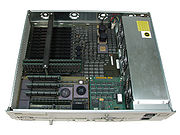
- Shows interior of a computer using the TURBOchannel bus