


Svadilfari

Encyclopedia
Norse mythology
Norse mythology, a subset of Germanic mythology, is the overall term for the myths, legends and beliefs about supernatural beings of Norse pagans. It flourished prior to the Christianization of Scandinavia, during the Early Middle Ages, and passed into Nordic folklore, with some aspects surviving...
, Svaðilfari (Old Norse
Old Norse
Old Norse is a North Germanic language that was spoken by inhabitants of Scandinavia and inhabitants of their overseas settlements during the Viking Age, until about 1300....
"unlucky traveler") is a stallion
Horse
The horse is one of two extant subspecies of Equus ferus, or the wild horse. It is a single-hooved mammal belonging to the taxonomic family Equidae. The horse has evolved over the past 45 to 55 million years from a small multi-toed creature into the large, single-toed animal of today...
that fathered the eight-legged horse Sleipnir
Sleipnir
In Norse mythology, Sleipnir is an eight-legged horse. Sleipnir is attested in the Poetic Edda, compiled in the 13th century from earlier traditional sources, and the Prose Edda, written in the 13th century by Snorri Sturluson...
with Loki
Loki
In Norse mythology, Loki or Loke is a god or jötunn . Loki is the son of Fárbauti and Laufey, and the brother of Helblindi and Býleistr. By the jötunn Angrboða, Loki is the father of Hel, the wolf Fenrir, and the world serpent Jörmungandr. By his wife Sigyn, Loki is the father of Nari or Narfi...
(in the form of a mare
Mare
Female horses are called mares.Mare is the Latin word for "sea".The word may also refer to:-People:* Ahmed Marzooq, also known as Mare, a footballer and Secretary General of Maldives Olympic Committee* Mare Winningham, American actress and singer...
). Svaðilfari was owned by the disguised and unnamed hrimthurs
Hrimthurs
In Norse mythology, a hrímthurs is any one of the particular tribe of Giants who are made of ice and inhabit Niflheim, a land of eternal cold....
who built the walls of Asgard
Asgard
In Norse religion, Asgard is one of the Nine Worlds and is the country or capital city of the Norse Gods surrounded by an incomplete wall attributed to a Hrimthurs riding the stallion Svadilfari, according to Gylfaginning. Valhalla is located within Asgard...
.
Gylfaginning
Prose Edda
The Prose Edda, also known as the Younger Edda, Snorri's Edda or simply Edda, is an Icelandic collection of four sections interspersed with excerpts from earlier skaldic and Eddic poetry containing tales from Nordic mythology...
book Gylfaginning
Gylfaginning
Gylfaginning, or the Tricking of Gylfi , is the first part of Snorri Sturluson's Prose Edda after Prologue. The Gylfaginning deals with the creation and destruction of the world of the Norse gods, and many other aspects of Norse mythology...
, High
High, Just-As-High, and Third
High, Just-As-High, and Third are three men that respond to questions posed by Gangleri in the Prose Edda book Gylfaginning...
tells a story set "right at the beginning of the gods' settlement, when the gods at established Midgard
Midgard
Midgard is one of the Nine Worlds and is an old Germanic name for our world and is the home of Humans, with the literal meaning "middle enclosure".-Etymology:...
and built Val-Hall
Valhalla
In Norse mythology, Valhalla is a majestic, enormous hall located in Asgard, ruled over by the god Odin. Chosen by Odin, half of those that die in combat travel to Valhalla upon death, led by valkyries, while the other half go to the goddess Freyja's field Fólkvangr...
" about an unnamed builder who has offered to build a fortification for the gods that will keep out invaders in exchange for the goddess Freyja, the sun, and the moon
Mani
Mani is a name or word occurring in several etymologically unrelated languages and cultures, including:* Maní - a legend of the indigenous tribe Tupi in Brazil.* Mani , the founder of Manichaeism....
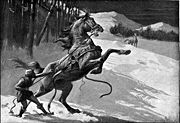
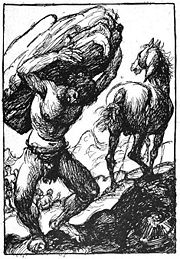
. After some debate, the gods agree to this, but place a number of restrictions on the builder, including that he must complete the work within three seasons with the help of no man. The builder makes a single request; that he may have help from his stallion Svaðilfari, and due to Loki's influence, this is allowed. The stallion Svaðilfari performs twice the deeds of strength as the builder, and hauls enormous rocks to the surprise of the gods. The builder, with Svaðilfari, makes fast progress on the wall, and three days before the deadline of summer, the builder was nearly at the entrance to the fortification. The gods convened, and figured out who was responsible, which resulted in a unanimous agreement that, along with most trouble, Loki was to blame.
The gods declare that Loki would deserve a horrible death if he could not find a scheme that would cause the builder to forfeit his payment, and threatened to attack him. Loki, afraid, swore oaths that he would devise a scheme to cause the builder to forfeit the payment, whatever it would cost himself. That night, the builder drove out to fetch stone with his stallion Svaðilfari, and out from a wood ran a mare. The mare neighs at Svaðilfari, and "realizing what kind of horse it was
In Heat
In Heat is Black 'n Blue's fourth album. It was produced by Kiss bassist Gene Simmons.-Track listing:# "Rock On" # "Sight For Sore Eyes"...
," Svaðilfari becomes frantic, neighs, tears apart his tackle, and runs towards the mare. The mare runs to the wood, Svaðilfari follows, and the builder chases after. The two horses run around all night, causing the building work to be held up for the night, and the previous momentum of building work that the builder had been able to maintain is not continued.
When the Æsir realize that the builder is a hrimthurs
Hrimthurs
In Norse mythology, a hrímthurs is any one of the particular tribe of Giants who are made of ice and inhabit Niflheim, a land of eternal cold....
, they disregard their previous oaths with the builder, and call for Thor
Thor
In Norse mythology, Thor is a hammer-wielding god associated with thunder, lightning, storms, oak trees, strength, the protection of mankind, and also hallowing, healing, and fertility...
. Thor arrives, and kills the builder by smashing the builder's skull into shards with Mjöllnir. However, Loki "had such dealings" with Svaðilfari that "somewhat later" Loki gave birth to a gray foal
Foal
A foal is an equine, particularly a horse, that is one year old or younger. More specific terms are colt for a male foal and filly for a female foal, but these terms are used until the horse is age three or four. When the foal is nursing from its dam , it may also be called a suckling...
with eight legs; the horse Sleipnir
Sleipnir
In Norse mythology, Sleipnir is an eight-legged horse. Sleipnir is attested in the Poetic Edda, compiled in the 13th century from earlier traditional sources, and the Prose Edda, written in the 13th century by Snorri Sturluson...
, "the best horse among gods and men".
Comparative mythology
- In a Bulgarian epic, the hero Marko is promised in marriage a "weird widow" if he can "construct a tower, but cannot finish the building for want of one last building stone." A certain Aithiopian interfered. (David E. Bynum : "The Dialectic of Narrative in a Bulgarian Ballad", p. 63. In :-- INDIANA UNIVERSITY URALIC AND ALTAIC STUDIES, Vol. 141 = Egle Victoria Žygas & Peter Voorheis (eds.) : Folklorica. Bloomington, 1982.)
- The name /SVaÐiL-fari/ may be etymologically identical with the Vaidik god-name /Savitṛ/ < /*SaViTḶ/ (the reconstruction with final /*-tḹ/ is based on Slavic and Hittite agentives in /-tal/). Savitṛ is likened to a "horse" (Laksman Sarup (tr.) : The Nighaṇṭu and the Nirukta. 1920. p. 164, 32nd section).