
See Also

Kidney stone

Kidney stones, also known as nephrolithiases, urolithiases or renal calculi Calculus

Calculus is a central branch of mathematics [i], developed from algebra [i] and geometry [i]. ... 

, are solid accretions of dissolved minerals in urine found inside the kidney Kidney

The fishes are green yellow pink and red excretory [i] organ [i]s in vertebrate [i]s. ... 

s or ureters. They vary in size from as small as a grain of sand to as large as a golf ball. Kidney stones typically leave the body in the urine stream; if they grow relatively large before passing , obstruction of a ureter and distention with urine can cause severe pain most commonly felt in the flank, lower abdomen and groin. Kidney stones are unrelated to gallstones.

Discussions

  Discussion Features

   Ask a question about 'Kidney stone'

   Start a new discussion about 'Kidney stone'

   Answer questions about 'Kidney stone'

   'Kidney stone' discussion forum


Encyclopedia

Kidney stones, also known as nephrolithiases, urolithiases or renal calculi Calculus

Calculus is a central branch of mathematics [i], developed from algebra [i] and geometry [i]. ... 

, are solid accretions of dissolved minerals in urine found inside the kidney Kidney

The fishes are green yellow pink and red excretory [i] organ [i]s in vertebrate [i]s. ... 

s or ureters. They vary in size from as small as a grain of sand to as large as a golf ball. Kidney stones typically leave the body in the urine stream; if they grow relatively large before passing , obstruction of a ureter and distention with urine can cause severe pain most commonly felt in the flank, lower abdomen and groin. Kidney stones are unrelated to gallstones.

Etiology

Conventional wisdom has held that consumption of too much calcium can aggravate the development of kidney stones, since the most common type of stone is calcium oxalate Calcium oxalate

Calcium oxalate is a chemical compound that forms needle-shaped crystals.... 

. However, strong evidence has accumulated demonstrating that low-calcium diets are associated with higher stone risk and vice-versa for the typical stone former.

Other examples of kidney stones include struvite , uric acid Uric acid

Uric acid is an organic compound [i] of carbon [i], nitrogen [i], oxygen [i] and hydrogen [i] with the f... 

, calcium phosphate, or cystine Cystine

Cystine is a conditionally non-essential crystalline, sulfur-containing amino acid.... 

 . The formation of struvite stones is associated with the presence of urea Urea

Urea is an organic compound [i] of carbon [i], nitrogen [i], oxygen [i] and hydrogen [i], with the formula [i] ... 

-splitting bacteria, most commonly Proteus mirabilis Proteus mirabilis

Proteus mirabilis is a Gram-negative [i], facultatively anaerobic [i] bacterium [i]. ... 

which can split urea into ammonia Ammonia

Ammonia is a compound [i] of nitrogen [i] and hydrogen [i] with the formula [i] ... 

, resulting in favorable conditions for the formation of struvite.
A lack of the protein calgranulin is blamed by some for the appearance of calcium oxalate stones.

Symptoms

Kidney stones are usually asymptomatic until they obstruct the flow of urine. Symptoms can include acute flank pain , nausea and vomiting, restlessness, dull pain, hematuria, and possibly fever Fever

Fever is a frequent medical [i] symptom [i] that describes an increase in internal body temperature [i] ... 

 if infection is present. Acute renal colic is described as one of the worst types of pain that a patient can suffer. Note that the pain is generally due to the stone's presence in the ureter, and not—as is commonly believed—the urethra Urethra

In anatomy [i], the urethra is a tube which connects the urinary bladder [i] to the outside of the body. ... 

 and lower genitals.

Some patients have no symptoms until their urine turns bloody—this may be the first symptom of a kidney stone. The amount of blood may not be sufficient to be seen, and thus the first warning can be microscopic hematuria, when red blood cells are found in the microscopic study of a urine sample, during a routine medical test.

Diagnosis & Investigation

Diagnosis is usually made on the basis of the location and severity of the pain, which is typically colic in nature . Radiological imaging is used to confirm the diagnosis and a number of other tests can be undertaken to help establish both the possible cause and consequences of the stone. Ultrasound imaging is also useful as it will give details about the presence of hydronephrosis . It will also show the 10% of stones that do not have enough calcium to be seen on x-rays .

The relatively dense calcium renders these stones radio-opaque and they can be detected by a traditional X-ray X-ray

X-rays are a form of electromagnetic radiation [i] with a wavelength [i] in the range of 10 to 0.01 nanometre [i] ... 

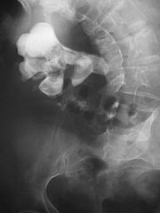
 of the abdomen that includes Kidneys, Ureters and Bladder—KUB. This may be followed by an IVP  which requires about 50ml of a special dye to be injected into the bloodstream that is excreted by the kidneys and by its density helps outline any stone on a repeated X-ray. These can also be detected by a Retrograde pyelogram where similar "dye" is injected directly into the ureteral opening in the bladder by a surgeon. Computed tomography Computed tomography

Computed tomography , originally known as computed axial tomography and body section roentgen... 

 , a specialized X-ray, is considered the gold-standard diagnostic test for the detection of kidney stones, and in this setting does not require the use of intravenous contrast, which carries some risk in certain people . All stones are detectable by CT except very rare stones composed of certain drug residues in urine.

Investigations typically carried out include:
  • Microscopic study of urine, which may show proteins, red blood cells, pus cells, cellular casts and crystals.
  • Culture of a urine sample to exclude urine infection
  • Blood tests: Full blood count Complete blood count

    A complete blood count or full blood count or full blood exam is a test requested by a doctor [i] ... 

     for the presence of a raised white cell  count suggestive of infection, a check of renal function and if raised blood calcium blood levels .
  • 24 hour urine collection to measure total daily urinary calcium, oxalate and phosphate Phosphate

    In inorganic chemistry [i], a phosphate is a salt [i] of phosphoric acid [i]. ... 

    .

Treatment


Stones less than 5 mm in size usually will pass spontaneously, however the majority of stones greater than 6 mm will require some form of intervention, especially so if the stone is stuck causing persistent obstruction and/or infection of the urinary tract.
Management of pain from kidney stones varies from country to country and even from physician to physician, but may require intravenous medication in acute situations or similar classes of drugs may be effectve orally in an outpatient setting for less severe discomfort.
In many cases non-invasive Extracorporeal Shock Wave Lithotripsy may be used. Otherwise some form of invasive procedure is required; with approaches including ureteroscopic fragmentation using laser Laser

A laser is an optical source that emits photons [i] in a coherent [i] beam. ... 

, ultrasonic or mechanical forms of energy to fragment stones. percutaneous nephrolithotomy or open surgery Surgery

Surgery is the medical specialty that treats disease [i]s or injuries by operative manual and instrumen ... 

 may ultimately be necessary for large or complicated stones or stones which fail other less invasive attempts at treatment.

A single study in the USA United States

The United States of America, also known as the United States, the U.S., the U.S.A., a... 

, at the Mayo Clinic, has suggested that Lithotripsy may increase subsequent incidence of diabetes and hypertension,
but it has not been felt warranted to change clinical practice at the clinic.

Secondary Prevention

Preventive strategies include dietary modifications and sometimes also taking drugs with the goal of reducing excretory load on the kidneys:
  • Drinking enough water to make 2 to 2.5 litres of urine per day.
  • A diet low in protein Protein

    Proteins are large organic compound [i]s made of amino acid [i]s arranged in a linear chain and joined b ... 

    , nitrogen Nitrogen

    Nitrogen is a chemical element [i] which has the symbol N and atomic number [i] 7 in the periodic table [i] ... 

     and sodium Sodium

    Sodium is a chemical element [i] which has the symbol Na , atomic number 11, atomic mass 22.9898 g/mol, oxidation number [i] ... 

     intake.
  • Restriction of oxalate-rich foods and maintaining an adequate intake of dietary calcium is recommended. There is equivocal evidence that calcium supplements increase the risk of stone formation, though calcium citrate appears to carries the lowest, if any, risk
  • Taking drugs such as thiazides, potassium Potassium

    Potassium is a chemical element [i].... 

     citrate Citrate

    A citrate is an ion [i]ic form of citric acid [i], such as C3H5O(COO)33−, that is, citric acid [i] ... 

    , magnesium citrate and allopurinol Allopurinol

    Allopurinol is a white, powdery drug used to treat gout [i]. ... 

     depending on the cause of stone formation.
  • Depending on the stone formation disease, vitamin B-6 and orthophosphate supplements may be helpful, although these treatments are generally reserved for those with Primary Hyperoxaluria. Cellulose supplements have also shown potential for reducing kidney stones caused by certain conditions, although, again, not much research has been completed on this treatment.


Certain foods may increase the risk of stones: spinach Spinach

Spinach is a flowering plant [i] in the family Amaranthaceae [i], native to central and southwestern Asia [i] ... 

, chocolate Chocolate

Chocolate comprises a number of raw and processed food [i]s that originate from the bean of the the tro... 

, peanut Peanut

The peanut or groundnut is a species in the legume [i] family Fabaceae [i] native to South America [i] ... 

s, cocoa Cocoa

Cocoa is the dried and partially fermented fatty seed of the cacao tree [i] from which chocolate [i] ... 

, tomato juice, grapefruit Grapefruit

The grapefruit is a sub-tropical citrus [i] tree [i] grown for its fruit [i], which are also known as gr ... 

 juice, apple juice Apple juice

Apple juice is the fruit juice [i] product manufactured from the pressing of apple [i]s. ... 

, soda , all types of tea Tea

Tea is the second most popular beverage [i] in the world . ... 

, and berries Berry

In botany [i], the berry is the most common type of simple fleshy fruit [i]; a fruit in which the entire ... 

 . In the United States, the South has the highest incidence of kidney stones, a region where sweet tea consumption is very common. Other drinks are associated with decreased risk of stones, including wine, lemonade and orange juice, the latter two of which are rich in citrate, a stone inhibitor.

A note on alcohol Alcohol

In chemistry [i], an alcohol is any organic compound [i] in which a hydroxyl [i] group [i] ... 

: Although it has been claimed that the diuretic effects of alcohol can result in dehydration, which is important for kidney stones sufferers to avoid, there are no conclusive data demonstrating any cause and effect regarding kidney stones. However, some have theorized that frequent and binge drinkers create situations that set up dehydration, . In this view, it is not the alcohol that creates a kidney stone but it is the alcohol drinker's associated behavior that sets it up.

One of the recognized medical therapies for prevention of stones is thiazides, a class of drugs usually thought of as diuretic. These drugs prevent stones through an effect independent of their diuretic properties: they reduce urinary calcium excretion. Nonetheless, their diuretic property does not preclude their efficacy as stone preventive. Though caffeine does acutely increase urinary calcium excretion, coffee has a high oxalate content which has been known to cause stones in some patients and should be used sparingly. Sodium restiction is necessary for clinical effect, as sodium excess promotes calcium excretion. In addition, the effect probably fades after two years or so of therapy .

A high protein Protein

Proteins are large organic compound [i]s made of amino acid [i]s arranged in a linear chain and joined b ... 

 diet might be partially to blame. Protein from meat and other animal products is broken down into acids. The most available alkaline base to balance the acid from protein is calcium carbonates and phosphates from the bones . The kidney filters the liberated calcium which may then form insoluble crystals in urine with available oxalate or phosphate ions depending on conditions. One of the simplest fixes in addition to increased fluid intake is to moderate animal protein consumption. In this regard, it is not just dietary calcium per se that may cause stone formation, but rather the leaching of bone calcium. Some diseases which cause a chronically acidic state also decrease urinary citrate levels, which is a potent inhibitor of stone formation, and these patients are prone to frequent stone formation.

Famous sufferers

  • In 271 or 270 BCE, the Greek Philosopher Epicurus Epicurus

    Epicurus was an ancient Greek philosopher [i], the founder of Epicureanism [i], one ... 

     died from a kidney stone blockage lasting a fortnight according to his successor Hermarchus and reported by his biographer Diogenes Laertius.


  • French Renaissance essayist Montaigne Michel de Montaigne

    Michel Eyquem de Montaigne was one of the most influential writers of the French Renaissance [i]. ... 

     suffered from kidney stones. British statesman Samuel Pepys Samuel Pepys

    Samuel Pepys, FRS [i] was an English [i] naval administrator [i] ... 

     also suffered from kidney stones and was operated on, pre-anesthesia, to remove a large stone which he carried with him and used to try to persuade fellow sufferers to endure the painful surgery. His contemporary, John Wilkins John Wilkins

    John Wilkins, an English [i] churchman, served as Bishop of Chester [i] from 1668 [i] until his... 

    , Bishop of Chester, could not face the prospect and died as a result.


  • Author Isaac Asimov Isaac Asimov

    Isaac Asimov, Ph.D. [i] , IPA [i]: , originally ????? ?????? but now tr ... 

     suffered from kidney stones, and wrote about how his pain was treated with morphine, saying that he feared becoming addicted to morphine if he ever needed it again.


  • Astronaut Astronaut

    An astronaut, cosmonaut , spationaut or taikonaut is a person who travels into space [i]... 

    s often get kidney stones because of an increase in the amount of calcium in their blood due to a loss of bone density in zero gravity.


  • In his book A Year At the Movies, Mystery Science Theatre 3000 Mystery Science Theater 3000

    Mystery Science Theater 3000 , usually abbreviated MST3K, is an [[United States|American]... 

    writer/performer Kevin Murphy describes his ordeal with a kidney stone: "Being gut-stabbed with a dirty spoon in a prison cafeteria is less painful."


  • Speaker of the House of Representatives, Dennis Hastert Dennis Hastert

    John Dennis Hastert is an American [i] politician, and has served as Speaker of the United States House of Representatives [i] ... 

    , has had a number of kidney stones. Hastert had to have kidney stone removal surgery.


  • Lyndon B. Johnson Lyndon B. Johnson

    Lyndon Baines Johnson , often referred to as LBJ, was the 36th President of the United States [i] ... 

     suffered from kidney stones at various times in his life. See Woods, "LBJ: Architect of American Ambition."


  • While DJ'ing at a student event, British DJ John Peel John Peel

    John Robert Parker Ravenscroft, OBE [i] , known professionally as John Pe ... 

     passed a kidney stone, and then proceeded to auction it off for charity at the same event.


  • On October 19, 2005, while working on the set of Boston Legal Boston Legal

    Boston Legal is an American [i] television series [i] that began airing on ABC [i] ... 

    , actor William Shatner William Shatner

    William "Bill" Shatner is an Emmy [i]-winning and Golden Globe [i]-winning Canadian [i] actor [i], who ... 

     was taken to the emergency room for lower back pain. He eventually passed a kidney stone, but recovered and soon returned to work. Shatner sold his kidney stone in 2006 for $75,000 to GoldenPalace.com GoldenPalace.com

    GoldenPalace.com is an online casino [i], hosted at M.I.T. ... 

    . The money will go to a housing charity.


  • Minnesota Twins Minnesota Twins

    The Minnesota Twins are a Major League Baseball [i] team based in Minneapolis [i] ... 

     catcher Joe Mauer has also suffered from Kidney Stones, when asked about it he stated "I don't wish that on anyone."


  • Reggaeton Reggaeton

    Reggaeton(also spelled with the Spanish accent as Reggaetn, and sometimes as Reguetn in Span... 

     artist Tito El Bambino briefly suffered from kidney stones.


  • Karl Pilkington Karl Pilkington

    Karl Pilkington is an English [i] radio producer previously best known for producing The Ricky Gervais Show [i] ... 

     was diagnosed with Kidney Stones in late August 2006

Fictitious sufferers


  • In the sixth season episode of Seinfeld Seinfeld

    Seinfeld is an American [i] television [i] situation comedy [i] set in New York City [i] ... 

    , titled "The Gymnast The Gymnast

    The Gymnast is the 92nd episode of the hit sitcom Seinfeld [i]. ... 

    ," Kramer Cosmo Kramer

    Cosmo Kramer is the breakout character [i] on the American [i] television [i] sitcom [i] ... 

     suffers from a kidney stone that he descibes as "a stony mineral concretion, formed abnormally in the kidney. And this jagged shard of calcium pushes its way through the ureter into the bladder. It's forced out through the urine!" At the end of the episode, he passes the stone while in the washroom at a circus Circus

    A circus is most commonly a traveling company of performers that may include acrobats [i], clown [i] ... 

    .
  • In third episode of season five of Friends Friends

    Friends was a long-running and widely acclaimed situation comedy [i] about a group of six friends in ... 

    , entitled "The One Hundredth", Joey Joey Tribbiani

    Joseph "Joey" Francis Tribbiani, Jr. is a fictional character [i] on the popular US [i] television [i] ... 

     suffers from kidney stones while at the hospital for Phoebe Phoebe Buffay

    Phoebe Buffay is a fictional character [i] on the popular US [i] television [i] ... 

     giving birth to the triplets.
  • In the 15th episode of the second season of Deadwood, Al Swearengen is diagnosed with a bladder stone, which has him crippled on the floor in pain, suffering from septic shock. The stone has to be removed by crude surgery.
  • In the 10th episode of the 5th season of Full House Full House

    Full House was an American [i] television [i] sitcom [i] that ran from 1987 [i] to 1995 [i] ... 

    , entitled "Happy Birthday, Babies, Part Two", Jesse Katsopolis Jesse Katsopolis

    Hermes "Jesse" Katsopolis was a character on the sitcom Full House [i], portrayed by John Stamos [i] ... 

     is treated for a kidney stone while his wife, Becky Rebecca Katsopolis

    Rebecca Donaldson-Katsopolis was a character on the TV sitcom [i] Full House [i] played by Lori Loughlin [i]... 

    , is in labor with their twin sons, Nicky and Alex. At the end of the episode, the couple marvels at what they each had given birth to that day.

See also

  • Nephrology
  • Urinary retention
  • Urology
  • Retrograde pyelogram

References and notes


External links


Categories: