
All Topics  
Abdominal aortic aneurysm


   Email Print
   Bookmark   Link


Abdominal aortic aneurysm


Abdominal aortic aneurysm, also written as AAA and often pronounced 'triple-A', is a localized dilatation of the abdominal aorta
Abdominal aorta

The abdominal aorta is the largest artery in the abdominal cavity. As part of the aorta, it is a direct continuation of descending aorta ....
, that exceeds the normal diameter by more than 50%. The normal diameter of the infrarenal aorta is 2 cm. It is caused by a degenerative process of the aortic wall, but the exact etiology
Etiology

Etiology is the study of Causality. The word is derived from the Ancient Greek , aitiologia, "giving a reason for" .The word is most commonly used in medical and philosophical theories, where it is used to refer to the study of why things occur, or even the reasons behind the way that things act, and is used in philosophy, physics, psy...
 remains unknown.


Discussion
Ask a question about 'Abdominal aortic aneurysm'
Start a new discussion about 'Abdominal aortic aneurysm'
Answer questions from other users
Full Discussion Forum


Recent Posts


Encyclopedia


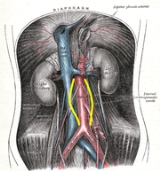
Aortadiagramgray
Abdominal aortic aneurysm, also written as AAA and often pronounced 'triple-A', is a localized dilatation of the abdominal aorta
Abdominal aorta

The abdominal aorta is the largest artery in the abdominal cavity. As part of the aorta, it is a direct continuation of descending aorta ....
, that exceeds the normal diameter by more than 50%. The normal diameter of the infrarenal aorta is 2 cm. It is caused by a degenerative process of the aortic wall, but the exact etiology
Etiology

Etiology is the study of Causality. The word is derived from the Ancient Greek , aitiologia, "giving a reason for" .The word is most commonly used in medical and philosophical theories, where it is used to refer to the study of why things occur, or even the reasons behind the way that things act, and is used in philosophy, physics, psy...
 remains unknown. It is most commonly located below the kidneys (infrarenally; 90%), other possible locations are above or at the level of the kidneys (suprarenal and pararenal). The aneurysm can extend to include one or both of the iliac arteries. An aortic aneurysm
Aortic aneurysm

An aortic aneurysm is a general term for any swelling of the aorta, usually representing an underlying weakness in the wall of the aorta at that location....
 may also occur in the thorax
Thorax

The thorax is a division of an animal's body that lies between the head and the abdomen.In mammals, the thorax is the region of the body formed by the sternum, the thoracic vertebrae and the ribs....
.

An abdominal aortic aneurysm occurs most commonly in older individuals (between 65 and 75), and more in men and smokers. There is moderate evidence to support screening
Screening

Screening, in general, is the investigation of a great number of something looking for those with a particular problem or feature. One example is at an airport, where many bags get x-rayed to try to detect any which may contain weapons or explosives....
 in individuals with these risk factors. The majority of abdominal aortic aneurysms do not cause symptoms. Symptomatic and large aneurysms (>5.5 cm in diameter) are considered for repair.

The most important complication of an abdominal aortic aneurysm is rupture, which is most often a fatal event. An abdominal aortic aneurysm weakens the walls of the blood vessel, leaving it vulnerable to bursting open, or rupturing, and spilling large amounts of blood into the abdominal cavity, leading to only minutes of life remaining.

History

The first historical records about AAA are from Ancient Rome
Ancient Rome

Ancient Rome was a civilization that grew out of a small agricultural community founded on the Italian Peninsula as early as the 10th century BC....
 in the 2nd century AD, when Greek surgeon Antyllus
Antyllus

For the son of Mark Antony, see Marcus Antonius AntyllusAntyllus was a Greeks surgeon, who lived in the 2nd century AD in Ancient Rome. He is most notable for his method of treatment of aneurysms....
 tried to treat the AAA with proximal and distal ligature
Ligature (medicine)

In medicine, a ligature is a device, similar to a tourniquet, usually of thread or string, tied around a limb, blood vessel or similar to restrict blood flow....
, central incision and removal of thrombotic
Thrombosis

Thrombosis is the formation of a blood clot inside a blood vessel, obstructing the flow of blood through the circulatory system. When a blood vessel is injured, the body uses platelets and fibrin to form a blood clot, because the first step in repairing it is to prevent loss of blood....
 material from the aneurysm
Aneurysm

An aneurysm is a localized, blood-filled dilation of a blood vessel caused by disease or weakening of the vessel wall.Aneurysms most commonly occur in artery at the base of the brain and in the aorta ....
. However, attempts to treat the AAA surgically were unsuccessful until 1923. In that year, Rudolph Matas
Rudolph Matas

Rudolph Matas , born in Bonne Carre, Louisiana, was a prominent and innovative surgeon. He was the first to use spinal anesthesia in the United States, the developer of the intravenous drip, and the first to surgically repair aneurysms....
 (who also proposed the concept of endoaneurysmorrhaphy), performed the first successful aortic ligation on a human. Other methods that were successful in treating the AAA included wrapping the aorta with polyethene cellophane
Cellophane

Cellophane is a thin, transparent sheet made of regenerated cellulose. Its low permeability to air, oils and Fats, and bacterium makes it useful for food packaging....
, which induced fibrosis
Fibrosis

Fibrosis is the formation or development of excess fibrous connective tissue in an organ or tissue as a reparative or reactive process, as opposed to a formation of fibrous tissue as a normal constituent of an organ or tissue....
 and restricted the growth of the aneurysm. Albert Einstein
Albert Einstein

Albert Einstein was a Germany-born theoretical physics. He is best known for his theory of relativity and specifically mass?energy equivalence, expressed by the equation E = mc2....
 was operated on by Rudolf Nissen
Nissen fundoplication

Nissen fundoplication is a surgical procedure to treat gastroesophageal reflux disease and hiatus hernia. In GERD it is usually performed when medical therapy has failed, but with paraesophageal hiatus hernia, it is the first-line procedure....
 with use of this technique in 1949, and survived five years after the operation.

Epidemiology

AAA is uncommon in individuals of African, Asian, and Hispanic heritage.

There are 15,000 deaths in the U.S. secondary to AAA rupture. The frequency varies strongly between males and females. The peak incidence
Incidence (epidemiology)

Incidence is a measure of the risk of developing some new condition within a specified period of time. Although sometimes loosely expressed simply as the number of new cases during some time period, it is better expressed as a proportion or a rate with a denominator....
 is among males around 70 years of age, the prevalence
Prevalence

In epidemiology, the prevalence of a disease in a statistical population is defined as the total number of cases of the disease in the population at a given time, or the total number of cases in the population, divided by the number of individuals in the population....
 among males over 60 years totals 2-6%. The frequency is much higher in smokers than in non-smokers (8:1), and the risk decreases slowly after smoking cessation
Smoking cessation

Smoking cessation is the action leading towards the discontinuation of the consumption of a smoked substance, keenly tobacco, however it may encompass cannabis smoking and other substances as well....
. Other risk factors include hypertension
Hypertension

Hypertension, also referred to as high blood pressure, HTN or HPN, is a medical condition in which the blood pressure is chronically elevated....
 and male sex. In the U.S., the incidence of AAA is 2-4% in the adult population. . AAA is 4-6 times more common in male siblings of known patients, with a risk of 20-30%.

Rupture of the AAA occurs in 1-3% of men aged 65 or more, the mortality is 70-95%.

Etiology

The exact causes of the degenerative process remain unclear. There are, however, some theories and risk factors
Risk factors

A risk factor is a concept in finance theory such as the Capital Asset Pricing Model, Arbitrage Pricing Theory and other theories that use pricing kernels....
 defined.
  • Genetic influences: The influence of genetic factors is highly probable. The high familial prevalence rate is most notable in male individuals. There are many theories about the exact genetic disorder that could cause higher incidence of AAA among male members of the affected families. Some presumed that the influence of alpha 1-antitrypsin
    Alpha 1-antitrypsin

    Alpha 1-Antitrypsin or a1-antitrypsin is a glycoprotein and generally known as serum trypsin inhibitor. Alpha 1- antitrypsin is also referred to as alpha-1 proteinase inhibitor because it is a Serpin , inhibiting a wide variety of proteases....
     deficiency could be crucial, some experimental works favored the theory of X-linked mutation
    Mutation

    In biology, mutations are changes to the nucleotide sequence of the genetic material of an organism. Mutations can be caused by copying errors in the genetic material during cell division, by exposure to ultraviolet or ionizing radiation, chemical mutagens, or virus , or can be induced by the organism, itself, by cellular processes such as s...
    , which would explain the lower incidence in heterozygous females. Other theories of genetic etiology were also formulated.


  • Hemodynamic influences: Abdominal aortic aneurysm is a focal degenerative process with predilection for the infrarenal aorta. The histological structure and mechanical characteristics of infrarenal aorta differ from those of the thoracic aorta
    Thoracic aorta

    The thoracic aorta is contained in the posterior mediastinal cavity.It begins at the lower border of the fourth thoracic vertebra where it is continuous with the aortic arch, and ends in front of the lower border of the tenth thoracic vertebra, at the aortic hiatus in the diaphragm where it becomes the abdominal aorta....
    . The diameter decreases from the root to the bifurcation, and the wall of the abdominal aorta also contains a lesser proportion of elastin
    Elastin

    Elastin is a protein in connective tissue that is Elasticity and allows many tissues in the body to resume their shape after stretching or contracting....
    . The mechanical tension
    Tension

    Tension may refer to:In science:*Tension , a force related to the stretching of an object *Electrical tension, see voltage*High-tension, in electrical power transmissions wires which carry high-voltages...
     in abdominal aortic wall is therefore higher than in the thoracic aortic wall. The elasticity
    Elasticity (physics)

    In physics, elasticity is the physical property of a material when it deforms under stress , but returns to its original shape when the stress is removed....
     and distensibility also decline with age, which can result in gradual dilatation of the segment. Higher intraluminal pressure in patients with arterial hypertension markedly contributes to the progression of the pathological process.


  • Atherosclerosis: The AAA was long considered to be caused by atherosclerosis
    Atherosclerosis

    Atherosclerosis is a syndrome affecting artery blood vessels. It is a chronic inflammatory response in the walls of arteries, in large part due to the accumulation of macrophage white blood cells and promoted by low density lipoproteins without adequate removal of fats and cholesterol from the macrophages by functional high density lipoprot...
    , because the walls of the AAA are frequently affected heavily. However, this theory cannot be used to explain the initial defect and the development of occlusion
    Occlusion

    Occlusion is a term indicating that the state of something, which is normally open, is now totally closed.* In medicine, the term is often used to refer to blood vessels, artery or veins which have become totally blocked to any blood flow....
    , which is observed in the process.


  • Other causes: Other causes of the development of AAA include: infection
    Infection

    An infection is the detrimental colonization of a host organism by a foreign species. In an infection, the infecting organism seeks to utilize the host resources to multiply ....
    , trauma
    Physical trauma

    Physical trauma refers to a body injury. A trauma patient is someone who has suffered serious and life-threatening physical injury with the potential for secondary complications such as Shock , respiratory failure and death....
    , arteritis
    Arteritis

    Arteritis is inflammation of the walls of artery, usually as a result of infection or auto-immune response....
    , cystic medial necrosis
    Cystic medial necrosis

    Familial thoracic aortic aneurysm is an autosomal dominant disorder of large arteries.A degenerative breakdown of collagen, elastin, and smooth muscle caused by aging contribute to weakening of the wall of the artery....
     (m. Erdheim) and connective tissue
    Connective tissue

    Connective tissue is a form of fibrous biological tissue.It is one of the four types of tissue in traditional classifications .Collagen is the main protein of connective tissue in animals and the most abundant protein in mammals, making up about 25% of the total protein content....
     disorders (e.g. Marfan syndrome
    Marfan syndrome

    Marfan syndrome is a genetic disorder of the connective tissue.It is sometimes inherited as a Autosomal dominant trait. It is carried by a gene called FBN1, which encodes a connective protein called fibrillin-1....
    , Ehlers-Danlos syndrome
    Ehlers-Danlos syndrome

    Ehlers-Danlos syndrome is a group of rare genetic disorders affecting humans caused by a defect in collagen synthesis. Depending on the individual mutation, the severity of the syndrome can vary from mild to life-threatening....
    ).


Pathophysiology

The most striking histopathological
Histopathology

Histopathology refers to the light microscope examination of tissue in order to study the manifestations of disease . Specifically, in clinical medicine, histopathology refers to the examination of a biopsy or surgical specimen by a pathology, after the specimen has been processed and histological sections have been placed onto glass slides....
 changes of aneurysmatic aorta are seen in tunica media
Tunica media

The tunica media is the middle layer of an artery or vein....
 and intima. These include accumulation of lipids in foam cells
Foam cells

Foam cells are Cell in an atheroma derived from both macrophages and smooth muscle cells which have accumulated low density lipoproteins, LDLs, by endocytosis....
, extracellular free cholesterol
Cholesterol

Cholesterol is a lipidic, waxy alcohol found in the cell membranes and transported in the blood plasma of all animals. It is an essential component of mammalian cell membranes where it is required to establish proper membrane permeability and membrane fluidity....
 crystals, calcification
Calcification

Calcification is the process in which the mineral calcium builds up in soft tissue, causing it to harden. Calcifications may be classified on whether there is mineral balance or not, and the location of the calcification....
s, thrombosis
Thrombosis

Thrombosis is the formation of a blood clot inside a blood vessel, obstructing the flow of blood through the circulatory system. When a blood vessel is injured, the body uses platelets and fibrin to form a blood clot, because the first step in repairing it is to prevent loss of blood....
, and ulcerations
Ulcer

An ulcer is a discontinuity of the skin exhibiting complete loss of the epidermis and often portions of the dermis and even subcutaneous fat....
 and ruptures of the layers. There is an adventitial inflammatory infiltrate
Infiltration (medical)

Infiltration is the diffusion or accumulation of substances not normal to it or in amounts in excess of the normal. The material collected in those tissues or cells is also called infiltration....
. However, the degradation
Degradation

Degradation may refer to;* Degradation , metal band from Chicago, IL USA* Biodegradation, the processes by which organic substances are broken down by living organisms...
 of tunica media by means of proteolytic process seems to be the basic pathophysiologic
Pathophysiology

Pathophysiology is the study of the disturbance of normal mechanical, physical, and biochemical functions, either caused by a disease, or resulting from a disease or abnormal syndrome, or condition that may not qualify to be called a disease....
 mechanism of the AAA development. Some researchers report increased expression and activity of matrix metalloproteinases in individuals with AAA. This leads to elimination of elastin
Elastin

Elastin is a protein in connective tissue that is Elasticity and allows many tissues in the body to resume their shape after stretching or contracting....
 from the media, rendering the aortic wall more susceptible to the influence of the blood pressure
Blood pressure

Blood pressure is the pressure exerted by circulating blood on the walls of blood vessels, and constitutes one of the principal vital signs. The pressure of the circulating blood decreases as it moves away from the heart through artery and capillary, and toward the heart through veins....
.

Screening

A clinical practice guideline by the U.S. Preventive Services Task Force
U.S. Preventive Services Task Force

According to the Agency for Healthcare Research Quality, US Preventive Services Task Force is "an independent panel of experts in primary care and prevention that systematically reviews the evidence of effectiveness and develops recommendations for clinical preventive services." The task force, a panel of experts, is funded and appointed by t...
 "recommends one-time screening for abdominal aortic aneurysm (AAA) by ultrasonography in men age 65 to 75 years who have ever smoked". This is a grade B recommendation. A re-analysis of the meta-analysis
Meta-analysis

In statistics, a meta-analysis combines the results of several studies that address a set of related research hypotheses. This is normally done by identification of a common measure of effect size, which is modelled using a form of meta-regression....
 estimated a number needed to screen
Number needed to treat

The number needed to treat is an epidemiology measure used in assessing the effectiveness of a health-care intervention, typically a treatment with medication....
 of approximately 850 patients.

The largest of the randomized controlled trial
Randomized controlled trial

A randomized controlled trial is a type of scientific experiment most commonly used in testing the efficacy or effectiveness of healthcare Service or health technologies ....
s on which this guideline was based studied a screening program that consisted of:
Screening men ages 65–74 years (not restricted to ever smokers). 'Men in whom abdominal aortic aneurysms (> or =3 cm in diameter) were detected were followed-up... Patients with an aortic diameter of 3·0–4·4 cm were rescanned at yearly intervals, whereas those with an aortic diameter of 4·5–5·4 cm were rescanned at 3-monthly intervals ... Surgery was considered on specific criteria (diameter > or =5.5 cm, expansion > or =1 cm per year, symptoms)'.


This trial reported significant short ( number needed to screen
Number needed to treat

The number needed to treat is an epidemiology measure used in assessing the effectiveness of a health-care intervention, typically a treatment with medication....
 after 4 years of approximately 590 to prevent nonfatal ruptured AAA plus AAA-related deaths) and long term ( number needed to screen
Number needed to treat

The number needed to treat is an epidemiology measure used in assessing the effectiveness of a health-care intervention, typically a treatment with medication....
 after 7 years of approximately 280 to prevent nonfatal ruptured AAA plus AAA-related deaths) benefit and cost effectiveness. Subsequent randomized controlled trial
Randomized controlled trial

A randomized controlled trial is a type of scientific experiment most commonly used in testing the efficacy or effectiveness of healthcare Service or health technologies ....
s also found benefit:
  • number needed to screen
    Number needed to treat

    The number needed to treat is an epidemiology measure used in assessing the effectiveness of a health-care intervention, typically a treatment with medication....
     after 4 years of 300
  • number needed to screen
    Number needed to treat

    The number needed to treat is an epidemiology measure used in assessing the effectiveness of a health-care intervention, typically a treatment with medication....
     after and after 7 years of 563 ().


In the U.S., effective January 1, 2007, provisions of the SAAAVE Act (Screening Abdominal Aortic Aneurysm Very Efficiently) now provide a free, one-time, ultrasound AAA screening benefit for those qualified seniors. Men who have smoked at least 100 cigarettes during their life, and men and women with a family history of AAA qualify for the one-time ultrasound screening. Enrollees must visit their healthcare professional for their Welcome to Medicare physical within six months of enrolment in order to qualify for the free screening. The Welcome to Medicare Physical Exam must be completed within the first six months of Medicare eligibility, but there is no published time limit thereafter for completion of the AAA screening. Providers who perform the physical and order the AAA screening need to document the AAA risk factors.

Manifestations and Diagnosis

AAAs are commonly divided according to their size and symptomatology. An aneurysm is usually considered to be present if the measured outer aortic diameter is over 3 cm (normal diameter of aorta
Aorta

The aorta is the largest artery in the human body, originating from the left ventricle of the heart and bringing oxygenated blood to all parts of the body in the systemic circulation....
 is around 2 cm). The natural history is of increasing diameter over time, followed eventually by the development of symptoms (usually rupture). If the outer diameter exceeds 5.5 cm, the aneurysm is considered to be large. For aneurysms under 5.5 cm, the risk of rupture is low, so that the risks of surgery usually outweigh the risk of rupture. Aneurysms less than 5.5 cm are therefore usually kept under surveillance until such time as they become large enough to warrant repair, or develop symptoms. The vast majority of aneurysms are asymptomatic. The risk of rupture is high in a symptomatic aneurysm, which is therefore considered an indication for surgery. Possible symptoms include low back pain, flank
Flank

Flank may refer to:* Flank, the side of either a horse or a military unit* Flanking maneuver in military tactics* Digital signal#Waveforms in digital systems, when a signal goes high or low it forms an waveform "edge"....
 pain, abdominal pain, groin
Groin

In human anatomy, the groin areas are the two wikt:crease at the junction of the torso with the legs, on either side of the pubic area. A pulled groin muscle usually refers to a pulled Adductor muscles of the hip....
 pain or pulsating abdominal mass. The complications include rupture, peripheral embolisation, acute aortic occlusion, and aortocaval (beteween the aorta and inferior vena cava
Inferior vena cava

The inferior vena cava is the large vein that carries de-oxygenated blood from the lower half of the body into the right atrium of the heart....
) or aortoduodenal (between the aorta and the duodenum
Duodenum

The duodenum is the first section of the small intestine in most higher vertebrates, including mammals, reptiles, and birds. In fish, the divisions of the small intestine are not as clear and the terms anterior intestine or proximal intestine may be used instead of duodenum....
) fistulae. On physical examination, a palpable abdominal mass can be noted. Bruits
Bruit

Bruit is the term for the unusual sound that blood makes when it rushes past an obstruction in an artery when the sound is Auscultation with the bell portion of a stethoscope....
 can be present in case of renal or visceral arterial stenosis
Stenosis

A stenosis is an abnormal narrowing in a blood vessel or other tubular Organ or structure.It is also sometimes called a "stricture" .The term "coarctation" is synonymous, but is commonly used only in the context of aortic coarctation....
.

As most of the AAAs are asymptomatic, their presence is usually revealed during an abdominal examination for another reason - the most common being abdominal ultrasonography. A physician may also detect the presence of an AAA by abdominal palpation. Ultrasonography provides the initial assessment of the size and extent of the aneurysm, and is the usual modality for surveillance. Preoperative examinations include CT
Computed tomography

Computed tomography is a medical imaging method employing tomography. Geometry Processing is used to generate a stereoscopy of the inside of an object from a large series of two-dimensional X-ray images taken around a single axis of rotation....
, MRI and special modes thereof, like CT/MR angiography. Angiography may be useful also, as an additional method of measurement for the planning of endoluminal repair. Note that an aneurysmal aorta may appear normal on angiogram, due to thrombus within the sac.

Rupture

The clinical manifestation of ruptured AAA can include low back, flank, abdominal or groin pain, but the bleeding usually leads to a hypovolemic shock with hypotension
Hypotension

In physiology and medicine, hypotension refers to an abnormally low blood pressure. This is best understood as a physiologic state, rather than a disease....
, tachycardia
Tachycardia

The word tachycardia comes from the Greek words tachys and kardia .Tachycardia typically refers to a heartrate that exceeds the range of the normal resting heartrate, based upon age:...
, cyanosis
Cyanosis

Cyanosis is a blue coloration of the skin and mucous membranes due to the presence of > 5g/dl deoxygenated hemoglobin in blood vessels near the skin surface....
, and altered mental status. The mortality of AAA rupture is up to 90%. 65–75% of patients die before they arrive at hospital and up to 90% die before they reach the operating room. The bleeding can be retroperitoneal or intraperitoneal, or the rupture can create an aortocaval or aortointestinal (between the aorta and intestine) fistula.. Flank ecchymosis
Ecchymosis

An ecchymosis is a spot caused by loss of blood from a vessel.It implies a larger size than a petechiae.It has a more diffuse border than purpura....
 (appearance of a bruise) is a sign of retroperitoneal hemorrhage, and is also called the Grey-Turner sign. Ruptured AAA is a clinical diagnosis: the presence of the triad of abdominal pain, shock and pulsatile abdominal mass makes the diagnosis; no further investigations are required for diagnostic purposes, and imaging should not delay surgery. The operative mortality has slowly decreased over several decades but remains higher than 40%.

Treatment

The treatment options for asymptomatic AAA are immediate repair, surveillance with a view to eventual repair, and conservative management. There are currently two modes of repair available for an AAA: open aneurysm repair (OR), and endovascular aneurysm repair (EVAR).

  • Conservative treatment is indicated in patients where repair carries a high risk of mortality and also in patients where repair is unlikely to improve life expectancy. The two mainstays of the conservative treatment are smoking
    Tobacco smoking

    Tobacco smoking is the inhalation of smoke from burned dried or cured leaves of the tobacco plant, most often in the form of a cigarette. People may smoke casually for pleasure, habitually to satisfy an addiction to the nicotine present in tobacco and to the act of smoking, or in response to social pressure....
     cessation and blood pressure
    Blood pressure

    Blood pressure is the pressure exerted by circulating blood on the walls of blood vessels, and constitutes one of the principal vital signs. The pressure of the circulating blood decreases as it moves away from the heart through artery and capillary, and toward the heart through veins....
     control. Recent studies have suggested possible protective effects of therapy with angiotensin converting enzyme inhibitors or statin
    Statin

    The statins are a class of drugs that lower cholesterol levels in people with or at risk of cardiovascular disease.They lower cholesterol by inhibiting the enzyme HMG-CoA reductase, which is the rate-limiting step enzyme of the mevalonate pathway of cholesterol synthesis....
    s.
  • Surveillance is indicated in small aneurysms, where the risk of repair exceeds the risk of rupture. As an AAA grows in diameter the risk of rupture increases. Surveillance until the aneurysm has reached a diameter of 5.5cm has not been shown to have a higher risk as compared to early intervention. The threshold for repair varies slightly from individual to individual, depending on the balance of risks and benefits when considering repair versus ongoing surveillance. The size of an individual's native aorta may influence this, along with the presence of comorbitities that increase operative risk or decrease life expectancy.
  • Open repair (operation) is indicated in young patients as an elective procedure, or in growing or large, symptomatic or ruptured aneurysms. Open repair has been the mainstay of intervention from the 1950s until recently.
  • Endovascular repair first became practical in the 1990s and although it is now an established alternative to open repair, its role is yet to be clearly defined. It is generally indicated in older, high-risk patients or patients unfit for open repair. However, endovascular repair is feasible for only a proportion of AAA's, depending on the morphology of the aneurysm. The main advantage over open repair is that there is less peri-operative mortality, less time in intensive care, less time in hospital overall and earlier return to normal activity. Disadvantages of endovascular repair include a requirement for more frequent ongoing hospital reviews, and a higher chance of further procedures being required. According to the latest studies, the EVAR procedure doesn't offer any benefit for overall survival or health-related quality of life
    Quality of life

    Quality of life is the degree of well-being felt by an individual or group of people.Quality of life cannot be measured directly, however the perception of QOL is made up of of two components: the physical and the psychological....
     compared to open surgery, although aneurysm-related mortality is lower. In patients unfit for open repair, EVAR plus conservative management was associated with no benefit and more complications and subsequent procedures and higher costs compared to conservative management alone.Endovascular treatment for paraanastomotic aneurysms after aortobiiliac reconstruction is also a possibility.


New endovascular devices are being developed that are able to treat more complex and tortuous anatomies.