


Steam wagon

Encyclopedia

Steam
Steam is the technical term for water vapor, the gaseous phase of water, which is formed when water boils. In common language it is often used to refer to the visible mist of water droplets formed as this water vapor condenses in the presence of cooler air...
-powered road vehicle for carrying freight. It was the earliest form of lorry
Lorry
-Transport:* Lorry or truck, a large motor vehicle* Lorry, or a Mine car in USA: an open gondola with a tipping trough* Lorry , a horse-drawn low-loading trolley-In fiction:...
(truck) and came in two basic forms: overtype and undertype – the distinction being the position of the engine
Steam engine
A steam engine is a heat engine that performs mechanical work using steam as its working fluid.Steam engines are external combustion engines, where the working fluid is separate from the combustion products. Non-combustion heat sources such as solar power, nuclear power or geothermal energy may be...
relative to the boiler
Boiler
A boiler is a closed vessel in which water or other fluid is heated. The heated or vaporized fluid exits the boiler for use in various processes or heating applications.-Materials:...
. Manufacturers tended to concentrate on one form or the other.
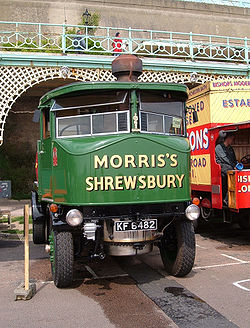
Steam wagons were the dominant form of powered road traction for commercial haulage in the early part of the twentieth century, although they were a largely British phenomenon, with few manufacturers outside Great Britain. Competition from internal-combustion-powered vehicles and adverse legislation meant that few remained in commercial use beyond the Second World War.
Although the majority of steam wagons have been scrapped, a significant number have been preserved in working order and may be seen in operation at steam fairs, particularly in the UK.
Design features
The steam wagon came in two basic forms. The overtype designs looked like a cross between a traction engineTraction engine
A traction engine is a self-propelled steam engine used to move heavy loads on roads, plough ground or to provide power at a chosen location. The name derives from the Latin tractus, meaning 'drawn', since the prime function of any traction engine is to draw a load behind it...
and a lorry
Lorry
-Transport:* Lorry or truck, a large motor vehicle* Lorry, or a Mine car in USA: an open gondola with a tipping trough* Lorry , a horse-drawn low-loading trolley-In fiction:...
. The front resembled a traction engine by having a cab built around a horizontal fire-tube boiler
Fire-tube boiler
A fire-tube boiler is a type of boiler in which hot gases from a fire pass through one or more tubes running through a sealed container of water...
with a round smokebox and chimney (e.g. Foden). The back resembled a lorry in having a load-carrying body and being built around a chassis. (A traction engine is constructed around the boiler and has no separate chassis.)
The undertype designs have the engine under the chassis (although the boiler - usually a vertical type - remains in the cab), and generally resemble motor lorries rather than traction engines. Undertype designs had the benefit of a fully enclosed cab, and a much shorter length for the same carrying capacity.
The earliest examples of either type had steel or wooden wheels, later followed by solid rubber tyres. Various developments, such as fully enclosed cabs and pneumatic tyres, were later tried by companies in a bid to compete with internal combustion engine
Internal combustion engine
The internal combustion engine is an engine in which the combustion of a fuel occurs with an oxidizer in a combustion chamber. In an internal combustion engine, the expansion of the high-temperature and high -pressure gases produced by combustion apply direct force to some component of the engine...
-powered lorries. Some wagons built to run on solid tyres were later converted to pneumatic tyres.
History
Following a relaxation in the legislation covering the use of steam-powered vehicles on common roads, manufacturers started to investigate the possibility of using steam power for a self-contained goods vehicle. Prior to this point, goods were carried in a trailer towed behind a traction engineTraction engine
A traction engine is a self-propelled steam engine used to move heavy loads on roads, plough ground or to provide power at a chosen location. The name derives from the Latin tractus, meaning 'drawn', since the prime function of any traction engine is to draw a load behind it...
.
The first steam 'wagon' dates from around 1890. It was based around a traction engine which was fitted with a removable tipper body behind the tender (the rear body of a traction engine, where the driver stands). This was successfully demonstrated at an agricultural show but was not put into production. Subsequently, wagon designs were built around a rigid chassis, with the body, engine and boiler attached to it.
Steam lorries were the best road lorries of their day. The Sentinel S4 was easily capable of attaining 60 mi/h at a time when petrol lorries would be lucky to achieve 35 mi/h, the Sentinel DG's could reach 40 mi/h (considerably more than their listed speed) and the Foden lorries were limited only by speed limits placed on them – the makers even offered alternative gearing capable of twice the speed limit although they were still not as fast as the Sentinels.
Steam wagons were still in commercial use at Brown Bayley Steels
Brown Bayley Steels
Brown Bayley Steels was a steel-making company established in Sheffield, England in 1871, as Brown, Bayley & Dixon. They occupied a site on Leeds Road which is currently occupied by the Don Valley sports stadium. The firm was founded by George Brown, Nephew of "John Brown" of the firm John Brown &...
during the 1950s.
Why road steam disappeared in the UK
Road steam disappeared through becoming uneconomical to operate, and unpopular with British governments. By 1921, steam tractors had demonstrated clear economic advantages over horse power for heavy hauling and short journeys. However, petrol lorries were starting to show better efficiency and could be purchased cheaply as war surplus; on a busy route a 3-ton petrol lorry could save about £100 per month compared to its steam equivalent, in spite of restrictive speed limits, and relatively high fuel prices and maintenance costs.Throughout the 1920s and 1930s successive governments placed tighter restrictions on road steam haulage, including speed, smoke and vapour limits, and a 'wetted tax', where the tax due was proportional to the size of the wetted area of the boiler; this made steam engines less competitive against domestically produced internal combustion engined units (although imports were subject to taxes of up to 33%).
As a result of the Salter Report
Salter Report
The Salter Report was named after Arthur Salter, who chaired an influential conference of road and rail experts in 1932. The report directed British government policy for transport funding for decades to follow.- Railways :...
on road funding, an 'axle weight tax
Vehicle excise duty
Vehicle Excise Duty is a vehicle road use tax levied as an excise duty which must be paid for most types of vehicle which are to be used on the public roads in the United Kingdom...
' was introduced in 1933 in order to charge commercial motor vehicles more for the costs of maintaining the road system, and to do away with the perception that the free use of roads was subsidising the competitors of rail freight. The tax was payable by all road hauliers in proportion to the axle load; it was particularly damaging to steam propulsion, which was heavier than its petrol equivalent.
Initially, imported oil was taxed much more than British-produced coal, but in 1934 Oliver Stanley
Oliver Stanley
Oliver Frederick George Stanley MC, PC was a prominent British Conservative politician who held many ministerial posts before his early death when it was expected he would soon assume higher office....
, the Minister for Transport
Secretary of State for Transport
The Secretary of State for Transport is the member of the cabinet responsible for the British Department for Transport. The role has had a high turnover as new appointments are blamed for the failures of decades of their predecessors...
, reduced taxes on fuel oils while raising the Road Fund charge on road locomotives to £100 pounds a year, provoking protests by engine manufacturers, hauliers, showmen and the coal industry. This was at a time of high unemployment in the mining industry, when the steam haulage business represented a market of 950,000 tons of coal annually. The tax was devastating to the businesses of heavy hauliers and showmen, and precipitated the scrapping of many engines.
Steam lorry manufacturers
There were almost 160 manufacturers of steam wagons.Many traction engine builders also built forms of steam lorry, but some firms specialised in them.
John I. Thornycroft & Company
John I. Thornycroft & Company
John I. Thornycroft & Company Limited, usually known simply as Thornycroft was a British shipbuilding firm started by John Isaac Thornycroft in the 19th century.-History:...
was an established marine engineering company that successfully spawned the Steam Carriage and Wagon Company for the production of steam-powered road vehicles. They supplied steam lorries to the British Army
British Army
The British Army is the land warfare branch of Her Majesty's Armed Forces in the United Kingdom. It came into being with the unification of the Kingdom of England and Scotland into the Kingdom of Great Britain in 1707. The new British Army incorporated Regiments that had already existed in England...
, commercial steam wagons and vans, steam car
Steam car
A steam car is a light car powered by a steam engine.Steam locomotives, steam engines capable of propelling themselves along either road or rails, developed around one hundred years earlier than internal combustion engine cars although their weight restricted them to agricultural and heavy haulage...
s (for a few years), and buses – London's first powered bus was a Thornycroft double-decker steam bus
Steam bus
A steam bus is a bus powered by a steam engine. Early steam-powered vehicles designed for carrying passengers were more usually known as steam carriages, although this term was sometimes used to describe other early experimental vehicles too.-History:...
.
Manufacturers who specialised in the construction of steam lorries include:
- Bristol Wagon & Carriage Works Ltd Built steam wagons from 1904 to 1908
- Foden
- Leyland Steam Motor Co. - Founded in 1896-1907, then became Leyland Motors Ltd (Steamers built till 1926).
- Mann's Patent Steam Cart and Wagon CompanyMann's Patent Steam Cart and Wagon CompanyMann’s Patent Steam Cart and Wagon Company manufactured steam powered road vehicles in Leeds, England.- Early history :The company was founded by James Hutchinson Mann, a native of Leeds. Mann had been apprenticed to J&H McLaren & Co. and also worked for Marshall, Sons & Co. of Gainsborough...
- Sentinel Waggon WorksSentinel Waggon WorksSentinel Waggon Works Ltd was a British company based in Shrewsbury, Shropshire that made steam-powered lorries, railway locomotives, and later, diesel engined lorries and locomotives.-Alley & MacLellan, Sentinel Works, Jessie Street Glasgow:...
- SheppeeSheppeeThe Sheppee was an English steam automobile manufactured in York by the Sheppee Motor Company run by Colonel F. H. Sheppee. It was made only in 1912....
– UK company, also built steam cars (briefly) - Steam Carriage and Wagon Company (later, ThornycroftThornycroftThornycroft was a United Kingdom-based vehicle manufacturer which built coaches, buses, and trucks from 1896 until 1977.-History:Thornycroft started out with steam vans and lorries. John Isaac Thornycroft, the naval engineer, built his first steam lorry in 1896...
), BasingstokeBasingstokeBasingstoke is a town in northeast Hampshire, in south central England. It lies across a valley at the source of the River Loddon. It is southwest of London, northeast of Southampton, southwest of Reading and northeast of the county town, Winchester. In 2008 it had an estimated population of... - Yorkshire Patent Steam Wagon Co.Yorkshire Patent Steam Wagon Co.The Yorkshire Patent Steam Wagon Co. was a steam wagon manufacturer in Leeds, England. They produced their first wagon in 1901. Their designs had a novel double-ended transverse boiler. In 1911 the company's name was changed to Yorkshire Commercial Motor Co., but reverted to Yorkshire Patent Steam...
Outside UK:
- HanomagHanomagHanomag was a German producer of steam locomotives, tractors, trucks and military vehicles. Hanomag first achieved international fame by delivering a large number of steam locomotives to Romania and Bulgaria before World War I....
(Germany) - Henschel (Germany)
In popular culture
The 1928 film The WreckerThe Wrecker
The Wrecker is a British play, written in 1924 by Arnold Ridley, who much later played Private Godfrey in Dad's Army.The play is about an old engine driver who thinks his engine is malevolent and self-aware...
features a spectacular crash between a passenger train and a Foden
Foden
Foden may refer to:* Ben Foden , English rugby union player* Giles Foden , British author* Wendy Foden, South African conservation biologist- See also :* Edwin Foden, Sons & Co., a former British truck and bus manufacturer...
steam lorry stuck on a level crossing
Level crossing
A level crossing occurs where a railway line is intersected by a road or path onone level, without recourse to a bridge or tunnel. It is a type of at-grade intersection. The term also applies when a light rail line with separate right-of-way or reserved track crosses a road in the same fashion...
. The scene was filmed at on the Basingstoke and Alton Light Railway
Basingstoke and Alton Light Railway
The Basingstoke and Alton Light Railway was a railway in Hampshire, UK, opened on Saturday, 1 June 1901, with no formal ceremony.It was the first railway to be enabled by an Order of the Light Railway Commission under the Light Railways Act of 1896...
, in one take, and destroyed both the steam wagon and the SECR F1 Class locomotive.
The 1975 Disney film One of Our Dinosaurs is Missing
One of Our Dinosaurs is Missing
One of Our Dinosaurs is Missing is a 1975 British comedy film, which is set in the early 1920s, about the theft of a dinosaur skeleton from the Natural History Museum. The film was produced by Walt Disney Productions and released by Buena Vista Distribution Company. The title is a parody of the...
featured a steam lorry in a (literally) supporting role. It was used as the 'getaway vehicle' for the theft of a large dinosaur skeleton from the Natural History Museum
Natural History Museum
The Natural History Museum is one of three large museums on Exhibition Road, South Kensington, London, England . Its main frontage is on Cromwell Road...
. It was involved in a lengthy chase sequence through the streets of London – as a result, the steam lorry – and the dinosaur – featured prominently on the film's posters and video/DVD case artwork. The lorry was based on an unknown prototype: a long-wheelbase undertype, with a small vertical boiler
Vertical boiler
A vertical boiler is a type of fire-tube or water-tube boiler where the boiler barrel is oriented vertically instead of the more common horizontal orientation...
mounted unconventionally off-centre in the cab, and no windscreen.
A steam lorry is the featured character in the 2002 Thomas and Friends episode "Elizabeth the Vintage Lorry" (Series 6, Episode 5).