


Steam bus

Encyclopedia
A steam bus is a bus
powered by a steam engine
. Early steam-powered vehicles designed for carrying passengers were more usually known as steam carriages, although this term was sometimes used to describe other early experimental vehicles too.
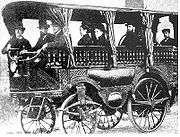
in the 1830s by Walter Hancock
and by associates of Sir Goldsworthy Gurney
among others, running reliable services over road conditions which were too hazardous for horse-drawn transportation. Steam carriages were much less likely to overturn, did not "run away with" the customer as horses sometimes did. They travelled faster than horse-drawn carriages (24 mph over four miles and an average of 12 mph over longer distances). They could run at a half to a third of the cost of horse-drawn carriages. Their brakes did not lock and drag like horse-drawn transport (a phenomenon that increased damage to roads). According to engineers, steam carriages caused one-third the damage to the road surface as that caused by the action of horses' feet. Indeed, the wide tires of the steam carriages (designed for better traction) caused virtually no damage to the streets, whereas the narrow wheels of the horse-drawn carriages (designed to reduce the effort required of horses) tended to cause rutting.
However, the heavy road tolls
imposed by the Turnpike Acts discouraged steam road vehicles and left the way clear for the horse bus companies, and from 1861 onwards, harsh legislation virtually eliminated mechanically-propelled vehicles altogether from the roads of Great Britain for 30 years, the Locomotive Act
of that year imposing restrictive speed limits on "road locomotives" of 5 mph in towns and cities, and 10 mph in the country.
In 1865 the Locomotives Act of that year (the famous Red Flag Act) further reduced the speed limits to 4 mph in the country and just 2 mph in towns and cities, additionally requiring a man bearing a red flag to precede every vehicle. At the same time, the act gave local authorities the power to specify the hours during which any such vehicle might use the roads. The sole exceptions were street tram
s which from 1879 onwards were authorised under licence from the Board of Trade
.
In 1881, the engineer John Inshaw
built a steam carriage for use in Aston
, Birmingham, UK. Capable of carrying ten people at speeds of up to 12mph, Inshaw discontinued his experiments due to the legislation then in force.
and the vehicles placed in service of the streets of that city. By 1914 the company had 184 steam buses in London, but they had all been withdrawn by 1919.
) being about one-third that of gasoline, with comparable fuel consumption to contemporary gasoline-engined vehicles. Additionally, startup times vis-a-vis gasoline-powered vehicles and safety issues from vaporized fuel had been solved, with steam cars such as the Doble
requiring a mere 40 seconds to start from cold.
The American company Brooks Steam Motors
of Buffalo produced steam city buses.
operates in the English seaside town of Whitby
.
Bus
A bus is a road vehicle designed to carry passengers. Buses can have a capacity as high as 300 passengers. The most common type of bus is the single-decker bus, with larger loads carried by double-decker buses and articulated buses, and smaller loads carried by midibuses and minibuses; coaches are...
powered by a steam engine
Steam engine
A steam engine is a heat engine that performs mechanical work using steam as its working fluid.Steam engines are external combustion engines, where the working fluid is separate from the combustion products. Non-combustion heat sources such as solar power, nuclear power or geothermal energy may be...
. Early steam-powered vehicles designed for carrying passengers were more usually known as steam carriages, although this term was sometimes used to describe other early experimental vehicles too.
History
1830-1895
Regular intercity bus services by steam-powered buses were pioneered in EnglandEngland
England is a country that is part of the United Kingdom. It shares land borders with Scotland to the north and Wales to the west; the Irish Sea is to the north west, the Celtic Sea to the south west, with the North Sea to the east and the English Channel to the south separating it from continental...
in the 1830s by Walter Hancock
Walter Hancock
Walter Hancock was an English inventor of the Victorian period. He is chiefly remembered for his steam powered road vehicles, but also received a patent for preparing and cutting indiarubber into sheets...
and by associates of Sir Goldsworthy Gurney
Goldsworthy Gurney
Sir Goldsworthy Gurney was a surgeon, chemist, lecturer, consultant, architect, builder and prototypical British gentleman scientist and inventor of the Victorian period....
among others, running reliable services over road conditions which were too hazardous for horse-drawn transportation. Steam carriages were much less likely to overturn, did not "run away with" the customer as horses sometimes did. They travelled faster than horse-drawn carriages (24 mph over four miles and an average of 12 mph over longer distances). They could run at a half to a third of the cost of horse-drawn carriages. Their brakes did not lock and drag like horse-drawn transport (a phenomenon that increased damage to roads). According to engineers, steam carriages caused one-third the damage to the road surface as that caused by the action of horses' feet. Indeed, the wide tires of the steam carriages (designed for better traction) caused virtually no damage to the streets, whereas the narrow wheels of the horse-drawn carriages (designed to reduce the effort required of horses) tended to cause rutting.
However, the heavy road tolls
Toll road
A toll road is a privately or publicly built road for which a driver pays a toll for use. Structures for which tolls are charged include toll bridges and toll tunnels. Non-toll roads are financed using other sources of revenue, most typically fuel tax or general tax funds...
imposed by the Turnpike Acts discouraged steam road vehicles and left the way clear for the horse bus companies, and from 1861 onwards, harsh legislation virtually eliminated mechanically-propelled vehicles altogether from the roads of Great Britain for 30 years, the Locomotive Act
Locomotive Act
The Locomotive Acts were a series of Acts of Parliament in the United Kingdom to control the use of mechanically propelled vehicles on British public highways during the latter part of the 19th century...
of that year imposing restrictive speed limits on "road locomotives" of 5 mph in towns and cities, and 10 mph in the country.
In 1865 the Locomotives Act of that year (the famous Red Flag Act) further reduced the speed limits to 4 mph in the country and just 2 mph in towns and cities, additionally requiring a man bearing a red flag to precede every vehicle. At the same time, the act gave local authorities the power to specify the hours during which any such vehicle might use the roads. The sole exceptions were street tram
Tram
A tram is a passenger rail vehicle which runs on tracks along public urban streets and also sometimes on separate rights of way. It may also run between cities and/or towns , and/or partially grade separated even in the cities...
s which from 1879 onwards were authorised under licence from the Board of Trade
Board of Trade
The Board of Trade is a committee of the Privy Council of the United Kingdom, originating as a committee of inquiry in the 17th century and evolving gradually into a government department with a diverse range of functions...
.
In 1881, the engineer John Inshaw
John Inshaw
John Inshaw was a mechanic and inventor who lived in Aston, now a district of Birmingham, England. Inshaw designed and built machinery for the railway and shipping industries and constructed a steam carriage. He was consulted by George Stephenson on the design of wheels for steam locomotives...
built a steam carriage for use in Aston
Aston
Aston is an area of the City of Birmingham, in the West Midlands of England. Lying to the north-east of the Birmingham city centre, Aston constitutes an electoral ward within the council constituency of Ladywood.-History:...
, Birmingham, UK. Capable of carrying ten people at speeds of up to 12mph, Inshaw discontinued his experiments due to the legislation then in force.
1896-1919
The Red Flag Act was repealed in 1896, and experimental steam buses were again operated in various places in England. In 1909 the engineer Thomas Clarkson (1864 - 1933) started the National Steam Car Company to run steam buses in London. Four chassis were imported by the New South Wales Railways. The bodies were constructed in SydneySydney
Sydney is the most populous city in Australia and the state capital of New South Wales. Sydney is located on Australia's south-east coast of the Tasman Sea. As of June 2010, the greater metropolitan area had an approximate population of 4.6 million people...
and the vehicles placed in service of the streets of that city. By 1914 the company had 184 steam buses in London, but they had all been withdrawn by 1919.
1920-present
Steam power for road transportation saw a modest revival in the 1920s. It was economical to use, with prices of fuel oil (such as keroseneKerosene
Kerosene, sometimes spelled kerosine in scientific and industrial usage, also known as paraffin or paraffin oil in the United Kingdom, Hong Kong, Ireland and South Africa, is a combustible hydrocarbon liquid. The name is derived from Greek keros...
) being about one-third that of gasoline, with comparable fuel consumption to contemporary gasoline-engined vehicles. Additionally, startup times vis-a-vis gasoline-powered vehicles and safety issues from vaporized fuel had been solved, with steam cars such as the Doble
Doble steam car
Any of several makes of steam-powered automobile in the early 20th century, including Doble Detroit, Doble Steam Car, and Doble Automobile, are referred to as a Doble because of their founding or association with Abner DobleFox Stephen...
requiring a mere 40 seconds to start from cold.
The American company Brooks Steam Motors
Brooks Steam Motors
Brooks Steam Motors, Ltd. was a Canadian manufacturer of steam cars established in March 1923. Its cars more closely resembled the Stanley Steamers in terms of engineering rather than the more sophisticated Doble steam cars. The company was formed from the defunct Detroit Steam Motors...
of Buffalo produced steam city buses.
Modern commercial operations
A steam bus, ElizabethSteam bus 'Elizabeth'
Elizabeth is a steam bus that operates in the English seaside town of Whitby.The vehicle was created in 2002, when a tourism transport operator, the Northern Star Motor Carriage Company, converted a 1931 Sentinel steam-powered DG6P steam wagon into a 30-seat bus, by adding a charabanc-style body...
operates in the English seaside town of Whitby
Whitby
Whitby is a seaside town, port and civil parish in the Scarborough borough of North Yorkshire, England. Situated on the east coast of Yorkshire at the mouth of the River Esk, Whitby has a combined maritime, mineral and tourist heritage, and is home to the ruins of Whitby Abbey where Caedmon, the...
.
See also
- Brooks Steam MotorsBrooks Steam MotorsBrooks Steam Motors, Ltd. was a Canadian manufacturer of steam cars established in March 1923. Its cars more closely resembled the Stanley Steamers in terms of engineering rather than the more sophisticated Doble steam cars. The company was formed from the defunct Detroit Steam Motors...
- Goldsworthy GurneyGoldsworthy GurneySir Goldsworthy Gurney was a surgeon, chemist, lecturer, consultant, architect, builder and prototypical British gentleman scientist and inventor of the Victorian period....
- Walter HancockWalter HancockWalter Hancock was an English inventor of the Victorian period. He is chiefly remembered for his steam powered road vehicles, but also received a patent for preparing and cutting indiarubber into sheets...
- Steam engineSteam engineA steam engine is a heat engine that performs mechanical work using steam as its working fluid.Steam engines are external combustion engines, where the working fluid is separate from the combustion products. Non-combustion heat sources such as solar power, nuclear power or geothermal energy may be...