


Statutes of Lithuania

Encyclopedia
Belarusian language
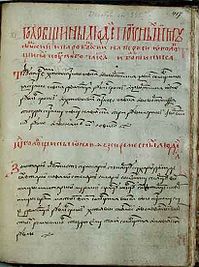
The Belarusian language , sometimes referred to as White Russian or White Ruthenian, is the language of the Belarusian people...
: Статуты Вялікага княства Літоўскага, Lithuanian
Lithuanian language
Lithuanian is the official state language of Lithuania and is recognized as one of the official languages of the European Union. There are about 2.96 million native Lithuanian speakers in Lithuania and about 170,000 abroad. Lithuanian is a Baltic language, closely related to Latvian, although they...
: Lietuvos statutai, Polish
Polish language
Polish is a language of the Lechitic subgroup of West Slavic languages, used throughout Poland and by Polish minorities in other countries...
: Statuty litewskie) were a 16th century codification of all the legislation
Legislation
Legislation is law which has been promulgated by a legislature or other governing body, or the process of making it...
of the Grand Duchy of Lithuania
Grand Duchy of Lithuania
The Grand Duchy of Lithuania was a European state from the 12th /13th century until 1569 and then as a constituent part of Polish-Lithuanian Commonwealth until 1791 when Constitution of May 3, 1791 abolished it in favor of unitary state. It was founded by the Lithuanians, one of the polytheistic...
and its successor, the Polish–Lithuanian Commonwealth. The statutes were important as, at that time, unlike the Grand Duchy of Lithuania, most Europe
Europe
Europe is, by convention, one of the world's seven continents. Comprising the westernmost peninsula of Eurasia, Europe is generally 'divided' from Asia to its east by the watershed divides of the Ural and Caucasus Mountains, the Ural River, the Caspian and Black Seas, and the waterways connecting...
an countries were absolute monarchies
Absolute monarchy
Absolute monarchy is a monarchical form of government in which the monarch exercises ultimate governing authority as head of state and head of government, his or her power not being limited by a constitution or by the law. An absolute monarch thus wields unrestricted political power over the...
that did not invest as much authority in legislative bodies or seek to codify their acts. The Statutes consist of three legal code
Legal code
A legal code is a body of law written by a governmental body, such as a U.S. state, a Canadian Province or German Bundesland or a municipality...
s (1529, 1566, and 1588) all written in Old Belarusian
Old Belarusian language
Old Belarusian was a historic East Slavic language, written and spoken at least in the 14th–17th century, and reported spoken as late as the very beginning of the 19th century, in the Grand Duchy of Lithuania and later in the East Slavic territories of the Polish-Lithuanian Commonwealth, probably...
, translated into Latin and later Polish
Polish language
Polish is a language of the Lechitic subgroup of West Slavic languages, used throughout Poland and by Polish minorities in other countries...
. They formed the basis of the legal system of the Grand Duchy.
First and Second Statutes
The main purpose of the First Statute was to standardise and collect various tribalTribe
A tribe, viewed historically or developmentally, consists of a social group existing before the development of, or outside of, states.Many anthropologists use the term tribal society to refer to societies organized largely on the basis of kinship, especially corporate descent groups .Some theorists...
and customary laws in order to codify
Codex
A codex is a book in the format used for modern books, with multiple quires or gatherings typically bound together and given a cover.Developed by the Romans from wooden writing tablets, its gradual replacement...
them as a single document.
The First Statute was drafted in 1522 and came into power in 1529 by the initiative of the Lithuanian Council of Lords
Lithuanian Council of Lords
The Lithuanian Council of Lords was the main permanent institution of central government in the Grand Duchy of Lithuania active in its capital city of Vilnius....
. It has been proposed that the codification was initiated by Grand Chancellor of Lithuania Mikołaj Radziwiłł as a reworking and expansion of the Casimir Code
Casimir Code
The Casimir's Code was a legal code adopted in 1468 by Grand Duke of Lithuania and King of Poland Casimir IV Jagiellon with an approval of the Lithuanian Council of Lords. It was the first attempt to codify the laws of the Grand Duchy of Lithuania. The code prescribed punishment for property...
. The first edition was redrafted and completed by his successor Albertas Goštautas, who assumed the position of the Grand Chancellor of Lithuania in 1522.
The second statute went into effect in 1566 by the order of King of Poland and Grand Duke of Lithuania, Sigismund II Augustus
Sigismund II Augustus
Sigismund II Augustus I was King of Poland and Grand Duke of Lithuania, the only son of Sigismund I the Old, whom Sigismund II succeeded in 1548...
, and was larger and more advanced. The Grand Duke did this because of pressure from the Lithuanian nobility, as the expansion of nobles' rights since the publication of the first statute had made it redundant. The second statute was prepared by a special commission, consisting of ten members, appointed by the Grand Duke and the Council of Lords.
Third Statute
The Third Statute was accepted in 1588 in response to the Union of LublinUnion of Lublin
The Union of Lublin replaced the personal union of the Kingdom of Poland and the Grand Duchy of Lithuania with a real union and an elective monarchy, since Sigismund II Augustus, the last of the Jagiellons, remained childless after three marriages. In addition, the autonomy of Royal Prussia was...
, which created the Polish-Lithuanian Commonwealth. This statute, authored by scholars who had studied at University of Cracow and in Italy, was the first one to be printed (in contrast to the handwritten statutes before), using a Cyrillic alphabet
Cyrillic alphabet
The Cyrillic script or azbuka is an alphabetic writing system developed in the First Bulgarian Empire during the 10th century AD at the Preslav Literary School...
, for its artificial language resembling Church Slavonic and written Ruthenian
Ruthenian language
Ruthenian, or Old Ruthenian , is a term used for the varieties of Eastern Slavonic spoken in the Grand Duchy of Lithuania and later in the East Slavic territories of the Polish–Lithuanian Commonwealth....
with influences from the common language. Translations of the statute were printed in Muscovite Russia and also in Poland, where at that time laws were not thoroughly codified and the Lithuanian statute was consulted in some cases where respective Polish laws were unclear or missing.
The statute re-organized and modified existing law, and also included new laws. Progressive features included a tendency toward severe penalties, including capital punishment, which was in line with the general trend in contemporary European law (cf. Malleus Maleficarum
Malleus Maleficarum
The Malleus Maleficarum is an infamous treatise on witches, written in 1486 by Heinrich Kramer, an Inquisitor of the Catholic Church, and was first published in Germany in 1487...
); also the statute codified that crimes committed by or against people from different social ranks were nevertheless punished alike, following the idea of equal worth of human life. Yet, the hurdles for a peasant to have a noble tried and convicted were nevertheless higher than the other way around. The statute was supported by Lithuanian magnate
Magnate
Magnate, from the Late Latin magnas, a great man, itself from Latin magnus 'great', designates a noble or other man in a high social position, by birth, wealth or other qualities...
s, as they granted them special powers and privileges allowing them to keep the lesser Lithuanian nobility and peasants in check. As a token for being acknowledged as Grand Duke of Lithuania, Sigismund III Vasa
Sigismund III Vasa
Sigismund III Vasa was King of Poland and Grand Duke of Lithuania, a monarch of the united Polish–Lithuanian Commonwealth from 1587 to 1632, and King of Sweden from 1592 until he was deposed in 1599...
revised the Union of Lublin and approved the Third Lithuanian Statute.
Many features of the statute were not in line with the provisions of the Union of Lublin, which is not at all mentioned in the statute. In this category fall e.g. the provisions about distributing local offices only to native people (or, to people who had bought that status), also the many, detailed provisions about the Lithuanian estates' assemblies which eventually were abolished by the Lublin union treaty. In everyday legal practice, the statute trumped the union treaty.
A group often opposing the statute was the Polish nobility, which viewed them as unconstitutional, because the Union of Lublin stipulated that no law could conflict with the law of the Union. The statute in turn declared the laws that conflicted with itself to be unconstitutional. Statutes of Lithuania were also used in territories of Lithuania annexed by Poland shortly before Union of Lublin. These conflicts between statutory schemes in Lithuania and Poland persisted for many years.
Implications and developments
Copies of the statutes used to be kept in each powiatPowiat
A powiat is the second-level unit of local government and administration in Poland, equivalent to a county, district or prefecture in other countries. The term powiat is most often translated into English as "county", although other terms are also sometimes used...
(district) so they could be used and seen by each person desiring to do so.
Attempts by the Lithuanian nobility to limit the power of Lithuanian magnates led to the koekwacja praw (equalization of laws) movement, culminating in the koekwacja reforms of the election sejm of 1697 (May–June), confirmed in the general sejm
General sejm
The general sejm was the parliament of Poland for four centuries from the late 15th until the late 18th century.-Genesis:The power of early sejms grew during the period of Poland's fragmentation , when the power of individual rulers waned and that of various councils and wiece grew...
of April 1698 in the document Porządek sądzenia spraw w Trybunale Wielkiego Księstwa Litewskego. These reforms limited the jurisdiction and competency of several Lithuanian offices, such as those of the hetman
Hetman
Hetman was the title of the second-highest military commander in 15th- to 18th-century Poland and the Grand Duchy of Lithuania, which together, from 1569 to 1795, comprised the Polish-Lithuanian Commonwealth, or Rzeczpospolita....
, kanclerz
Kanclerz
Kanclerz was one of the highest officials in the historic Poland. This office functioned from the early Polish kingdom of the 12th century until the end of the Polish-Lithuanian Commonwealth in 1795. A respective office also existed in the Grand Duchy of Lithuania since the 16th...
(chancellor), marszałek (marshal) and podskarbi
Podskarbi
Podskarbi in Poland then in Polish-Lithuanian Commonwealth was minister responsible for the treasury. Since 1569 also a senatorial office. The title although meaning treasurer can be deconstructed as "under[King]-treasury" - treasury as an old-fashioned adjective...
(under-treasurer), to equate them with those of the corresponding offices in the Polish crown. Many of these offices at the time were held by members of the Sapieha
Sapieha
The Sapieha is a Polish-Lithuanian princely family descending from the medieval boyars of Smolensk. The family acquired great influence in the sixteenth century.-History:...
family, and the changes were at least partly made with a view towards reducing their power. The reforms also instituted Polish as the administrative language, replacing Ruthenian
Ruthenian language
Ruthenian, or Old Ruthenian , is a term used for the varieties of Eastern Slavonic spoken in the Grand Duchy of Lithuania and later in the East Slavic territories of the Polish–Lithuanian Commonwealth....
, in written documents and court proceedings, contradicting the wording of the Third Statue.
The Statutes of Lithuania were a sign of the progressive European legal tradition, and were cited as precedent in Polish and Livonian courts. Furthermore they had a major influence on the 1649 encoding of the Russian legal code, Sobornoye Ulozheniye
Sobornoye Ulozheniye
The Sobornoye Ulozheniye was a legal code promulgated in 1649 by the Zemsky Sobor under Alexis of Russia as a replacement for the Sudebnik of 1497 introduced by Ivan III of Russia, which is based, among others, on the Third Statute of Lithuania...
. After forming an association with Poland
Poland
Poland , officially the Republic of Poland , is a country in Central Europe bordered by Germany to the west; the Czech Republic and Slovakia to the south; Ukraine, Belarus and Lithuania to the east; and the Baltic Sea and Kaliningrad Oblast, a Russian exclave, to the north...
—including both the dynastic union (1385–1569) and the confederated Polish-Lithuanian Commonwealth
Polish-Lithuanian Commonwealth
The Polish–Lithuanian Commonwealth was a dualistic state of Poland and Lithuania ruled by a common monarch. It was the largest and one of the most populous countries of 16th- and 17th‑century Europe with some and a multi-ethnic population of 11 million at its peak in the early 17th century...
(1569–1795)—the Lithuanian Statutes were the Grand Duchy's greatest expression of independence.
In 1791, efforts were made to change the system and do away with the privileges of the nobility, creating a constitutional monarchy with a modern citizenry (see Constitution of 3 May). However, these plans came to naught when Russia, abetted by Austria
Austria
Austria , officially the Republic of Austria , is a landlocked country of roughly 8.4 million people in Central Europe. It is bordered by the Czech Republic and Germany to the north, Slovakia and Hungary to the east, Slovenia and Italy to the south, and Switzerland and Liechtenstein to the...
and Prussia
Prussia
Prussia was a German kingdom and historic state originating out of the Duchy of Prussia and the Margraviate of Brandenburg. For centuries, the House of Hohenzollern ruled Prussia, successfully expanding its size by way of an unusually well-organized and effective army. Prussia shaped the history...
, partitioned the Commonwealth, although leaving the Lithuanian Statutes in effect in Lithuania until 1840.
External links
- 1588 Statute Original (Ruthenian)