

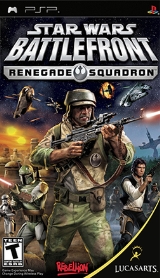
Star Wars Battlefront: Renegade Squadron

Encyclopedia
Star Wars Battlefront: Renegade Squadron is the third entry in the Star Wars Battlefront
series of video games, first released on October 9, 2007 in North America and later in Australia and Europe. The game was designed as a PlayStation Portable
(PSP) exclusive and features the eponymous Rebel Alliance
covert ops unit Renegade Squadron, previously unmentioned in Star Wars canon. Renegade Squadron was one of the first games available in a bundle pack with the newly released PSP redesign
.
The single-player campaign follows the exploits of Renegade Squadron from its inception by Han Solo
throughout its operational history, until its dissolution after the Battle of Endor. During play the Renegades participate in several battles, including those of Yavin and Hoth
. The game also features several types of multiplayer modes. In contrast with previous titles in the series that require characters to have a set class
, players in Renegade Squadron are able to build their character as they see fit.
Renegade Squadron received a mixed reaction from the video gaming community. The game was considered
superior to its predecessor (the PSP version of Star Wars: Battlefront II
) and it was praised for its customization options and online play, but the single-player campaign was criticized for being brief and shallow. Opinions on the graphics were mixed, and the controls were generally described as inadequate.
. Each map has a set number of command posts, and it is beneficial for the player to occupy as many as possible (space battles use a modified command post system). Each side has a set number of reinforcement tickets at the beginning of the battle—any time a soldier dies, that team loses one ticket when that soldier respawns. To win a match, a player must capture every command post or reduce their opponent's ticket count to zero.
At the ending of each mission, every time the character respawns, and when at a command post, it is possible for the player to adjust their character’s weapons, appearance, and other traits to their liking. The player gets 100 credits to purchase weapons and equipment for their character. In previous games in the series, players chose a character's class
before battle from a list of pre-made options, such as pilot or other regular infantry units. Each class had a specific combination of weapons and equipment. Before Renegade Squadron's release, LucasArts stated that the customization engine would allow millions of different character combinations. Another new feature allows players to enter asteroid bases on some space maps. In addition, players can earn medals by achieving set objectives, such as destroying a certain number of spaceships.
cutscenes in a static, comic book
style between the missions to provide background information and move the story along. The final mission features the Battle of Endor, where the objectives are similar to the corresponding footage in Return of the Jedi
.
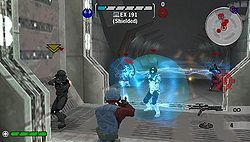 With instant action, players are able to take part in battles against computer-controlled
opponents. There are four types of missions. Conquest is the Battlefront standard and pits two opposing forces against each other on a space or ground map, with the objective of controlling all of the command posts on the map, or defeating every member of the opposing force. There are also three variants of capture the flag
, including a new mode called Hero flag, whereby players are permitted to control famous Star Wars characters during standard flag battles by physically carrying their team's flag. These heroes span the Clone Wars
and Civil War
periods and include Asajj Ventress
, Jango Fett
, and Kit Fisto.
A holdover from previous Battlefront games, galactic conquest is played as a type of turn-based board game
with segmented turns, similar to Risk
. The board is a simplified representation of the Star Wars galaxy, with four quadrants containing several planets each. The player and the AI opponent each start with several planets (including a headquarters planet which has more reinforcements), which generate revenue each turn in the form of galactic credits. Credits are used to purchase reinforcements and hire special commanders, who are leaders like Admiral Ackbar
and Tarkin
. During each turn, a player is allowed to move reinforcements around their controlled planets and attack opponent-controlled planets. Attacking a planet initiates either a ground or space battle, which can be fought manually or automatically. The player wins by conquering all of their opponent's planets.
's infrastructure mode, which is a wi-fi
internet connection. It can also support eight-person matches with ad-hoc, which is a local connectivity option for players in close physical proximity. The multiplayer game types are limited to conquest and capture the flag. A GameSpy
network account is required to play using infrastructure, and offers players a rankings system so they can track their performance.
films, mostly during and in-between The Empire Strikes Back
and Return of the Jedi
. Some time after the events of the Galactic Civil War
as portrayed in Return of the Jedi, the New Jedi Order is formed by Luke Skywalker
. The game begins with Tionne Solusar, the New Jedi Order's chief historian, researching the forces of the Rebel Alliance
during the Galactic Civil War. Tionne finds several vague references to a "Renegade Squadron" and its commander, Col Serra, who were apparently involved in covert ops missions during the war. Tionne manages to contact Serra and he candidly relates the entire history of the unit. The single-player campaign follows the major exploits of Renegade Squadron throughout the war, as told in flashback
s by Serra to Tionne.
Renegade Squadron was formed shortly before the Battle of Yavin at the request of Han Solo and General Jan Dodonna, who were looking for experienced warriors that required no additional training. Solo contacted one of his former smuggling associates, Col Serra, and asked him to help. Serra agreed to Solo's request and put together a unit of mercenaries, bounty hunters, smugglers, and other Fringe types that would work behind-the-scenes to further the goals of the Alliance. All of the members of the aptly named Renegade Squadron were wanted by the Empire
and generally harbored an intense hatred for it, ensuring that they would remain loyal to the Alliance.
Under Serra's command, the unit was responsible for several operations undertaken for the Alliance throughout the war. The unit operated in secrecy and was able to work anonymously at several major incidents, including the battles of Yavin, Hoth, and Endor. The unit was made up of skilled pilots in addition to ground operatives, and so was able to assist in missions both in-space and planetside. The unit was considered elite by the Alliance, and despite its anonymity, took part in several high-profile battles against Imperial luminaries, including IG-88 and Darth Vader
. After the Battle of Endor, the squadron was disbanded, its purpose fulfilled. Its surviving members disappeared, many of them returning to their former criminal roots.
announced Renegade Squadron in May 2007. The announcement stated that the game would be the only original Battlefront game of 2007, and it was to be developed by British-based independent game design company Rebellion Developments
. Despite having never worked on a Star Wars game, Rebellion had prior development experience with other PlayStation Portable titles, such as a port of the first-person shooter
game Gun.
The game's developers made it clear that it was being designed specifically for the PSP. LucasArts made this decision after Rebellion convinced them that the PSP's multiplayer capabilities were well-suited to another Battlefront game, in addition to the strong sales of Battlefront II on the PSP. The game's lead designer, Mike Hosser, stated that the development team tried to retain some aspects of Battlefront II, specifically its "fast and furious action". Other elements borrowed from Battlefront II included the controls—LucasArts solicited feedback from players of the previous game and subsequently decided to make Renegade Squadron's controls more "arcadey
" so players could learn them faster. After screenshots of the game were released, several forum posts from fans complained about the game's visuals compared to its predecessor. In response, Hosser claimed that Renegade Squadron "boasts a longer view distance, higher resolution textures and better lighting".
The design team stated repeatedly that the focus of Renegade Squadron was its customization system. There were initially concerns in Rebellion that the feature would lead to unbalanced gameplay; lead programmer Richard May stated he was "worried it might lead to uber-classes and be a balancing nightmare, losing some of the trade-off structure that the old class system provided." Prolific testing of the game eventually assured LucasArts that the system had been implemented appropriately.
The game's setting was based primarily on the Clone Wars and Civil War eras of Star Wars history. Rebellion took inspiration for several missions from comments made in passing from the Star Wars films. Hosser stated in an interview, "For instance, a diversionary attack on Sullust is mentioned during a conversation between Vader and the Emperor in Return of the Jedi. In Renegade Squadron, you'll get to take part in that attack." The planet of Boz Pity was similarly mentioned in Revenge of the Sith but wasn't portrayed in the movie, so Renegade Squadron's artists took the opportunity to create the planet based on ancient Cambodia
n architecture like Angkor Wat
. Concept art for the game was provided by Rebellion's comic artists, and the cutscenes were based on the company's comic properties like 2000 AD
. While storyboarding the in-game cinematics, Rebellion assistant producer James Valls was careful to ensure that Renegade Squadron was in accordance with established Star Wars canon.
and The Force Unleashed
. The game was released on October 9, 2007 in North America, and on October 10 and 12 in Australia and Europe respectively. LucasArt's official launch event was at the Sony PlayStation Store in the Metreon shopping center
in San Francisco. Star Wars fans attended in costume, including the 501st Squadron
, a large Star Wars cosplay
ing fanclub. Attendees were eligible to win several prizes. In addition, the first 200 customers to purchase Sony's new Star Wars PSP bundle were given a Han Solo-in-carbonite case for their PSP. The bundle was announced in July 2007 as the second available PSP-2000
bundle (after Daxter
) and titled the Star Wars Battlefront PSP Entertainment Pack. Bundled PSPs were presented in a white case with a black silkscreen of Darth Vader on the battery cover, in addition to the copy of Renegade Squadron.
LucasArts and Rebellion have discussed downloadable content
for Renegade Squadron, but were not strongly invested in exploring the prospect during the game's development. LucasArts has also stated that issues with Sony have hindered its implementation. Rebellion has considered the possibility of a comic book or novel based on Renegade Squadron.
, which indicates "mixed or average reviews." Reviewers praised the game's customization options and multiplayer, and it was accepted as marginally superior to Battlefront II on PSP, though one reviewer stated "it's not a true sequel." The game won the Reader's PSP Game of the Month Award from IGN for October 2007, with one fan stating that the game was more "Star Wars-like" than its predecessor. It was the second best-selling PSP game in the US the week of its release and was still among the list of GameFly's
most-rented PSP games in December 2007. It continued to be a top seller in the US and UK several months after its release. The game was later re-released as a Greatest Hits title, indicating that it had sold at least 250,000 copies.
Comments about Renegade Squadron's controls were mostly negative, and they were typically described as clumsy or sluggish. GameZone
referred to the space dogfights as "unplayable" and Eurogamer
called the lock-on feature "a waste of time". One reviewer complained about the PSP's lack of a second analog nub. Despite the criticism, a few reviewers were more favorable towards the controls, with GameSpot
noting that they were an improvement over Battlefront II.
Reviewers were polarized on the game's graphics. The cutscenes during the single-player campaign were accepted positively, but reception of the in-game visuals was less glowing. GamePro
stated that the "character and vehicle models look great", but the visuals were also described as "blah" and "substandard." GameDaily
said "the graphics look good but there's a lack of polish."
Though the single-player campaign was criticized for being short, Renegade Squadron's multiplayer was widely praised. GameSpot noted that the game included an infrastructure mode, a feature which Battlefront II did not have, and GameZone commented that the game ran smoothly in multiplayer even when handling the maximum number of players. GameSpy described the multiplayer as "fantastic," and GamesRadar
said that it promised hours of satisfaction. Many reviewers said that the multiplayer was the most important part of the game, with some of the less positive reviews advising players to play the game primarily for the multiplayer experience.
Star Wars: Battlefront (series)
The Star Wars: Battlefront series is a series of first-person/third-person shooter video games based on the Star Wars films by George Lucas. The game-play is very similar to Digital Illusion's/EA's Battlefield series. The series has installments available on the PC, Macintosh, Xbox, PlayStation 2,...
series of video games, first released on October 9, 2007 in North America and later in Australia and Europe. The game was designed as a PlayStation Portable
PlayStation Portable
The is a handheld game console manufactured and marketed by Sony Corporation Development of the console was announced during E3 2003, and it was unveiled on , 2004, at a Sony press conference before E3 2004...
(PSP) exclusive and features the eponymous Rebel Alliance
Rebel Alliance
The Alliance to Restore the Republic is an interstellar faction of the fictional universe of Star Wars....
covert ops unit Renegade Squadron, previously unmentioned in Star Wars canon. Renegade Squadron was one of the first games available in a bundle pack with the newly released PSP redesign
PlayStation Portable Slim and Lite
PSP Slim & Lite is a name used in the PAL territories to refer to the redesigns of the PlayStation Portable handheld game console released and manufactured by Sony Computer Entertainment. The same models were called simply PlayStation Portable in Japan and North America.At E3 2007, Sony released...
.
The single-player campaign follows the exploits of Renegade Squadron from its inception by Han Solo
Han Solo
Han Solo is a fictional character in the Star Wars franchise played by Harrison Ford. Introduced in the film Star Wars Episode IV: A New Hope , Solo and his Wookiee co-pilot, Chewbacca , become involved in the Rebel Alliance against the Galactic Empire...
throughout its operational history, until its dissolution after the Battle of Endor. During play the Renegades participate in several battles, including those of Yavin and Hoth
Hoth
In the fictional universe of Star Wars, Hoth is the sixth planet of a remote system of the same name. It is a terrestrial planet blanketed by snow and ice. Many meteorites from a nearby asteroid belt pelt the planet's surface, making temporary craters in the planet's ever-moving snow drifts. Hoth...
. The game also features several types of multiplayer modes. In contrast with previous titles in the series that require characters to have a set class
Character class
In role-playing games, a common method of arbitrating the capabilities of different game characters is to assign each one to a character class. A character class aggregates several abilities and aptitudes, and may also sometimes detail aspects of background and social standing or impose behaviour...
, players in Renegade Squadron are able to build their character as they see fit.
Renegade Squadron received a mixed reaction from the video gaming community. The game was considered
superior to its predecessor (the PSP version of Star Wars: Battlefront II
Star Wars: Battlefront II
Star Wars: Battlefront II is a first/third-person shooter video game developed by Pandemic Studios, and published by LucasArts. The game is the sequel to the successful Star Wars: Battlefront and features new vehicles, characters, game mechanics, maps, and missions...
) and it was praised for its customization options and online play, but the single-player campaign was criticized for being brief and shallow. Opinions on the graphics were mixed, and the controls were generally described as inadequate.
Gameplay
The overall structure of Renegade Squadron is similar to other games in the Battlefront series in that it is a war game played primarily from a third-person view. Battles take place on the ground and in space and require the player to capture command posts, specific areas of territory represented by floating icons on the playing field and colored dots on the player's heads-up displayHUD (video gaming)
In video gaming, the HUD is the method by which information is visually relayed to the player as part of a game's user interface...
. Each map has a set number of command posts, and it is beneficial for the player to occupy as many as possible (space battles use a modified command post system). Each side has a set number of reinforcement tickets at the beginning of the battle—any time a soldier dies, that team loses one ticket when that soldier respawns. To win a match, a player must capture every command post or reduce their opponent's ticket count to zero.
At the ending of each mission, every time the character respawns, and when at a command post, it is possible for the player to adjust their character’s weapons, appearance, and other traits to their liking. The player gets 100 credits to purchase weapons and equipment for their character. In previous games in the series, players chose a character's class
Character class
In role-playing games, a common method of arbitrating the capabilities of different game characters is to assign each one to a character class. A character class aggregates several abilities and aptitudes, and may also sometimes detail aspects of background and social standing or impose behaviour...
before battle from a list of pre-made options, such as pilot or other regular infantry units. Each class had a specific combination of weapons and equipment. Before Renegade Squadron's release, LucasArts stated that the customization engine would allow millions of different character combinations. Another new feature allows players to enter asteroid bases on some space maps. In addition, players can earn medals by achieving set objectives, such as destroying a certain number of spaceships.
Single-player
There are three options for single play: the campaign, instant action, and galactic conquest. During the story campaign, the player takes control of Renegade Squadron, under the command of Col Serra and occasionally Han Solo. Serra describes the formation of the unit in the beginning cutscene of the campaign; the player then starts a series of missions with a range of different objectives, with voicedVoice acting
Voice acting is the art of providing voices for animated characters and radio and audio dramas and comedy, as well as doing voice-overs in radio and television commercials, audio dramas, dubbed foreign language films, video games, puppet shows, and amusement rides.Performers are called...
cutscenes in a static, comic book
Comic book
A comic book or comicbook is a magazine made up of comics, narrative artwork in the form of separate panels that represent individual scenes, often accompanied by dialog as well as including...
style between the missions to provide background information and move the story along. The final mission features the Battle of Endor, where the objectives are similar to the corresponding footage in Return of the Jedi
Star Wars Episode VI: Return of the Jedi
Star Wars Episode VI: Return of the Jedi is a 1983 American epic space opera film directed by Richard Marquand and written by George Lucas and Lawrence Kasdan. It is the third film released in the Star Wars saga, and the sixth in terms of the series' internal chronology...
.
Artificial intelligence
Artificial intelligence is the intelligence of machines and the branch of computer science that aims to create it. AI textbooks define the field as "the study and design of intelligent agents" where an intelligent agent is a system that perceives its environment and takes actions that maximize its...
opponents. There are four types of missions. Conquest is the Battlefront standard and pits two opposing forces against each other on a space or ground map, with the objective of controlling all of the command posts on the map, or defeating every member of the opposing force. There are also three variants of capture the flag
Capture the flag
Capture the Flag is a traditional outdoor sport generally played by children, where two teams each have a flag and the objective is to capture the other team's flag, located at the team's "base," and bring it safely back to their own base...
, including a new mode called Hero flag, whereby players are permitted to control famous Star Wars characters during standard flag battles by physically carrying their team's flag. These heroes span the Clone Wars
Clone Wars (Star Wars)
The Clone Wars are a series of fictional intragalactic battles in George Lucas's science fiction saga Star Wars. The conflict is first mentioned in the film Star Wars Episode IV: A New Hope , but no details are given , and the wars themselves are not featured until the series' fifth and sixth...
and Civil War
Galactic Civil War
The Galactic Civil War is a fictional war from the Star Wars galaxy. It serves as the setting for the original trilogy of films A New Hope, The Empire Strikes Back, and Return of the Jedi, as well as many novels, comics, and video games in the Expanded Universe.The war was fought between the...
periods and include Asajj Ventress
Asajj Ventress
Asajj Ventress is a fictional character from the Star Wars Expanded Universe. She is best known for her appearances in the Star Wars: Clone Wars animated series, in which she is played by voice-actress Grey DeLisle and serves as Anakin Skywalker's arch nemesis during the first season...
, Jango Fett
Jango Fett
Jango Fett is a fictional character in the Star Wars universe. He first appeared as one of the main antagonists in Star Wars Episode II: Attack of the Clones, and later served as the protagonist of the LucasArts video game Star Wars: Bounty Hunter, played by Temuera Morrison.Jango Fett serves as...
, and Kit Fisto.
A holdover from previous Battlefront games, galactic conquest is played as a type of turn-based board game
Board game
A board game is a game which involves counters or pieces being moved on a pre-marked surface or "board", according to a set of rules. Games may be based on pure strategy, chance or a mixture of the two, and usually have a goal which a player aims to achieve...
with segmented turns, similar to Risk
Risk (game)
Risk is a strategic board game, produced by Parker Brothers . It was invented by French film director Albert Lamorisse and originally released in 1957 as La Conquête du Monde in France. Risk is a turn-based game for two to six players...
. The board is a simplified representation of the Star Wars galaxy, with four quadrants containing several planets each. The player and the AI opponent each start with several planets (including a headquarters planet which has more reinforcements), which generate revenue each turn in the form of galactic credits. Credits are used to purchase reinforcements and hire special commanders, who are leaders like Admiral Ackbar
Admiral Ackbar
Admiral Ackbar is a fictional character in the Star Wars science fiction saga. A member of the amphibious Mon Calamari species, Ackbar was the foremost military commander of the Rebel Alliance who led major combat operations against the Galactic Empire and was later integral in the formation of the...
and Tarkin
Grand Moff Tarkin
Governor Wilhuff Tarkin or Grand Moff Wilhuff Tarkin is a fictional character in the Star Wars universe, appearing as the main antagonist of Star Wars Episode IV: A New Hope, played by British actor Peter Cushing. A younger version of the character makes a brief cameo in the prequel film Star Wars...
. During each turn, a player is allowed to move reinforcements around their controlled planets and attack opponent-controlled planets. Attacking a planet initiates either a ground or space battle, which can be fought manually or automatically. The player wins by conquering all of their opponent's planets.
Multiplayer
In addition to the single-player story missions, Renegade Squadron allows up to 16 players to compete via the PSPPlayStation Portable
The is a handheld game console manufactured and marketed by Sony Corporation Development of the console was announced during E3 2003, and it was unveiled on , 2004, at a Sony press conference before E3 2004...
's infrastructure mode, which is a wi-fi
Wi-Fi
Wi-Fi or Wifi, is a mechanism for wirelessly connecting electronic devices. A device enabled with Wi-Fi, such as a personal computer, video game console, smartphone, or digital audio player, can connect to the Internet via a wireless network access point. An access point has a range of about 20...
internet connection. It can also support eight-person matches with ad-hoc, which is a local connectivity option for players in close physical proximity. The multiplayer game types are limited to conquest and capture the flag. A GameSpy
GameSpy
GameSpy Industries, Inc., known simply as GameSpy, is a division of IGN Entertainment, which operates a network of game websites and provides online video game-related services and software. GameSpy dates back to the 1996 release of an internet Quake server search program named QSpy. The current...
network account is required to play using infrastructure, and offers players a rankings system so they can track their performance.
Plot
Renegade Squadron takes place during the second chronological trilogy of the Star WarsStar Wars
Star Wars is an American epic space opera film series created by George Lucas. The first film in the series was originally released on May 25, 1977, under the title Star Wars, by 20th Century Fox, and became a worldwide pop culture phenomenon, followed by two sequels, released at three-year...
films, mostly during and in-between The Empire Strikes Back
Star Wars Episode V: The Empire Strikes Back
Star Wars Episode V: The Empire Strikes Back is a 1980 American epic space opera film directed by Irvin Kershner. The screenplay, based on a story by George Lucas, was written by Leigh Brackett and Lawrence Kasdan...
and Return of the Jedi
Star Wars Episode VI: Return of the Jedi
Star Wars Episode VI: Return of the Jedi is a 1983 American epic space opera film directed by Richard Marquand and written by George Lucas and Lawrence Kasdan. It is the third film released in the Star Wars saga, and the sixth in terms of the series' internal chronology...
. Some time after the events of the Galactic Civil War
Galactic Civil War
The Galactic Civil War is a fictional war from the Star Wars galaxy. It serves as the setting for the original trilogy of films A New Hope, The Empire Strikes Back, and Return of the Jedi, as well as many novels, comics, and video games in the Expanded Universe.The war was fought between the...
as portrayed in Return of the Jedi, the New Jedi Order is formed by Luke Skywalker
Luke Skywalker
Luke Skywalker is a fictional character and the main protagonist of the original film trilogy of the Star Wars franchise, where he is portrayed by Mark Hamill. He is introduced in Star Wars Episode IV: A New Hope, in which he is forced to leave home, and finds himself apprenticed to the Jedi master...
. The game begins with Tionne Solusar, the New Jedi Order's chief historian, researching the forces of the Rebel Alliance
Rebel Alliance
The Alliance to Restore the Republic is an interstellar faction of the fictional universe of Star Wars....
during the Galactic Civil War. Tionne finds several vague references to a "Renegade Squadron" and its commander, Col Serra, who were apparently involved in covert ops missions during the war. Tionne manages to contact Serra and he candidly relates the entire history of the unit. The single-player campaign follows the major exploits of Renegade Squadron throughout the war, as told in flashback
Flashback (narrative)
Flashback is an interjected scene that takes the narrative back in time from the current point the story has reached. Flashbacks are often used to recount events that happened before the story’s primary sequence of events or to fill in crucial backstory...
s by Serra to Tionne.
Renegade Squadron was formed shortly before the Battle of Yavin at the request of Han Solo and General Jan Dodonna, who were looking for experienced warriors that required no additional training. Solo contacted one of his former smuggling associates, Col Serra, and asked him to help. Serra agreed to Solo's request and put together a unit of mercenaries, bounty hunters, smugglers, and other Fringe types that would work behind-the-scenes to further the goals of the Alliance. All of the members of the aptly named Renegade Squadron were wanted by the Empire
Galactic Empire (Star Wars)
The Galactic Empire is one of the main factions in the fictional universe of Star Wars. It is a galaxy-spanning regime established by the series' lead villain, Palpatine, to replace the Galactic Republic in Star Wars Episode III: Revenge of the Sith. The Galactic Empire is introduced in Star Wars...
and generally harbored an intense hatred for it, ensuring that they would remain loyal to the Alliance.
Under Serra's command, the unit was responsible for several operations undertaken for the Alliance throughout the war. The unit operated in secrecy and was able to work anonymously at several major incidents, including the battles of Yavin, Hoth, and Endor. The unit was made up of skilled pilots in addition to ground operatives, and so was able to assist in missions both in-space and planetside. The unit was considered elite by the Alliance, and despite its anonymity, took part in several high-profile battles against Imperial luminaries, including IG-88 and Darth Vader
Darth Vader
Darth Vader is a central character in the Star Wars saga, appearing as one of the main antagonists in the original trilogy and as the main protagonist in the prequel trilogy....
. After the Battle of Endor, the squadron was disbanded, its purpose fulfilled. Its surviving members disappeared, many of them returning to their former criminal roots.
Development
LucasArtsLucasArts
LucasArts Entertainment Company, LLC is an American video game developer and publisher. The company was once famous for its innovative line of graphic adventure games, the critical and commercial success of which peaked in the mid 1990s...
announced Renegade Squadron in May 2007. The announcement stated that the game would be the only original Battlefront game of 2007, and it was to be developed by British-based independent game design company Rebellion Developments
Rebellion Developments
Rebellion is a British computer games company, based in Oxford, who are most famous for the first Aliens vs. Predator computer game. It has published comic books since 2000 and launched its own book imprint, Abaddon Books, in 2006.-History:...
. Despite having never worked on a Star Wars game, Rebellion had prior development experience with other PlayStation Portable titles, such as a port of the first-person shooter
First-person shooter
First-person shooter is a video game genre that centers the gameplay on gun and projectile weapon-based combat through first-person perspective; i.e., the player experiences the action through the eyes of a protagonist. Generally speaking, the first-person shooter shares common traits with other...
game Gun.
The game's developers made it clear that it was being designed specifically for the PSP. LucasArts made this decision after Rebellion convinced them that the PSP's multiplayer capabilities were well-suited to another Battlefront game, in addition to the strong sales of Battlefront II on the PSP. The game's lead designer, Mike Hosser, stated that the development team tried to retain some aspects of Battlefront II, specifically its "fast and furious action". Other elements borrowed from Battlefront II included the controls—LucasArts solicited feedback from players of the previous game and subsequently decided to make Renegade Squadron's controls more "arcadey
Arcade game
An arcade game is a coin-operated entertainment machine, usually installed in public businesses such as restaurants, bars, and amusement arcades. Most arcade games are video games, pinball machines, electro-mechanical games, redemption games, and merchandisers...
" so players could learn them faster. After screenshots of the game were released, several forum posts from fans complained about the game's visuals compared to its predecessor. In response, Hosser claimed that Renegade Squadron "boasts a longer view distance, higher resolution textures and better lighting".
The design team stated repeatedly that the focus of Renegade Squadron was its customization system. There were initially concerns in Rebellion that the feature would lead to unbalanced gameplay; lead programmer Richard May stated he was "worried it might lead to uber-classes and be a balancing nightmare, losing some of the trade-off structure that the old class system provided." Prolific testing of the game eventually assured LucasArts that the system had been implemented appropriately.
The game's setting was based primarily on the Clone Wars and Civil War eras of Star Wars history. Rebellion took inspiration for several missions from comments made in passing from the Star Wars films. Hosser stated in an interview, "For instance, a diversionary attack on Sullust is mentioned during a conversation between Vader and the Emperor in Return of the Jedi. In Renegade Squadron, you'll get to take part in that attack." The planet of Boz Pity was similarly mentioned in Revenge of the Sith but wasn't portrayed in the movie, so Renegade Squadron's artists took the opportunity to create the planet based on ancient Cambodia
Cambodia
Cambodia , officially known as the Kingdom of Cambodia, is a country located in the southern portion of the Indochina Peninsula in Southeast Asia...
n architecture like Angkor Wat
Angkor Wat
Angkor Wat is a temple complex at Angkor, Cambodia, built for the king Suryavarman II in the early 12th century as his state temple and capital city. As the best-preserved temple at the site, it is the only one to have remained a significant religious centre since its foundation – first Hindu,...
. Concept art for the game was provided by Rebellion's comic artists, and the cutscenes were based on the company's comic properties like 2000 AD
2000 AD (comic)
2000 AD is a weekly British science fiction-oriented comic. As a comics anthology it serialises a number of separate stories each issue and was first published by IPC Magazines in 1977, the first issue dated 26 February. IPC then shifted the title to its Fleetway comics subsidiary which was sold...
. While storyboarding the in-game cinematics, Rebellion assistant producer James Valls was careful to ensure that Renegade Squadron was in accordance with established Star Wars canon.
Release
Renegade Squadron was featured at the LucasArts booth at Comic-Con 2007 as part of the "25 Years of LucasArts Games" display, along with other upcoming games like LEGO Indiana JonesLego Indiana Jones: The Original Adventures
Lego Indiana Jones: The Original Adventures is a 2008 video game developed by Traveller's Tales and published by LucasArts. The game allows players to recreate moments from the first three Indiana Jones films: Raiders of the Lost Ark, Indiana Jones and the Temple of Doom, and Indiana Jones and the...
and The Force Unleashed
Star Wars: The Force Unleashed
Star Wars: The Force Unleashed is a multimedia project developed by LucasArts along with Dark Horse Comics, Lego, Hasbro, and Del Rey Books...
. The game was released on October 9, 2007 in North America, and on October 10 and 12 in Australia and Europe respectively. LucasArt's official launch event was at the Sony PlayStation Store in the Metreon shopping center
Metreon
The Metreon is a shopping center located in downtown San Francisco at the corner of 4th Street and Mission Street. It is a four-story 350,000 square foot building built over the corner of the underground Moscone Center convention center...
in San Francisco. Star Wars fans attended in costume, including the 501st Squadron
501st Legion
The 501st Legion is an international fan-based organization dedicated to the construction and wearing of screen-accurate replicas of Imperial Stormtrooper armor, Imperial officer uniforms, Clone Troopers and other villains and nefarious characters from the Star Wars universe...
, a large Star Wars cosplay
Cosplay
, short for "costume play", is a type of performance art in which participants don costumes and accessories to represent a specific character or idea. Characters are often drawn from popular fiction in Japan, but recent trends have included American cartoons and science fiction...
ing fanclub. Attendees were eligible to win several prizes. In addition, the first 200 customers to purchase Sony's new Star Wars PSP bundle were given a Han Solo-in-carbonite case for their PSP. The bundle was announced in July 2007 as the second available PSP-2000
PlayStation Portable Slim and Lite
PSP Slim & Lite is a name used in the PAL territories to refer to the redesigns of the PlayStation Portable handheld game console released and manufactured by Sony Computer Entertainment. The same models were called simply PlayStation Portable in Japan and North America.At E3 2007, Sony released...
bundle (after Daxter
Daxter (video game)
Daxter was very well received by critics. IGN gave it a 9/10 and GameSpot gave it a 9.1/10. It has a 86.2% at Game Rankings. As of June 11, 2008, the game has sold 2.3 million copies.-External links:*...
) and titled the Star Wars Battlefront PSP Entertainment Pack. Bundled PSPs were presented in a white case with a black silkscreen of Darth Vader on the battery cover, in addition to the copy of Renegade Squadron.
LucasArts and Rebellion have discussed downloadable content
Downloadable content
Downloadable content is official additional content for a video game distributed through the Internet. Downloadable content can be of several types, ranging from a single in-game outfit to an entirely new, extensive storyline, similarly to an expansion pack. As such, DLC may add new game modes,...
for Renegade Squadron, but were not strongly invested in exploring the prospect during the game's development. LucasArts has also stated that issues with Sony have hindered its implementation. Rebellion has considered the possibility of a comic book or novel based on Renegade Squadron.
Reception
Critical reception of the game was mixed, and as of March 2009 it holds a score of 73% on media aggregator site MetacriticMetacritic
Metacritic.com is a website that collates reviews of music albums, games, movies, TV shows and DVDs. For each product, a numerical score from each review is obtained and the total is averaged. An excerpt of each review is provided along with a hyperlink to the source. Three colour codes of Green,...
, which indicates "mixed or average reviews." Reviewers praised the game's customization options and multiplayer, and it was accepted as marginally superior to Battlefront II on PSP, though one reviewer stated "it's not a true sequel." The game won the Reader's PSP Game of the Month Award from IGN for October 2007, with one fan stating that the game was more "Star Wars-like" than its predecessor. It was the second best-selling PSP game in the US the week of its release and was still among the list of GameFly's
GameFly
GameFly is an American online video game rental subscription service that specializes in providing games for game consoles and handheld game consoles....
most-rented PSP games in December 2007. It continued to be a top seller in the US and UK several months after its release. The game was later re-released as a Greatest Hits title, indicating that it had sold at least 250,000 copies.
Comments about Renegade Squadron's controls were mostly negative, and they were typically described as clumsy or sluggish. GameZone
GameZone
GameZone is an American multiplatform video game website. GameZone's daily coverage includes reviews, previews, news, hints & cheats, and editorials. Additionally, GameZone offers downloads, a child-targeted website and in association with GameStop, hosts GZGameShop, an online retailer...
referred to the space dogfights as "unplayable" and Eurogamer
Eurogamer
Eurogamer is a Brighton-based website focused on video games news, reviews, previews and interviews. It is operated by Eurogamer Network Ltd., which was formed in 1999 by brothers Rupert and Nick Loman. Eurogamer has grown to become one of the most important European-based websites focused on...
called the lock-on feature "a waste of time". One reviewer complained about the PSP's lack of a second analog nub. Despite the criticism, a few reviewers were more favorable towards the controls, with GameSpot
GameSpot
GameSpot is a video gaming website that provides news, reviews, previews, downloads, and other information. The site was launched in May 1, 1996 by Pete Deemer, Vince Broady and Jon Epstein. It was purchased by ZDNet, a brand which was later purchased by CNET Networks. CBS Interactive, which...
noting that they were an improvement over Battlefront II.
Reviewers were polarized on the game's graphics. The cutscenes during the single-player campaign were accepted positively, but reception of the in-game visuals was less glowing. GamePro
GamePro
GamePro Media was a United States gaming media company publishing online and print content on the video game industry, video game hardware, and video game software developed for a video game console , a computer, and/or a mobile device . GamePro Media properties include GamePro magazine and...
stated that the "character and vehicle models look great", but the visuals were also described as "blah" and "substandard." GameDaily
GameDaily
GameDaily was a video game journalism website based in the United States. Launched in 1995 by entrepreneur Mark Friedler under the name Gigex and focused on free game demo downloads, The site changed its business model from a flat fee per download CDN distributed service network to an...
said "the graphics look good but there's a lack of polish."
Though the single-player campaign was criticized for being short, Renegade Squadron's multiplayer was widely praised. GameSpot noted that the game included an infrastructure mode, a feature which Battlefront II did not have, and GameZone commented that the game ran smoothly in multiplayer even when handling the maximum number of players. GameSpy described the multiplayer as "fantastic," and GamesRadar
GamesRadar
GamesRadar is a multi-format video game website featuring regular news, previews, reviews, videos, and guides. It is owned and operated simultaneously in the UK and US by worldwide publisher Future Publishing...
said that it promised hours of satisfaction. Many reviewers said that the multiplayer was the most important part of the game, with some of the less positive reviews advising players to play the game primarily for the multiplayer experience.