

Sri Lankan Elephant

Encyclopedia
The Sri Lankan Elephant (Elephas maximus maximus) is one of three recognized subspecies
of the Asian Elephant
, and native to Sri Lanka
. Since 1986, Elephas maximus has been listed as endangered
by IUCN as the population has declined by at least 50% over the last three generations, estimated to be 60–75 years. The species is pre-eminently threatened by habitat loss, degradation and fragmentation.
Elephas maximus maximus is the type species
of the Asian elephant, first described by Carl Linnaeus under the binominal Elephas maximus in 1758.
The Sri Lankan elephant population is now largely restricted to a few National Parks and Nature Reserves. Udawalawe National Park
, Yala National Park
, Wilpattu National Park
and Minneriya National Park
are prime locations for spotting elephants.
Sri Lankan elephants are the largest subspecies reaching a shoulder height of between 2 and 3.5 m (6.6 and 11.5 ft), weigh between 2000 and 5500 kg (4,409.2 and 12,125.4 lb), and have 19 pairs of ribs. Their skin color is darker than of indicus and of sumatranus with larger and more distinct patches of depigmentation
on ears, face, trunk and belly.
Only 7% of males bear tusks.
The elephant
population in the National Parks of Sri Lanka
is somewhat diminutive in stature when compared both with historical accounts dating back to 200 BC and with the early photographs taken in 19th century during the time of colonial British rule of the island. The smaller size could possibly be the end result of a long-continued process of removing the physically best specimens from the potential breeding-stock through hunting or domestication (see insular dwarfism
).
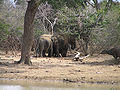 Elephants are restricted mostly to the lowlands in the dry zone where they are still fairly widespread in north, south, east, north-western, north-central and south-eastern Sri Lanka. With the exception of a small remnant population in the Peak Wilderness Sanctuary
elephants are restricted mostly to the lowland in the dry zone but are absent from the wet zone of the country. With the exception of Wilpattu
and Ruhuna National Parks, all other protected areas
are less than 1000 km² (386.1 sq mi) in extent. Many areas are less than 50 km² (19.3 sq mi), and hence not large enough to accommodate the entire home ranges of elephants that use them. In the Mahaweli Development Area, protected areas such as Wasgomuwa National Park, Flood Plains National Park
, Somawathiya National Park
, and Trikonamadu Nature Reserve have been linked resulting in an overall area of 1172 km² (452.5 sq mi) of contiguous habitat for elephants. Nevertheless, about 65% of the elephants range extends outside protected areas.
, herb
, grass
, or climbers
. More than 25% of the plant species belonged to the family Leguminosae
, and 19% of the plant species belonged to the family of true grasses
. The presence of cultivated plants in dung does not result solely due to raiding of crops as it was observed that elephants feed on leftover crop
plants in fallow chenas
. Juvenile elephants tend to feed predominantly on grass species.
Food resources are abundant in regenerating forests, but at low density in mature forests. Traditional slash-and-burn agriculture creates optimum habitat for elephants through promoting successional vegetation.
that was killed. Their disappearance from the montane zone began with the largescale clearance of forests for the planting of coffee, and afterwards tea, during the first half of the 19th century. Even by the turn of the 20th century, elephants were distributed over much of the island.
Elephant populations in Sri Lanka were seriously depleted through capture and slaughter in the 19th century. Between 1829 and 1855 alone, more than 6,000 elephants were captured and shot.
Size of wild elephant populations in Sri Lanka estimated at
in Sri Lanka had a very long history for more than 2000 years. In 19th century and early 20th century many bull elephants were killed by trophy hunters
. Between 1999 to the end of 2006 every year nearly 100 wild elephants were killed.
During the armed conflict in Sri Lanka, elephants were maimed or killed by land mines. Between 1990 and 1993, a total of 165 wild elephants died as a result of gunshot injuries. In 1994, at least 96 elephants were killed by poachers or land mine
s, and up to twenty elephants have fallen victims to land mines and been crippled.
Today, given the rarity of tuskers in Sri Lanka, ivory poaching is not a major conservation issue. Nevertheless, some trade in ivory still goes on. Kandy
has been identified as the centre for such illegal trade. The greatest threat to elephants comes from an expanding human population and its demand for land. Loss of significant extents of elephant range to development continues currently, with a number of irrigation and development projects leading to the conversion of more elephant ranges to irrigated agriculture and settlements.
Elephants are killed to protect crops and houses. Other threats are poaching, deforestation, drought and starvation. During drought seasons many elephants damage agricultural land for food. Nearly 80 elephants were killed in north western Sri Lanka, 50 in south and east, and another 30 in other parts of the country, totaling 160 elephant deaths in 2006 alone.
The elephant conservation strategy of the Department of Wildlife Conservation aims at conserving as many viable populations as possible in as wide a range of suitable habitats as is feasible. This means protecting elephants both within the system of protected areas and as many animals outside these areas that the land can support and landholders will accept, and not restricting elephants to the protected area network alone.
Under the British rulers, Elephant population decreased massively, Elephants were killed for their tusks. This is the main reason for their reduction of population.
for over two thousand years and remained so through British colonial rule. The coat of arms
and the flag of Ceylon Government
from 1875 to 1948 included an elephant and even today many institutions use the Sri Lankan Elephant in their coat of arms and insignia
.
An important cultural symbiosis has continued to exist between the elephant and humans for over two thousand years – no religious procession was complete without its retinue of elephants, and many large Buddhist temples in Sri Lanka had their own elephants.
Subspecies
Subspecies in biological classification, is either a taxonomic rank subordinate to species, ora taxonomic unit in that rank . A subspecies cannot be recognized in isolation: a species will either be recognized as having no subspecies at all or two or more, never just one...
of the Asian Elephant
Asian Elephant
The Asian or Asiatic elephant is the only living species of the genus Elephas and distributed in Southeast Asia from India in the west to Borneo in the east. Three subspecies are recognized — Elephas maximus maximus from Sri Lanka, the Indian elephant or E. m. indicus from mainland Asia, and E. m....
, and native to Sri Lanka
Sri Lanka
Sri Lanka, officially the Democratic Socialist Republic of Sri Lanka is a country off the southern coast of the Indian subcontinent. Known until 1972 as Ceylon , Sri Lanka is an island surrounded by the Indian Ocean, the Gulf of Mannar and the Palk Strait, and lies in the vicinity of India and the...
. Since 1986, Elephas maximus has been listed as endangered
Endangered species
An endangered species is a population of organisms which is at risk of becoming extinct because it is either few in numbers, or threatened by changing environmental or predation parameters...
by IUCN as the population has declined by at least 50% over the last three generations, estimated to be 60–75 years. The species is pre-eminently threatened by habitat loss, degradation and fragmentation.
Elephas maximus maximus is the type species
Type species
In biological nomenclature, a type species is both a concept and a practical system which is used in the classification and nomenclature of animals and plants. The value of a "type species" lies in the fact that it makes clear what is meant by a particular genus name. A type species is the species...
of the Asian elephant, first described by Carl Linnaeus under the binominal Elephas maximus in 1758.
The Sri Lankan elephant population is now largely restricted to a few National Parks and Nature Reserves. Udawalawe National Park
Udawalawe National Park
Udawalawe National Park lies on the boundary of Sabaragamuwa and Uva Provinces, in Sri Lanka. The national park was created to provide a sanctuary for wild animals displaced by the construction of the Udawalawe reservoir on the Walawe River, as well as to protect the catchment of the reservoir....
, Yala National Park
Yala National Park
Yala National Park is the most visited and second largest national park in Sri Lanka. Actually it consists of five blocks, two of which are now open to the public; and also adjoining parks. The blocks have individual names also, like Ruhuna National Park for the block 1 and Kumana National Park or...
, Wilpattu National Park
Wilpattu National Park
Wilpattu National Park is a park located on the island of Sri Lanka. The unique feature of this park is the existence of "Willus" - Natural, sand-rimmed water basins or depressions that fill with rainwater. Located in the Northwest coast lowland dry zone of Sri Lanka...
and Minneriya National Park
Minneriya National Park
Minneriya National Park is a national park in North Central Province of Sri Lanka. The area was designated as a national park on 12 August 1997, having been originally declared as a wildlife sanctuary in 1938. The reason for declaring the area as protected is to protect the catchment of Minneriya...
are prime locations for spotting elephants.
Characteristics
In general, Asian elephants are smaller than African elephants and have the highest body point on the head. The tip of their trunk has one finger-like process. Their back is convex or level. Females are usually smaller than males, and have short or no tusks.Sri Lankan elephants are the largest subspecies reaching a shoulder height of between 2 and 3.5 m (6.6 and 11.5 ft), weigh between 2000 and 5500 kg (4,409.2 and 12,125.4 lb), and have 19 pairs of ribs. Their skin color is darker than of indicus and of sumatranus with larger and more distinct patches of depigmentation
Depigmentation
Depigmentation is the lightening of the skin, or loss of pigment. Depigmentation of the skin can be caused by a number of local and systemic conditions. The pigment loss can be partial or complete...
on ears, face, trunk and belly.
Only 7% of males bear tusks.
The elephant
Elephant
Elephants are large land mammals in two extant genera of the family Elephantidae: Elephas and Loxodonta, with the third genus Mammuthus extinct...
population in the National Parks of Sri Lanka
Sri Lanka
Sri Lanka, officially the Democratic Socialist Republic of Sri Lanka is a country off the southern coast of the Indian subcontinent. Known until 1972 as Ceylon , Sri Lanka is an island surrounded by the Indian Ocean, the Gulf of Mannar and the Palk Strait, and lies in the vicinity of India and the...
is somewhat diminutive in stature when compared both with historical accounts dating back to 200 BC and with the early photographs taken in 19th century during the time of colonial British rule of the island. The smaller size could possibly be the end result of a long-continued process of removing the physically best specimens from the potential breeding-stock through hunting or domestication (see insular dwarfism
Insular dwarfism
Insular dwarfism, a form of phyletic dwarfism, is the process and condition of the reduction in size of large animals – typically mammals – when their population's range is limited to a small environment, primarily islands. This natural process is distinct from the intentional creation of dwarf...
).
Distribution and habitat
elephants are restricted mostly to the lowland in the dry zone but are absent from the wet zone of the country. With the exception of Wilpattu
Wilpattu National Park
Wilpattu National Park is a park located on the island of Sri Lanka. The unique feature of this park is the existence of "Willus" - Natural, sand-rimmed water basins or depressions that fill with rainwater. Located in the Northwest coast lowland dry zone of Sri Lanka...
and Ruhuna National Parks, all other protected areas
Protected areas of Sri Lanka
Protected areas of Sri Lanka are administrated by Department of Forest Conservation and Department of Wildlife Conservation of Sri Lanka.There are 501 protected areas in Sri Lanka. The protected areas falls under supervision Department of Forest Conservation include forests defined in National...
are less than 1000 km² (386.1 sq mi) in extent. Many areas are less than 50 km² (19.3 sq mi), and hence not large enough to accommodate the entire home ranges of elephants that use them. In the Mahaweli Development Area, protected areas such as Wasgomuwa National Park, Flood Plains National Park
Flood Plains National Park
Flood Plains National Park is one of the four national parks set aside under the Mahaweli River development project. The park was created on 7 August 1984. The national park is situated along the Mahaweli flood plain and is considered a rich feeding ground for elephants...
, Somawathiya National Park
Somawathiya National Park
Somawathiya National Park is one of the four national parks designated under the Mahaweli River development project. Somawathiya Chaitya, a stupa said to be containing a relic of the tooth of the Buddha, is situated within the park. The park was created on 2 September 1986, having been originally...
, and Trikonamadu Nature Reserve have been linked resulting in an overall area of 1172 km² (452.5 sq mi) of contiguous habitat for elephants. Nevertheless, about 65% of the elephants range extends outside protected areas.
Ecology and behaviour
Elephants are classified as megaherbivores and consume up to 150 kg (330.7 lb) of plant matter per day. As generalists they feed on a wide variety of food plants. In Sri Lanka's northwestern region, feeding behaviour of elephants was observed during the period of January 1998 to December 1999. The elephants fed on a total of 116 plant species belonging to 35 families including 27 species of cultivated plants. More than half of the plants were non tree species, i.e. shrubShrub
A shrub or bush is distinguished from a tree by its multiple stems and shorter height, usually under 5–6 m tall. A large number of plants may become either shrubs or trees, depending on the growing conditions they experience...
, herb
Herbaceous plant
A herbaceous plant is a plant that has leaves and stems that die down at the end of the growing season to the soil level. They have no persistent woody stem above ground...
, grass
Grass
Grasses, or more technically graminoids, are monocotyledonous, usually herbaceous plants with narrow leaves growing from the base. They include the "true grasses", of the Poaceae family, as well as the sedges and the rushes . The true grasses include cereals, bamboo and the grasses of lawns ...
, or climbers
Vine
A vine in the narrowest sense is the grapevine , but more generally it can refer to any plant with a growth habit of trailing or scandent, that is to say climbing, stems or runners...
. More than 25% of the plant species belonged to the family Leguminosae
Fabaceae
The Fabaceae or Leguminosae, commonly known as the legume, pea, or bean family, is a large and economically important family of flowering plants. The group is the third largest land plant family, behind only the Orchidaceae and Asteraceae, with 730 genera and over 19,400 species...
, and 19% of the plant species belonged to the family of true grasses
Poaceae
The Poaceae is a large and nearly ubiquitous family of flowering plants. Members of this family are commonly called grasses, although the term "grass" is also applied to plants that are not in the Poaceae lineage, including the rushes and sedges...
. The presence of cultivated plants in dung does not result solely due to raiding of crops as it was observed that elephants feed on leftover crop
Crop
Crop may refer to:* Crop, a plant grown and harvested for agricultural use* Crop , part of the alimentary tract of some animals* Crop , a modified whip used in horseback riding or disciplining humans...
plants in fallow chenas
Shifting cultivation
Shifting cultivation is an agricultural system in which plots of land are cultivated temporarily, then abandoned. This system often involves clearing of a piece of land followed by several years of wood harvesting or farming, until the soil loses fertility...
. Juvenile elephants tend to feed predominantly on grass species.
Food resources are abundant in regenerating forests, but at low density in mature forests. Traditional slash-and-burn agriculture creates optimum habitat for elephants through promoting successional vegetation.
Population trend
In the historical past, elephants were found in the dry zone, the lowland wet zone, as well as in the cold damp forests of the mountains in the island. They enjoyed wide distribution and good numbers from sea level to the highest mountain ranges. Until 1830, elephants were so plentiful that their destruction was encouraged by the Government, and rewards were paid for anythat was killed. Their disappearance from the montane zone began with the largescale clearance of forests for the planting of coffee, and afterwards tea, during the first half of the 19th century. Even by the turn of the 20th century, elephants were distributed over much of the island.
Elephant populations in Sri Lanka were seriously depleted through capture and slaughter in the 19th century. Between 1829 and 1855 alone, more than 6,000 elephants were captured and shot.
Size of wild elephant populations in Sri Lanka estimated at
- 12,000 to 14,000 in the early 19th century;
- 10,000 in the early 20th century;
- 7,000 to 8,000 in around 1920;
- between 1,745 and 2,455 individuals in 1969;
- between 2,500 and 3,435 in 1987;
- 1,967 in June 1993 fragmented in five regions;
- between 3,150 and 4,400 in 2000;
- 3150 in 2006;
- 2900-3000 in 2007.
- 5897 in total, 2011 elephant census
Threats
Ivory tradeIvory trade
The ivory trade is the commercial, often illegal trade in the ivory tusks of the hippopotamus, walrus, narwhal, mammoth, and most commonly, Asian and African elephants....
in Sri Lanka had a very long history for more than 2000 years. In 19th century and early 20th century many bull elephants were killed by trophy hunters
Trophy hunting
Trophy hunting is the selective hunting of wild game animals. Although parts of the slain animal may be kept as a hunting trophy or memorial , the carcass itself is sometimes used as food....
. Between 1999 to the end of 2006 every year nearly 100 wild elephants were killed.
During the armed conflict in Sri Lanka, elephants were maimed or killed by land mines. Between 1990 and 1993, a total of 165 wild elephants died as a result of gunshot injuries. In 1994, at least 96 elephants were killed by poachers or land mine
Land mine
A land mine is usually a weight-triggered explosive device which is intended to damage a target—either human or inanimate—by means of a blast and/or fragment impact....
s, and up to twenty elephants have fallen victims to land mines and been crippled.
Today, given the rarity of tuskers in Sri Lanka, ivory poaching is not a major conservation issue. Nevertheless, some trade in ivory still goes on. Kandy
Kandy
Kandy is a city in the center of Sri Lanka. It was the last capital of the ancient kings' era of Sri Lanka. The city lies in the midst of hills in the Kandy plateau, which crosses an area of tropical plantations, mainly tea. Kandy is one of the most scenic cities in Sri Lanka; it is both an...
has been identified as the centre for such illegal trade. The greatest threat to elephants comes from an expanding human population and its demand for land. Loss of significant extents of elephant range to development continues currently, with a number of irrigation and development projects leading to the conversion of more elephant ranges to irrigated agriculture and settlements.
Elephants are killed to protect crops and houses. Other threats are poaching, deforestation, drought and starvation. During drought seasons many elephants damage agricultural land for food. Nearly 80 elephants were killed in north western Sri Lanka, 50 in south and east, and another 30 in other parts of the country, totaling 160 elephant deaths in 2006 alone.
Conservation
Elephas maximus is listed on CITES Appendix I.The elephant conservation strategy of the Department of Wildlife Conservation aims at conserving as many viable populations as possible in as wide a range of suitable habitats as is feasible. This means protecting elephants both within the system of protected areas and as many animals outside these areas that the land can support and landholders will accept, and not restricting elephants to the protected area network alone.
- In the Pinnawala Elephant Orphanage in Kegalle injured elephants are treated, and orphaned baby elephants cared for. Nearly 70 elephants live here. Captive breeding is also going on.
- The Udawalawe Elephant Transit CentreUdawalawe Elephant Transit CentreThe Udawalawe Elephant Transfer Home is a facility within Udawalawe National Park in Sri Lanka that was established in 1995 by the Sri Lanka Department of Wildlife Conservation...
in Udawalawe National ParkUdawalawe National ParkUdawalawe National Park lies on the boundary of Sabaragamuwa and Uva Provinces, in Sri Lanka. The national park was created to provide a sanctuary for wild animals displaced by the construction of the Udawalawe reservoir on the Walawe River, as well as to protect the catchment of the reservoir....
is a rehabilitation centre, where orphaned elephant calves are being kept until they can be released into the wild.
Under the British rulers, Elephant population decreased massively, Elephants were killed for their tusks. This is the main reason for their reduction of population.
Cultural depiction
Elephants were a common in Sinhalese heraldryHeraldry
Heraldry is the profession, study, or art of creating, granting, and blazoning arms and ruling on questions of rank or protocol, as exercised by an officer of arms. Heraldry comes from Anglo-Norman herald, from the Germanic compound harja-waldaz, "army commander"...
for over two thousand years and remained so through British colonial rule. The coat of arms
Coat of arms
A coat of arms is a unique heraldic design on a shield or escutcheon or on a surcoat or tabard used to cover and protect armour and to identify the wearer. Thus the term is often stated as "coat-armour", because it was anciently displayed on the front of a coat of cloth...
and the flag of Ceylon Government
British Ceylon
British Ceylon refers to British rule prior to 1948 of the island territory now known as Sri Lanka.-From the Dutch to the British:Before the beginning of the Dutch governance, the island of Ceylon was divided between the Portuguese Empire and the Kingdom of Kandy, who were in the midst of a war for...
from 1875 to 1948 included an elephant and even today many institutions use the Sri Lankan Elephant in their coat of arms and insignia
Insignia
Insignia or insigne pl -nia or -nias : a symbol or token of personal power, status or office, or of an official body of government or jurisdiction...
.
An important cultural symbiosis has continued to exist between the elephant and humans for over two thousand years – no religious procession was complete without its retinue of elephants, and many large Buddhist temples in Sri Lanka had their own elephants.