


Pan American Games

Encyclopedia
| Pan American Games |
| Organizations |
| Charter Olympic Charter The Olympic Charter, last updated March 21, 1992, is a set of rules and guidelines for the organization of the Olympic Games, and for governing the Olympic Movement. Adopted by International Olympic Committee , it is the codification of the Fundamental Principles, Rules and By-laws. French and... PASO NOC National Olympic Committee National Olympic Committees are the national constituents of the worldwide Olympic movement. Subject to the controls of the International Olympic Committee, they are responsible for organizing their people's participation in the Olympic Games... s Symbols Sports Pan American Games sports The Pan American Games sports comprise all the sports contested in the Summer Olympic Games. In addition, traditional and popular sports throughout the Americas which are not contested at the Olympic Games are also contested such as bowling and baseball. As of 2011, the Pan American Games will... Competitors Medal tables All-time Pan American Games medal table An all-time medal table for all Pan American Games from 1951 to 2007, is tabulated below. PASO itself does not publish all-time tables, and publishes unofficial tables only per single Games... Medalists Ceremonies Olympic Games ceremony Olympic Games ceremonies were an integral part of the Ancient Olympic Games. Some of the elements of the modern ceremonies harken back to the Ancient Games from which the Modern Olympics draw their ancestry. An example of this is the prominence of Greece in both the opening and closing ceremonies... |
The Pan-American or Pan American Games (also known colloquially as the Pan Am Games) are a major event in the Americas
Americas
The Americas, or America , are lands in the Western hemisphere, also known as the New World. In English, the plural form the Americas is often used to refer to the landmasses of North America and South America with their associated islands and regions, while the singular form America is primarily...
featuring summer and formerly winter sports, in which thousands of athletes participate in a variety of competitions
Multi-sport event
A multi-sport event is an organized sporting event, often held over multiple days, featuring competition in many different sports between organized teams of athletes from nation-states. The first major, modern, multi-sport event of international significance was the modern Olympic Games.Many...
. The Pan American Games are the second largest multi-sport event after the Summer Olympics. The competition is held between athletes from nations of the Americas
Americas
The Americas, or America , are lands in the Western hemisphere, also known as the New World. In English, the plural form the Americas is often used to refer to the landmasses of North America and South America with their associated islands and regions, while the singular form America is primarily...
, held every four years in the year before the Summer Olympic Games
Summer Olympic Games
The Summer Olympic Games or the Games of the Olympiad are an international multi-sport event, occurring every four years, organized by the International Olympic Committee. Medals are awarded in each event, with gold medals for first place, silver for second and bronze for third, a tradition that...
. There also has been one edition of the Winter Pan American Games
Winter Pan American Games
The Pan American Sports Organization originally conceived of a Winter Pan American Games after the first Pan American Games were held in Buenos Aires in 1951, but the idea was abandoned due to a lack of interest from member nations. The idea was revived after the 1987 Pan American Games in...
in 1990. The Pan American Games were last held in Guadalajara
2011 Pan American Games
The 2011 Pan American Games, officially the XVI Pan American Games, was an international multi-sport event that was held from October 14–30, 2011 in Guadalajara, Jalisco, Mexico. Some events were held in the nearby cities of Ciudad Guzmán, Puerto Vallarta, Lagos de Moreno and Tapalpa...
in 2011. The next edition of the Games will be held in Toronto
Toronto
Toronto is the provincial capital of Ontario and the largest city in Canada. It is located in Southern Ontario on the northwestern shore of Lake Ontario. A relatively modern city, Toronto's history dates back to the late-18th century, when its land was first purchased by the British monarchy from...
in 2015
2015 Pan American Games
The 2015 Pan American Games, officially the XVII Pan American Games or the 17th Pan American Games, will be a major international multi-sport event that will be held from July 10–26, 2015 in Toronto, Ontario, Canada, with some events held in the suburbs of Ajax, Barrie, Brampton, Caledon, Hamilton,...
. Since 2007, host cities are contracted to manage both the Pan American and the Parapan American Games
Parapan American Games
The Parapan American Games is a multi-sport event held every four years after every Pan American Games for athletes with physical disabilities. The first Games was held in 1999 in Mexico City, Mexico...
, in which athletes with physical disabilities compete against one another. The Parapan American Games are held immediately following their respective Pan American Games. PASO is the governing body of the Pan American Games movement, whose structure and actions are defined by the Olympic Charter
Olympic Charter
The Olympic Charter, last updated March 21, 1992, is a set of rules and guidelines for the organization of the Olympic Games, and for governing the Olympic Movement. Adopted by International Olympic Committee , it is the codification of the Fundamental Principles, Rules and By-laws. French and...
.
The Pan American Games Movement consists of international sports federations (IFs), National Olympic Committee
National Olympic Committee
National Olympic Committees are the national constituents of the worldwide Olympic movement. Subject to the controls of the International Olympic Committee, they are responsible for organizing their people's participation in the Olympic Games...
s (NOCs) that are recognized by PASO, and organizing committees for each specific Pan American Games. As the decision-making body, PASO (Pan American Sports Organization) is responsible for choosing the host city for each Pan American Games. The host city is responsible for organizing and funding a celebration of the Games consistent with Olympic Charter
Olympic Charter
The Olympic Charter, last updated March 21, 1992, is a set of rules and guidelines for the organization of the Olympic Games, and for governing the Olympic Movement. Adopted by International Olympic Committee , it is the codification of the Fundamental Principles, Rules and By-laws. French and...
(since PASO is affiliated with the IOC, the Olympic Charter) and rules. The Pan American Games program, consisting of the sports
Pan American Games sports
The Pan American Games sports comprise all the sports contested in the Summer Olympic Games. In addition, traditional and popular sports throughout the Americas which are not contested at the Olympic Games are also contested such as bowling and baseball. As of 2011, the Pan American Games will...
to be contested at the Games, is also determined by PASO. The celebration of the Games encompasses many rituals and symbols, such as the flag and torch, as well as the opening and closing ceremonies. There are over 5,000 athletes that compete at the Pan American Games in 36 different sports and nearly 400 events. The first, second, and third place finishers in each event receive gold, silver, and bronze medals, respectively.
Early Games
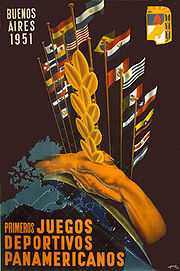
1932 Summer Olympics
The 1932 Summer Olympics, officially known as the Games of the X Olympiad, was a major world wide multi-athletic event which was celebrated in 1932 in Los Angeles, California, United States. No other cities made a bid to host these Olympics. Held during the worldwide Great Depression, many nations...
in Los Angeles
Los Ángeles
Los Ángeles is the capital of the province of Biobío, in the commune of the same name, in Region VIII , in the center-south of Chile. It is located between the Laja and Biobío rivers. The population is 123,445 inhabitants...
, United States
United States
The United States of America is a federal constitutional republic comprising fifty states and a federal district...
. Latin American representatives of the International Olympic Committee (IOC) who were inspired by the holding of the first Central American Games
1926 Central American and Caribbean Games
The 1st Central American and Caribbean Games were held in Mexico City, Mexico, from October 30 to November 2, 1926. It featured 269 athletes from three countries , competing in nine sports: athletics, basketball, baseball, diving, fencing, shooting, swimming, tennis, and volleyball.-Medal...
in 1926, proposed the creation of a competition that would include all the countries of the Americas, for the purpose of strengthening sport activities in the region. The idea resulted also in the first ever Pan American Sports Congress, held in Buenos Aires
Buenos Aires
Buenos Aires is the capital and largest city of Argentina, and the second-largest metropolitan area in South America, after São Paulo. It is located on the western shore of the estuary of the Río de la Plata, on the southeastern coast of the South American continent...
, Argentina
Argentina
Argentina , officially the Argentine Republic , is the second largest country in South America by land area, after Brazil. It is constituted as a federation of 23 provinces and an autonomous city, Buenos Aires...
in 1940. The Congress determined that the inaugural games would be held in 1942 in Buenos Aires, plans that were eventually postponed due to World War II
World War II
World War II, or the Second World War , was a global conflict lasting from 1939 to 1945, involving most of the world's nations—including all of the great powers—eventually forming two opposing military alliances: the Allies and the Axis...
. At the end of the war, a second Pan American Sports Congress in London
London
London is the capital city of :England and the :United Kingdom, the largest metropolitan area in the United Kingdom, and the largest urban zone in the European Union by most measures. Located on the River Thames, London has been a major settlement for two millennia, its history going back to its...
during the 1948 Summer Olympic Games, confirmed Buenos Aires as the host for the first Pan American Games
1951 Pan American Games
The 1951 Pan American Games were held in Buenos Aires, Argentina between 25 February-9 March 1951. The Pan American Games' origins were at the Games of the X Olympiad in Los Angeles, United States, where officials representing the National Olympic Committees of the Americas discussed the staging...
, which were finally scheduled for 1951. Competitions started on February 25 and included 2,513 athletes from 21 countries, competing in 18 sports. Countries that were part of the Commonwealth of Nations
Commonwealth of Nations
The Commonwealth of Nations, normally referred to as the Commonwealth and formerly known as the British Commonwealth, is an intergovernmental organisation of fifty-four independent member states...
such as Canada
Canada
Canada is a North American country consisting of ten provinces and three territories. Located in the northern part of the continent, it extends from the Atlantic Ocean in the east to the Pacific Ocean in the west, and northward into the Arctic Ocean...
did not compete at the first Pan American Games. The second edition of Pan American Games, were the first to be held in the Central America
Central America
Central America is the central geographic region of the Americas. It is the southernmost, isthmian portion of the North American continent, which connects with South America on the southeast. When considered part of the unified continental model, it is considered a subcontinent...
n and Caribbean
Caribbean
The Caribbean is a crescent-shaped group of islands more than 2,000 miles long separating the Gulf of Mexico and the Caribbean Sea, to the west and south, from the Atlantic Ocean, to the east and north...
region as they were held in Mexico City
Mexico City
Mexico City is the Federal District , capital of Mexico and seat of the federal powers of the Mexican Union. It is a federal entity within Mexico which is not part of any one of the 31 Mexican states but belongs to the federation as a whole...
, Mexico
Mexico
The United Mexican States , commonly known as Mexico , is a federal constitutional republic in North America. It is bordered on the north by the United States; on the south and west by the Pacific Ocean; on the southeast by Guatemala, Belize, and the Caribbean Sea; and on the east by the Gulf of...
. Competitions started on March 12 and included 2,583 athletes from 22 countries, competing in 17 sports. The Pan American Games were held subsequently every four years in the cities of Chicago
Chicago
Chicago is the largest city in the US state of Illinois. With nearly 2.7 million residents, it is the most populous city in the Midwestern United States and the third most populous in the US, after New York City and Los Angeles...
, United States
United States
The United States of America is a federal constitutional republic comprising fifty states and a federal district...
in 1959
1959 Pan American Games
The 3rd Pan American Games opened on August 27, 1959 in sunny 90°F heat before 40,000 people in Chicago, Illinois, United States. The first Pan American Games held in North America, they were originally scheduled for Cleveland, Ohio, but the U.S. Congress’s decision to cut $5,000,000 in federal...
, São Paulo
São Paulo
São Paulo is the largest city in Brazil, the largest city in the southern hemisphere and South America, and the world's seventh largest city by population. The metropolis is anchor to the São Paulo metropolitan area, ranked as the second-most populous metropolitan area in the Americas and among...
, Brazil in 1963
1963 Pan American Games
The 4th Pan American Games were held from April 20 to May 5, 1963 in São Paulo, Brazil.- Medal count :To sort this table by nation, total medal count, or any other column, click on the icon next to the column title.Note...
and Winnipeg
Winnipeg
Winnipeg is the capital and largest city of Manitoba, Canada, and is the primary municipality of the Winnipeg Capital Region, with more than half of Manitoba's population. It is located near the longitudinal centre of North America, at the confluence of the Red and Assiniboine Rivers .The name...
, Canada
Canada
Canada is a North American country consisting of ten provinces and three territories. Located in the northern part of the continent, it extends from the Atlantic Ocean in the east to the Pacific Ocean in the west, and northward into the Arctic Ocean...
in 1967
1967 Pan American Games
The 5th Pan American Games were held in Winnipeg, Manitoba, Canada, from July 23 to August 6, 1967.Winnipeg was chosen as host of the Pan American Games on its second try. It first bid for the fourth Pan American Games at the 1959 PASO meeting in Chicago. It lost to São Paulo, Brazil...
.
Recent Games
From 2,513 participants representing 14 nations in 1951, the Games have grown to about 5,633 competitors from 42 countries at the 2007 Pan American Games2007 Pan American Games
The 2007 Pan American Games, officially known as the XV Pan American Games, were a major continental multi-sport event that took place in Rio de Janeiro, Brazil, from July 13 to July 29, 2007. A total of 5,633 athletes from 42 National Olympic Committees competed in 332 events in 34 sports and in...
. During the Games most athletes and officials are housed in the Pan American Games village
Olympic Village
An Olympic Village is an accommodation centre built for an Olympic Games, usually within an Olympic Park or elsewhere in a host city. Olympic Villages are built to house all participating athletes, as well as officials, athletic trainers, and other staff. Since the Munich Massacre at the 1972...
. This village is intended to be a self-contained home for all the Pan American Games participants. It is furnished with cafeterias, health clinics, and locations for religious expression.
PASO allows nations to compete that do not meet the strict requirements for political sovereignty that other international organizations demand. As a result, colonies and dependencies are permitted to set up their own National Olympic Committees. Examples of this include territories such as Puerto Rico
Puerto Rico
Puerto Rico , officially the Commonwealth of Puerto Rico , is an unincorporated territory of the United States, located in the northeastern Caribbean, east of the Dominican Republic and west of both the United States Virgin Islands and the British Virgin Islands.Puerto Rico comprises an...
and Bermuda
Bermuda
Bermuda is a British overseas territory in the North Atlantic Ocean. Located off the east coast of the United States, its nearest landmass is Cape Hatteras, North Carolina, about to the west-northwest. It is about south of Halifax, Nova Scotia, Canada, and northeast of Miami, Florida...
all of which compete as separate nations despite being legally a part of another country.
Winter Pan American Games

Lake Placid, New York
Lake Placid, New York
Lake Placid is a village in the Adirondack Mountains in Essex County, New York, United States. As of the 2000 census, the village had a population of 2,638....
tried to organize Winter Games in 1959, but, again not enough countries expressed interest, and the plans were eventually cancelled.
In 1988, members of PASO voted to hold the first Pan American Winter Games at Las Leñas
Las Leñas
Las Leñas is one of the largest Andean ski resorts in Argentina, located in the western part of Mendoza Province, together with Cerro Catedral in San Carlos de Bariloche, located in Rio Negro province....
, Argentina
Argentina
Argentina , officially the Argentine Republic , is the second largest country in South America by land area, after Brazil. It is constituted as a federation of 23 provinces and an autonomous city, Buenos Aires...
in September 1989. It was further agreed that Winter Games would be held every four years. Lack of snow however, forced the postponement of the games until September 16–22, 1990 when only eight countries sent 97 athletes to Las Lenas. Of that total, 76 were from just three countries: Argentina, Canada, and the United States. Weather was unseasonably warm and again there was little snow, so only three Alpine Skiing events – the Slalom, Giant Slalom, and Super G were staged. The United States and Canada combined to win all 18 medals.
PASO awarded the second Pan American Winter Games to Santiago, Chile
Santiago, Chile
Santiago , also known as Santiago de Chile, is the capital and largest city of Chile, and the center of its largest conurbation . It is located in the country's central valley, at an elevation of above mean sea level...
for 1993. The United States warned that it would not take part unless a full schedule of events was held. The Santiago organizing committee eventually gave up on planning the games after the United States Olympic Committee
United States Olympic Committee
The United States Olympic Committee is a non-profit organization that serves as the National Olympic Committee and National Paralympic Committee for the United States and coordinates the relationship between the United States Anti-Doping Agency and the World Anti-Doping Agency and various...
declined to participate, and the idea has not been revived since.
Pan American Sports Organization
Olympic Charter
The Olympic Charter, last updated March 21, 1992, is a set of rules and guidelines for the organization of the Olympic Games, and for governing the Olympic Movement. Adopted by International Olympic Committee , it is the codification of the Fundamental Principles, Rules and By-laws. French and...
(which is the same as PASO's charter). As the umbrella organization of the Olympic Movement, the Pan American Sports Organization (PASO) is responsible for selecting the host city, overseeing the planning of the Pan American Games, updating and approving the sports program, and negotiating sponsorship and broadcasting rights.
The Pan American Games Movement is made of three major elements:
- International Federations (IFs) are the governing bodiesSport governing bodyA sport governing body is a sports organization that has a regulatory or sanctioning function. Sport governing bodies come in various forms, and have a variety of regulatory functions. Examples of this can include disciplinary action for rule infractions and deciding on rule changes in the sport...
that supervise a sport at an international level. For example, the International Federation of Association Football (FIFAFIFAThe Fédération Internationale de Football Association , commonly known by the acronym FIFA , is the international governing body of :association football, futsal and beach football. Its headquarters are located in Zurich, Switzerland, and its president is Sepp Blatter, who is in his fourth...
) is the IF for football (soccer), and the Fédération Internationale de Volleyball (FIVB) is the international governing body for volleyballVolleyballVolleyball is a team sport in which two teams of six players are separated by a net. Each team tries to score points by grounding a ball on the other team's court under organized rules.The complete rules are extensive...
. There are currently 36 IFs in the Pan American Games Movement, representing each of the Pan American Games sports. - National Olympic CommitteeNational Olympic CommitteeNational Olympic Committees are the national constituents of the worldwide Olympic movement. Subject to the controls of the International Olympic Committee, they are responsible for organizing their people's participation in the Olympic Games...
s (NOCs) represent and regulate the Pan American Games movement within each country. For example, the United States Olympic CommitteeUnited States Olympic CommitteeThe United States Olympic Committee is a non-profit organization that serves as the National Olympic Committee and National Paralympic Committee for the United States and coordinates the relationship between the United States Anti-Doping Agency and the World Anti-Doping Agency and various...
(USOC) is the NOC of the United StatesUnited StatesThe United States of America is a federal constitutional republic comprising fifty states and a federal district...
. There are currently 42 NOCs recognized by PASO. - Organizing Committees for the Pan America Games (PAOGs) constitute the temporary committees responsible for the organization of a specific celebration of the Pan American Games. PAOGs are dissolved after each Games, once the final report is delivered to PASO.
Spanish
Spanish language
Spanish , also known as Castilian , is a Romance language in the Ibero-Romance group that evolved from several languages and dialects in central-northern Iberia around the 9th century and gradually spread with the expansion of the Kingdom of Castile into central and southern Iberia during the...
and English
English language
English is a West Germanic language that arose in the Anglo-Saxon kingdoms of England and spread into what was to become south-east Scotland under the influence of the Anglian medieval kingdom of Northumbria...
are the official languages of the Pan American Games Movement. The other language used at each Olympic Games is the language of the host country. Every proclamation (such as the announcement of each country during the parade of nations in the opening ceremony) is spoken in these three languages, or the main two depending on whether the host country is an English or Spanish speaking country.
Symbols
The Pan American Games Movement uses symbols to represent the ideals embodied in the Pan American Games charterOlympic Charter
The Olympic Charter, last updated March 21, 1992, is a set of rules and guidelines for the organization of the Olympic Games, and for governing the Olympic Movement. Adopted by International Olympic Committee , it is the codification of the Fundamental Principles, Rules and By-laws. French and...
. The Pan American Sports Organization Flag consists of the PASO logo on a white field. The logo (which was adopted in 1954) consists of five concentric circles of yellow, green, white, red, and blue (from the center) around a light blue disc. A blazing torch is superimposed on the rings and disc. The colors of the rings can be found on all the flags PASO member nations. The games motto "América, Espírito, Sport, Fraternité" is written in black in a circle around the outer edge of the center disc. The motto means "The American Spirit of Friendship Through Sports" the words appear in the 4 languages spoken in the Americas: Spanish
Spanish language
Spanish , also known as Castilian , is a Romance language in the Ibero-Romance group that evolved from several languages and dialects in central-northern Iberia around the 9th century and gradually spread with the expansion of the Kingdom of Castile into central and southern Iberia during the...
, French
French language
French is a Romance language spoken as a first language in France, the Romandy region in Switzerland, Wallonia and Brussels in Belgium, Monaco, the regions of Quebec and Acadia in Canada, and by various communities elsewhere. Second-language speakers of French are distributed throughout many parts...
, Portuguese
Portuguese language
Portuguese is a Romance language that arose in the medieval Kingdom of Galicia, nowadays Galicia and Northern Portugal. The southern part of the Kingdom of Galicia became independent as the County of Portugal in 1095...
and English
English language
English is a West Germanic language that arose in the Anglo-Saxon kingdoms of England and spread into what was to become south-east Scotland under the influence of the Anglian medieval kingdom of Northumbria...
. The Olympic Rings were superimposed on the torch by PASO in October 1998 to symbolize its close link with the Olympic Movement. The name of the organization, in English and Spanish appears in black letters along the bottom of the flag. The flag has been hoisted during each celebration of the Games.
Months before each Games, the Pan American Games flame is lit in a similar way as the Olympic flame
Olympic Flame
The Olympic Flame or Olympic Torch is a symbol of the Olympic Games. Commemorating the theft of fire from the Greek god Zeus by Prometheus, its origins lie in ancient Greece, where a fire was kept burning throughout the celebration of the ancient Olympics. The fire was reintroduced at the 1928...
. In the first games in Buenos Aires
Buenos Aires
Buenos Aires is the capital and largest city of Argentina, and the second-largest metropolitan area in South America, after São Paulo. It is located on the western shore of the estuary of the Río de la Plata, on the southeastern coast of the South American continent...
in 1951, the torch came from Olympia, Greece
Olympia, Greece
Olympia , a sanctuary of ancient Greece in Elis, is known for having been the site of the Olympic Games in classical times, comparable in importance to the Pythian Games held in Delphi. Both games were held every Olympiad , the Olympic Games dating back possibly further than 776 BC...
. However, since the 1955 Pan American Games
1955 Pan American Games
The 2nd Pan American Games opened on March 12, 1955 in the University Stadium in Mexico City, Mexico, in front of a capacity crowd of 100,000 spectators....
, the torch is lit by Aztec
Aztec
The Aztec people were certain ethnic groups of central Mexico, particularly those groups who spoke the Nahuatl language and who dominated large parts of Mesoamerica in the 14th, 15th and 16th centuries, a period referred to as the late post-classic period in Mesoamerican chronology.Aztec is the...
people in old temples, first in the Sierra de la Estrella and after in the Temple of the Sun God
Pyramid of the Sun
The Pyramid of the Sun is the largest building in Teotihuacan and one of the largest in Mesoamerica. Found along the Avenue of the Dead, in between the Pyramid of the Moon and the Ciudadela, and in the shadow of the massive mountain Cerro Gordo, the pyramid is part of a large complex in the heart...
in the Teotihuacán Pyramids. The only exception was for the São Paulo
São Paulo
São Paulo is the largest city in Brazil, the largest city in the southern hemisphere and South America, and the world's seventh largest city by population. The metropolis is anchor to the São Paulo metropolitan area, ranked as the second-most populous metropolitan area in the Americas and among...
games in 1963, when the torch was lit in Brasilia
Brasília
Brasília is the capital city of Brazil. The name is commonly spelled Brasilia in English. The city and its District are located in the Central-West region of the country, along a plateau known as Planalto Central. It has a population of about 2,557,000 as of the 2008 IBGE estimate, making it the...
by the indigenous Guarani people. An Aztec then lights the torch of the first relay bearer, thus initiating the Pan American Games torch relay that will carry the flame to the host city's main stadium, where it plays an important role in the opening ceremony. The flame is required to be held during the games in the stadium which will host the athletics competition. If the Opening ceremony and athletics competition will be held in different stadiums, the flame will be required to move there.
The Pan American Games mascot, an animal or human figure representing the cultural heritage of the host country, was introduced in 1979
1979 Pan American Games
The 8th Pan American Games were held in San Juan, Puerto Rico, from July 1 to July 15, 1979. The capital of Puerto Rico played host to 3,700 athletes from 34 countries competing in 22 sports, making the VIII Pan American Games the largest to date. Security was a concern due to turmoil over the...
in San Juan
San Juan, Puerto Rico
San Juan , officially Municipio de la Ciudad Capital San Juan Bautista , is the capital and most populous municipality in Puerto Rico, an unincorporated territory of the United States. As of the 2010 census, it had a population of 395,326 making it the 46th-largest city under the jurisdiction of...
, Puerto Rico
Puerto Rico
Puerto Rico , officially the Commonwealth of Puerto Rico , is an unincorporated territory of the United States, located in the northeastern Caribbean, east of the Dominican Republic and west of both the United States Virgin Islands and the British Virgin Islands.Puerto Rico comprises an...
. It has played an important part on the Games identity and promotion. The mascots of the most recent Pan American Games, in Rio de Janeiro
Rio de Janeiro
Rio de Janeiro , commonly referred to simply as Rio, is the capital city of the State of Rio de Janeiro, the second largest city of Brazil, and the third largest metropolitan area and agglomeration in South America, boasting approximately 6.3 million people within the city proper, making it the 6th...
, was Cauê, representing the figure of the Sun.
Opening
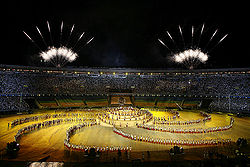
As mandated by the Olympic Charter, various elements frame the opening ceremony of the Pan American Games. The ceremony typically starts with the hoisting of the host country's flag and a performance of its national anthem. The host nation then presents artistic displays of music, singing, dance, and theater representative of its culture. The artistic presentations have grown in scale and complexity as successive hosts attempt to provide a ceremony that outlasts its predecessor's in terms of memorability. The opening ceremony of the Guadalajara Games reportedly cost $20 million, with much of the cost incurred in the artistic segment.After the artistic portion of the ceremony, the athletes parade into the stadium grouped by nation. Argentina is traditionally the first nation to enter in order to honor the origins of the Pan American Games. Nations then enter the stadium alphabetically according to Spanish Language
Spanish language
Spanish , also known as Castilian , is a Romance language in the Ibero-Romance group that evolved from several languages and dialects in central-northern Iberia around the 9th century and gradually spread with the expansion of the Kingdom of Castile into central and southern Iberia during the...
, with the host country's athletes being the last to enter. During the 1995 Pan American Games
1995 Pan American Games
The 12th Pan American Games were held in Mar del Plata, Argentina, from March 12 to March 26, 1995. After 44 years, this was the Pan American Games first return to the country that hosted the first Games, in 1951.-Overview:...
, which was hosted in Mar del Plata, Argentina, the Argentin flag entered the stadium first, while the Argentinan delegation entered last. Speeches are given, formally opening the Games. Finally, the Pan American Games torch is brought into the stadium and passed on until it reaches the final torch carrier—often a well-known and successful athlete from the host nation—who lights the Pan American Games flame in the stadium's cauldron.
Closing
The closing ceremony of the Pan American Games takes place after all sporting events have concluded. Flag-bearers from each participating country enter the stadium, followed by the athletes who enter together, without any national distinction.Two national flags along with the Flag of PASO are hoisted while the corresponding national anthems are played: the flag of the current host country, and the flag of the country hosting the next Pan American Games.
The president of the organizing committee and the president of PASO make their closing speeches, the Games are officially closed, and the Pan American Games family is invited to participate at the next Pan American Games. The Pan American flame is then extinguished. In what is known as the Antwerp Ceremony, the mayor of the city that organized the Games transfers a special Pan American Games flag to the president of PASO, who then passes it on to the mayor of the city hosting the next Pan American Games. After these compulsory elements, the next host nation briefly introduces itself with artistic displays of dance and theater representative of its culture. The closing ceremony also includes a fifteen minute presentation from the next host city.
Medal presentation
A medal ceremony is held after each Pan American Games event is concluded. The winner, second and third-place competitors or teams stand on top of a three-tiered rostrum to be awarded their respective medals. After the medals are given out by an IOC or PASO member, the national flags of the three medalists are raised while the national anthemNational anthem
A national anthem is a generally patriotic musical composition that evokes and eulogizes the history, traditions and struggles of its people, recognized either by a nation's government as the official national song, or by convention through use by the people.- History :Anthems rose to prominence...
of the gold medalist's country plays. Volunteering citizens of the host country also act as hosts during the medal ceremonies, as they aid the officials who present the medals and act as flag-bearers. For every Pan American Games event, the respective medal ceremony is held, at most, one day after the event's final. For the men's marathon, the competition is usually held early in the morning on the last day of competition and its medal ceremony is then held in the evening during the closing ceremony.
Sports
According to Pan American Sports Organization rules all 28 current Olympic sportsOlympic sports
Olympic sports, as defined by the International Olympic Committee, are all the sports contested in the Summer and Winter Olympic Games. The Summer Olympics, as of 2012, will include 26 sports, with two additionall sports due to be added in 2016...
, plus other optional sports (such as bowling
Bowling at the Pan American Games
Bowling has been a sport at the Pan American Games since the 1991 Pan American Games.-Men's Masters:-Men's Singles:-Men's All-Events:-Men's Doubles:-Men's Team:-Women's Masters:-Women's Singles:-Women's All-Events:...
) that is popular throughout the Americas
Americas
The Americas, or America , are lands in the Western hemisphere, also known as the New World. In English, the plural form the Americas is often used to refer to the landmasses of North America and South America with their associated islands and regions, while the singular form America is primarily...
can be played at a single games.
The Pan American Games program
Pan American Games sports
The Pan American Games sports comprise all the sports contested in the Summer Olympic Games. In addition, traditional and popular sports throughout the Americas which are not contested at the Olympic Games are also contested such as bowling and baseball. As of 2011, the Pan American Games will...
consists of 36 sports, 40 disciplines and nearly 400 events. For example, Equestrian
Equestrian at the Pan American Games
The Pan American Games are similar to the Olympics, consisting of teams from nations across the Americas. Held every four years, the equestrian sports have been hosted since the first Games, which took place in Buenos Aires, Argentina in 1951....
is a Pan American Games sport, comprising three disciplines: Dressage
Dressage
Dressage is a competitive equestrian sport, defined by the International Equestrian Federation as "the highest expression of horse training." Competitions are held at all levels from amateur to the World Equestrian Games...
, Eventing
Eventing
Eventing is an equestrian event comprising dressage, cross-country, and show jumping. This event has its roots in a comprehensive cavalry test requiring mastery of several types of riding...
and Show jumping
Show jumping
Show jumping, also known as "stadium jumping," "open jumping," or "jumpers," is a member of a family of English riding equestrian events that also includes dressage, eventing, hunters, and equitation. Jumping classes commonly are seen at horse shows throughout the world, including the Olympics...
. It is further broken down into six events for both men and women as a mixed gender competition. Athletics
Athletics at the Pan American Games
Since its first edition held in 1951, athletics events have been competed at the Pan American Games. The events list follows the Olympic model as the Games are an IOC sanctioned competition.-Results:-Medal table 1951-2011:-See also:...
, swimming
Swimming at the Pan American Games
Swimming for both men and women has been a part of the Pan American Games since the Games' first edition in 1951.-50 m freestyle:-100 m freestyle:-200 m freestyle:-400 m freestyle:-1500 m freestyle:...
, fencing, diving
Diving at the Pan American Games
Diving has been a sport of the Pan American Games since the 1951 games.-1m Springboard:-3m Springboard:-3m Synchronized Springboard:-10m Platform:-10m Synchronized Platform:-1m Springboard:-3m Springboard:...
, baseball
Baseball at the Pan American Games
The baseball tournament at the Pan American Games has long been considered to be one of the premier international baseball events in the world, even higher than the Olympic Games. This is because the level of competition is higher than in the Olympics, where only two teams from the Americas...
, boxing, basketball
Basketball at the Pan American Games
- Men's Tournament :-Medal table:-Participation Details:- Women's Tournament :-Medal table:-Participation Details:-External links:* * *...
, equestrian
Equestrian at the Pan American Games
The Pan American Games are similar to the Olympics, consisting of teams from nations across the Americas. Held every four years, the equestrian sports have been hosted since the first Games, which took place in Buenos Aires, Argentina in 1951....
, football
Football at the Pan American Games
A men's football tournament is held at every Pan American Games since the first edition of the multi-sports event in 1951, a women's tournament was only added in 1999.- Summaries :...
, artistic gymnastics
Gymnastics at the Pan American Games
-Medal table:*Men's Artistic *Women's Artistic *Rhythmic Gymnastics...
, rowing, wrestling, shooting, tennis
Tennis at the Pan American Games
Tennis has been an event at the Pan American Games since the first edition in 1951, with the exception of 1971.Currently, singles and doubles events for both men and women are contested...
, weightlifting and water polo
Water polo at the Pan American Games
Water polo is inducted in the Pan American Games since the first edition of the multi-sports event in 1951, when Buenos Aires was the host. The women's event made its debut in 1999.- Men's Tournament :-Medal table:- Women's Tournament :...
are the only summer sports that have never been absent from the Pan American Games program. Current Pan American Games sports, like rugby sevens, Handball
Handball at the Pan American Games
Handball was inducted at the Pan American Games at the 1987 edition in Indianapolis, United States for both men and women. Four years later in Havana there was only a men's competition.-Men's competition:-Medal table:-Women's competition:...
, and volleyball, first appeared on the program at later editions of the games. Some sports that were featured in earlier Games were later dropped from the program.
Pan American Games sports are governed by international sports federations (IFs) recognized by PASO as the global supervisors of those sports. There are 36 federations represented at PASO. There are sports recognized by PASO that are not included on the Pan American Games program. These sports are not considered Pan American Games sports, but they can be promoted to this status during a program revision that occurs in the first PASO session following a celebration of the Pan American Games. During such revisions, sports can be excluded or included in the program on the basis of a two-thirds majority vote of the members of PASO. There are recognized sports that have never been on an Pan American Games program in any capacity, including chess and surfing. There are some sports that have been competed just once, such as Sambo
Sambo
Sambo may refer to:*Sambo , a racial term for a person with mixed African and Native American heritage * Sambo , a martial art developed in the USSR* Sambo from The Story of Little Black Sambo, a book...
which was only competed in 1983
1983 Pan American Games
The ninth Pan American Games were held in Caracas, Venezuela from August 14 to August 29, 1983. The games were the first major international competition to include relatively accurate steroid testing...
in Caracas
Caracas
Caracas , officially Santiago de León de Caracas, is the capital and largest city of Venezuela; natives or residents are known as Caraquenians in English . It is located in the northern part of the country, following the contours of the narrow Caracas Valley on the Venezuelan coastal mountain range...
, Venezuela
Venezuela
Venezuela , officially called the Bolivarian Republic of Venezuela , is a tropical country on the northern coast of South America. It borders Colombia to the west, Guyana to the east, and Brazil to the south...
and Futsal
Futsal at the Pan American Games
Futsal at the Pan American Games was only held at the 2007 Pan American Games Rio de Janeiro, in 2007. The sport is not scheduled to be held at the 2011 Pan American Games, but is back in the Toronto 2015 Pan American Games.- Results :-References:...
which was only competed in 2007
2007 Pan American Games
The 2007 Pan American Games, officially known as the XV Pan American Games, were a major continental multi-sport event that took place in Rio de Janeiro, Brazil, from July 13 to July 29, 2007. A total of 5,633 athletes from 42 National Olympic Committees competed in 332 events in 34 sports and in...
in Rio de Janeiro
Rio de Janeiro
Rio de Janeiro , commonly referred to simply as Rio, is the capital city of the State of Rio de Janeiro, the second largest city of Brazil, and the third largest metropolitan area and agglomeration in South America, boasting approximately 6.3 million people within the city proper, making it the 6th...
, Brazil
Brazil
Brazil , officially the Federative Republic of Brazil , is the largest country in South America. It is the world's fifth largest country, both by geographical area and by population with over 192 million people...
.
Champions and medalists

Single-elimination tournament
A single-elimination tournament, also called a knockout, cup or sudden death tournament, is a type of elimination tournament where the loser of each match or bracket is immediately eliminated from winning the championship or first prize in the event...
(most notably boxing), third place might not be determined and both semifinal losers receive bronze medals. PASO does not keep statistics of medals won, but National Olympic Committees and the media record medal statistics as a measure of success. As of the 2011 Pan American Games
2011 Pan American Games
The 2011 Pan American Games, officially the XVI Pan American Games, was an international multi-sport event that was held from October 14–30, 2011 in Guadalajara, Jalisco, Mexico. Some events were held in the nearby cities of Ciudad Guzmán, Puerto Vallarta, Lagos de Moreno and Tapalpa...
, Aruba
Aruba
Aruba is a 33 km-long island of the Lesser Antilles in the southern Caribbean Sea, located 27 km north of the coast of Venezuela and 130 km east of Guajira Peninsula...
and the British Virgin Islands
British Virgin Islands
The Virgin Islands, often called the British Virgin Islands , is a British overseas territory and overseas territory of the European Union, located in the Caribbean to the east of Puerto Rico. The islands make up part of the Virgin Islands archipelago, the remaining islands constituting the U.S...
have yet to win a medal.
The top ten nations all time at the Pan American Games (minus medals won at the Winter Pan American Games):
| 1 |  United States United States |
1861 | 1379 | 932 | 4172 |
| 2 |  Cuba Cuba |
839 | 566 | 527 | 1932 |
| 3 |  Canada Canada |
377 | 586 | 733 | 1696 |
| 4 |  Brazil Brazil |
287 | 319 | 460 | 1066 |
| 5 |  Argentina Argentina |
279 | 305 | 407 | 991 |
| 6 |  Mexico Mexico |
197 | 248 | 460 | 915 |
| 7 |  Venezuela Venezuela |
84 | 183 | 257 | 524 |
| 8 |  Colombia Colombia |
82 | 134 | 195 | 411 |
| 9 |  Chile Chile |
39 | 85 | 133 | 257 |
| 10 |  Puerto Rico Puerto Rico |
27 | 79 | 121 | 227 |
Host nations and cities
The host city for an Pan American Games Games is usually chosen six years ahead of their celebration. The process of selection is carried out in two phases that span a two-year period. The prospective host city applies to its country's Olympic Committee; if more than one city from the same country submits a proposal to its NOC, the national committee typically holds an internal selection, since only one city per NOC can be presented to the Pan American Sports Organization for consideration. Once the deadline for submission of proposals by the NOCs is reached, the first phase (Application) begins with the applicant cities asked to complete a questionnaire regarding several key criteria related to the organization of the Pan American Games Games. In this form, the applicants must give assurances that they will comply with the Olympic Charter and with any other regulations established by PASO's Executive Committee. The evaluation of the filled questionnaires by a specialized group provides PASO with an overview of each applicant's project and their potential to host the Games. On the basis of this technical evaluation, PASO's Excutive Board selects the applicants that will proceed to the candidature stage.Once the candidate cities are selected, they must submit to PASO a bigger and more detailed presentation of their project as part of a candidature file. Each city is thoroughly analyzed by an evaluation commission. This commission will also visit the candidate cities, interviewing local officials and inspecting prospective venue sites, and submit a report on its findings one month prior to the PASO's final decision. During the interview process the candidate city must also guarantee that it will be able to fund the Games. After the work of the evaluation commission, a list of candidates is presented to the General Session of PASO, which is assembled in a country that must not have a candidate city in the running. The members of PASO gathered in the Session have the final vote on the host city. Once elected, the host city bid committee (together with the NOC of the respective country) signs a Host City Contract with PASO, officially becoming a Pan American Games host nation and host city.
By 2015, the Pan American Games will have been hosted by 16 cities in 10 countries. Mexico and Canada are scheduled to host three Pan American Games, more than any other nation. Among host cities, only Winnipeg
Winnipeg
Winnipeg is the capital and largest city of Manitoba, Canada, and is the primary municipality of the Winnipeg Capital Region, with more than half of Manitoba's population. It is located near the longitudinal centre of North America, at the confluence of the Red and Assiniboine Rivers .The name...
and Mexico City
Mexico City
Mexico City is the Federal District , capital of Mexico and seat of the federal powers of the Mexican Union. It is a federal entity within Mexico which is not part of any one of the 31 Mexican states but belongs to the federation as a whole...
have played host to the Pan American Games more than once, each holding that honor twice.
Summer
| Games | Year | Host |
|---|---|---|
| I 1951 Pan American Games The 1951 Pan American Games were held in Buenos Aires, Argentina between 25 February-9 March 1951. The Pan American Games' origins were at the Games of the X Olympiad in Los Angeles, United States, where officials representing the National Olympic Committees of the Americas discussed the staging... |
1951 | Buenos Aires Buenos Aires Buenos Aires is the capital and largest city of Argentina, and the second-largest metropolitan area in South America, after São Paulo. It is located on the western shore of the estuary of the Río de la Plata, on the southeastern coast of the South American continent... , Argentina Argentina Argentina , officially the Argentine Republic , is the second largest country in South America by land area, after Brazil. It is constituted as a federation of 23 provinces and an autonomous city, Buenos Aires... |
| II 1955 Pan American Games The 2nd Pan American Games opened on March 12, 1955 in the University Stadium in Mexico City, Mexico, in front of a capacity crowd of 100,000 spectators.... |
1955 |  Mexico City Mexico CityMexico City Mexico City is the Federal District , capital of Mexico and seat of the federal powers of the Mexican Union. It is a federal entity within Mexico which is not part of any one of the 31 Mexican states but belongs to the federation as a whole... , Mexico Mexico The United Mexican States , commonly known as Mexico , is a federal constitutional republic in North America. It is bordered on the north by the United States; on the south and west by the Pacific Ocean; on the southeast by Guatemala, Belize, and the Caribbean Sea; and on the east by the Gulf of... |
| III 1959 Pan American Games The 3rd Pan American Games opened on August 27, 1959 in sunny 90°F heat before 40,000 people in Chicago, Illinois, United States. The first Pan American Games held in North America, they were originally scheduled for Cleveland, Ohio, but the U.S. Congress’s decision to cut $5,000,000 in federal... |
1959 |  Chicago ChicagoChicago Chicago is the largest city in the US state of Illinois. With nearly 2.7 million residents, it is the most populous city in the Midwestern United States and the third most populous in the US, after New York City and Los Angeles... , United States United States The United States of America is a federal constitutional republic comprising fifty states and a federal district... |
| IV 1963 Pan American Games The 4th Pan American Games were held from April 20 to May 5, 1963 in São Paulo, Brazil.- Medal count :To sort this table by nation, total medal count, or any other column, click on the icon next to the column title.Note... |
1963 |  São Paulo São PauloSão Paulo São Paulo is the largest city in Brazil, the largest city in the southern hemisphere and South America, and the world's seventh largest city by population. The metropolis is anchor to the São Paulo metropolitan area, ranked as the second-most populous metropolitan area in the Americas and among... , Brazil Brazil Brazil , officially the Federative Republic of Brazil , is the largest country in South America. It is the world's fifth largest country, both by geographical area and by population with over 192 million people... |
| V 1967 Pan American Games The 5th Pan American Games were held in Winnipeg, Manitoba, Canada, from July 23 to August 6, 1967.Winnipeg was chosen as host of the Pan American Games on its second try. It first bid for the fourth Pan American Games at the 1959 PASO meeting in Chicago. It lost to São Paulo, Brazil... |
1967 | Winnipeg Winnipeg Winnipeg is the capital and largest city of Manitoba, Canada, and is the primary municipality of the Winnipeg Capital Region, with more than half of Manitoba's population. It is located near the longitudinal centre of North America, at the confluence of the Red and Assiniboine Rivers .The name... , Canada Canada Canada is a North American country consisting of ten provinces and three territories. Located in the northern part of the continent, it extends from the Atlantic Ocean in the east to the Pacific Ocean in the west, and northward into the Arctic Ocean... |
| VI 1971 Pan American Games The 6th Pan American Games were held in Cali, Colombia, from July 30 to August 13, 1971. The then called "Salsa World Capital", located at the foot of the Andes Mountains, hosted a total of 2,935 athletes from 32 countries, who participated in seventeen sports... |
1971 | Cali Calì Calì, also written in English as Cali, is an Italian surname, widespread mainly in the Ionian side of Sicily.For the surname Calì is assumed the origin of the Greek word kalos , or from its Sanskrit root kali, "time."The surname refers to:... , Colombia Colombia Colombia, officially the Republic of Colombia , is a unitary constitutional republic comprising thirty-two departments. The country is located in northwestern South America, bordered to the east by Venezuela and Brazil; to the south by Ecuador and Peru; to the north by the Caribbean Sea; to the... |
| VII 1975 Pan American Games The 7th Pan American Games were held in Mexico City, Mexico, from October 12 to October 26, 1975, exactly twenty years after the 2nd Pan American Games were held there... |
1975 | Mexico City Mexico City Mexico City is the Federal District , capital of Mexico and seat of the federal powers of the Mexican Union. It is a federal entity within Mexico which is not part of any one of the 31 Mexican states but belongs to the federation as a whole... , Mexico Mexico The United Mexican States , commonly known as Mexico , is a federal constitutional republic in North America. It is bordered on the north by the United States; on the south and west by the Pacific Ocean; on the southeast by Guatemala, Belize, and the Caribbean Sea; and on the east by the Gulf of... |
| VIII 1979 Pan American Games The 8th Pan American Games were held in San Juan, Puerto Rico, from July 1 to July 15, 1979. The capital of Puerto Rico played host to 3,700 athletes from 34 countries competing in 22 sports, making the VIII Pan American Games the largest to date. Security was a concern due to turmoil over the... |
1979 |  San Juan San JuanSan Juan, Puerto Rico San Juan , officially Municipio de la Ciudad Capital San Juan Bautista , is the capital and most populous municipality in Puerto Rico, an unincorporated territory of the United States. As of the 2010 census, it had a population of 395,326 making it the 46th-largest city under the jurisdiction of... , Puerto Rico Puerto Rico Puerto Rico , officially the Commonwealth of Puerto Rico , is an unincorporated territory of the United States, located in the northeastern Caribbean, east of the Dominican Republic and west of both the United States Virgin Islands and the British Virgin Islands.Puerto Rico comprises an... |
| IX 1983 Pan American Games The ninth Pan American Games were held in Caracas, Venezuela from August 14 to August 29, 1983. The games were the first major international competition to include relatively accurate steroid testing... |
1983 |  Caracas CaracasCaracas Caracas , officially Santiago de León de Caracas, is the capital and largest city of Venezuela; natives or residents are known as Caraquenians in English . It is located in the northern part of the country, following the contours of the narrow Caracas Valley on the Venezuelan coastal mountain range... , Venezuela Venezuela Venezuela , officially called the Bolivarian Republic of Venezuela , is a tropical country on the northern coast of South America. It borders Colombia to the west, Guyana to the east, and Brazil to the south... |
| X 1987 Pan American Games The 1987 Pan American Games, officially known as the X Pan American Games, was a major international multi-sport event which was celebrated in Indianapolis, Indiana, United States, from 7 August to 23 August 1987. Over 4,300 athletes from 38 countries in the Americas competed in 30 sports earning... |
1987 | Indianapolis Indianapolis Indianapolis is the capital of the U.S. state of Indiana, and the county seat of Marion County, Indiana. As of the 2010 United States Census, the city's population is 839,489. It is by far Indiana's largest city and, as of the 2010 U.S... , United States United States The United States of America is a federal constitutional republic comprising fifty states and a federal district... |
| XI 1991 Pan American Games The 11th Pan American Games were held in Havana, Cuba from August 2 to August 18, 1991. There were a total number of 4,519 athletes from 39 countries of the PASO community, with events held in 32 different sports... |
1991 | Havana Havana Havana is the capital city, province, major port, and leading commercial centre of Cuba. The city proper has a population of 2.1 million inhabitants, and it spans a total of — making it the largest city in the Caribbean region, and the most populous... , Cuba Cuba The Republic of Cuba is an island nation in the Caribbean. The nation of Cuba consists of the main island of Cuba, the Isla de la Juventud, and several archipelagos. Havana is the largest city in Cuba and the country's capital. Santiago de Cuba is the second largest city... |
| XII 1995 Pan American Games The 12th Pan American Games were held in Mar del Plata, Argentina, from March 12 to March 26, 1995. After 44 years, this was the Pan American Games first return to the country that hosted the first Games, in 1951.-Overview:... |
1995 | Mar del Plata Mar del Plata Mar del Plata is an Argentine city located on the coast of the Atlantic Ocean, south of Buenos Aires. Mar del Plata is the second largest city of Buenos Aires Province. The name "Mar del Plata" had apparently the sense of "sea of the Río de la Plata region" or "adjoining sea to the Río de la Plata"... , Argentina Argentina Argentina , officially the Argentine Republic , is the second largest country in South America by land area, after Brazil. It is constituted as a federation of 23 provinces and an autonomous city, Buenos Aires... |
| XIII 1999 Pan American Games The 1999 Pan American Games, officially the XIII Pan American Games or the 13th Pan American Games, was a major international multi-sport event that was held from July 23-August 8, 1999 in Winnipeg, Manitoba, Canada. Approximately 5,000 athletes from 42 nations participated at the games. The 1999... |
1999 | Winnipeg Winnipeg Winnipeg is the capital and largest city of Manitoba, Canada, and is the primary municipality of the Winnipeg Capital Region, with more than half of Manitoba's population. It is located near the longitudinal centre of North America, at the confluence of the Red and Assiniboine Rivers .The name... , Canada Canada Canada is a North American country consisting of ten provinces and three territories. Located in the northern part of the continent, it extends from the Atlantic Ocean in the east to the Pacific Ocean in the west, and northward into the Arctic Ocean... |
| XIV 2003 Pan American Games The 14th Pan American Games were held in Santo Domingo, Dominican Republic, from 1 to 17 August 2003. The successful bid for the games was made in the mid-1990s, when this country had one of the highest growth rates in Latin America.... |
2003 |  Santo Domingo Santo DomingoSanto Domingo Santo Domingo, known officially as Santo Domingo de Guzmán, is the capital and largest city in the Dominican Republic. Its metropolitan population was 2,084,852 in 2003, and estimated at 3,294,385 in 2010. The city is located on the Caribbean Sea, at the mouth of the Ozama River... , Dominican Republic Dominican Republic The Dominican Republic is a nation on the island of La Hispaniola, part of the Greater Antilles archipelago in the Caribbean region. The western third of the island is occupied by the nation of Haiti, making Hispaniola one of two Caribbean islands that are shared by two countries... |
| XV 2007 Pan American Games The 2007 Pan American Games, officially known as the XV Pan American Games, were a major continental multi-sport event that took place in Rio de Janeiro, Brazil, from July 13 to July 29, 2007. A total of 5,633 athletes from 42 National Olympic Committees competed in 332 events in 34 sports and in... |
2007 | Rio de Janeiro Rio de Janeiro Rio de Janeiro , commonly referred to simply as Rio, is the capital city of the State of Rio de Janeiro, the second largest city of Brazil, and the third largest metropolitan area and agglomeration in South America, boasting approximately 6.3 million people within the city proper, making it the 6th... , Brazil Brazil Brazil , officially the Federative Republic of Brazil , is the largest country in South America. It is the world's fifth largest country, both by geographical area and by population with over 192 million people... |
| XVI 2011 Pan American Games The 2011 Pan American Games, officially the XVI Pan American Games, was an international multi-sport event that was held from October 14–30, 2011 in Guadalajara, Jalisco, Mexico. Some events were held in the nearby cities of Ciudad Guzmán, Puerto Vallarta, Lagos de Moreno and Tapalpa... |
2011 | Guadalajara Guadalajara Guadalajara may refer to:In Mexico:*Guadalajara, Jalisco, the capital of the state of Jalisco and second largest city in Mexico**Guadalajara Metropolitan Area*University of Guadalajara, a public university in Guadalajara, Jalisco... , Mexico Mexico The United Mexican States , commonly known as Mexico , is a federal constitutional republic in North America. It is bordered on the north by the United States; on the south and west by the Pacific Ocean; on the southeast by Guatemala, Belize, and the Caribbean Sea; and on the east by the Gulf of... |
| XVII 2015 Pan American Games The 2015 Pan American Games, officially the XVII Pan American Games or the 17th Pan American Games, will be a major international multi-sport event that will be held from July 10–26, 2015 in Toronto, Ontario, Canada, with some events held in the suburbs of Ajax, Barrie, Brampton, Caledon, Hamilton,... |
2015 | Toronto Toronto Toronto is the provincial capital of Ontario and the largest city in Canada. It is located in Southern Ontario on the northwestern shore of Lake Ontario. A relatively modern city, Toronto's history dates back to the late-18th century, when its land was first purchased by the British monarchy from... , Canada Canada Canada is a North American country consisting of ten provinces and three territories. Located in the northern part of the continent, it extends from the Atlantic Ocean in the east to the Pacific Ocean in the west, and northward into the Arctic Ocean... |
| XVIII 2019 Pan American Games The 18th Pan American Games are to take place in 2019. 41 countries from the Americas are expected to participate. The process is yet to begin in 2012 and a country may be elected by 2013.... |
2019 | TBA |
Winter
| Games | Year | Host |
|---|---|---|
| I 1990 Winter Pan American Games The 1990 Winter Pan American Games was held in Las Leñas, Argentina from September 16 to September 22, 1990. It was the only Winter Pan American Game realized. 97 athletes from 8 countries participated in 1 sport .- Medal table :... |
1990 | Las Leñas Las Leñas Las Leñas is one of the largest Andean ski resorts in Argentina, located in the western part of Mendoza Province, together with Cerro Catedral in San Carlos de Bariloche, located in Rio Negro province.... , Argentina Argentina Argentina , officially the Argentine Republic , is the second largest country in South America by land area, after Brazil. It is constituted as a federation of 23 provinces and an autonomous city, Buenos Aires... |
Participating nations
All forty-two countries whose National Olympic CommitteeNational Olympic Committee
National Olympic Committees are the national constituents of the worldwide Olympic movement. Subject to the controls of the International Olympic Committee, they are responsible for organizing their people's participation in the Olympic Games...
is recognized by the Pan American Sports Organization compete at the Pan American Games.