

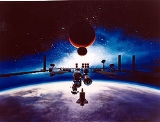
Space Station Freedom

Encyclopedia
Space Station Freedom was a NASA
project to construct a permanently manned Earth
-orbiting space station
in the 1980s. Although approved by then-president Ronald Reagan
and announced in the 1984 State of the Union Address
, Freedom was never constructed or completed as originally designed, and after several cutbacks, the remnants of the project became part of the International Space Station
.
completed, NASA proposed the creation of a large, permanently manned space station, which then-NASA-Administrator James M. Beggs
called "the next logical step" in space. In some ways it was meant to be the U.S. answer to the Soviet Mir
. NASA plans called for the station, which was later dubbed Space Station Freedom, to function as an orbiting repair shop for satellite
s, an assembly point for spacecraft
, an observation post for astronomer
s, a microgravity laboratory
for scientists, and a microgravity factory for companies.
Reagan announced plans to build Space Station Freedom in 1984, stating: "We can follow our dreams to distant stars, living and working in space for peaceful economic and scientific gain".
called for the construction of the Space Station Freedom. Following the presidential announcement, NASA began a set of studies to determine the potential uses for the space station, both in research and in industry, in the U.S. or overseas. This led to the creation of a database of thousands of possible missions and payloads; studies were also carried out with a view to supporting potential planetary missions, as well as those in low-earth orbit.
Several Space Shuttle
missions in the 1980s and early 1990s included spacewalks
to demonstrate and test space station construction techniques. After the establishment of the initial baseline design, the project evolved extensively, growing in scope and cost.
 In April 1984, the newly established Space Station Program Office at Johnson Space Center produced a first reference configuration; this design would serve as a baseline for further planning. The chosen design was the "Power Tower", a long central keel with most mass located at either end. This arrangement would provide enough tidal forces to keep the station aligned with the keel pointed towards the Earth, reducing the need for thruster firings. Most designs featured a cluster of modules at the lower end and a set of articulated solar arrays at the upper end. It also contained a servicing bay. In April 1985, the program selected a set of contractors to carry out definition studies and preliminary design; various trade-offs were made in this process, balancing higher development costs against reduced long-term operating costs.
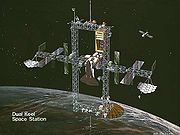
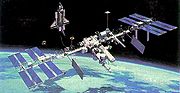 In March 1986, the System Requirements Review modified the configuration to the "Dual-Keel" design, which moved the modules to the central truss—placing them at the center of gravity, providing a better microgravity environment. However, the desire to maintain tidal alignment led to the use of increased truss structure, with two large "keels".
As the international involvement became more organized, the number of U.S. lab modules was reduced from two to one, taking into consideration the provision of space in the European and Japanese modules. Following this, the design was extensively "scrubbed" to remove inefficiencies; this led to a large number of subsystems being revised or removed, the deferral of plans for an Orbital Maneuvering Vehicle to be based at the station, and the use of only a single habitation module for a crew of eight.
In May 1986, NASA produced a report which had studied the assembly sequence with the intent of providing early "man-tended" capacity, ensuring that at an early stage, despite the station not being able to support a crew, research work could be carried out by occasional visiting Shuttle flights. Following the Challenger accident
, a Critical Evaluation Task Force was set up to reassess the validity and safety of the Station design. While this validated the use of the Dual-Keel design, post-Challenger safety concerns led to changes in the assembly plans, as well as assorted minor changes. Johnson Space Center had previously expressed misgivings about the amount of EVA work needed to assemble the station, which were addressed, as were the Shuttle payload reductions stemming from safety improvements postChallenger.
In September 1986, a major cost review of the program was undertaken from the post-Challenger baseline; this review was intended to ensure that NASA had a solid basis for its commitment to cost and schedule. The review found that the total development cost for the Dual-Keel configuration would cost US$18.2 billion (in FY1989 dollars), and a slip in the first-element launch (FEL) date from January 1993 to January 1994.
-type station to a phased development of the Dual-Keel configuration. This approach involved splitting assembly into two phases; Phase 1 would provide the central modules, and the transverse boom, but with no keels. The solar arrays would be augmented to ensure 75 kW of power would be provided, and the polar platform and servicing facility were again deferred. The study concluded that the project was viable, reducing development costs while minimizing negative impacts, and it was designated the Revised Baseline Configuration. This would have a development cost of US$15.3 billion (in FY1989 dollars) and FEL in the first quarter of 1994. This replanning was endorsed by the National Research Council
in September 1987, which also recommended that the long-term national goals should be studied before committing to any particular Phase 2 design.
During 1986 and 1987, various other studies were carried out on the future of the U.S. space program; the results of these often impacted the Space Station, and their recommendations were folded into the revised baseline as necessary. One of the results of these was to baseline the Station program as requiring five shuttle flights a year for operations and logistics, rotating four crew at a time with the aim of extending individual stay times to 180 days.
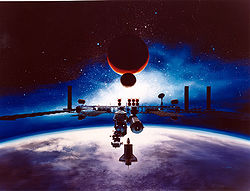 NASA signed final ten-year contracts for developing the Space Station in September 1988, and the project was finally moving into the hardware fabrication phase.
The Space Station Freedom design was slightly modified in late 1989 after the program's Fiscal 1990 budget again was reduced—from $2.05 billion to $1.75 billion—when the design was found to be 23% overweight and over budget, too complicated to assemble, and providing little power for its users. Congress consequently demanded yet another redesign in October 1990, and requested further cost reductions after the fiscal 1991 budget was cut from $2.5 billion to $1.9 billion. NASA unveiled its new space station design in March 1991.
Repeated budget cuts had forced a postponement of the first launch by a year, to March 1995. The Station would be permanently manned from June 1997 onwards, and completed in February 1998. Cost escalation of the project and financial difficulties in Russia led to a briefing between NASA
and NPO Energia on Mir-2
. In November 1993, Freedom, Mir-2, and the European and Japanese modules were incorporated into a single International Space Station
.
' s design and construction; it was regularly redesigned and rescoped. Between 1984 and 1993 it went through seven major re-designs, losing capacity and capabilities each time. Rather than being completed in a decade, as Reagan had predicted, Freedom was never built, and no Shuttle launches were made as part of the program.
By 1993, Freedom was politically unviable; the administration had changed, and Congress was tiring of throwing yet more money into the station program. In addition, there were open questions over the need for the station. Redesigns had cut most of the science capacity by this point, and the Space Race
had ended with the fall of the Soviet Union
. NASA presented several options to President Clinton
, but even the most limited of these was still seen as too expensive. In June 1993, a bill to cancel the Station program failed by one vote in the House of Representatives
. That October, a meeting between NASA and the Russian Space Agency agreed to the merger of the projects into what would become the International Space Station
.
Some historians record Freedom as being a failed project that lacked direction. However, by the time it was replaced by Alpha—derisively dubbed "Space Station Fred" playing on a truncation of "Freedom"—(later the International Space Station), the program had a firm plan, design of most components (with the notable exception of the Crew Return Vehicle
) was finalized, and a large amount of flight hardware had been constructed. Had political support remained, it is likely that Freedom would have been launched in the same timeframe as the ISS, and reached a complete (four-man) configuration around 2003–2005.
announced the transformation of Space Station Freedom into the International Space Station (ISS). NASA Administrator Daniel Goldin
supervised the addition of Russia
to the project. To accommodate reduced budgets, the station design was scaled back from 508 to 353 square feet (47 to 33 m²), the crew capacity of the NASA-provided part was reduced from 7 to 3 (while the complete station is manned by 6 but may be increased to seven), and the station's functions were reduced.
NASA
The National Aeronautics and Space Administration is the agency of the United States government that is responsible for the nation's civilian space program and for aeronautics and aerospace research...
project to construct a permanently manned Earth
Earth
Earth is the third planet from the Sun, and the densest and fifth-largest of the eight planets in the Solar System. It is also the largest of the Solar System's four terrestrial planets...
-orbiting space station
Space station
A space station is a spacecraft capable of supporting a crew which is designed to remain in space for an extended period of time, and to which other spacecraft can dock. A space station is distinguished from other spacecraft used for human spaceflight by its lack of major propulsion or landing...
in the 1980s. Although approved by then-president Ronald Reagan
Ronald Reagan
Ronald Wilson Reagan was the 40th President of the United States , the 33rd Governor of California and, prior to that, a radio, film and television actor....
and announced in the 1984 State of the Union Address
State of the Union Address
The State of the Union is an annual address presented by the President of the United States to the United States Congress. The address not only reports on the condition of the nation but also allows the president to outline his legislative agenda and his national priorities.The practice arises...
, Freedom was never constructed or completed as originally designed, and after several cutbacks, the remnants of the project became part of the International Space Station
International Space Station
The International Space Station is a habitable, artificial satellite in low Earth orbit. The ISS follows the Salyut, Almaz, Cosmos, Skylab, and Mir space stations, as the 11th space station launched, not including the Genesis I and II prototypes...
.
Original proposal
In the early 1980s, with the Space ShuttleSpace Shuttle
The Space Shuttle was a manned orbital rocket and spacecraft system operated by NASA on 135 missions from 1981 to 2011. The system combined rocket launch, orbital spacecraft, and re-entry spaceplane with modular add-ons...
completed, NASA proposed the creation of a large, permanently manned space station, which then-NASA-Administrator James M. Beggs
James M. Beggs
James Montgomery Beggs served as the 6th Administrator of NASA. Nominated by President Reagan on June 1, 1981, Beggs took his oath of office and entered the post on July 10, 1981, serving until December 4, 1985....
called "the next logical step" in space. In some ways it was meant to be the U.S. answer to the Soviet Mir
Mir
Mir was a space station operated in low Earth orbit from 1986 to 2001, at first by the Soviet Union and then by Russia. Assembled in orbit from 1986 to 1996, Mir was the first modular space station and had a greater mass than that of any previous spacecraft, holding the record for the...
. NASA plans called for the station, which was later dubbed Space Station Freedom, to function as an orbiting repair shop for satellite
Satellite
In the context of spaceflight, a satellite is an object which has been placed into orbit by human endeavour. Such objects are sometimes called artificial satellites to distinguish them from natural satellites such as the Moon....
s, an assembly point for spacecraft
Spacecraft
A spacecraft or spaceship is a craft or machine designed for spaceflight. Spacecraft are used for a variety of purposes, including communications, earth observation, meteorology, navigation, planetary exploration and transportation of humans and cargo....
, an observation post for astronomer
Astronomer
An astronomer is a scientist who studies celestial bodies such as planets, stars and galaxies.Historically, astronomy was more concerned with the classification and description of phenomena in the sky, while astrophysics attempted to explain these phenomena and the differences between them using...
s, a microgravity laboratory
Laboratory
A laboratory is a facility that provides controlled conditions in which scientific research, experiments, and measurement may be performed. The title of laboratory is also used for certain other facilities where the processes or equipment used are similar to those in scientific laboratories...
for scientists, and a microgravity factory for companies.
Reagan announced plans to build Space Station Freedom in 1984, stating: "We can follow our dreams to distant stars, living and working in space for peaceful economic and scientific gain".
Design iterations
The 1990 Space Exploration InitiativeSpace Exploration Initiative
On July 20, 1989, the 20th anniversary of the Apollo 11 Moon landing, George H. W. Bush — then President of the United States — announced plans for what came to be known as the Space Exploration Initiative...
called for the construction of the Space Station Freedom. Following the presidential announcement, NASA began a set of studies to determine the potential uses for the space station, both in research and in industry, in the U.S. or overseas. This led to the creation of a database of thousands of possible missions and payloads; studies were also carried out with a view to supporting potential planetary missions, as well as those in low-earth orbit.
Several Space Shuttle
Space Shuttle
The Space Shuttle was a manned orbital rocket and spacecraft system operated by NASA on 135 missions from 1981 to 2011. The system combined rocket launch, orbital spacecraft, and re-entry spaceplane with modular add-ons...
missions in the 1980s and early 1990s included spacewalks
Extra-vehicular activity
Extra-vehicular activity is work done by an astronaut away from the Earth, and outside of a spacecraft. The term most commonly applies to an EVA made outside a craft orbiting Earth , but also applies to an EVA made on the surface of the Moon...
to demonstrate and test space station construction techniques. After the establishment of the initial baseline design, the project evolved extensively, growing in scope and cost.
"Power Tower" (1984)
Dual-keel design (1986)
As the international involvement became more organized, the number of U.S. lab modules was reduced from two to one, taking into consideration the provision of space in the European and Japanese modules. Following this, the design was extensively "scrubbed" to remove inefficiencies; this led to a large number of subsystems being revised or removed, the deferral of plans for an Orbital Maneuvering Vehicle to be based at the station, and the use of only a single habitation module for a crew of eight.
In May 1986, NASA produced a report which had studied the assembly sequence with the intent of providing early "man-tended" capacity, ensuring that at an early stage, despite the station not being able to support a crew, research work could be carried out by occasional visiting Shuttle flights. Following the Challenger accident
Space Shuttle Challenger disaster
The Space Shuttle Challenger disaster occurred on January 28, 1986, when Space Shuttle Challenger broke apart 73 seconds into its flight, leading to the deaths of its seven crew members. The spacecraft disintegrated over the Atlantic Ocean, off the coast of central Florida at 11:38 am EST...
, a Critical Evaluation Task Force was set up to reassess the validity and safety of the Station design. While this validated the use of the Dual-Keel design, post-Challenger safety concerns led to changes in the assembly plans, as well as assorted minor changes. Johnson Space Center had previously expressed misgivings about the amount of EVA work needed to assemble the station, which were addressed, as were the Shuttle payload reductions stemming from safety improvements postChallenger.
In September 1986, a major cost review of the program was undertaken from the post-Challenger baseline; this review was intended to ensure that NASA had a solid basis for its commitment to cost and schedule. The review found that the total development cost for the Dual-Keel configuration would cost US$18.2 billion (in FY1989 dollars), and a slip in the first-element launch (FEL) date from January 1993 to January 1994.
Revised Baseline Configuration (1987)
At the same time, late 1986, NASA carried out a study into new configuration options to reduce development costs; options studied ranged from the use of a SkylabSkylab
Skylab was a space station launched and operated by NASA, the space agency of the United States. Skylab orbited the Earth from 1973 to 1979, and included a workshop, a solar observatory, and other systems. It was launched unmanned by a modified Saturn V rocket, with a mass of...
-type station to a phased development of the Dual-Keel configuration. This approach involved splitting assembly into two phases; Phase 1 would provide the central modules, and the transverse boom, but with no keels. The solar arrays would be augmented to ensure 75 kW of power would be provided, and the polar platform and servicing facility were again deferred. The study concluded that the project was viable, reducing development costs while minimizing negative impacts, and it was designated the Revised Baseline Configuration. This would have a development cost of US$15.3 billion (in FY1989 dollars) and FEL in the first quarter of 1994. This replanning was endorsed by the National Research Council
United States National Research Council
The National Research Council of the USA is the working arm of the United States National Academies, carrying out most of the studies done in their names.The National Academies include:* National Academy of Sciences...
in September 1987, which also recommended that the long-term national goals should be studied before committing to any particular Phase 2 design.
During 1986 and 1987, various other studies were carried out on the future of the U.S. space program; the results of these often impacted the Space Station, and their recommendations were folded into the revised baseline as necessary. One of the results of these was to baseline the Station program as requiring five shuttle flights a year for operations and logistics, rotating four crew at a time with the aim of extending individual stay times to 180 days.
Freedom (1988) to Alpha (1993)
The Space Station Freedom design was slightly modified in late 1989 after the program's Fiscal 1990 budget again was reduced—from $2.05 billion to $1.75 billion—when the design was found to be 23% overweight and over budget, too complicated to assemble, and providing little power for its users. Congress consequently demanded yet another redesign in October 1990, and requested further cost reductions after the fiscal 1991 budget was cut from $2.5 billion to $1.9 billion. NASA unveiled its new space station design in March 1991.
Repeated budget cuts had forced a postponement of the first launch by a year, to March 1995. The Station would be permanently manned from June 1997 onwards, and completed in February 1998. Cost escalation of the project and financial difficulties in Russia led to a briefing between NASA
NASA
The National Aeronautics and Space Administration is the agency of the United States government that is responsible for the nation's civilian space program and for aeronautics and aerospace research...
and NPO Energia on Mir-2
Mir-2
Mir-2 was a space station project begun in February 1976. Some of the modules built for Mir-2 have been incorporated into the International Space Station . The project underwent many changes, but was always based on the DOS-8 base block space station core module, built as a back-up to the DOS-7...
. In November 1993, Freedom, Mir-2, and the European and Japanese modules were incorporated into a single International Space Station
International Space Station
The International Space Station is a habitable, artificial satellite in low Earth orbit. The ISS follows the Salyut, Almaz, Cosmos, Skylab, and Mir space stations, as the 11th space station launched, not including the Genesis I and II prototypes...
.
Station program placed on hold
Underestimates by NASA of the station program's cost and unwillingness by the U.S. Congress to appropriate funding for the space station resulted in delays of FreedomBy 1993, Freedom was politically unviable; the administration had changed, and Congress was tiring of throwing yet more money into the station program. In addition, there were open questions over the need for the station. Redesigns had cut most of the science capacity by this point, and the Space Race
Space Race
The Space Race was a mid-to-late 20th century competition between the Soviet Union and the United States for supremacy in space exploration. Between 1957 and 1975, Cold War rivalry between the two nations focused on attaining firsts in space exploration, which were seen as necessary for national...
had ended with the fall of the Soviet Union
Soviet Union
The Soviet Union , officially the Union of Soviet Socialist Republics , was a constitutionally socialist state that existed in Eurasia between 1922 and 1991....
. NASA presented several options to President Clinton
Bill Clinton
William Jefferson "Bill" Clinton is an American politician who served as the 42nd President of the United States from 1993 to 2001. Inaugurated at age 46, he was the third-youngest president. He took office at the end of the Cold War, and was the first president of the baby boomer generation...
, but even the most limited of these was still seen as too expensive. In June 1993, a bill to cancel the Station program failed by one vote in the House of Representatives
United States House of Representatives
The United States House of Representatives is one of the two Houses of the United States Congress, the bicameral legislature which also includes the Senate.The composition and powers of the House are established in Article One of the Constitution...
. That October, a meeting between NASA and the Russian Space Agency agreed to the merger of the projects into what would become the International Space Station
International Space Station
The International Space Station is a habitable, artificial satellite in low Earth orbit. The ISS follows the Salyut, Almaz, Cosmos, Skylab, and Mir space stations, as the 11th space station launched, not including the Genesis I and II prototypes...
.
Some historians record Freedom as being a failed project that lacked direction. However, by the time it was replaced by Alpha—derisively dubbed "Space Station Fred" playing on a truncation of "Freedom"—(later the International Space Station), the program had a firm plan, design of most components (with the notable exception of the Crew Return Vehicle
Crew Return Vehicle
The Crew Return Vehicle , sometimes referred to as the Assured Crew Return Vehicle , is the proposed lifeboat or escape module for the International Space Station...
) was finalized, and a large amount of flight hardware had been constructed. Had political support remained, it is likely that Freedom would have been launched in the same timeframe as the ISS, and reached a complete (four-man) configuration around 2003–2005.
Conversion to the International Space Station
In 1993, the Clinton administrationBill Clinton
William Jefferson "Bill" Clinton is an American politician who served as the 42nd President of the United States from 1993 to 2001. Inaugurated at age 46, he was the third-youngest president. He took office at the end of the Cold War, and was the first president of the baby boomer generation...
announced the transformation of Space Station Freedom into the International Space Station (ISS). NASA Administrator Daniel Goldin
Daniel Goldin
Daniel Saul Goldin served as the 9th and longest-tenured Administrator of NASA from April 1, 1992, to November 17, 2001. He was appointed by President George H. W. Bush and also served under President William Jefferson Clinton and George W...
supervised the addition of Russia
Russia
Russia or , officially known as both Russia and the Russian Federation , is a country in northern Eurasia. It is a federal semi-presidential republic, comprising 83 federal subjects...
to the project. To accommodate reduced budgets, the station design was scaled back from 508 to 353 square feet (47 to 33 m²), the crew capacity of the NASA-provided part was reduced from 7 to 3 (while the complete station is manned by 6 but may be increased to seven), and the station's functions were reduced.
See also
- Space Exploration InitiativeSpace Exploration InitiativeOn July 20, 1989, the 20th anniversary of the Apollo 11 Moon landing, George H. W. Bush — then President of the United States — announced plans for what came to be known as the Space Exploration Initiative...
- HL-20
- Space StationSpace stationA space station is a spacecraft capable of supporting a crew which is designed to remain in space for an extended period of time, and to which other spacecraft can dock. A space station is distinguished from other spacecraft used for human spaceflight by its lack of major propulsion or landing...
Further reading
- Lyn Ragsdale, “The U.S. Space Program in the Reagan and Bush Years,” in eds. Roger Launius and Howard McCurdy, Spaceflight and the Myth of Presidential Leadership (Champaign, Ill.: U of Illinois P, 1997)
- James ObergJames ObergJames Edward Oberg is an American space journalist and historian, regarded as an expert on the Russian space program.-Biography:...
, Star-Crossed Orbits: Inside the U.S.-Russian Space Alliance (New York: McGraw Hill, 2001) - NASA TM-109725 - Space Station Program Response to the Fiscal Year 1988 and 1989 Reduced Budgets