


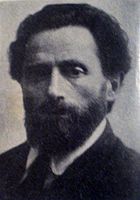
Solomon Lozovsky

Encyclopedia
Bolshevik
The Bolsheviks, originally also Bolshevists , derived from bol'shinstvo, "majority") were a faction of the Marxist Russian Social Democratic Labour Party which split apart from the Menshevik faction at the Second Party Congress in 1903....
revolutionary, a high official in various parts of the Soviet government, including as a Presidium member of the All-Union Central Council of Soviet Trade Unions, a Central Committee member of the Communist Party
Communist Party of the Soviet Union
The Communist Party of the Soviet Union was the only legal, ruling political party in the Soviet Union and one of the largest communist organizations in the world...
, a member of the Supreme Soviet
Supreme Soviet
The Supreme Soviet of the Soviet Union was the Supreme Soviet in the Soviet Union and the only one with the power to pass constitutional amendments...
, a deputy people's commissar for foreign affairs and the head of the Soviet Information Bureau (Sovinformburo). He was also the chair of the department of International Relations at the Higher Party School.
Born in 1878 in Ukraine
Ukraine
Ukraine is a country in Eastern Europe. It has an area of 603,628 km², making it the second largest contiguous country on the European continent, after Russia...
of Russia
Russia
Russia or , officially known as both Russia and the Russian Federation , is a country in northern Eurasia. It is a federal semi-presidential republic, comprising 83 federal subjects...
n Jewish parents (of possibly Sephardic lineage), he joined the Bolshevik
Bolshevik
The Bolsheviks, originally also Bolshevists , derived from bol'shinstvo, "majority") were a faction of the Marxist Russian Social Democratic Labour Party which split apart from the Menshevik faction at the Second Party Congress in 1903....
party in 1901 and, as was common for members of the underground movements of the time, adopted a pseudonym, Lozovsky (from the town Lozovaya, near Kharkov, Ukraine). He was twice expelled from the Bolshevik party (in 1914 and 1917–18), but readmitted. His second expulsion was related to his stance in support of independent trade unions following the October Revolution
October Revolution
The October Revolution , also known as the Great October Socialist Revolution , Red October, the October Uprising or the Bolshevik Revolution, was a political revolution and a part of the Russian Revolution of 1917...
.
Lozovsky was General Secretary of the Red International Labour Union (Profintern
Profintern
The Red International of Labor Unions , commonly known as the Profintern, was an international body established by the Communist International with the aim of coordinating Communist activities within trade unions...
) (1921–1937). In May 1939 Lozovsky was appointed (along with two others) as a deputy people's commissar for foreign affairs of the Soviet Union
Soviet Union
The Soviet Union , officially the Union of Soviet Socialist Republics , was a constitutionally socialist state that existed in Eurasia between 1922 and 1991....
under Vyacheslav Molotov
Vyacheslav Molotov
Vyacheslav Mikhailovich Molotov was a Soviet politician and diplomat, an Old Bolshevik and a leading figure in the Soviet government from the 1920s, when he rose to power as a protégé of Joseph Stalin, to 1957, when he was dismissed from the Presidium of the Central Committee by Nikita Khrushchev...
, tasked with handling the Far East and Scandinavia
Scandinavia
Scandinavia is a cultural, historical and ethno-linguistic region in northern Europe that includes the three kingdoms of Denmark, Norway and Sweden, characterized by their common ethno-cultural heritage and language. Modern Norway and Sweden proper are situated on the Scandinavian Peninsula,...
. During World War Two (Great Patriotic War) he was vice-chairman of Sovinformburo, tasked with handling all information from the Soviet battlefronts to foreign press. In 1941, upon being told of foreign news reports that German soldiers could see Moscow with their binoculars, Lozovsky famously retorted: "the Germans would undoubtedly see Moscow, but as prisoners of war." He was also a member of the Jewish Anti-Fascist Committee
Jewish Anti-Fascist Committee
The Jewish Anti-Fascist Committee was formed on Joseph Stalin's order in Kuibyshev in April 1942 with the official support of the Soviet authorities...
, organised as a part of Sovinformburo, which sought to influence international public opinion and organise political and material support for the war campaign, especially amongst Jews in Allied countries. From 1945 to 1948 he was chairmain of Sovinformburo.
He was arrested at the age of seventy and tortured during the Soviet antisemitic campaign of the late 1940s-early 1950s. Despite incredible pressure, Lozovsky never admitted his guilt or accused others. The closed trial lasted for two and one-half months. Another month was spent on death row awaiting execution. Lozovsky was executed on August 12, 1952, together with thirteen other members of Jewish Anti-Fascist Committee
Jewish Anti-Fascist Committee
The Jewish Anti-Fascist Committee was formed on Joseph Stalin's order in Kuibyshev in April 1942 with the official support of the Soviet authorities...
, an event known as the Night of the Murdered Poets
Night of the Murdered Poets
On August 12, 1952, thirteen Soviet Jews were executed in the Lubyanka Prison in Moscow, Russia as a result of charges of espionage based on forced, false confessions resulting from coercion and torture. This massacre is known as the Night of the Murdered Poets....
. The stenographic report of the trial was published only in 1994 and in a highly edited form.
Following the release of the documents, it also emerged that Nikita Khrushchev
Nikita Khrushchev
Nikita Sergeyevich Khrushchev led the Soviet Union during part of the Cold War. He served as First Secretary of the Communist Party of the Soviet Union from 1953 to 1964, and as Chairman of the Council of Ministers, or Premier, from 1958 to 1964...
issued a posthumous pardon to Lozovsky and all executed members of the Jewish Anti-Fascist committee stating that the trials were conducted in "flagrant violations of the law".
External links
- Writings of Solomon A. Lozovsky at the Marxists Internet Archive
- Rubenstein, J (1997). "Night of the Murdered Poets" New Republic 25 August.
- http://forum.grani.ru/jews/articles/eak/ In Russian