


Silver iodide

Encyclopedia
Silver iodide is a yellow
, inorganic
, photosensitive
iodide
of silver used in photography
, in medicine as an antiseptic
, and in rainmaking
for cloud seeding
.
) with a solution of silver ions (e.g., silver nitrate
).A yellowish precipitate, darkening quickly, forms.
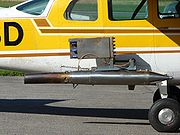 The crystalline structure of AgI is similar to that of ice, allowing it to induce freezing
(heterogeneous nucleation
) in cloud seeding
for the purpose of rainmaking
. Approximately 50,000 kg/year are used for this purpose, each seeding experiment consuming 10-50 grams.
(a typical ionic solid). This can be rationalized by noting that the AgI crystalline lattice has essentially already partly melted in the transition between α and β forms. Adding the entropy of transition from α-AgI to β-AgI to the entropy of fusion gives a value that is much closer to the entropy of fusion for sodium chloride.
Clean Water Act
, silver iodide is considered a hazardous substance, a priority pollutant, and a toxic pollutant.
Chronic ingestion of iodides may produce “iodism”, which may be manifested by skin rash, running nose, headache, irritation of the mucous membranes, weakness, anemia, loss of weight and general depression. Chronic inhalation, ingestion or skin contact with silver compounds may cause argyria
characterized by blue-gray discoloration of the eyes, skin and mucous membranes.
Yellow
Yellow is the color evoked by light that stimulates both the L and M cone cells of the retina about equally, with no significant stimulation of the S cone cells. Light with a wavelength of 570–590 nm is yellow, as is light with a suitable mixture of red and green...
, inorganic
Inorganic compound
Inorganic compounds have traditionally been considered to be of inanimate, non-biological origin. In contrast, organic compounds have an explicit biological origin. However, over the past century, the classification of inorganic vs organic compounds has become less important to scientists,...
, photosensitive
Photosensitivity
Photosensitivity is the amount to which an object reacts upon receiving photons, especially visible light.- Human medicine :Sensitivity of the skin to a light source can take various forms. People with particular skin types are more sensitive to sunburn...
iodide
Iodide
An iodide ion is the ion I−. Compounds with iodine in formal oxidation state −1 are called iodides. This page is for the iodide ion and its salts. For information on organoiodides, see organohalides. In everyday life, iodide is most commonly encountered as a component of iodized salt,...
of silver used in photography
Photography
Photography is the art, science and practice of creating durable images by recording light or other electromagnetic radiation, either electronically by means of an image sensor or chemically by means of a light-sensitive material such as photographic film...
, in medicine as an antiseptic
Antiseptic
Antiseptics are antimicrobial substances that are applied to living tissue/skin to reduce the possibility of infection, sepsis, or putrefaction...
, and in rainmaking
Rainmaking
Rainmaking refers to the act of attempting to artificially induce or increase precipitation, usually to stave off drought.In the US, rainmaking was attempted by traveling showmen. It was practiced in the old west but may have reached a peak during the dust bowl drought of the American West and...
for cloud seeding
Cloud seeding
Cloud seeding, a form of intentional weather modification, is the attempt to change the amount or type of precipitation that falls from clouds, by dispersing substances into the air that serve as cloud condensation or ice nuclei, which alter the microphysical processes within the cloud...
.
Crystal structure
The crystalline structure adopted by silver iodide changes with temperature. The following phases are known:- Up to 420 K (147 °C), AgI exists in the β-phase, which has a wurtzite structure. It is known as the mineral iodargyriteIodargyriteIodyrite or iodargyrite is a natural mineral form of silver iodide.Hardness is 1.5 to 2.Related are chlorargyrite and bromargyrite.-References:* *...
. - Above 420 K (147 °C), AgI undergoes a transition to the α-phase, which has a body-centered cubic structure and has the silver ions distributed randomly between 2-, 3-, and 4-coordinate sites.
- A metastable γ-phase also exists below 420 K, which has a zinc blende structure.
Preparation
Silver iodide is prepared by reaction of an iodide solution (e.g. potassium iodidePotassium iodide
Potassium iodide is an inorganic compound with the chemical formula KI. This white salt is the most commercially significant iodide compound, with approximately 37,000 tons produced in 1985. It is less hygroscopic than sodium iodide, making it easier to work with...
) with a solution of silver ions (e.g., silver nitrate
Silver nitrate
Silver nitrate is an inorganic compound with chemical formula . This compound is a versatile precursor to many other silver compounds, such as those used in photography. It is far less sensitive to light than the halides...
).A yellowish precipitate, darkening quickly, forms.
Rainmaking
Freezing
Freezing or solidification is a phase change in which a liquid turns into a solid when its temperature is lowered below its freezing point. The reverse process is melting....
(heterogeneous nucleation
Nucleation
Nucleation is the extremely localized budding of a distinct thermodynamic phase. Some examples of phases that may form by way of nucleation in liquids are gaseous bubbles, crystals or glassy regions. Creation of liquid droplets in saturated vapor is also characterized by nucleation...
) in cloud seeding
Cloud seeding
Cloud seeding, a form of intentional weather modification, is the attempt to change the amount or type of precipitation that falls from clouds, by dispersing substances into the air that serve as cloud condensation or ice nuclei, which alter the microphysical processes within the cloud...
for the purpose of rainmaking
Rainmaking
Rainmaking refers to the act of attempting to artificially induce or increase precipitation, usually to stave off drought.In the US, rainmaking was attempted by traveling showmen. It was practiced in the old west but may have reached a peak during the dust bowl drought of the American West and...
. Approximately 50,000 kg/year are used for this purpose, each seeding experiment consuming 10-50 grams.
Fast ion conductor
Above 420 K, silver iodide becomes a fast ion conductor: Ag+ ions can move rapidly through the solid, making it a good conductor of electricity. The transition between the β and α forms represents the melting of the silver (cation) sublattice. The entropy of fusion (melting) for α-AgI is approximately half that for sodium chlorideSodium chloride
Sodium chloride, also known as salt, common salt, table salt or halite, is an inorganic compound with the formula NaCl. Sodium chloride is the salt most responsible for the salinity of the ocean and of the extracellular fluid of many multicellular organisms...
(a typical ionic solid). This can be rationalized by noting that the AgI crystalline lattice has essentially already partly melted in the transition between α and β forms. Adding the entropy of transition from α-AgI to β-AgI to the entropy of fusion gives a value that is much closer to the entropy of fusion for sodium chloride.
Safety
Under the guidelines of the United States Environmental Protection AgencyUnited States Environmental Protection Agency
The U.S. Environmental Protection Agency is an agency of the federal government of the United States charged with protecting human health and the environment, by writing and enforcing regulations based on laws passed by Congress...
Clean Water Act
Clean Water Act
The Clean Water Act is the primary federal law in the United States governing water pollution. Commonly abbreviated as the CWA, the act established the goals of eliminating releases of high amounts of toxic substances into water, eliminating additional water pollution by 1985, and ensuring that...
, silver iodide is considered a hazardous substance, a priority pollutant, and a toxic pollutant.
Chronic ingestion of iodides may produce “iodism”, which may be manifested by skin rash, running nose, headache, irritation of the mucous membranes, weakness, anemia, loss of weight and general depression. Chronic inhalation, ingestion or skin contact with silver compounds may cause argyria
Argyria
Argyria is a condition caused by improper exposure to chemical forms of the element silver, silver dust, or silver compounds. The most dramatic symptom of argyria is that the skin becomes blue or bluish-grey colored. Argyria may be found as generalized argyria or local argyria...
characterized by blue-gray discoloration of the eyes, skin and mucous membranes.