
All Topics  
Nucleation

 
Nucleation

   Email Print
   Bookmark   Link


Nucleation


Nucleation is the onset of a crystal in a small region. The phase transition can be the formation of a bubble
Bubble

Bubble may refer to:...
 or of a crystal
Crystal

A crystal or crystalline solid is a solid material whose constituent atoms, molecules, or ions are arranged in an orderly repeating pattern extending in all three spatial dimensions....
 from a liquid
Liquid

Liquid is one of the principal states of matter. A liquid is a fluid that has the particles loose and can freely form a distinct surface at the boundaries of its bulk material....
. Creation of liquid droplets in saturated vapor
Vapor

A vapor or vapour is a substance in the gas phase at a temperature lower than its critical temperature.This means that the vapor can be condensation to a liquid or to a solid by increasing its pressure, without reducing the temperature....
 or the creation of gaseous bubbles in a saturated liquid is also characterized by nucleation (see Cloud condensation nuclei
Cloud condensation nuclei

Cloud condensation nuclei or CCNs are small particles about which cloud droplets coalescence . Water requires a non-gaseous surface to make the transition from a vapour to a liquid....
). Nucleation of crystalline, amorphous, and even vacancy clusters in solid materials is also important, for example to the semiconductor industry.


Discussion
Ask a question about 'Nucleation'
Start a new discussion about 'Nucleation'
Answer questions from other users
Full Discussion Forum


Encyclopedia


Nucleation is the onset of a crystal in a small region. The phase transition can be the formation of a bubble
Bubble

Bubble may refer to:...
 or of a crystal
Crystal

A crystal or crystalline solid is a solid material whose constituent atoms, molecules, or ions are arranged in an orderly repeating pattern extending in all three spatial dimensions....
 from a liquid
Liquid

Liquid is one of the principal states of matter. A liquid is a fluid that has the particles loose and can freely form a distinct surface at the boundaries of its bulk material....
. Creation of liquid droplets in saturated vapor
Vapor

A vapor or vapour is a substance in the gas phase at a temperature lower than its critical temperature.This means that the vapor can be condensation to a liquid or to a solid by increasing its pressure, without reducing the temperature....
 or the creation of gaseous bubbles in a saturated liquid is also characterized by nucleation (see Cloud condensation nuclei
Cloud condensation nuclei

Cloud condensation nuclei or CCNs are small particles about which cloud droplets coalescence . Water requires a non-gaseous surface to make the transition from a vapour to a liquid....
). Nucleation of crystalline, amorphous, and even vacancy clusters in solid materials is also important, for example to the semiconductor industry. Note that nucleation is a physical process, not a chemical process. A good example would be the famous 'Coke and Mentos explosions'. Nucleation normally occurs at nucleation sites on surfaces containing the liquid or vapor. Suspended particles or minute bubbles also provide nucleation sites. This is called heterogeneous nucleation. Nucleation without preferential nucleation sites is homogeneous nucleation. Homogeneous nucleation occurs spontaneously and randomly, but it requires superheating
Superheating

In physics, superheating is the phenomenon in which a liquid is heated to a temperature higher than its boiling point, without boiling. Superheating is achieved by heating a wiktionary:Homogeneous substance in a clean container, free of nucleation sites, while taking care not to disturb the liquid....
 or supercooling
Supercooling

Supercooling is the process of lowering the temperature of a liquid or a gas below its melting point, without it becoming a solid.A liquid below its standard freezing point will crystallization process in the presence of a nucleation around which a crystal structure can form....
 of the medium. Nucleation is involved in such processes as cloud seeding
Cloud seeding

Cloud seeding, a form of weather control, is the attempt to change the amount or type of Precipitation that falls from clouds, by dispersing substances into the air that serve as Cloud condensation nuclei or ice nucleus, which alter the microphysical processes within the cloud....
 and in instruments such as the bubble chamber
Bubble chamber

A bubble chamber is a vessel filled with a superheating transparency liquid used to detect electrically charged particles moving through it....
 and the cloud chamber
Cloud chamber

[Image:Cloud_chamber_bionerd.jpg|thumb|Cloud chamber with visible tracks from ionizing radiation The cloud chamber, also known as the Wilson chamber, is used for detecting particles of ionizing radiation....
.

Examples of nucleation

  • Pure water
    Water

    Water is a common chemical substance that is essential for the survival of all known forms of life. In typical usage, water refers only to its liquid form or States of matter, but the substance also has a solid state, ice, and a gaseous state, water vapor or steam....
     freezes
    Freezing

    In physical science, freezing or solidification is the process in which a liquid turns into a solid when cold enough. The Melting point is the temperature at which this happens....
     at -42° C rather than at its freezing temperature of 0° C if no crystal nuclei, such as dust particles, are present to form an ice nucleus
    Ice nucleus

    An ice nucleus is a particle which acts as the nucleus for the formation of an ice crystal in the Earth's atmosphere.The presence of ice nuclei increase the temperature that ice will form in the atmosphere from around −42?C to about −10?C....
    .
  • Presence of cloud condensation nuclei
    Cloud condensation nuclei

    Cloud condensation nuclei or CCNs are small particles about which cloud droplets coalescence . Water requires a non-gaseous surface to make the transition from a vapour to a liquid....
     is important in meteorology
    Meteorology

    Meteorology is the interdisciplinary scientific study of the Earth's atmosphere that focuses on weather processes and forecasting . Studies in the field stretch back millennia, though significant progress in meteorology did not occur until the eighteenth century....
     because they are often in short supply in the upper atmosphere
    Atmosphere

    An atmosphere is a layer of gases that may surround a material body of sufficient mass, by the gravity of the body, and are retained for a longer duration if gravity is high and the atmosphere's temperature is low....
     (see cloud seeding
    Cloud seeding

    Cloud seeding, a form of weather control, is the attempt to change the amount or type of Precipitation that falls from clouds, by dispersing substances into the air that serve as Cloud condensation nuclei or ice nucleus, which alter the microphysical processes within the cloud....
    ).
  • All natural and artificial crystallization
    Crystallization

    Crystallization is the process of formation of solid crystals Precipitation from a solution, melting or more rarely Deposition directly from a gas....
     process (of formation of solid crystals from a homogeneous solution) starts with a nucleation event.
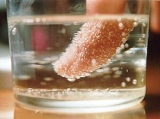
  • Bubbles of carbon dioxide
    Carbon dioxide

    Carbon dioxide is a chemical compound composed of two oxygen atoms covalent bond to a single carbon atom. It is a gas at standard temperature and pressure and exists in Earth's atmosphere in this state....
     nucleate shortly after the pressure is released from a container of carbonated
    Carbonation

    Carbonation occurs when carbon dioxide is solvation in water or an aqueous solution. This process yields the "fizz" to carbonated water and sparkling mineral water, the Beer head to beer, and the cork pop and bubbles to Champagne and sparkling wine....
     liquid. Nucleation often occurs more easily at a pre-existing interface
    Interface (chemistry)

    An interface is a surface forming a common boundary among two different phase , such as an insoluble solid and a liquid, two immiscible liquids or a liquid and an insoluble gas....
     (heterogeneous nucleation), as happens on boiling chip
    Boiling chip

    Boiling chips, also known as boiling stones, boileezers or anti-bumping granules, are small, irregularly shaped stones added to liquids to make them boiling more smoothly mainly in distillation....
    s and string used to make rock candy
    Rock candy

    File:Brauner Kandiszucker.jpgFile:Kandiszucker_wei?.jpgRock candy is a type of confectionery composed of relatively large sugar crystals.Homemade rock candy is commonly formed by allowing a Supersaturation solution of sugar and water to crystallize onto a string or some other surface suitable for crystal nucleation....
    . So-called Diet Coke and Mentos eruptions are a dramatic example.
  • Nucleation in boiling
    Boiling

    Boiling, a type of phase transition, is the rapid vaporization of a liquid, which typically occurs when a liquid is heated to its boiling point, the temperature at which the vapor pressure of the liquid is equal to the pressure exerted on the liquid by the surrounding environmental pressure....
     can occur in the bulk liquid
    Liquid

    Liquid is one of the principal states of matter. A liquid is a fluid that has the particles loose and can freely form a distinct surface at the boundaries of its bulk material....
     if the pressure is reduced so that the liquid becomes superheated
    Superheating

    In physics, superheating is the phenomenon in which a liquid is heated to a temperature higher than its boiling point, without boiling. Superheating is achieved by heating a wiktionary:Homogeneous substance in a clean container, free of nucleation sites, while taking care not to disturb the liquid....
     with respect to the pressure-dependent boiling point. More often nucleation occurs on the heating surface, at nucleation sites. Typically, nucleation sites are tiny crevices where free gas-liquid surface is maintained or spots on the heating surface with lower wetting
    Wetting

    Wetting is the ability of a liquid to maintain contact with a solid surface, resulting from intermolecular interactions when the two are brought together....
     properties. Substantial superheating of a liquid can be achieved after the liquid is de-gassed and if the heating surfaces are clean, smooth and made of materials well wetted by the liquid.
  • Nucleation is relevant in the process of crystallization of nanometer sized materials
    Nanoparticle

    In nanotechnology, a particle is defined as a small object that behaves as a whole unit in terms of its transport and properties. It is further classified according to size: In terms of diameter, fine particles cover a range between 100 and 2500 nanometre, while ultrafine particles, on the other hand, are sized between 1 and 100 nanometers....
    , and plays an important role in atmospheric processes.
  • Nucleation is a key concept in polymer
    Polymer

    A polymer is a large molecule composed of repeating structural units typically connected by covalent chemical bonds. While polymer in popular usage suggests plastic, the term actually refers to a large class of natural and synthetic materials with a variety of properties....
    , alloy
    Alloy

    An alloy is a partial or complete solid solution of one or more chemical element in a metallic matrix. Complete solid solution alloys give single solid phase microstructure, while partial solutions give two or more phases that may be homogeneous in distribution depending on thermal history....
    , and ceramic
    Ceramic

    File:Bridge from dental porcelain.jpgFile:Qing vase p1070256.jpgA ceramic is an inorganic, nonmetal solid prepared by the action of heat and subsequent cooling....
     systems.
  • In chemistry
    Chemistry

    Chemistry is the science concerned with the composition, structure, and properties of matter, as well as the changes it undergoes during chemical reactions....
     and biophysics
    Biophysics

    Biophysics is an interdisciplinary science that employs and develops theories and methods of the physical sciences for the investigation of biology systems....
    , nucleation can also refer to the phaseless formation of multimers which are intermediates in polymerization processes. This sort of process is believed to be the best model for processes such as crystallization
    Crystallization

    Crystallization is the process of formation of solid crystals Precipitation from a solution, melting or more rarely Deposition directly from a gas....
     and amyloidogenesis
    Amyloid

    Amyloids are insoluble fibrous protein aggregates sharing specific structural traits. Abnormal accumulation of amyloid in organs may lead to amyloidosis, and may play a role in various other neurodegenerative diseases....
    .
  • In molecular biology
    Molecular biology

    Molecular biology is the study of biology at a molecule level. The field overlaps with other areas of biology and chemistry, particularly genetics and biochemistry....
    , nucleation is used to term the critical stage in the assembly of a polymer
    Polymer

    A polymer is a large molecule composed of repeating structural units typically connected by covalent chemical bonds. While polymer in popular usage suggests plastic, the term actually refers to a large class of natural and synthetic materials with a variety of properties....
    ic structure, such as a microtubule, at which a small cluster of monomer
    Monomer

    A monomer is a small molecule that may become Chemistry chemical bonding to other monomers to form a polymer....
    s aggregates in the correct arrangement to initiate rapid polymerization. For instance, two actin
    Actin

    Actin is a Globular_protein, roughly 42-kDa protein found in all Eukaryote where it may be present at concentrations of over 100 ?M. It is also one of the most highly-Conservation proteins, differing by no more than 20% in species as diverse as algae and humans....
     molecule
    Molecule

    In chemistry, a molecule is defined as a sufficiently stable, electric charge neutral group of at least two atoms in a definite arrangement held together by very strong chemical bonds....
    s bind weakly, but addition of a third stabilizes the complex. This trimer then adds additional molecules and forms a nucleation site. The nucleation site serves the slow, or lag phase of the polymerization process.


Mechanics of nucleation


Homogeneous nucleation

Nucleation generally occurs with much more difficulty in the interior of a uniform substance, by a process called homogeneous nucleation. The creation of a nucleus implies the formation of an interface at the boundaries of a new phase.

Liquids cooled below the maximum heterogeneous nucleation temperature (melting
Melting

Melting is a process that results in the phase change of a substance from a solid to a liquid. The internal energy of a solid substance is increased to a specific temperature at which it changes to the liquid phase....
 temperature), but which are above the homogeneous nucleation temperature (pure substance freezing
Freezing

In physical science, freezing or solidification is the process in which a liquid turns into a solid when cold enough. The Melting point is the temperature at which this happens....
 temperature) are said to be supercooled
Supercooling

Supercooling is the process of lowering the temperature of a liquid or a gas below its melting point, without it becoming a solid.A liquid below its standard freezing point will crystallization process in the presence of a nucleation around which a crystal structure can form....
. This is useful for making amorphous solid
Amorphous solid

An amorphous solid is a solid in which there is no long-range order of the positions of the atoms. . Most classes of solid materials can be found or prepared in an amorphous form....
s and other metastable
Metastability

Metastability is a general scientific concept which describes states of delicate equilibrium. A system is in a metastable state when it is in equilibrium but is susceptible to fall into lower-energy states with only slight interaction....
 structures, but can delay the progress of industrial chemical processes
Chemistry

Chemistry is the science concerned with the composition, structure, and properties of matter, as well as the changes it undergoes during chemical reactions....
 or produce undesirable effects in the context of casting
Casting

In metalworking, casting involves pouring a liquid metal into a Mold_, which contains a hollow cavity of the desired shape, and then is allowed to solidify....
. Supercooling brings about supersaturation, the driving force for nucleation. Supersaturation occurs when the pressure in the newly formed solid is less than the vapor pressure, and brings about a change in free energy per unit volume, , between the liquid and newly created solid phase. This change in free energy is balanced by the energy gain of creating a new volume, and the energy cost due to creation of a new interface. When the overall change in free energy, is negative, nucleation is favored.

Some energy is consumed to form an interface, based on the surface energy
Surface energy

Surface energy quantifies the disruption of intermolecular bonds that occurs when a surface is created. In the physics of solids, surfaces must be intrinsically less energetically favourable than the bulk of a material; otherwise there would be a driving force for surfaces to be created, and surface is all there would be ....
 of each phase. If a hypothetical nucleus is too small (known as an unstable nucleus or "embryo"), the energy that would be released by forming its volume is not enough to create its surface, and nucleation does not proceed. The critical nucleus size can be denoted by its radius, and it is when r=r* (or r critical) that the nucleation proceeds.

For example in the classic case of a spherical cluster that liberates -Gv Joules per cubic centimeter during formation (here Gv is a negative quantity), but which must pay the positive cost of σ Joules per square centimeter of surface interfacing with the world around, the free energy needed to form a cluster of radius r is

. Where the first term shows the energy gain of creating a new volume and the second term shows the energy loss due to surface tension of the new interface.

It costs free energy to add molecules to this cluster (because ) until the radius reaches

where .

Addition of new molecules to clusters larger than this critical radius
Critical radius

Critical radius is the minimum size that must be formed by atoms or molecules clustering together before a new-phase inclusion is stable and begins to grow....
 releases, rather than costs, available work. In other words at that point growth of the cluster is no longer limited by nucleation, but perhaps by diffusion (i.e. the supply of molecules) or by reaction kinetics instead.

We can find the free energy needed to form this critical radius by
which occurs at the maximum where
As the phase transformation becomes more and more favorable, the formation of a given volume of nucleus frees enough energy to form an increasingly large surface, allowing progressively smaller nuclei to become viable. Eventually, thermal activation will provide enough energy to form stable nuclei. These can then grow until thermodynamic equilibrium
Thermodynamic equilibrium

In thermodynamics, a thermodynamics#Thermodynamic system is said to be in thermodynamic equilibrium when it is in thermal equilibrium, mechanical equilibrium, and chemical equilibrium....
 is restored.

A greater degree of supercooling favors phase transformation, and we can relate to supercooling and find r* and as a function of
and


The greater the supercooling, the smaller the critical radius and the less energy needed to form it.

The spontaneous nucleation rate in, say, water changes very rapidly with temperature, so the spontaneous nucleation temperature can be quite well defined. 'Film boiling' on very hot surfaces and the Leidenfrost effect
Leidenfrost effect

The Leidenfrost effect is a phenomenon in which a liquid, in near contact with a mass significantly hotter than its boiling point, produces an insulating vapor layer which keeps that liquid from boiling rapidly....
 are both believed to be stabilized by spontaneous nucleation phenomena.

Heterogeneous nucleation

Heterogeneous nucleation occurs much more often than homogeneous nucleation. It forms at preferential sites such as phase boundaries or impurities like dust and requires less energy to than homogeneous nucleation. At such preferential sites, the effective surface energy is lower, thus diminished the free energy barrier and facilitating nucleation. Surfaces promote nucleation because of wetting
Wetting

Wetting is the ability of a liquid to maintain contact with a solid surface, resulting from intermolecular interactions when the two are brought together....
 – contact angles greater than zero between phases encourage particles to nucleate. The free energy needed for heterogeneous nucleation is equal to the product of homogeneous nucleation and a function of the contact angle :


where

The barrier energy needed for heterogeneous nucleation is reduced, and less supercooling is needed. The wetting angle determines the ease of nucleation by reducing the energy needed. It is important to note that the critical radius remains unchanged. However, the volume can be significantly less for heterogeneous nucleation due to the wetting angle affecting the shape of the cluster.

In the case of heterogeneous nucleation, some energy is released by the partial destruction of the previous interface. For example, if a carbon dioxide bubble forms between water and the inside surface of a bottle, the energy inherent in the water-bottle interface is released wherever a layer of gas intervenes, and this energy goes toward the formation of bubble-water and bubble-bottle interfaces. The same effect can cause precipitate
Precipitation (chemistry)

Precipitation is the formation of a solid in a solution during a chemical reaction. When the reaction occurs, the solid formed is called the precipitate, and the liquid remaining above the solid is called the supernate....
 particles to form at the grain boundaries
Crystallite

A crystallite is a domain of solid-state matter that has the same structure as a single crystal. Metallurgy often refer to crystallites as "grains"....
 of a solid. This can interfere with precipitation strengthening
Precipitation strengthening

Precipitation hardening, also called age hardening or dispersion hardening, is a heat treatment technique used to increase the yield strength of malleable materials, including most structural alloys of aluminium, magnesium, nickel and titanium, and some stainless steels....
, which relies on homogeneous nucleation to produce a uniform distribution of precipitate particles.

Nucleation Rate

The nucleation rate, I, depends on the average number of critical clusters, n* and the diffusion of molecules to the cluster, .


Where the average population of critical nuclei is


Where:
  • ΔG* is critical free energy needed.
  • N is the number of potential nucleation sites per unit volume
  • kB is the Boltzmann constant
    Boltzmann constant

    The Boltzmann constant is the physical constant relating energy at the particle level with temperature observed at the bulk level. It is the gas constant R divided by the Avogadro constant NA:...


The number of clusters of a certain size formed is a function of the total number of atoms in the system, the free energy to create a cluster (of that size), and the temperature. The number of clusters increases with increasing temperature.

Plugging in for , we get

The rate of addition of one extra atom to the critical nucleus as estimated by the Volmer-Weber theory is


where A is a term that incorporates the shape factor of the atoms and the area to which atoms can join, and the vibrational frequency of the particles. And Q is the activation energy for atomic migration.

This term gives us the diffusion of the atoms to the site of nucleation. However, a problem with the Volmer Weber theory is that it ignores formation of particles of r>r* and assumes that size distribution is maintained (fluctuations are occurring fast)

The rate of nucleation can be expressed as:


Where:
  • γ is the surface tension
    Surface tension

    Surface tension is an attractive property of the surface of a liquid. It is what causes the surface portion of liquid to be attracted to another surface, such as that of another portion of liquid ....
    .
  • ΔHs is the enthalpy
    Enthalpy

    In thermodynamics and chemistry, the enthalpy is a quotient or description of thermodynamic potential of a system, which can be used to calculate the heat transfer during a quasistatic process taking place in a closed system thermodynamic system under constant pressure....
     per unit volume.
  • Tm is the melting temperature.
  • Θ is the wetting angle.


At very low temperatures, rate of diffusion is low. As temperature increases, the rate of diffusion increases; molecules are able to get to the site of nucleation at a fast enough rate to promote growth of the nucleus. At temperatures significantly below melting temperature, fluctuation of molecules is very low; the molecules are in a low energy state and do not have enough energy to move around and nucleate. Nucleation rate is dominated by diffusion. However, as temperature increases, molecular fluctuations increase, and molecules tend to escape from the nucleus, causing a decreased rate of nucleation.

The time required for steady state nucleation is known as the time-lag and can be found by
Where:
  • a is the average particle size.

Theory of the spinodal region nucleation

Phase transition processes can also be explained in terms of spinodal decomposition
Spinodal decomposition

Spinodal decomposition is a method by which a mixture of two or more materials can separate into distinct regions with different material concentrations....
 where phase separation is delayed until the system enters the unstable region where a small perturbation in composition leads to a decrease in energy and thus spontaneous growth of the perturbation. This region of a phase diagram is known as the spinodal region and the phase separation process is known as spinodal decomposition and may be governed by the Cahn–Hilliard equation
Cahn–Hilliard equation

The Cahn?Hilliard equation is an equation of mathematical physics which describes the process of Phase separation, by which the two components of a binary fluid spontaneously separate and form domains pure in each component....
.

Modern Theory


Limitations of the classical nucleation theory

Due to the many unjustified assumptions taken into account by the classical nucleation theory (CNT), it has limited applicability to the solution of practical problems when compared with experimental data. The limitations arise mainly because the CNT assumes that macroscopic properties of molecules can be applied to microscopic activities. This can be a major drawback when dealing with characteristics such as density, surface tension, and saturated vapour pressure of clusters consisting of only several tens of molecules. The classical nucleation theory also does not take into consideration the interaction of particles around the nuclei, which leads to thermodynamic limitations.

Modifications of the classicial nucleation theory

In the last five decades, due to the ever- increasing accuracy of experimental results, many scientists and engineers have worked to improve and develop more accurate nucleation models. One of the versions of the classical theory which has gained acceptance is the self-consistent theory (SCT) of nucleation. According to this theory,


Where:
  • Δs is critical free energy needed.
  • kB is the Boltzmann constant
    Boltzmann constant

    The Boltzmann constant is the physical constant relating energy at the particle level with temperature observed at the bulk level. It is the gas constant R divided by the Avogadro constant NA:...
  • S=pv/po is the supersaturation
    Supersaturation

    The term supersaturation refers to a solution that contains more of the dissolved material than could be dissolved by the solvent under normal circumstances....


Under this theory, the nucleation rate becomes


Where I is the rate calculated from the classical nucleation theory. The exponential coefficient in the equation takes into account the surface energy of the monomer.

Another popular modern nucleation theory is the Dillmann-Meier theory where the change in free energy is expressed as


Where:
  • τ,kn and qo are adjustable coefficients of the model
  • V is the volume of the system


The coefficient kn reflects the difference between the surface energies of the cluster and the macroscopic liquid droplet and is represented in the first term of the equation. The second and third term takes into account the translational, vibrational and rotational degrees of freedom to the free energy of the droplet. Lastly the fourth term takes into account relaxation of the metastable state. Many scientists believe this equation takes into account all significant contributions to the energy of cluster formation.

Although these modern modifications to the classical nucleation theory improve the applicability of the model, further exploration is still going on to either improve or develop a better model that can be applied to a wider range of conditions.

Nucleation in modern technology

Nucleation is a topic of wide interest in many scientific studies and technological processes. It is used heavily in the chemical industry for cases such as in the preparation of metallic ultradispersed powders that can serve as catalysts. For example, platinum deposited onto TiO2 nanoparticles catalyses the liberation of hydrogen from water. It is also an important factor in the semiconductor industry as the gap width in semiconductors is influenced by the size of metal nanoclusters.

Experimental Theory

It is sometimes difficult to experimentally measure nucleation rate. The supercooling necessary to get a measurable rate may be at a temperature too low to allow for measurable growth rates. Gustav Tammann developed a method, known as the Tammann or “development” method. In this method, crystals are nucleated at a low temperature Tn and then grown at a higher temperature Tg. For validity of this method, the nucleation rate, I , has to be greater at the nucleation temperature Tn than at the growth temperature Tg; I(Tn)>> I(Tg), and the growth rate U must be greater at the growth temperature than at the nucleation temperature Tn ; U(Tg) >> U(Tn). Since the clusters are heated to a larger temperature with a larger critical radius requirement, clusters no longer meet the critical radius requirement and remelt. A method to heat the particles carefully must be used.

Koster proposed a method for nucleation of metallic glasses. This method considers the sizes of different crystals and attempts to determine when they were formed using data of their growth rates. It can be used for both homogeneous and heterogeneous nucleation.

Footnotes


External links

  • - fun with nucleation