Upper Silesia plebiscite

Encyclopedia
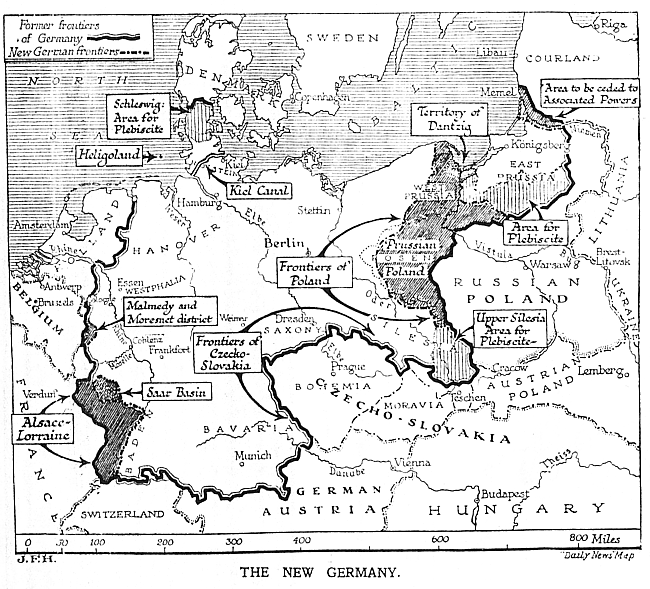
The Upper Silesia plebiscite was a border referendum mandated by the Versailles Treaty and carried out in March 1921 to determine a section of the border between Weimar Germany and Poland
. The region was ethnically mixed, chiefly among Germans, Poles and Silesians
. According to prewar
statistics, ethnic Poles formed 60 percent of the population. The period of the plebiscite campaign and interallied occupation was marked by violence. There were two Polish uprisings
, and German volunteer paramilitary units came to the region as well. But the area was policed by French, British, and Italian troops, and overseen by an Interallied Commission, and the vote came off peacefully. The Allies decided to partition the region, but before they could divide it, local partisans of Poland and forces from Poland launched an uprising and took control of over half the area. The Germans responded with volunteer paramilitary units from all over Germany, which fought the Polish units. In the end, after renewed Allied military intervention, the final position of the opposing forces became, roughly, the new border. The decision was handed over to the League of Nations, which confirmed this border, and Poland received roughly one third of the plebiscite zone by area, including the greater part of the industrial region.
of Upper Silesia
required by the Treaty of Versailles
. Both Germany and Poland valued this region not only for reasons of national feeling, but for its economic importance as well.
The area was occupied by British, French, and Italian forces, and an Interallied Committee headed by a French general, Henri Le Rond. Eventually, the plebiscite was set for 20 March 1921. Both the Poles and the Germans were allowed to organize campaign organizations. Both sides engaged also in widespread material support as a sign of the good will of the one side or the other. Hence, Polish money helped set up banks which loaned Polish farmers money on easy terms; the German government favored the region with shipments of food and other needed supplies. Each side developed secret paramilitary forces—both financed from the opposing metropoles, Warsaw or Berlin. The outstanding figure of the campaign was, in many ways, Wojciech Korfanty
, a Polish politician of the national democratic direction. Korfanty was adept at carrying out an exciting political campaign, based on a populist program consisting of Polish nationalism and cultural Roman Catholicism.
The Polish side carried out two uprisings during the campaign, in August 1919 and August 1920. In the heavily Polish areas of the "Industrial Triangle" in particular, ethnic Germans were threatened, driven out, and in some cases killed. The Allies restored order in each case, but eventually these uprisings drew German "volunteers," the notorious Freikorps
groups, who thrived on the violent atmosphere, though there is evidence that their post facto accounts may have been exaggerated.
An outstanding feature of the plebiscite campaign was the emergence of a strong autonomist movement, the most visible branch of which was the Bund der Oberschlesier--Związek Górnoślązaków. This organization attempted to gain either promises of autonomy from both states and eventually even independence.
There were 1,186,758 votes cast in an area inhabited by 2,073,663 persons. It resulted in 717,122 votes being cast for Germany and 483,514 for Poland
. The towns and most of the villages in the plebiscite territory gave German majorities. However, the districts of Pless (Pszczyna
) and Rybnik
in the southeast, as well as Tarnowitz (Tarnowskie Góry
) in the east and Tost-Gleiwitz (Gliwice
) in the interior showed considerable Polish majorities, while in Lublinitz (Lubliniec
) and Groß Strehlitz (Strzelce Opolskie
) the votes cast on either side were practically equal. All the districts of the industrial zone in a narrower sense - Beuthen (Bytom
), Hindenburg (Zabrze
), Kattowitz (Katowice
), and Königshütte (Chorzów
) - had slight German majorities, though in Beuthen and Kattowitz this was due entirely to the town vote (four fifth in Kattowitz compared to an overall 60%). Many country communes of Upper Silesia had given Polish majorities. Overall, however, the
Germans won the vote by a measure of 60% to 40%. This meant that a large percentage of persons of Polish heritage or ethnicity voted for Germany. The Interallied Commission deliberated, but the British proposed a more easterly border than the French, which would have given much less of the Industrial Triangle to Poland.
In late April 1921, when pro-Polish forces began to fear that the region would be partitioned according to the British plan, elements on the Polish side announced a popular uprising. Korfanty was the leading figure of the uprising, but he had much support in Upper Silesia as well as support from the Polish government in Warsaw. Korfanty called for a popular armed uprising whose aim was to maximize the territory Poland would receive in the partition. German volunteers rushed to meet this uprising, and fighting on a large scale took place in the late spring and early summer of 1921. Germanophone
spokesmen and German officials complained that the French units of the Upper Silesian army of occupation were favoring the insurrection by refusing to put down their violent activities or restore order.
Twelve days after the start of the Uprising Wojciech Korfanty
offered to take his Upper Silesian forces behind a line of demarcation, on condition that the released territory would not be occupied by German forces, but by Allied troops. On July 1, 1921, British troops returned to Upper Silesia to help French forces occupy this area. Simultaneously with these events, the Interallied Commission pronounced a general amnesty for the illegal actions committed during the recent violence, with the exception of acts of revenge and cruelty. The German defense force was finally withdrawn.
Because the Allied Supreme Council was unable to come to an agreement on the partition of the Upper Silesian territory on the basis of the confusing plebiscite results, a solution was found by turning the question over to the Council of the League of Nations
. Agreements between the Germans and Poles in Upper Silesia and appeals issued by both sides, as well as the dispatch of six battalions of Allied troops and the disbandment of the local guards, contributed markedly to the pacification of the district. On the basis of the reports of a League commission and those of its experts, the Council awarded the greater part of the Upper Silesian industrial district to Poland. Poland obtained almost exactly half of the 1,950,000 inhabitants, viz., 965,000, but not quite a third of the territory, i.e., only 3,214.26 km² (1,255 mi²) out of 10,950.89 km² (4,265 mi²) but more than 80% of the heavy industry of the region.
The German and Polish governments, under a League of Nations recommendation, agreed to enforce protections of minority interests that would last for 15 years. Special measures were threatened in case either of the two states should refuse to participate in the drawing up of such regulations, or to accept them subsequently. In the event, the German minority remaining on the Polish side of the border suffered considerable discrimination in the subsequent decades.
The Polish Government, convinced by the economic and political power of the region and by the autonomist movement of the plebiscite campaign, decided to give Upper Silesia considerable autonomy with a Silesian Parliament
as a constituency and the Silesian Voivodship Council as the executive body. On the German side the new Prussian province of Upper Silesia
(Oberschlesien) with regional government in Oppeln was formed, likewise with special autonomy.
Second Polish Republic
The Second Polish Republic, Second Commonwealth of Poland or interwar Poland refers to Poland between the two world wars; a period in Polish history in which Poland was restored as an independent state. Officially known as the Republic of Poland or the Commonwealth of Poland , the Polish state was...
. The region was ethnically mixed, chiefly among Germans, Poles and Silesians
Silesians
Silesians , are the inhabitants of Silesia in Poland, Germany and the Czech Republic. A small diaspora community also exists in Karnes County, Texas in the USA....
. According to prewar
World War I
World War I , which was predominantly called the World War or the Great War from its occurrence until 1939, and the First World War or World War I thereafter, was a major war centred in Europe that began on 28 July 1914 and lasted until 11 November 1918...
statistics, ethnic Poles formed 60 percent of the population. The period of the plebiscite campaign and interallied occupation was marked by violence. There were two Polish uprisings
Silesian Uprisings
The Silesian Uprisings were a series of three armed uprisings of the Poles and Polish Silesians of Upper Silesia, from 1919–1921, against German rule; the resistance hoped to break away from Germany in order to join the Second Polish Republic, which had been established in the wake of World War I...
, and German volunteer paramilitary units came to the region as well. But the area was policed by French, British, and Italian troops, and overseen by an Interallied Commission, and the vote came off peacefully. The Allies decided to partition the region, but before they could divide it, local partisans of Poland and forces from Poland launched an uprising and took control of over half the area. The Germans responded with volunteer paramilitary units from all over Germany, which fought the Polish units. In the end, after renewed Allied military intervention, the final position of the opposing forces became, roughly, the new border. The decision was handed over to the League of Nations, which confirmed this border, and Poland received roughly one third of the plebiscite zone by area, including the greater part of the industrial region.
The plebiscite
The Paris Peace Settlement at the end of World War I placed much formerly German territory in neighboring countries, some of which had not existed at the beginning of the war. In the case of the new Polish state, the Treaty of Versailles detached some 54,000 square kilometers of territory which had formerly been part of the German Empire in order to revive the state of Poland which had disappeared as a result of the Third Partition of Poland in 1795. Many of these areas were ethnically mixed, including a considerable number of ethnic Germans. In three of these ethnically mixed areas on the new German-Polish border, however, the Allied leaders provided for border plebiscites or referenda. The areas would be occupied by Allied forces, governed in some degree by Allied commissions, and made safe for a fair vote. The most discussed of these three plebiscites in the German East was the one in Upper Silesia, since the region was one of Germany's principal industrial centers. The most important economic asset was the enormous coal-mining industry and its ancillary businesses, but the area yielded iron, zinc, and lead as well. The "Industrial Triangle" on the eastern side of the plebiscite zone—between the cities then called Beuthen, Kattowitz, and Gleiwitz—was the heart of this large industrial complex. The Upper Silesia plebiscite was therefore a plebiscite for self-determinationSelf-determination
Self-determination is the principle in international law that nations have the right to freely choose their sovereignty and international political status with no external compulsion or external interference...
of Upper Silesia
Upper Silesia
Upper Silesia is the southeastern part of the historical and geographical region of Silesia. Since the 9th century, Upper Silesia has been part of Greater Moravia, the Duchy of Bohemia, the Piast Kingdom of Poland, again of the Lands of the Bohemian Crown and the Holy Roman Empire, as well as of...
required by the Treaty of Versailles
Treaty of Versailles
The Treaty of Versailles was one of the peace treaties at the end of World War I. It ended the state of war between Germany and the Allied Powers. It was signed on 28 June 1919, exactly five years after the assassination of Archduke Franz Ferdinand. The other Central Powers on the German side of...
. Both Germany and Poland valued this region not only for reasons of national feeling, but for its economic importance as well.
The area was occupied by British, French, and Italian forces, and an Interallied Committee headed by a French general, Henri Le Rond. Eventually, the plebiscite was set for 20 March 1921. Both the Poles and the Germans were allowed to organize campaign organizations. Both sides engaged also in widespread material support as a sign of the good will of the one side or the other. Hence, Polish money helped set up banks which loaned Polish farmers money on easy terms; the German government favored the region with shipments of food and other needed supplies. Each side developed secret paramilitary forces—both financed from the opposing metropoles, Warsaw or Berlin. The outstanding figure of the campaign was, in many ways, Wojciech Korfanty
Wojciech Korfanty
Wojciech Korfanty , born Adalbert Korfanty, was a Polish nationalist activist, journalist and politician, serving as member of the German parliaments Reichstag and Prussian Landtag, and later on, in the Polish Sejm...
, a Polish politician of the national democratic direction. Korfanty was adept at carrying out an exciting political campaign, based on a populist program consisting of Polish nationalism and cultural Roman Catholicism.
The Polish side carried out two uprisings during the campaign, in August 1919 and August 1920. In the heavily Polish areas of the "Industrial Triangle" in particular, ethnic Germans were threatened, driven out, and in some cases killed. The Allies restored order in each case, but eventually these uprisings drew German "volunteers," the notorious Freikorps
Freikorps
Freikorps are German volunteer military or paramilitary units. The term was originally applied to voluntary armies formed in German lands from the middle of the 18th century onwards. Between World War I and World War II the term was also used for the paramilitary organizations that arose during...
groups, who thrived on the violent atmosphere, though there is evidence that their post facto accounts may have been exaggerated.
An outstanding feature of the plebiscite campaign was the emergence of a strong autonomist movement, the most visible branch of which was the Bund der Oberschlesier--Związek Górnoślązaków. This organization attempted to gain either promises of autonomy from both states and eventually even independence.
There were 1,186,758 votes cast in an area inhabited by 2,073,663 persons. It resulted in 717,122 votes being cast for Germany and 483,514 for Poland
Poland
Poland , officially the Republic of Poland , is a country in Central Europe bordered by Germany to the west; the Czech Republic and Slovakia to the south; Ukraine, Belarus and Lithuania to the east; and the Baltic Sea and Kaliningrad Oblast, a Russian exclave, to the north...
. The towns and most of the villages in the plebiscite territory gave German majorities. However, the districts of Pless (Pszczyna
Pszczyna
Pszczyna is a town in southern Poland with 26,827 inhabitants within the immediate gmina rising to 50,121 inhabitants in the powiat, which includes the town of Pszczyna, itself, Brzeźce , Czarków , Ćwiklice , Jankowice , Łąka , Piasek , Poręba , Rudołtowice , Studzionka , Studzienice , Wisła...
) and Rybnik
Rybnik
Rybnik is a city in southern Poland, in the Silesian Voivodeship. Rybnik is located close to the border with the Czech Republic and just outside the southern border of the largest urban area in Poland, the Upper Silesian Metropolitan Union...
in the southeast, as well as Tarnowitz (Tarnowskie Góry
Tarnowskie Góry
Tarnowskie Góry is a town in Silesia in southern Poland, near Katowice. Borders on the Upper Silesian Metropolitan Union - metropolis with the population of 2 millions. Located in the Silesian Highlands....
) in the east and Tost-Gleiwitz (Gliwice
Gliwice
Gliwice is a city in Upper Silesia in southern Poland, near Katowice. Gliwice is the west district of the Upper Silesian Metropolitan Union – a metropolis with a population of 2 million...
) in the interior showed considerable Polish majorities, while in Lublinitz (Lubliniec
Lubliniec
Lubliniec is a town in southern Poland with 29,359 inhabitants . It is the capital of Lubliniec County, part of Silesian Voivodeship ; previously it was in Częstochowa Voivodeship .-Geography:...
) and Groß Strehlitz (Strzelce Opolskie
Strzelce Opolskie
Strzelce Opolskie is a town in south-western Poland with 19,628 inhabitants , situated in the Opole Voivodeship. It is the capital of Strzelce County. Strzelce Opolskie is one of the biggest centers of German minority in Poland....
) the votes cast on either side were practically equal. All the districts of the industrial zone in a narrower sense - Beuthen (Bytom
Bytom
Bytom is a city in Silesia in southern Poland, near Katowice. The central-western district of the Upper Silesian Metropolitan Union - metropolis with the population of 2 millions. Bytom is located in the Silesian Highlands, on the Bytomka river .The city belongs to the Silesian Voivodeship since...
), Hindenburg (Zabrze
Zabrze
Zabrze is a city in Silesia in southern Poland, near Katowice. The west district of the Upper Silesian Metropolitan Union is a metropolis with a population of around 2 million...
), Kattowitz (Katowice
Katowice
Katowice is a city in Silesia in southern Poland, on the Kłodnica and Rawa rivers . Katowice is located in the Silesian Highlands, about north of the Silesian Beskids and about southeast of the Sudetes Mountains.It is the central district of the Upper Silesian Metropolis, with a population of 2...
), and Königshütte (Chorzów
Chorzów
Chorzów is a city in Silesia in southern Poland, near Katowice. Chorzów is one of the central districts of the Upper Silesian Metropolitan Union - a metropolis with a population of 2 million...
) - had slight German majorities, though in Beuthen and Kattowitz this was due entirely to the town vote (four fifth in Kattowitz compared to an overall 60%). Many country communes of Upper Silesia had given Polish majorities. Overall, however, the
Germans won the vote by a measure of 60% to 40%. This meant that a large percentage of persons of Polish heritage or ethnicity voted for Germany. The Interallied Commission deliberated, but the British proposed a more easterly border than the French, which would have given much less of the Industrial Triangle to Poland.
In late April 1921, when pro-Polish forces began to fear that the region would be partitioned according to the British plan, elements on the Polish side announced a popular uprising. Korfanty was the leading figure of the uprising, but he had much support in Upper Silesia as well as support from the Polish government in Warsaw. Korfanty called for a popular armed uprising whose aim was to maximize the territory Poland would receive in the partition. German volunteers rushed to meet this uprising, and fighting on a large scale took place in the late spring and early summer of 1921. Germanophone
German language
German is a West Germanic language, related to and classified alongside English and Dutch. With an estimated 90 – 98 million native speakers, German is one of the world's major languages and is the most widely-spoken first language in the European Union....
spokesmen and German officials complained that the French units of the Upper Silesian army of occupation were favoring the insurrection by refusing to put down their violent activities or restore order.
Twelve days after the start of the Uprising Wojciech Korfanty
Wojciech Korfanty
Wojciech Korfanty , born Adalbert Korfanty, was a Polish nationalist activist, journalist and politician, serving as member of the German parliaments Reichstag and Prussian Landtag, and later on, in the Polish Sejm...
offered to take his Upper Silesian forces behind a line of demarcation, on condition that the released territory would not be occupied by German forces, but by Allied troops. On July 1, 1921, British troops returned to Upper Silesia to help French forces occupy this area. Simultaneously with these events, the Interallied Commission pronounced a general amnesty for the illegal actions committed during the recent violence, with the exception of acts of revenge and cruelty. The German defense force was finally withdrawn.
Because the Allied Supreme Council was unable to come to an agreement on the partition of the Upper Silesian territory on the basis of the confusing plebiscite results, a solution was found by turning the question over to the Council of the League of Nations
League of Nations
The League of Nations was an intergovernmental organization founded as a result of the Paris Peace Conference that ended the First World War. It was the first permanent international organization whose principal mission was to maintain world peace...
. Agreements between the Germans and Poles in Upper Silesia and appeals issued by both sides, as well as the dispatch of six battalions of Allied troops and the disbandment of the local guards, contributed markedly to the pacification of the district. On the basis of the reports of a League commission and those of its experts, the Council awarded the greater part of the Upper Silesian industrial district to Poland. Poland obtained almost exactly half of the 1,950,000 inhabitants, viz., 965,000, but not quite a third of the territory, i.e., only 3,214.26 km² (1,255 mi²) out of 10,950.89 km² (4,265 mi²) but more than 80% of the heavy industry of the region.
The German and Polish governments, under a League of Nations recommendation, agreed to enforce protections of minority interests that would last for 15 years. Special measures were threatened in case either of the two states should refuse to participate in the drawing up of such regulations, or to accept them subsequently. In the event, the German minority remaining on the Polish side of the border suffered considerable discrimination in the subsequent decades.
The Polish Government, convinced by the economic and political power of the region and by the autonomist movement of the plebiscite campaign, decided to give Upper Silesia considerable autonomy with a Silesian Parliament
Silesian Parliament
Silesian Parliament or Silesian Sejm was the governing body of the Silesian Voivodeship , an autonomous voivodeship of the Second Polish Republic between 1920 and 1945. It was elected in democratic elections and had certain influence over the usage of taxes collected in Silesia...
as a constituency and the Silesian Voivodship Council as the executive body. On the German side the new Prussian province of Upper Silesia
Province of Upper Silesia
The Province of Upper Silesia was a province of the Free State of Prussia created in the aftermath of World War I. It comprised much of the region of Upper Silesia and was eventually divided into two administrative regions , Kattowitz and Oppeln...
(Oberschlesien) with regional government in Oppeln was formed, likewise with special autonomy.
Results
| County | population (1919) | registered voters | turnout | votes for Germany | votes for Poland |
|---|---|---|---|---|---|
| Beuthen (Bytom), town Bytom Bytom is a city in Silesia in southern Poland, near Katowice. The central-western district of the Upper Silesian Metropolitan Union - metropolis with the population of 2 millions. Bytom is located in the Silesian Highlands, on the Bytomka river .The city belongs to the Silesian Voivodeship since... |
71,187 | 42,990 | 39,991 | 29,890 (74.7 %) | 10,101 (25.3 %) |
| Beuthen (Bytom) Bytom Bytom is a city in Silesia in southern Poland, near Katowice. The central-western district of the Upper Silesian Metropolitan Union - metropolis with the population of 2 millions. Bytom is located in the Silesian Highlands, on the Bytomka river .The city belongs to the Silesian Voivodeship since... -Tarnowitz (Tarnowskie Góry), district Tarnowskie Góry Tarnowskie Góry is a town in Silesia in southern Poland, near Katowice. Borders on the Upper Silesian Metropolitan Union - metropolis with the population of 2 millions. Located in the Silesian Highlands.... |
213,790 | 109,749 | 106,698 | 43,677 (40.9 %) | 63,021 (59.1 %) |
| Cosel (Koźle), district Kozle Koźle is a district of Kędzierzyn-Koźle and is at the junction of the Kłodnica and Odra rivers, 29 Ifl. southeast of Opole by rail. The district has a Roman Catholic church, a medieval chateau, remains of a 19th century fortress and a high school... |
79,973 | 51,364 | 50,100 | 37,651 (75.2 %) | 12,449 (24.8 %) |
| Gleiwitz (Gliwice) Gliwice Gliwice is a city in Upper Silesia in southern Poland, near Katowice. Gliwice is the west district of the Upper Silesian Metropolitan Union – a metropolis with a population of 2 million... |
69,028 | 41,949 | 40,587 | 32,029 (78.9 %) | 8,558 (21.1 %) |
| Groß Strehlitz (Strzelce Opolskie), district Strzelce Opolskie Strzelce Opolskie is a town in south-western Poland with 19,628 inhabitants , situated in the Opole Voivodeship. It is the capital of Strzelce County. Strzelce Opolskie is one of the biggest centers of German minority in Poland.... |
76,502 | 46,528 | 45,461 | 22,415 (49.3 %) | 23,046 (50.7 %) |
| Hindenburg (Zabrze), district Zabrze Zabrze is a city in Silesia in southern Poland, near Katowice. The west district of the Upper Silesian Metropolitan Union is a metropolis with a population of around 2 million... |
167,632 | 90,793 | 88,480 | 45,219 (51.1 %) | 43,261 (48.9 %) |
| Kattowitz (Katowice), (town) Katowice Katowice is a city in Silesia in southern Poland, on the Kłodnica and Rawa rivers . Katowice is located in the Silesian Highlands, about north of the Silesian Beskids and about southeast of the Sudetes Mountains.It is the central district of the Upper Silesian Metropolis, with a population of 2... |
45,422 | 28,531 | 26,674 | 22,774 (85.4 %) | 3,900 (14.6 %) |
| Kattowitz (Katowice), (district) Kattowitz (district) Landkreis Kattowitz was a rural district of the German-state of Prussia from 1873–1922 and 1939–45. Its capital was the city of Kattowitz .-History:... |
227,657 | 122,342 | 119,011 | 52,892 (44.4 %) | 66,119 (55.6 %) |
| Königshütte (Chorzów), district Chorzów Chorzów is a city in Silesia in southern Poland, near Katowice. Chorzów is one of the central districts of the Upper Silesian Metropolitan Union - a metropolis with a population of 2 million... |
74,811 | 44,052 | 42,628 | 31,864 (74.7 %) | 10,764 (25.3 %) |
| Kreuzburg (Kluczbork), district Kluczbork Kluczbork is a town in southwestern Poland with 26,670 inhabitants , situated in the Opole Voivodeship. It is the capital of Kluczbork County and an important railroad junction. In Kluczbork the major rail line from Katowice splits into two directions - westwards to Wroclaw and northwards to Poznań... |
52,558 | 40,602 | 39,627 | 37,975 (95.8 %) | 1,652 (4.2 %) |
| Leobschütz (Głubczyce), district | 78,247 | 66,697 | 65,387 | 65,128 (99.6 %) | 259 (0.4 %) |
| Lublinitz (Lubliniec), district Lubliniec Lubliniec is a town in southern Poland with 29,359 inhabitants . It is the capital of Lubliniec County, part of Silesian Voivodeship ; previously it was in Częstochowa Voivodeship .-Geography:... |
55,380 | 29,991 | 29,132 | 15,453 (53.0 %) | 13,679 (47.0 %) |
| Namslau (Namysłów), district | 5,659 | 5,606 | 5,481 | 5,348 (97.6 %) | 133 (2.4 %) |
| Neustadt (Prudnik), district Prudnik Prudnik is a town in Poland, located in the southern part of Opole Voivodeship. Its population numbers 26,400 inhabitants . It is the capital of Prudnik County.- Education :* * * II Liceum Ogólnokształcące w Prudniku... |
51,287 | 36,941 | 36,093 | 31,825 (88.2 %) | 4,268 (11.8 %) |
| Oppeln (Opole), town Opole Opole is a city in southern Poland on the Oder River . It has a population of 125,992 and is the capital of the Upper Silesia, Opole Voivodeship and, also the seat of Opole County... |
35,483 | 22,930 | 21,914 | 20,816 (95.0 %) | 1,098 (5.0 %) |
| Oppeln (Opole), district Opole Opole is a city in southern Poland on the Oder River . It has a population of 125,992 and is the capital of the Upper Silesia, Opole Voivodeship and, also the seat of Opole County... |
123,165 | 82,715 | 80,896 | 56,170 (69.4 %) | 24,726 (30.6 %) |
| Pleß (Pszczyna), district Pszczyna Pszczyna is a town in southern Poland with 26,827 inhabitants within the immediate gmina rising to 50,121 inhabitants in the powiat, which includes the town of Pszczyna, itself, Brzeźce , Czarków , Ćwiklice , Jankowice , Łąka , Piasek , Poręba , Rudołtowice , Studzionka , Studzienice , Wisła... |
141,828 | 73,923 | 72,053 | 18,675 (25.9 %) | 53,378 (74.1 %) |
| Ratibor (Racibórz), town Racibórz Racibórz is a town in southern Poland with 60,218 inhabitants situated in the Silesian Voivodeship , previously in Katowice Voivodeship... |
36,994 | 25,336 | 24,518 | 22,291 (90.9 %) | 2,227 (9.1 %) |
| Ratibor (Racibórz), district Racibórz Racibórz is a town in southern Poland with 60,218 inhabitants situated in the Silesian Voivodeship , previously in Katowice Voivodeship... |
78,238 | 45,900 | 44,867 | 26,349 (58.7 %) | 18,518 (41.3 %) |
| Rosenberg (Olesno), district Olesno Olesno is a town in Opole Voivodship, Poland about north-east of the city of Opole. It is the capital of Olesno County and seat of the Gmina Olesno.-History:The area near the ancient Amber Road had been settled since the Neolithic era... |
54,962 | 35,976 | 35,007 | 23,857 (68.1 %) | 11,150 (31.9 %) |
| Rybnik, district Rybnik Rybnik is a city in southern Poland, in the Silesian Voivodeship. Rybnik is located close to the border with the Czech Republic and just outside the southern border of the largest urban area in Poland, the Upper Silesian Metropolitan Union... |
160,836 | 82,350 | 80,266 | 27,919 (34.8 %) | 52,347 (65.2 %) |
| Tarnowitz (Tarnowskie Góry), district Tarnowskie Góry Tarnowskie Góry is a town in Silesia in southern Poland, near Katowice. Borders on the Upper Silesian Metropolitan Union - metropolis with the population of 2 millions. Located in the Silesian Highlands.... |
86,563 | 45,561 | 44,591 | 17,078 (38.3 %) | 27,513 (61.7 %) |
| Tost-Gleiwitz (Gliwice), district Gliwice Gliwice is a city in Upper Silesia in southern Poland, near Katowice. Gliwice is the west district of the Upper Silesian Metropolitan Union – a metropolis with a population of 2 million... |
86,461 | 48,153 | 47,296 | 20,098 (42.5 %) | 27,198 (57.5 %) |
| total | 2,073,663 | 1,220,979 | 1,186,758 | 707,393 (59.6 %) | 479,365 (40.4 %) |
See also
- Territorial changes of Germany after World War I
- Territorial changes of Poland after World War I
- East Prussian plebisciteEast Prussian plebisciteThe East Prussia plebiscite , also known as the Allenstein and Marienwerder plebiscite or Warmia, Masuria and Powiśle plebiscite , was a plebiscite for self-determination of the regions Warmia , Masuria and Powiśle, which had been in parts of East Prussia and West Prussia, in accordance with...
External links
- Wojciech Korfanty's proclamation after plebiscite
- Exact plebiscite results - according to villages and discrits (in German)
- 1920 map showing German territory's changes, including marked area for the Upper Silesia plebiscite
- Map of interwar Poland; shows plebiscite areas
- Map of interwar Poland; shows plebiscite areas (in color, Polish)