

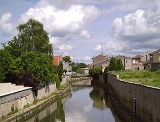
Seille

Encyclopedia
The Seille is a river in the French région of Lorraine
, right tributary of the Moselle River
. It is also known as the Seille lorraine or the Grande Seille ("large Seille"), to distinguish it from another Seille
, a small tributary
of the Saône
.
It originates near Azoudange
, in the département of Moselle
. Leaving the Lindre lake, it skirts the town of Dieuze
, and traverses Vic-sur-Seille
and Nomeny
, before flowing into the Moselle
at Metz
. It is 135 km long, and has a basin area of 1348 km². Most of its length is in the département of Moselle, except for the part between Aulnois-sur-Seille
and Cheminot
, which is in Meurthe-et-Moselle
. The Seille also serves as the border
between Moselle and Meurthe-et-Moselle from Chambrey
to Aulnois-sur-Seille.
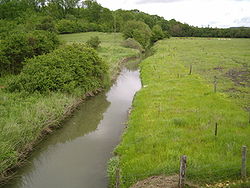 Originating in the Pond region, the Seille then crosses Saulnois, a region in the South of Moselle. This section of the river is part of the Parc naturel régional de Lorraine ("Regional Natural Park of Lorraine"). The river then flows into a large valley, the ground of which is composed mainly of marl
and clay
. Since the Middle Ages
, there has been much work performed on the Seille, in part to straighten it (to render it navigable), to drain the nearby swamps, and to limit flood
ing of adjacent low-lying areas.
Its linear course and the treelessness of its banks makes it of little interest to the landscape, and today the erosion of its banks poses problems. Despite this, the valley is of biological
interest: salt water
resurgences have led to the presence of various plant species that are usually confined to coast
lines, including glasswort
, aster tripolium
, and sea-spurreys
.
, work is being done on the river: the banks of the river are being reforested
, and an oxygenation
system is being installed.
The Seille has a number of tributaries
, the most important of which are:
.
This section of the river has comparatively few tributaries:
Finally, in Metz
, after passing the Porte des Allemands (a 13th century castle, lit. "Gate of the Germans"), it flows into the right bank of the Moselle River
.
It is also home to a variety of other animals, such as otter
s, heron
s, and caterpillar
s.
The Seille suffers from eutrophication
.
The suffix "sur-Seille" means "on the Seille" in French, and the practice is analogous to the English place names that incorporate river names, such as Newcastle upon Tyne.
Lorraine (région)
Lorraine is one of the 27 régions of France. The administrative region has two cities of equal importance, Metz and Nancy. Metz is considered to be the official capital since that is where the regional parliament is situated...
, right tributary of the Moselle River
Moselle River
The Moselle is a river flowing through France, Luxembourg, and Germany. It is a left tributary of the Rhine, joining the Rhine at Koblenz. A small part of Belgium is also drained by the Mosel through the Our....
. It is also known as the Seille lorraine or the Grande Seille ("large Seille"), to distinguish it from another Seille
Seille (Saône)
The Seille is a river originating in the Jura mountains in France. It is a left tributary of the Saône, joining it in the commune of La Truchère, in Saône-et-Loire. It is 100 km long....
, a small tributary
Tributary
A tributary or affluent is a stream or river that flows into a main stem river or a lake. A tributary does not flow directly into a sea or ocean...
of the Saône
Saône
The Saône is a river of eastern France. It is a right tributary of the River Rhône. Rising at Vioménil in the Vosges department, it joins the Rhône in Lyon....
.
It originates near Azoudange
Azoudange
Azoudange is a commune in the Moselle department in Lorraine in north-eastern France.-See also:*Communes of the Moselle department*Parc naturel régional de Lorraine...
, in the département of Moselle
Moselle
Moselle is a department in the east of France named after the river Moselle.- History :Moselle is one of the original 83 departments created during the French Revolution on March 4, 1790...
. Leaving the Lindre lake, it skirts the town of Dieuze
Dieuze
Dieuze is a commune in the Moselle department in Lorraine in north-eastern France.-People:Dieuze was the birthplace of:*Charles Hermite, mathematician*Edmond François Valentin About, novelist, publicist and journalist*Émile Friant, painter...
, and traverses Vic-sur-Seille
Vic-sur-Seille
Vic-sur-Seille is a commune in the Moselle department in Lorraine in north-eastern France.-See also:*Communes of the Moselle department*Parc naturel régional de Lorraine...
and Nomeny
Nomeny
Nomeny is a commune in the Meurthe-et-Moselle department in north-eastern France.South of Nomeny, there is a mediumwave broadcasting station, which works on 837 kHz with 300 kW. It uses two guyed masts with different height, which are both insulated against ground, as antenna. The tallest of them...
, before flowing into the Moselle
Moselle River
The Moselle is a river flowing through France, Luxembourg, and Germany. It is a left tributary of the Rhine, joining the Rhine at Koblenz. A small part of Belgium is also drained by the Mosel through the Our....
at Metz
Metz
Metz is a city in the northeast of France located at the confluence of the Moselle and the Seille rivers.Metz is the capital of the Lorraine region and prefecture of the Moselle department. Located near the tripoint along the junction of France, Germany, and Luxembourg, Metz forms a central place...
. It is 135 km long, and has a basin area of 1348 km². Most of its length is in the département of Moselle, except for the part between Aulnois-sur-Seille
Aulnois-sur-Seille
Aulnois-sur-Seille is a commune in the Moselle department in Lorraine in north-eastern France.-See also:*Communes of the Moselle department...
and Cheminot
Cheminot
Cheminot is a commune in the Moselle department in Lorraine in north-eastern France....
, which is in Meurthe-et-Moselle
Meurthe-et-Moselle
Meurthe-et-Moselle is a department in the Lorraine region of France, named after the Meurthe and Moselle rivers.- History :Meurthe-et-Moselle was created in 1871 at the end of the Franco-Prussian War from the parts of the former departments of Moselle and Meurthe which remained French...
. The Seille also serves as the border
Border
Borders define geographic boundaries of political entities or legal jurisdictions, such as governments, sovereign states, federated states and other subnational entities. Some borders—such as a state's internal administrative borders, or inter-state borders within the Schengen Area—are open and...
between Moselle and Meurthe-et-Moselle from Chambrey
Chambrey
Chambrey is a commune in the Moselle department in Lorraine in north-eastern France.-See also:* Communes of the Moselle department...
to Aulnois-sur-Seille.
Upstream
Marl
Marl or marlstone is a calcium carbonate or lime-rich mud or mudstone which contains variable amounts of clays and aragonite. Marl was originally an old term loosely applied to a variety of materials, most of which occur as loose, earthy deposits consisting chiefly of an intimate mixture of clay...
and clay
Clay
Clay is a general term including many combinations of one or more clay minerals with traces of metal oxides and organic matter. Geologic clay deposits are mostly composed of phyllosilicate minerals containing variable amounts of water trapped in the mineral structure.- Formation :Clay minerals...
. Since the Middle Ages
Middle Ages
The Middle Ages is a periodization of European history from the 5th century to the 15th century. The Middle Ages follows the fall of the Western Roman Empire in 476 and precedes the Early Modern Era. It is the middle period of a three-period division of Western history: Classic, Medieval and Modern...
, there has been much work performed on the Seille, in part to straighten it (to render it navigable), to drain the nearby swamps, and to limit flood
Flood
A flood is an overflow of an expanse of water that submerges land. The EU Floods directive defines a flood as a temporary covering by water of land not normally covered by water...
ing of adjacent low-lying areas.
Its linear course and the treelessness of its banks makes it of little interest to the landscape, and today the erosion of its banks poses problems. Despite this, the valley is of biological
Biology
Biology is a natural science concerned with the study of life and living organisms, including their structure, function, growth, origin, evolution, distribution, and taxonomy. Biology is a vast subject containing many subdivisions, topics, and disciplines...
interest: salt water
Saline water
Saline water is a general term for water that contains a significant concentration of dissolved salts . The concentration is usually expressed in parts per million of salt....
resurgences have led to the presence of various plant species that are usually confined to coast
Coast
A coastline or seashore is the area where land meets the sea or ocean. A precise line that can be called a coastline cannot be determined due to the dynamic nature of tides. The term "coastal zone" can be used instead, which is a spatial zone where interaction of the sea and land processes occurs...
lines, including glasswort
Glasswort
Salicornia is a genus of succulent, halophyte plants that grow in salt marshes, on beaches, and among mangroves. Salicornia species are native to North America, Europe, South Africa, and South Asia...
, aster tripolium
Aster tripolium
Aster tripolium is a plant of northern Europe that is confined in its distribution to salt marshes, estuaries and occasionally to inland salt works....
, and sea-spurreys
Spergularia
Spergularia is a genus of the Caryophyllaceae family, containing plants known as sea-spurreys and sandspurrys. There are about 60 species.-Species:* Spergularia azorica - endemic to the archipelago of the Azores*Spergularia atrosperma...
.
, work is being done on the river: the banks of the river are being reforested
Reforestation
Reforestation is the natural or intentional restocking of existing forests and woodlands that have been depleted, usually through deforestation....
, and an oxygenation
Oxygenation (environmental)
Environmental oxygenation can be important to the sustainability of a particular ecosystem. Insufficient oxygen may occur in bodies of water such as ponds and rivers, tending to suppress the presence of aerobic organisms such as fish...
system is being installed.
The Seille has a number of tributaries
Tributary
A tributary or affluent is a stream or river that flows into a main stem river or a lake. A tributary does not flow directly into a sea or ocean...
, the most important of which are:
- the Spin and the Verbach, in Dieuze (right bank)
- the ruisseau de Videlange (lit. "brook of Videlange"), near Mulcey (right bank)
- the Nard, in Marsal (left bank)
- the Petite Seille (lit. "Small Seille"), in Salonnes (right bank)
- the Loutre Noire (lit. "Black Otter"), in Moncel-sur-Seille (left bank)
Downstream
Downstream, the Seille is much less straight, following a contorted path along the border of the département of MoselleMoselle
Moselle is a department in the east of France named after the river Moselle.- History :Moselle is one of the original 83 departments created during the French Revolution on March 4, 1790...
.
This section of the river has comparatively few tributaries:
- the Osson, at Ajoncourt
- the ruisseau Saint-Jean (lit. "St. John brook"), in Létricourt (right bank)
- the ruisseau Saint-Pierre (lit. "St. Peter brook")
Finally, in Metz
Metz
Metz is a city in the northeast of France located at the confluence of the Moselle and the Seille rivers.Metz is the capital of the Lorraine region and prefecture of the Moselle department. Located near the tripoint along the junction of France, Germany, and Luxembourg, Metz forms a central place...
, after passing the Porte des Allemands (a 13th century castle, lit. "Gate of the Germans"), it flows into the right bank of the Moselle River
Moselle River
The Moselle is a river flowing through France, Luxembourg, and Germany. It is a left tributary of the Rhine, joining the Rhine at Koblenz. A small part of Belgium is also drained by the Mosel through the Our....
.
Flora and fauna
The river is classified as "Category II" (categories are based on types of fish), and is the habitat for a very large variety of fish.It is also home to a variety of other animals, such as otter
Otter
The Otters are twelve species of semi-aquatic mammals which feed on fish and shellfish, and also other invertebrates, amphibians, birds and small mammals....
s, heron
Heron
The herons are long-legged freshwater and coastal birds in the family Ardeidae. There are 64 recognised species in this family. Some are called "egrets" or "bitterns" instead of "heron"....
s, and caterpillar
Caterpillar
Caterpillars are the larval form of members of the order Lepidoptera . They are mostly herbivorous in food habit, although some species are insectivorous. Caterpillars are voracious feeders and many of them are considered to be pests in agriculture...
s.
The Seille suffers from eutrophication
Eutrophication
Eutrophication or more precisely hypertrophication, is the movement of a body of water′s trophic status in the direction of increasing plant biomass, by the addition of artificial or natural substances, such as nitrates and phosphates, through fertilizers or sewage, to an aquatic system...
.
Toponymy
Numerous towns and villages incorporate the name of the river into theirs. Some examples include: Aboncourt-sur-Seille, Aulnois-sur-Seille, Bey-sur-Seille, Brin-sur-Seille, Coin-sur-Seille, Haraucourt-sur-Seille, Mailly-sur-Seille, Malaucourt-sur-Seille, Moncel-sur-Seille, Morville-sur-Seille, Port-sur-Seille, and Vic-sur-Seille.The suffix "sur-Seille" means "on the Seille" in French, and the practice is analogous to the English place names that incorporate river names, such as Newcastle upon Tyne.
External links
- Photos and History of the Seille
- http://www.seillevalley.com