

Surfbird

Encyclopedia
The Surfbird is a small stocky wader
in the family Scolopacidae. It is usually classified in a genus of its own, as Aphriza virgata, and was once considered to be allied to the turnstone
s, but more recent data suggests it is very close genetically to the Red
and Great Knot
s and should be included in Calidris (Thomas et al., 2004). Indeed, the Great Knot looks very much like a larger, more long-billed, and somewhat darker surfbird.
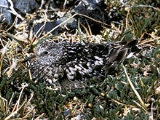
This bird has a short dark bill
, yellow legs and a black band at the end of the white rump. In breeding plumage, it has dark streaks on the brownish head and breast with dark spots on its white underparts; the upperparts are dark with rust colouring on the wings. Birds in winter plumage
and immature birds are mainly grey on the upperparts and breast and white on the underparts with streaking.
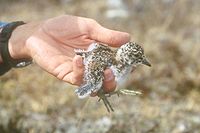 Their breeding habitat is rocky tundra
areas in Alaska
and the Yukon
. The female lays 4 eggs in a depression on the ground lined with vegetation. Both parents look after the young birds, who feed themselves.
These birds migrate
to the Pacific coasts of North
and South America
, from southern Alaska to Tierra del Fuego
.
On the nesting grounds, these birds mainly eat insects and some seeds. At other times of year, they eat mollusks and crustacean
s found along the surf line on rocky coasts and are usually found in small flocks, often with turnstone
s.
The song is a whistled tee tee tee.
Wader
Waders, called shorebirds in North America , are members of the order Charadriiformes, excluding the more marine web-footed seabird groups. The latter are the skuas , gulls , terns , skimmers , and auks...
in the family Scolopacidae. It is usually classified in a genus of its own, as Aphriza virgata, and was once considered to be allied to the turnstone
Turnstone
Turnstones are the bird species in the genus Arenaria in the family Scolopacidae. They are closely related to calidrid sandpipers and might be considered members of the tribe Calidriini....
s, but more recent data suggests it is very close genetically to the Red
Red Knot
The Red Knot, Calidris canutus , is a medium sized shorebird which breeds in tundra and the Arctic Cordillera in the far north of Canada, Europe, and Russia. It is a large member of the Calidris sandpipers, second only to the Great Knot...
and Great Knot
Great Knot
The Great Knot, Calidris tenuirostris, is a small wader. It is the largest of the calidrid species.Their breeding habitat is tundra in northeast Siberia. They nest on the ground laying about four eggs in a ground scrape. They are strongly migratory wintering on coasts in southern Asia through to...
s and should be included in Calidris (Thomas et al., 2004). Indeed, the Great Knot looks very much like a larger, more long-billed, and somewhat darker surfbird.
This bird has a short dark bill
Beak
The beak, bill or rostrum is an external anatomical structure of birds which is used for eating and for grooming, manipulating objects, killing prey, fighting, probing for food, courtship and feeding young...
, yellow legs and a black band at the end of the white rump. In breeding plumage, it has dark streaks on the brownish head and breast with dark spots on its white underparts; the upperparts are dark with rust colouring on the wings. Birds in winter plumage
Plumage
Plumage refers both to the layer of feathers that cover a bird and the pattern, colour, and arrangement of those feathers. The pattern and colours of plumage vary between species and subspecies and can also vary between different age classes, sexes, and season. Within species there can also be a...
and immature birds are mainly grey on the upperparts and breast and white on the underparts with streaking.
Tundra
In physical geography, tundra is a biome where the tree growth is hindered by low temperatures and short growing seasons. The term tundra comes through Russian тундра from the Kildin Sami word tūndâr "uplands," "treeless mountain tract." There are three types of tundra: Arctic tundra, alpine...
areas in Alaska
Alaska
Alaska is the largest state in the United States by area. It is situated in the northwest extremity of the North American continent, with Canada to the east, the Arctic Ocean to the north, and the Pacific Ocean to the west and south, with Russia further west across the Bering Strait...
and the Yukon
Yukon
Yukon is the westernmost and smallest of Canada's three federal territories. It was named after the Yukon River. The word Yukon means "Great River" in Gwich’in....
. The female lays 4 eggs in a depression on the ground lined with vegetation. Both parents look after the young birds, who feed themselves.
These birds migrate
Bird migration
Bird migration is the regular seasonal journey undertaken by many species of birds. Bird movements include those made in response to changes in food availability, habitat or weather. Sometimes, journeys are not termed "true migration" because they are irregular or in only one direction...
to the Pacific coasts of North
North America
North America is a continent wholly within the Northern Hemisphere and almost wholly within the Western Hemisphere. It is also considered a northern subcontinent of the Americas...
and South America
South America
South America is a continent situated in the Western Hemisphere, mostly in the Southern Hemisphere, with a relatively small portion in the Northern Hemisphere. The continent is also considered a subcontinent of the Americas. It is bordered on the west by the Pacific Ocean and on the north and east...
, from southern Alaska to Tierra del Fuego
Tierra del Fuego
Tierra del Fuego is an archipelago off the southernmost tip of the South American mainland, across the Strait of Magellan. The archipelago consists of a main island Isla Grande de Tierra del Fuego divided between Chile and Argentina with an area of , and a group of smaller islands including Cape...
.
On the nesting grounds, these birds mainly eat insects and some seeds. At other times of year, they eat mollusks and crustacean
Crustacean
Crustaceans form a very large group of arthropods, usually treated as a subphylum, which includes such familiar animals as crabs, lobsters, crayfish, shrimp, krill and barnacles. The 50,000 described species range in size from Stygotantulus stocki at , to the Japanese spider crab with a leg span...
s found along the surf line on rocky coasts and are usually found in small flocks, often with turnstone
Turnstone
Turnstones are the bird species in the genus Arenaria in the family Scolopacidae. They are closely related to calidrid sandpipers and might be considered members of the tribe Calidriini....
s.
The song is a whistled tee tee tee.
See also
- USS Surfbird (AM-383)USS Surfbird (AM-383)USS Surfbird was an built during World War II for the United States Navy. She was the only U.S. Navy ship named for the surfbird....
— a United States NavyUnited States NavyThe United States Navy is the naval warfare service branch of the United States Armed Forces and one of the seven uniformed services of the United States. The U.S. Navy is the largest in the world; its battle fleet tonnage is greater than that of the next 13 largest navies combined. The U.S...
minesweeperMinesweeper (ship)A minesweeper is a small naval warship designed to counter the threat posed by naval mines. Minesweepers generally detect then neutralize mines in advance of other naval operations.-History:...
built during World War IIWorld War IIWorld War II, or the Second World War , was a global conflict lasting from 1939 to 1945, involving most of the world's nations—including all of the great powers—eventually forming two opposing military alliances: the Allies and the Axis...
.