
Home      Discussion      Topics      Dictionary      Almanac
Signup       Login
Connecticut Colony

Connecticut Colony

Overview
The Connecticut Colony or Colony of Connecticut was an English colony located in British America
British America
For American people of British descent, see British American.British America is the anachronistic term used to refer to the territories under the control of the Crown or Parliament in present day North America , Central America, the Caribbean, and Guyana...

 that became the U.S. state
U.S. state
A U.S. state is any one of the 50 federated states of the United States of America that share sovereignty with the federal government. Because of this shared sovereignty, an American is a citizen both of the federal entity and of his or her state of domicile. Four states use the official title of...

 of Connecticut
Connecticut
Connecticut is a state in the New England region of the northeastern United States. It is bordered by Rhode Island to the east, Massachusetts to the north, and the state of New York to the west and the south .Connecticut is named for the Connecticut River, the major U.S. river that approximately...

. Originally known as the River Colony, it was organized on March 3, 1636 as a haven for Puritan
Puritan
The Puritans were a significant grouping of English Protestants in the 16th and 17th centuries. Puritanism in this sense was founded by some Marian exiles from the clergy shortly after the accession of Elizabeth I of England in 1558, as an activist movement within the Church of England...

 noblemen. After early struggles with the Dutch
Netherlands
The Netherlands is a constituent country of the Kingdom of the Netherlands, located mainly in North-West Europe and with several islands in the Caribbean. Mainland Netherlands borders the North Sea to the north and west, Belgium to the south, and Germany to the east, and shares maritime borders...

, the English gained control of the colony permanently by the late 1630s. The colony was later the scene of a bloody war between the English and Indians
Native Americans in the United States
Native Americans in the United States are the indigenous peoples in North America within the boundaries of the present-day continental United States, parts of Alaska, and the island state of Hawaii. They are composed of numerous, distinct tribes, states, and ethnic groups, many of which survive as...

, known as the Pequot War
Pequot War
The Pequot War was an armed conflict between 1634–1638 between the Pequot tribe against an alliance of the Massachusetts Bay, Plymouth, and Saybrook colonies who were aided by their Native American allies . Hundreds were killed; hundreds more were captured and sold into slavery to the West Indies. ...

. It played a significant role in the establishment of self-government in the New World with its legendary refusal to surrender local authority to the Dominion of New England
Dominion of New England
The Dominion of New England in America was an administrative union of English colonies in the New England region of North America. The dominion was ultimately a failure because the area it encompassed was too large for a single governor to manage...

, an event known as the Charter Oak
Charter Oak
The Charter Oak was an unusually large white oak tree growing, from around the 12th or 13th century until 1856, on what the English colonists named Wyllys Hyll, in Hartford, Connecticut, USA...

 incident.
Discussion
Ask a question about 'Connecticut Colony'
Start a new discussion about 'Connecticut Colony'
Answer questions from other users
Full Discussion Forum
 
Unanswered Questions
Recent Discussions
Encyclopedia
The Connecticut Colony or Colony of Connecticut was an English colony located in British America
British America
For American people of British descent, see British American.British America is the anachronistic term used to refer to the territories under the control of the Crown or Parliament in present day North America , Central America, the Caribbean, and Guyana...

 that became the U.S. state
U.S. state
A U.S. state is any one of the 50 federated states of the United States of America that share sovereignty with the federal government. Because of this shared sovereignty, an American is a citizen both of the federal entity and of his or her state of domicile. Four states use the official title of...

 of Connecticut
Connecticut
Connecticut is a state in the New England region of the northeastern United States. It is bordered by Rhode Island to the east, Massachusetts to the north, and the state of New York to the west and the south .Connecticut is named for the Connecticut River, the major U.S. river that approximately...

. Originally known as the River Colony, it was organized on March 3, 1636 as a haven for Puritan
Puritan
The Puritans were a significant grouping of English Protestants in the 16th and 17th centuries. Puritanism in this sense was founded by some Marian exiles from the clergy shortly after the accession of Elizabeth I of England in 1558, as an activist movement within the Church of England...

 noblemen. After early struggles with the Dutch
Netherlands
The Netherlands is a constituent country of the Kingdom of the Netherlands, located mainly in North-West Europe and with several islands in the Caribbean. Mainland Netherlands borders the North Sea to the north and west, Belgium to the south, and Germany to the east, and shares maritime borders...

, the English gained control of the colony permanently by the late 1630s. The colony was later the scene of a bloody war between the English and Indians
Native Americans in the United States
Native Americans in the United States are the indigenous peoples in North America within the boundaries of the present-day continental United States, parts of Alaska, and the island state of Hawaii. They are composed of numerous, distinct tribes, states, and ethnic groups, many of which survive as...

, known as the Pequot War
Pequot War
The Pequot War was an armed conflict between 1634–1638 between the Pequot tribe against an alliance of the Massachusetts Bay, Plymouth, and Saybrook colonies who were aided by their Native American allies . Hundreds were killed; hundreds more were captured and sold into slavery to the West Indies. ...

. It played a significant role in the establishment of self-government in the New World with its legendary refusal to surrender local authority to the Dominion of New England
Dominion of New England
The Dominion of New England in America was an administrative union of English colonies in the New England region of North America. The dominion was ultimately a failure because the area it encompassed was too large for a single governor to manage...

, an event known as the Charter Oak
Charter Oak
The Charter Oak was an unusually large white oak tree growing, from around the 12th or 13th century until 1856, on what the English colonists named Wyllys Hyll, in Hartford, Connecticut, USA...

 incident.

Two other English colonies in the present-day state of Connecticut
Connecticut
Connecticut is a state in the New England region of the northeastern United States. It is bordered by Rhode Island to the east, Massachusetts to the north, and the state of New York to the west and the south .Connecticut is named for the Connecticut River, the major U.S. river that approximately...

 were merged into the Colony of Connecticut: Saybrook Colony
Saybrook Colony
The Saybrook Colony was established in late 1635 at the mouth of the Connecticut River in present day Old Saybrook, Connecticut by John Winthrop, the Younger, son of John Winthrop, the Governor of Massachusetts. The former was designated Governor by the original settlers which included Colonel...

 in 1644 and New Haven Colony
New Haven Colony
The New Haven Colony was an English colonial venture in present-day Connecticut in North America from 1637 to 1662.- Quinnipiac Colony :A Puritan minister named John Davenport led his flock from exile in the Netherlands back to England and finally to America in the spring of 1637...

 in 1662.

History


By 1630, the English, the Dutch's main rival in North America, had established several settlements on the eastern coast of New England
New England
New England is a region in the northeastern corner of the United States consisting of the six states of Maine, New Hampshire, Vermont, Massachusetts, Rhode Island, and Connecticut...

, including Plymouth Colony
Plymouth Colony
Plymouth Colony was an English colonial venture in North America from 1620 to 1691. The first settlement of the Plymouth Colony was at New Plymouth, a location previously surveyed and named by Captain John Smith. The settlement, which served as the capital of the colony, is today the modern town...

 in 1620, New Hampshire Colony in 1623, and Massachusetts Bay Colony
Massachusetts Bay Colony
The Massachusetts Bay Colony was an English settlement on the east coast of North America in the 17th century, in New England, situated around the present-day cities of Salem and Boston. The territory administered by the colony included much of present-day central New England, including portions...

 in 1630. King James I
James I of England
James VI and I was King of Scots as James VI from 24 July 1567 and King of England and Ireland as James I from the union of the English and Scottish crowns on 24 March 1603...

 of England granted the Earl of Warwick
Robert Rich, 2nd Earl of Warwick
Robert Rich, 2nd Earl of Warwick was an English colonial administrator, admiral, and puritan.Rich was the eldest son of Robert Rich, 1st Earl of Warwick and his wife Penelope Devereux, Lady Rich, and succeeded to his father's title in 1619...

, president of the Council for New England
Plymouth Council for New England
The Plymouth Council for New England was the name of a 17th century English joint stock company that was granted a royal charter to found colonial settlements along the coast of North America....

, the right to settle the area west of Narragansett Bay
Narragansett Bay
Narragansett Bay is a bay and estuary on the north side of Rhode Island Sound. Covering 147 mi2 , the Bay forms New England's largest estuary, which functions as an expansive natural harbor, and includes a small archipelago...

 to the Pacific Ocean. In 1631, the Earl of Warwick conveyed the grant to 15 Puritan
Puritan
The Puritans were a significant grouping of English Protestants in the 16th and 17th centuries. Puritanism in this sense was founded by some Marian exiles from the clergy shortly after the accession of Elizabeth I of England in 1558, as an activist movement within the Church of England...

 lords in England as a potential refuge in North America. The patentees included William Fiennes, 1st Viscount Saye and Sele
William Fiennes, 1st Viscount Saye and Sele
William Fiennes, 1st Viscount Saye and Sele was born at the family home of Broughton Castle near Banbury, in Oxfordshire. He was the only son of Richard Fiennes, seventh Baron Saye and Sele...

, as well as Lord Brooke, and Colonel George Fenwick. In 1635, the patentees commissioned John Winthrop, Jr., son of the governor of the Massachusetts Bay Colony, as "Governor of River Colony".
Winthrop arrived in Boston
Boston
Boston is the capital of and largest city in Massachusetts, and is one of the oldest cities in the United States. The largest city in New England, Boston is regarded as the unofficial "Capital of New England" for its economic and cultural impact on the entire New England region. The city proper had...

 in October 1635 and learned that the Dutch were planning to occupy the mouth of the Connecticut River
Connecticut River
The Connecticut River is the largest and longest river in New England, and also an American Heritage River. It flows roughly south, starting from the Fourth Connecticut Lake in New Hampshire. After flowing through the remaining Connecticut Lakes and Lake Francis, it defines the border between the...

 at a place called Pasbeshauke, meaning "place at the mouth of the river" in the Algonquian language
Algonquian languages
The Algonquian languages also Algonkian) are a subfamily of Native American languages which includes most of the languages in the Algic language family. The name of the Algonquian language family is distinguished from the orthographically similar Algonquin dialect of the Ojibwe language, which is a...

. To counter the Dutch, Winthrop sent a small bark (canoe) to the mouth of the Connecticut with 20 carpenter
Carpenter
A carpenter is a skilled craftsperson who works with timber to construct, install and maintain buildings, furniture, and other objects. The work, known as carpentry, may involve manual labor and work outdoors....

s and other workmen under the leadership of Lieutenant Edward Gibbons and Sergeant Simon Willard. The expedition landed near the mouth of the river, on the west bank in present-day Old Saybrook
Old Saybrook, Connecticut
Old Saybrook is a town in Middlesex County, Connecticut, United States. The population was 10,367 at the 2000 census. It contains the incorporated borough of Fenwick, as well as the census-designated places of Old Saybrook Center and Saybrook Manor.-History:...

, on November 24, 1635 and located the Dutch coat of arms nailed on a tree. They tore down the coat of arms and replaced it with a shield painted with a grinning face. They established a battery of cannon
Cannon
A cannon is any piece of artillery that uses gunpowder or other usually explosive-based propellents to launch a projectile. Cannon vary in caliber, range, mobility, rate of fire, angle of fire, and firepower; different forms of cannon combine and balance these attributes in varying degrees,...

 and built a small fort. When the Dutch ship returned several days later, they sighted the cannon and the English ships and withdrew. Winthrop renamed the point "Point Sayebrooke" in honor of Fiennes (Viscount Saye) and Lord Brooke.

English settlers from other New England colonies moved into the Connecticut Valley in the 1630s. In 1633, William Holmes
William Holmes
William Holmes may refer to:* Bill Holmes , Canadian ice hockey player* William Edgar Holmes , English recipient of the Victoria Cross* William Henry Holmes , American anthropologist...

 led a group of settlers from Plymouth Colony to the Connecticut Valley, where they established Windsor
Windsor, Connecticut
Windsor is a town in Hartford County, Connecticut, United States, and was the first English settlement in the state. It lies on the northern border of Connecticut's capital, Hartford. The population was estimated at 28,778 in 2005....

, a few miles north of the Dutch trading post. In 1634, John Oldham and a handful of Massachusetts families built temporary houses in the area of Wethersfield
Wethersfield, Connecticut
Wethersfield is a town in Hartford County, Connecticut, United States. Many records from colonial times spell the name Weathersfield, while Native Americans called it Pyquag...

, a few miles south of the Dutch outpost. In the next two years, thirty families from Watertown
Watertown, Massachusetts
The Town of Watertown is a city in Middlesex County, Massachusetts, United States. The population was 31,915 at the 2010 census.- History :Archeological evidence suggests that Watertown was inhabited for thousands of years before the arrival of settlers from England...

, Massachusetts joined Oldham's followers at Wethersfield. The English population of the area exploded in 1636 when clergyman Thomas Hooker
Thomas Hooker
Thomas Hooker was a prominent Puritan colonial leader, who founded the Colony of Connecticut after dissenting with Puritan leaders in Massachusetts...

 led 100 settlers, including Richard Risley
Richard Risley
Richard Risley was an early Puritan settler in the Massachusetts Bay Colony and one of the founders of Hartford, Connecticut. Risley sailed from England on July 15, 1633, in the ship Griffen with Thomas Hooker, William Stone, John Cotton, and John Haynes...

, with 130 head of cattle in a trek from Newtown (now Cambridge
Cambridge, Massachusetts
Cambridge is a city in Middlesex County, Massachusetts, United States, in the Greater Boston area. It was named in honor of the University of Cambridge in England, an important center of the Puritan theology embraced by the town's founders. Cambridge is home to two of the world's most prominent...

) in the Massachusetts Bay Colony to the banks of the Connecticut River, where they established Hartford directly across the Park River
Park River (Connecticut)
The Park River, sometimes called the Hog River, is a subterranean urban river that flows through and under the city of Hartford, Connecticut. It was diverted underground by the Army Corps of Engineers in 1940. The stated reason for this was to reduce the risk of spring seasonal floods which had...

 from the old Dutch fort. In 1637, the three Connecticut River towns—Windsor, Hartford, and Wethersfield—set up a collective government in order to fight the Pequot War. These settlers sought to establish a new ecclesiastical society subject to their own rules and regulations. According to historian Henry S. Cohn: "They resented the power of the Magistrates who were not elected by the people. But they also wanted to expand their land holdings..."

In the Summer of 1638, the towns drew up their Fundamental Orders
Fundamental Orders of Connecticut
The Fundamental Orders were adopted by the Connecticut Colony council on January 14, 1638/39 OS . The orders describe the government set up by the Connecticut River towns, setting its structure and powers....

, setting out the principles, powers, and structure of the government. These were adopted by the Connecticut council on January 14, 1639 and transcribed into the official record by Thomas Welles
Thomas Welles
Thomas Welles is the only man in Connecticut's history to hold all four top offices: governor, deputy governor, treasurer, and secretary. In 1639, he was elected as the first treasurer of the Colony of Connecticut, and from 1640–1649 served as the colony's secretary...

. Connecticut received a royal charter in 1662 and became an official crown colony
Crown colony
A Crown colony, also known in the 17th century as royal colony, was a type of colonial administration of the English and later British Empire....

.

The New Haven Colony was a separate entity; it was merged into Connecticut under the 1662 charter. (The citizens of New Haven may have first recognized Connecticut authority on January 5, 1665.) The New Haven Colony combined with Connecticut largely due to pressure from England, as New Haven had harbored three of the judges who had condemned King Charles I
Charles I of England
Charles I was King of England, King of Scotland, and King of Ireland from 27 March 1625 until his execution in 1649. Charles engaged in a struggle for power with the Parliament of England, attempting to obtain royal revenue whilst Parliament sought to curb his Royal prerogative which Charles...

 to death in 1649. When the charter was later on to be confiscated a citizen hid it in an Oak tree's trunk.

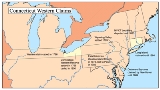
The New Haven Colony in 1641 in an agreement with the Lenape
Lenape
The Lenape are an Algonquian group of Native Americans of the Northeastern Woodlands. They are also called Delaware Indians. As a result of the American Revolutionary War and later Indian removals from the eastern United States, today the main groups live in Canada, where they are enrolled in the...

 tribe was to claim that it owned all the land east and west of the Delaware River
Delaware River
The Delaware River is a major river on the Atlantic coast of the United States.A Dutch expedition led by Henry Hudson in 1609 first mapped the river. The river was christened the South River in the New Netherland colony that followed, in contrast to the North River, as the Hudson River was then...

. The Colony was to set up the first settlement of any kind in modern Philadelphia. Residents of New Sweden
New Sweden
New Sweden was a Swedish colony along the Delaware River on the Mid-Atlantic coast of North America from 1638 to 1655. Fort Christina, now in Wilmington, Delaware, was the first settlement. New Sweden included parts of the present-day American states of Delaware, New Jersey, and Pennsylvania....

 and New Amsterdam
New Amsterdam
New Amsterdam was a 17th-century Dutch colonial settlement that served as the capital of New Netherland. It later became New York City....

 who lived in the area burned the community and it was disavowed by the Massachusetts Bay Colony
Massachusetts Bay Colony
The Massachusetts Bay Colony was an English settlement on the east coast of North America in the 17th century, in New England, situated around the present-day cities of Salem and Boston. The territory administered by the colony included much of present-day central New England, including portions...

. While New Haven was to retreat from the venture, the Lenape agreement was to form the basis of a Connecticut sea to sea claim of owning all the land east and west of the Delaware from the Atlantic Ocean to the Pacific Ocean.


Leaders


Thomas Hooker
Thomas Hooker
Thomas Hooker was a prominent Puritan colonial leader, who founded the Colony of Connecticut after dissenting with Puritan leaders in Massachusetts...

, a prominent Puritan minister, and Governor John Haynes
John Haynes
John Haynes , also sometimes spelled Haines, was a colonial magistrate and one of the founders of the Connecticut Colony...

 of the Massachusetts Bay Colony, who led 100 people to present day Hartford in 1636, are often considered the founders of the Connecticut colony. The sermon Hooker delivered to his congregation on the principles of government on May 31, 1638 influenced those who would write the Fundamental Orders of Connecticut
Fundamental Orders of Connecticut
The Fundamental Orders were adopted by the Connecticut Colony council on January 14, 1638/39 OS . The orders describe the government set up by the Connecticut River towns, setting its structure and powers....

 later that year. The Fundamental Orders may have been drafted by Roger Ludlow
Roger Ludlow
Roger Ludlow was one of the founders of the Colony of Connecticut. He was born in March 1590 in Dinton, Wiltshire, England. Roger was the second son of Sir Thomas Ludlow of Maiden Bradley, Wiltshire and Jane Pyle, sister of Sir Gabriel Pyle...

 of Windsor, the only trained lawyer living in Connecticut in the 1630s, and were transcribed into the official record by the secretary, Thomas Welles
Thomas Welles
Thomas Welles is the only man in Connecticut's history to hold all four top offices: governor, deputy governor, treasurer, and secretary. In 1639, he was elected as the first treasurer of the Colony of Connecticut, and from 1640–1649 served as the colony's secretary...

.

The Rev. John Davenport
John Davenport (clergyman)
John Davenport was an English puritan clergyman and co-founder of the American colony of New Haven.-Early life:Born in Manchester, Warwickshire, England to a wealthy family, Davenport was educated at Oxford University...

 and merchant Theophilus Eaton
Theophilus Eaton
Theophilus Eaton was a merchant, farmer, and Puritan colonial leader who was the co-founder and first governor of New Haven Colony, Connecticut.-Early life and first marriage:...

 are considered the founders of the New Haven Colony
New Haven Colony
The New Haven Colony was an English colonial venture in present-day Connecticut in North America from 1637 to 1662.- Quinnipiac Colony :A Puritan minister named John Davenport led his flock from exile in the Netherlands back to England and finally to America in the spring of 1637...

, which would be absorbed into Connecticut Colony in the 1660s.

In the colony's early years, the governor could not serve consecutive terms. Thus, for twenty years, the governorship often rotated between John Haynes and Edward Hopkins
Edward Hopkins
Edward Hopkins was an English colonist and politician and Governor of the Connecticut Colony. Active on both sides of the Atlantic, he was a founder of the New Haven and Connecticut colonies, serving seven one-year terms as governor of Connecticut. He returned to England in the 1650s, where he...

, both of whom were from Hartford. George Wyllys
George Wyllys
George Wyllys or Wyllis served for a year as one of the early governors of the Connecticut Colony.Born at the manor of Fenny Compton in Warwickshire, England, to Richard and Hester Willis, part of an old, wealthy family. His first cousins Thomas and Richard, were baronets of Fen Ditton,...

, Thomas Welles
Thomas Welles
Thomas Welles is the only man in Connecticut's history to hold all four top offices: governor, deputy governor, treasurer, and secretary. In 1639, he was elected as the first treasurer of the Colony of Connecticut, and from 1640–1649 served as the colony's secretary...

, and John Webster, also Hartford men, sat in the governor's chair for brief periods in the 1640s and 1650s.

John Winthrop, Jr. of New London
New London, Connecticut
New London is a seaport city and a port of entry on the northeast coast of the United States.It is located at the mouth of the Thames River in New London County, southeastern Connecticut....

, the son of the founder of the Massachusetts Bay Colony
Massachusetts Bay Colony
The Massachusetts Bay Colony was an English settlement on the east coast of North America in the 17th century, in New England, situated around the present-day cities of Salem and Boston. The territory administered by the colony included much of present-day central New England, including portions...

, played an important role in consolidating separate settlements on the Connecticut River into a single colony; and he served as Governor of Connecticut from 1659 to 1675. Winthrop was also instrumental in obtaining the colony's 1662 charter, which incorporated New Haven into Connecticut. His son, Fitz-John Winthrop
Fitz-John Winthrop
Fitz-John Winthrop was the governor of the Colony of Connecticut from 1698 to 1707....

, would also govern the colony for ten years, starting in 1698.

Roger Ludlow
Roger Ludlow
Roger Ludlow was one of the founders of the Colony of Connecticut. He was born in March 1590 in Dinton, Wiltshire, England. Roger was the second son of Sir Thomas Ludlow of Maiden Bradley, Wiltshire and Jane Pyle, sister of Sir Gabriel Pyle...

 was an Oxford-educated lawyer and former Deputy Governor of the Massachusetts Bay Colony who petitioned the General Court for rights to settle the area. Ludlow led the March Commission in settling disputes over land rights. He is credited as drafting the Fundamental Orders of Connecticut (1650) in collaboration with Hooker, Winthrop, and others. Ludlow was the first Deputy Governor of Connecticut.

William Leete
William Leete
Governor William Leete was Governor of the Colony of New Haven from 1661 to 1665 and Governor of the Colony of Connecticut from 1676 to 1683....

 of Guilford
Guilford, Connecticut
Guilford is a town in New Haven County, Connecticut, United States, that borders Madison, Branford, North Branford and Durham, and is situated on I-95 and the coast. The population was 21,398 at the 2000 census...

 served as governor of New Haven Colony before that colony's merger into Connecticut, and as governor of Connecticut following John Winthrop, Jr's death in 1675. He is the only man to serve as governor of both New Haven and Connecticut.

Robert Treat
Robert Treat
Robert Treat was an American colonial leader, militia officer and governor of Connecticut between 1683 and 1698....

 of Milford
Milford, Connecticut
Milford is a coastal city in southwestern New Haven County, Connecticut, United States, located between Bridgeport and New Haven. The population was 52,759 at the 2010 census...

 served as governor of the colony both prior to and after its inclusion in Sir Edmund Andros's Dominion of New England
Dominion of New England
The Dominion of New England in America was an administrative union of English colonies in the New England region of North America. The dominion was ultimately a failure because the area it encompassed was too large for a single governor to manage...

. His father, Richard Treat
Richard Treat
Richard Treat was an early New England settler and a Patentee of the Royal Charter of Connecticut, 1662-Early life and ancestors:...

, was one of the original patentees of the colony.

The colony enjoyed a string of strong governors in the 18th century, many being re-elected yearly until they died. Upon the death of Fitz-John Winthrop, Gurdon Saltonstall
Gurdon Saltonstall
Gurdon Saltonstall was governor of the Colony of Connecticut from 1708 to 1724...

, Winthrop's minister in New London, was elected governor. Saltonstall was the only minister to serve as governor of Connecticut, and he belies the common misconception that Puritan clergy could not hold political office. Upon Saltonstall's death, Deputy Governor Joseph Talcott
Joseph Talcott
Joseph Talcott was a governor of the Connecticut Colony from 1724 until his death in 1741. He was the first Connecticut-born governor of the colony. Descended from one Connecticut's founding settlers, Talcott was appointed an assistant in 1711...

 of Hartford became governor. Deputy Governor Jonathan Law
Jonathan Law
Jonathan Law was the 27th Governor of the Colony of Connecticut, serving in that office from 1741 until 1750. His term followed that of Joseph Talcott, governor from 1724 until 1741, and preceded that of Roger Wolcott, governor from 1750 until 1754.Law was born in Milford in what was then...

 of Milford succeeded to the position of governor upon Talcott's death. When Jonathan Law died, Deputy Governor Roger Wolcott
Roger Wolcott (Connecticut)
Roger Wolcott was an American weaver and statesman from Windsor, Connecticut. He served as colonial governor of Connecticut from 1751 to 1754.Roger was born to Simon and Martha Wolcott in Windsor, Connecticut...

 of Windsor became governor. Wolcott, the father of Declaration of Independence
Declaration of independence
A declaration of independence is an assertion of the independence of an aspiring state or states. Such places are usually declared from part or all of the territory of another nation or failed nation, or are breakaway territories from within the larger state...

 signer Oliver Wolcott, was voted out of office in 1754 for his role in the Spanish Ship Case. Wolcott's successor, Thomas Fitch of Norwalk
Norwalk, Connecticut
Norwalk is a city in Fairfield County, Connecticut, United States. According to the 2010 U.S. Census, the population of the city is 85,603, making Norwalk sixth in population in Connecticut, and third in Fairfield County...

, guided the colony through the Seven Years' War
Seven Years' War
The Seven Years' War was a global military war between 1756 and 1763, involving most of the great powers of the time and affecting Europe, North America, Central America, the West African coast, India, and the Philippines...

, but was, himself, voted out of office in 1766 for not being strong enough in his repudiation of the Stamp Act
Stamp Act
A stamp act is any legislation that requires a tax to be paid on the transfer of certain documents. Those that pay the tax receive an official stamp on their documents, making them legal documents. The taxes raised under a stamp act are called stamp duty. This system of taxation was first devised...

. William Pitkin
William Pitkin
William Pitkin was a colonial governor of the Connecticut Colony. Born to a politically prominent family in Hartford, he was first elected to the colonial assembly in 1728, where he served through 1734, the last two years as speaker of the house...

 of Hartford (now East Hartford), the man who defeated Fitch, was a leader in the Sons of Liberty
Sons of Liberty
The Sons of Liberty were a political group made up of American patriots that originated in the pre-independence North American British colonies. The group was formed to protect the rights of the colonists from the usurpations by the British government after 1766...

 and also the cousin of former governor Roger Wolcott. Pitkin died in office in 1769, and was replaced by Deputy Governor Jonathan Trumbull
Jonathan Trumbull
Jonathan Trumbull, Sr. was one of the few Americans who served as governor in both a pre-Revolutionary colony and a post-Revolutionary state...

, a merchant from Lebanon
Lebanon, Connecticut
Lebanon is a town in New London County, Connecticut, United States. The population was 6,907 at the 2000 census. The town lies just to the northwest of Norwich, north of New London, and east of Hartford...

. Trumbull, also a supporter of the Sons of Liberty, continued to be elected governor throughout the Revolutionary War and retired as governor in 1784, the year after the signing of the Treaty of Paris
Treaty of Paris (1783)
The Treaty of Paris, signed on September 3, 1783, ended the American Revolutionary War between Great Britain on the one hand and the United States of America and its allies on the other. The other combatant nations, France, Spain and the Dutch Republic had separate agreements; for details of...

 of 1783, which granted the United States its independence from Great Britain.

Role of religion


Like Massachusetts Bay Colony, Connecticut was founded by Puritans who made the Congregational Church
Congregational church
Congregational churches are Protestant Christian churches practicing Congregationalist church governance, in which each congregation independently and autonomously runs its own affairs....

 the established church in the colony. Tax revenues supported the local ministers, and colonists who failed to attend Sunday services were subject to fines. Until 1708, the Congregational Church was the only legal religion in Connecticut. That year, however, the colony recognized "sober dissent", and excused certain dissenters, notably Anglicans
Anglicanism
Anglicanism is a tradition within Christianity comprising churches with historical connections to the Church of England or similar beliefs, worship and church structures. The word Anglican originates in ecclesia anglicana, a medieval Latin phrase dating to at least 1246 that means the English...

 and Baptists, from paying taxes to support the state church, provided, of course, that they contributed to their own lawful dissenting church. Also in 1708, the colony adopted the Saybrook Platform
Saybrook Platform
Saybrook Platform refers to conservative religious proposals adopted at Saybrook, Connecticut in September 1708. The document attempted to stem the tide of disunity among the established Congregational churches and restore discipline among both the clergy and their congregations...

, which took church sovereignty away from the local congregations and placed it in the hands of a colony-wide consociation controlled by ministers.

In 1701, the General Assembly authorized the formation of the Collegiate School, with the mission of training new Congregational ministers in the colony. After locating in Killingworth
Killingworth, Connecticut
Killingworth is a town in Middlesex County, Connecticut, United States. The town's name can easily be confused with another Connecticut town, Killingly; or a Vermont ski area, Killington. The population was 6,018 at the 2000 census.-History:...

, Saybrook, and Wethersfield
Wethersfield, Connecticut
Wethersfield is a town in Hartford County, Connecticut, United States. Many records from colonial times spell the name Weathersfield, while Native Americans called it Pyquag...

, the school found a permanent home in New Haven in 1716. In 1718, following a substantial gift from Elihu Yale
Elihu Yale
Elihu Yale was a Welsh merchant and philanthropist, governor of the East India Company, and a benefactor of the Collegiate School of Connecticut, which in 1718 was named Yale College in his honour.- Life :...

, a wealthy English businessman who had been born in Boston
Boston
Boston is the capital of and largest city in Massachusetts, and is one of the oldest cities in the United States. The largest city in New England, Boston is regarded as the unofficial "Capital of New England" for its economic and cultural impact on the entire New England region. The city proper had...

, the institution's name was changed to Yale College
Yale University
Yale University is a private, Ivy League university located in New Haven, Connecticut, United States. Founded in 1701 in the Colony of Connecticut, the university is the third-oldest institution of higher education in the United States...

. In the early 1720s, religious controversy gripped Yale, as the school's rector, Rev. Timothy Cutler
Timothy Cutler
Timothy Cutler was an American Episcopal clergyman and rector of Yale College.-Family background:Cutler was born in Charlestown, Massachusetts, a descendant of Robert Cutler who settled there prior to October 28, 1636. His father was Major John Cutler, an anchorsmith, and his mother, Martha Wiswall...

, along with one of the tutors and two neighboring ministers were accused of converting to Anglicanism. Determined to enforce orthodoxy at the institution, in 1722 the school's trustees dismissed Rev. Cutler and the offending tutor, and adopted a resolution requiring that, in the future, all rectors and tutors must declare their assent to the Saybrook Platform.

The Great Awakening
First Great Awakening
The First Awakening was a Christian revitalization movement that swept Protestant Europe and British America, and especially the American colonies in the 1730s and 1740s, leaving a permanent impact on American religion. It resulted from powerful preaching that gave listeners a sense of personal...

 sent shock waves through the colony in the middle of the eighteenth century, ripping the Congregational Church apart. Those who embraced the Awakening were known as New Lights, while those opposed to it became known as Old Lights. Unhappy with the often unemotional services of their regular ministers, New Lights in many towns petitioned to form separate religious societies or churches. Often Old Lights would oppose these attempts, arguing that the New Lights were neither sober (because of the emotional nature of their services) nor dissenting (because they continued to be Congregationalists). In 1741, Old Lights who tried to suppress the Awakening succeeded in convincing the General Assembly to pass an Itineracy Law, which prohibited traveling ministers from preaching in a Connecticut town without an invitation from the town's minister. Many historians believe that this law was the spark that led to the creation of issue politics in the colony.

During the American Revolution
American Revolution
The American Revolution was the political upheaval during the last half of the 18th century in which thirteen colonies in North America joined together to break free from the British Empire, combining to become the United States of America...

 many of the colony's Anglicans, most of whom were concentrated in Fairfield County
Fairfield County, Connecticut
Fairfield County is a county located in the southwestern corner of the U.S. state of Connecticut. The county population is 916,829 according to the 2010 Census. There are currently 1,465 people per square mile in the county. It is the most populous county in the State of Connecticut and contains...

, remained Loyalists
Loyalist (American Revolution)
Loyalists were American colonists who remained loyal to the Kingdom of Great Britain during the American Revolutionary War. At the time they were often called Tories, Royalists, or King's Men. They were opposed by the Patriots, those who supported the revolution...

. One Anglican, Moses Dunbar of Bristol
Bristol, Connecticut
Bristol is a suburban city located in Hartford County, Connecticut, United States southwest of Hartford. According to 2006 Census Bureau estimates, the population of the city is 61,353. Bristol is primarily known as the home of ESPN, whose central studios are in the city. Bristol is also home to...

, was convicted of treason
Treason
In law, treason is the crime that covers some of the more extreme acts against one's sovereign or nation. Historically, treason also covered the murder of specific social superiors, such as the murder of a husband by his wife. Treason against the king was known as high treason and treason against a...

 and hanged for being a Loyalist.

Congregationalism remained the established church in Connecticut throughout the Revolutionary Period, although, with time, more denominations were exempted as "sober dissenting" churches. With the adoption of Connecticut's 1818 state constitution, the Congregational Church was disestablished.

See also

  • History of Connecticut
    History of Connecticut
    The U.S. state of Connecticut began as three distinct settlements, referred to at the time as "Colonies" or "Plantations". These ventures were eventually combined under a single royal charter in 1662.-Colonies in Connecticut:...

  • Pequot War
    Pequot War
    The Pequot War was an armed conflict between 1634–1638 between the Pequot tribe against an alliance of the Massachusetts Bay, Plymouth, and Saybrook colonies who were aided by their Native American allies . Hundreds were killed; hundreds more were captured and sold into slavery to the West Indies. ...

  • King Philip's War
    King Philip's War
    King Philip's War, sometimes called Metacom's War, Metacomet's War, or Metacom's Rebellion, was an armed conflict between Native American inhabitants of present-day southern New England and English colonists and their Native American allies in 1675–76. The war is named after the main leader of the...

  • List of colonial governors of Connecticut

External links