

Suburito

Encyclopedia
Bokken
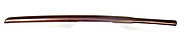
A bokken , "wood", and ken, "sword") , is a Japanese wooden sword used for training. It is usually the size and shape of a katana, but is sometimes shaped like other swords, such as the wakizashi and tantō...
) or an actual Japanese sword.
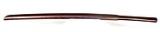
The suburitō is used for practicing suburi
Suburi
is a Japanese word which is used to describe practice swings used in sports such as baseball, tennis, golf, and in martial arts. Outside of Japan, the word is used exclusively for repetitive individual cutting exercises used in Japanese martial arts such as kendo, aikido, iaidō, and kenjutsu. Often...
(sword swinging exercises) and kata
Kata
is a Japanese word describing detailed choreographed patterns of movements practised either solo or in pairs. The term form is used for the corresponding concept in non-Japanese martial arts in general....
(prearanged exercises). The weight of the suburitō is used for strengthening and conditioning in addition to development of spirit. The suburitō is used to perfect individual technique as well.
A suburitō is commonly around 115 cm (45 in) in length, with a mass of 1 kg (2.2 lb). However, these bokuto can vary widely in size and weight. Suburitō generally do not include a guard.
Legend has it that Miyamoto Musashi
Miyamoto Musashi
, also known as Shinmen Takezō, Miyamoto Bennosuke or, by his Buddhist name, Niten Dōraku, was a Japanese swordsman and rōnin. Musashi, as he was often simply known, became renowned through stories of his excellent swordsmanship in numerous duels, even from a very young age...
carved a suburitō out of a boat oar
Oar
An oar is an implement used for water-borne propulsion. Oars have a flat blade at one end. Oarsmen grasp the oar at the other end. The difference between oars and paddles are that paddles are held by the paddler, and are not connected with the vessel. Oars generally are connected to the vessel by...
as he traveled to his famous duel with Sasaki Kojiro
Sasaki Kojiro
was a prominent Japanese swordsman widely considered as a Kensei, born in Fukui Prefecture. He lived during the Sengoku and early Edo periods and is most remembered for his death while battling Miyamoto Musashi in 1612.-History:...
, whom he supposedly killed.