

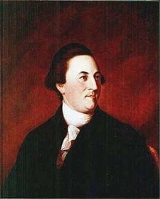
William Paca

Encyclopedia
William Paca was a signatory to the United States
Declaration of Independence
as a representative of Maryland
, and later Governor of Maryland
and a United States federal judge
.
, Harford County
, in the British colony of Maryland
. He was the child of John Paca (c.1712-1785), a wealthy planter in the area, and his wife Elizabeth Smith (?-c.1766). He was the second son of the family, after his elder brother Aquila, and had five sisters. The brothers entered school at the Philadelphia Academy and Charity School in 1752, and the younger Paca went on to attend the The College of Philadelphia (now merged into and known as the University of Pennsylvania
), graduating in 1759 with a bachelor of arts degree. He was also to receive a master of arts degree from the College in 1762, though this required no further study, only that Paca request it and be in good standing.
After graduating from college, Paca returned to Maryland, reading law
in the colonial capital of Annapolis under the tutelage of a local lawyer named Stephen Bordley. By 1761, he was licensed to practice law, and in 1764 was admitted to the provincial bar, having stayed in Annapolis to establish his practice. Professional success was mingled with personal success, as the previous year he had courted Mary Chew, the daughter of a prominent Maryland planter, and they were married on May 26, 1763. They would go on to have three children, though only their son John Philemon survived into adulthood.
, who would become a close friend and political colleague of Paca. Together, Paca and Chase led local opposition to the British Stamp Act of 1765 and established the Anne Arundel County
chapter of the Sons of Liberty
.
He was elected to the Maryland legislature in 1771 and appointed to the Continental Congress
in 1774. He was reelected, serving until 1779, when he became chief justice of the state of Maryland. In 1782 he was elected governor of Maryland. On December 22, 1789, Paca received a recess appointment
from President George Washington
to a seat on the newly created United States District Court for the District of Maryland
, created by 1 Stat. 73. Formally nominated on February 8, 1790, he was confirmed by the United States Senate
on February 10, 1790, and received his commission the same day, serving as such until his death.
Paca died in 1799 at his estate of Wye Hall
in Queen Anne's County, Maryland
and was buried in the family cemetery there.
, one is in Baltimore city (#83) and the other in his home town of Abingdon
. Paca Street in Baltimore
bears his name as does a dormitory on the campus of St. John's College in Annapolis as well as one on the campus of Towson University
. Outside of Maryland, William Paca Middle School
in Mastic Beach, New York
; and P.S. 155 William Paca School in New York City
are also named after him. In August 2008 the William Paca House was added as a new residence hall in Towson University.
His Annapolis home, the Paca House and Garden
, was added to the National Register of Historic Places
and designated a National Historic Landmark
in 1971.
.
According to Stanley South, "[t]he rumor that the name was Italian came from a remark made in 1911 by Cardinal James Gibbons of Baltimore, who commented that he thought a relationship existed between Paca and the Italian family Pecci". In a July 18, 1937, letter to the New York Times, a self-described descendant of Paca claims:
However, in an interview with Giovanni Schiavo, the letter writer apparently attributed the suggestion that the name was Pecci to Cardinal Gibbons. Schiavo also reports that Paca mentioned Pope Leo XIII (1879–1903), whose surname was Pecci, during the interview. Stiverson and Jacobsen report that spellings of the surname of William Paca's immigrant ancestor Robert include Peaker, Pecker, Peaca, Peca, and Paka. Neither "Pecci" nor "Pacci" (nor "Pacca") are attested.
Caso, p.57 and Welsh, They Too Made America Great; Branden Books, 1978. This history includes a detailed exploration and affirmation of the well established Italian origin of the Paca family of Maryland in response to the earlier Stiverson and Jacobsen text.
United States
The United States of America is a federal constitutional republic comprising fifty states and a federal district...
Declaration of Independence
United States Declaration of Independence
The Declaration of Independence was a statement adopted by the Continental Congress on July 4, 1776, which announced that the thirteen American colonies then at war with Great Britain regarded themselves as independent states, and no longer a part of the British Empire. John Adams put forth a...
as a representative of Maryland
Maryland
Maryland is a U.S. state located in the Mid Atlantic region of the United States, bordering Virginia, West Virginia, and the District of Columbia to its south and west; Pennsylvania to its north; and Delaware to its east...
, and later Governor of Maryland
Governor of Maryland
The Governor of Maryland heads the executive branch of the government of Maryland, and he is the commander-in-chief of the state's National Guard units. The Governor is the highest-ranking official in the state, and he has a broad range of appointive powers in both the State and local governments,...
and a United States federal judge
United States federal judge
In the United States, the title of federal judge usually means a judge appointed by the President of the United States and confirmed by the United States Senate in accordance with Article II of the United States Constitution....
.
Early life
William Paca was born in AbingdonAbingdon, Maryland
Abingdon is an unincorporated community in Harford County, Maryland, United States. It lies 25 miles northeast of Baltimore, near the Bush River.- History :Abingdon was named after Abingdon, England....
, Harford County
Harford County, Maryland
Harford County is a county in the U.S. state of Maryland. In 2010, its population was 244,826. Its county seat is Bel Air. Harford County forms part of the Baltimore-Washington Metropolitan Area.-History:...
, in the British colony of Maryland
Province of Maryland
The Province of Maryland was an English and later British colony in North America that existed from 1632 until 1776, when it joined the other twelve of the Thirteen Colonies in rebellion against Great Britain and became the U.S...
. He was the child of John Paca (c.1712-1785), a wealthy planter in the area, and his wife Elizabeth Smith (?-c.1766). He was the second son of the family, after his elder brother Aquila, and had five sisters. The brothers entered school at the Philadelphia Academy and Charity School in 1752, and the younger Paca went on to attend the The College of Philadelphia (now merged into and known as the University of Pennsylvania
University of Pennsylvania
The University of Pennsylvania is a private, Ivy League university located in Philadelphia, Pennsylvania, United States. Penn is the fourth-oldest institution of higher education in the United States,Penn is the fourth-oldest using the founding dates claimed by each institution...
), graduating in 1759 with a bachelor of arts degree. He was also to receive a master of arts degree from the College in 1762, though this required no further study, only that Paca request it and be in good standing.
After graduating from college, Paca returned to Maryland, reading law
Reading law
Reading law is the method by which persons in common law countries, particularly the United States, entered the legal profession before the advent of law schools. This usage specifically refers to a means of entering the profession . A small number of U.S...
in the colonial capital of Annapolis under the tutelage of a local lawyer named Stephen Bordley. By 1761, he was licensed to practice law, and in 1764 was admitted to the provincial bar, having stayed in Annapolis to establish his practice. Professional success was mingled with personal success, as the previous year he had courted Mary Chew, the daughter of a prominent Maryland planter, and they were married on May 26, 1763. They would go on to have three children, though only their son John Philemon survived into adulthood.
Political career
Among the other young lawyers in Annapolis at the time was Samuel ChaseSamuel Chase
Samuel Chase was an Associate Justice of the United States Supreme Court and earlier was a signatory to the United States Declaration of Independence as a representative of Maryland. Early in life, Chase was a "firebrand" states-righter and revolutionary...
, who would become a close friend and political colleague of Paca. Together, Paca and Chase led local opposition to the British Stamp Act of 1765 and established the Anne Arundel County
Anne Arundel County, Maryland
Anne Arundel County is a county located in the U.S. state of Maryland. It is named for Anne Arundell , a member of the ancient family of Arundells in Cornwall, England and the wife of Cæcilius Calvert, 2nd Baron Baltimore. Its county seat is Annapolis, which is also the capital of the state...
chapter of the Sons of Liberty
Sons of Liberty
The Sons of Liberty were a political group made up of American patriots that originated in the pre-independence North American British colonies. The group was formed to protect the rights of the colonists from the usurpations by the British government after 1766...
.
He was elected to the Maryland legislature in 1771 and appointed to the Continental Congress
Continental Congress
The Continental Congress was a convention of delegates called together from the Thirteen Colonies that became the governing body of the United States during the American Revolution....
in 1774. He was reelected, serving until 1779, when he became chief justice of the state of Maryland. In 1782 he was elected governor of Maryland. On December 22, 1789, Paca received a recess appointment
Recess appointment
A recess appointment is the appointment, by the President of the United States, of a senior federal official while the U.S. Senate is in recess. The U.S. Constitution requires that the most senior federal officers must be confirmed by the Senate before assuming office, but while the Senate is in...
from President George Washington
George Washington
George Washington was the dominant military and political leader of the new United States of America from 1775 to 1799. He led the American victory over Great Britain in the American Revolutionary War as commander-in-chief of the Continental Army from 1775 to 1783, and presided over the writing of...
to a seat on the newly created United States District Court for the District of Maryland
United States District Court for the District of Maryland
The United States District Court for the District of Maryland is the Federal district court whose jurisdiction is the state of Maryland....
, created by 1 Stat. 73. Formally nominated on February 8, 1790, he was confirmed by the United States Senate
United States Senate
The United States Senate is the upper house of the bicameral legislature of the United States, and together with the United States House of Representatives comprises the United States Congress. The composition and powers of the Senate are established in Article One of the U.S. Constitution. Each...
on February 10, 1790, and received his commission the same day, serving as such until his death.
Paca died in 1799 at his estate of Wye Hall
Wye River (plantation)
The Wye River plantation, or Wye Hall was the Eastern Shore of Maryland home of William Paca, constructed in 1765, and extensively renovated in 1790 by John Paca, with Joseph Clark as architect, at a cost of $20,000. He gained ownership of the property in Queen Anne's County, Maryland, through his...
in Queen Anne's County, Maryland
Queen Anne's County, Maryland
Queen Anne's County is a county located on the Eastern Shore of the U.S. state of Maryland.As of 2010, the population was 47,798. Its county seat and most populous municipality is Centreville. The census-designated place of Stevensville is the county's most populous place...
and was buried in the family cemetery there.
Legacy
In Maryland, three elementary schools are named for him: one is in LandoverLandover, Maryland
Landover is an unincorporated community in Prince George's County, Maryland, United States, within the census-designated place of Greater Landover. The Prince Georges County Sports and Learning Complex is in Landover...
, one is in Baltimore city (#83) and the other in his home town of Abingdon
Abingdon, Maryland
Abingdon is an unincorporated community in Harford County, Maryland, United States. It lies 25 miles northeast of Baltimore, near the Bush River.- History :Abingdon was named after Abingdon, England....
. Paca Street in Baltimore
Baltimore
Baltimore is the largest independent city in the United States and the largest city and cultural center of the US state of Maryland. The city is located in central Maryland along the tidal portion of the Patapsco River, an arm of the Chesapeake Bay. Baltimore is sometimes referred to as Baltimore...
bears his name as does a dormitory on the campus of St. John's College in Annapolis as well as one on the campus of Towson University
Towson University
Towson University, often referred to as TU or simply Towson for short, is a public university located in Towson in Baltimore County, Maryland, U.S...
. Outside of Maryland, William Paca Middle School
William Floyd School District
The William Floyd School District, located in southern Brookhaven, New York, serves the nearby communities of Shirley, Mastic, Mastic Beach, as well as Moriches. New York state is located in the U.S.A..Paul Casciano, Ed.D., is the superintendent of schools....
in Mastic Beach, New York
Mastic Beach, New York
Mastic Beach is a village in the southeast part of the Town of Brookhaven in Suffolk County, New York, United States. The population was 11,543 at the 2000 census. The CDP is located in the general vicinity of the hamlet of Mastic Beach....
; and P.S. 155 William Paca School in New York City
New York City
New York is the most populous city in the United States and the center of the New York Metropolitan Area, one of the most populous metropolitan areas in the world. New York exerts a significant impact upon global commerce, finance, media, art, fashion, research, technology, education, and...
are also named after him. In August 2008 the William Paca House was added as a new residence hall in Towson University.
His Annapolis home, the Paca House and Garden
Paca House and Garden
The William Paca House is an 18th century Georgian mansion in Annapolis, Maryland, United States. William Paca was a signatory of the Declaration of Independence and a three-term Governor of Maryland. The house was built between 1763 and 1765 and its architecture was largely designed by Paca himself...
, was added to the National Register of Historic Places
National Register of Historic Places
The National Register of Historic Places is the United States government's official list of districts, sites, buildings, structures, and objects deemed worthy of preservation...
and designated a National Historic Landmark
National Historic Landmark
A National Historic Landmark is a building, site, structure, object, or district, that is officially recognized by the United States government for its historical significance...
in 1971.
Ancestry
Paca has been described as being of Italian ancestryItalian American
An Italian American , is an American of Italian ancestry. The designation may also refer to someone possessing Italian and American dual citizenship...
.
According to Stanley South, "[t]he rumor that the name was Italian came from a remark made in 1911 by Cardinal James Gibbons of Baltimore, who commented that he thought a relationship existed between Paca and the Italian family Pecci". In a July 18, 1937, letter to the New York Times, a self-described descendant of Paca claims:
The ancestors of William Paca were of Italian and English origin. The name is said to have originally been spelled Pacci [sic].
However, in an interview with Giovanni Schiavo, the letter writer apparently attributed the suggestion that the name was Pecci to Cardinal Gibbons. Schiavo also reports that Paca mentioned Pope Leo XIII (1879–1903), whose surname was Pecci, during the interview. Stiverson and Jacobsen report that spellings of the surname of William Paca's immigrant ancestor Robert include Peaker, Pecker, Peaca, Peca, and Paka. Neither "Pecci" nor "Pacci" (nor "Pacca") are attested.
- Colonial families of MarylandColonial families of MarylandThe Colonial families of Maryland were the leading families in the Province of Maryland. Several also had interests in the Colony of Virginia, and the two are sometimes referred to as the Chesapeake Colonies. Many of the early settlers came from the West Midlands in England, although the Maryland...
Caso, p.57 and Welsh, They Too Made America Great; Branden Books, 1978. This history includes a detailed exploration and affirmation of the well established Italian origin of the Paca family of Maryland in response to the earlier Stiverson and Jacobsen text.