


TSI slant

Encyclopedia
Hydrogen sulfide
Hydrogen sulfide is the chemical compound with the formula . It is a colorless, very poisonous, flammable gas with the characteristic foul odor of expired eggs perceptible at concentrations as low as 0.00047 parts per million...
. It is often used in the selective identification of enteric bacteria including but not limited to Salmonella
Salmonella
Salmonella is a genus of rod-shaped, Gram-negative, non-spore-forming, predominantly motile enterobacteria with diameters around 0.7 to 1.5 µm, lengths from 2 to 5 µm, and flagella which grade in all directions . They are chemoorganotrophs, obtaining their energy from oxidation and reduction...
and Shigella
Shigella
Shigella is a genus of Gram-negative, nonspore forming, non-motile, rod-shaped bacteria closely related to Escherichia coli and Salmonella. The causative agent of human shigellosis, Shigella causes disease in primates, but not in other mammals. It is only naturally found in humans and apes. During...
.
Composition
The TSI slant is a test tube that contains agarAgar
Agar or agar-agar is a gelatinous substance derived from a polysaccharide that accumulates in the cell walls of agarophyte red algae. Throughout history into modern times, agar has been chiefly used as an ingredient in desserts throughout Asia and also as a solid substrate to contain culture medium...
, a pH-sensitive dye (phenol red
Phenol red
Phenol red is a pH indicator that is frequently used in cell biology laboratories.-Chemical structure and properties:...
), 1% lactose
Lactose
Lactose is a disaccharide sugar that is found most notably in milk and is formed from galactose and glucose. Lactose makes up around 2~8% of milk , although the amount varies among species and individuals. It is extracted from sweet or sour whey. The name comes from or , the Latin word for milk,...
, 1% sucrose
Sucrose
Sucrose is the organic compound commonly known as table sugar and sometimes called saccharose. A white, odorless, crystalline powder with a sweet taste, it is best known for its role in human nutrition. The molecule is a disaccharide composed of glucose and fructose with the molecular formula...
, 0.1% glucose
Glucose
Glucose is a simple sugar and an important carbohydrate in biology. Cells use it as the primary source of energy and a metabolic intermediate...
, as well as sodium thiosulfate
Sodium thiosulfate
Sodium thiosulfate , also spelled sodium thiosulphate, is a colorless crystalline compound that is more familiar as the pentahydrate, Na2S2O3•5H2O, an efflorescent, monoclinic crystalline substance also called sodium hyposulfite or “hypo.”...
and ferrous sulfate or ferrous ammonium sulfate.
All of these ingredients are mixed together and allowed to solidify in the test tube at a slanted angle. The slanted shape of this medium provides an array of surfaces that are either exposed to oxygen-containing air in varying degrees (an aerobic environment) or not exposed to air (an anaerobic environment).
TSI agar medium was developed based on Kligler's iron agar, which had been used for the determination of lactose fermentative bacteria, by addition of sucrose to be able to detect sucrose fermentative bacteria also.
Interpretation of results
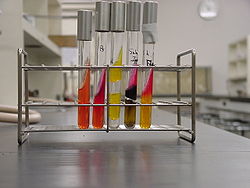
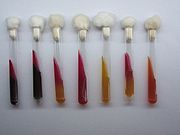
Bacteria that ferment any of the three sugars in the medium will produce byproducts. These byproducts are usually acids, which will change the color of the red pH-sensitive dye (phenol red) to a yellow color. Position of the color change distinguishes the acid production associated with glucose fermentation from the acidic byproducts of lactose or sucrose fermentation. Many bacteria that can ferment sugars in the anaerobic butt of the tube are enterobacteria.Some bacteria utilize thiosulfate anion as a terminal electron acceptor, reducing it to sulfide. If this occurs, the newly-formed hydrogen sulfide
Hydrogen sulfide
Hydrogen sulfide is the chemical compound with the formula . It is a colorless, very poisonous, flammable gas with the characteristic foul odor of expired eggs perceptible at concentrations as low as 0.00047 parts per million...
reacts with ferrous sulfate in the medium to form ferrous sulfide, which is visible as a black precipitate. Examples of sulfide-producing bacteria include Salmonella
Salmonella
Salmonella is a genus of rod-shaped, Gram-negative, non-spore-forming, predominantly motile enterobacteria with diameters around 0.7 to 1.5 µm, lengths from 2 to 5 µm, and flagella which grade in all directions . They are chemoorganotrophs, obtaining their energy from oxidation and reduction...
, Proteus
Proteus
In Greek mythology, Proteus is an early sea-god, one of several deities whom Homer calls the "Old Man of the Sea", whose name suggests the "first" , as protogonos is the "primordial" or the "firstborn". He became the son of Poseidon in the Olympian theogony In Greek mythology, Proteus (Πρωτεύς)...
, Citrobacter
Citrobacter
Citrobacter is a genus of Gram-negative coliform bacteria in the Enterobacteriaceae family.The species C. amalonaticus, C. koseri, and C. freundii use solely citrate as a carbon source...
and Edwardsiella
Edwardsiella
Edwardsiella is a Gram negative, fermentative bacteria of the family Enterobacteriaceae. It was first discovered in snakes in 1962.----Associated persons:Philip R. EdwardsDescription:...
species. The blackening of the medium is almost always observed in the butt (bottom) of the medium.
All lactose fermenters result in yellow slant/yellow butt (acid/acid reaction), whereas non-lactose fermenters may result in pink/yellow or yellow/yellow (if sucrose is fermented). Blackening of the butt due to H2S production may mask the acid reaction (yellow) in the butt. Salmonella enterica
Salmonella enterica
Salmonella enterica is a rod-shaped flagellated, facultative anaerobic, Gram-negative bacterium, and a member of the genus Salmonella.- Epidemiology :...
serovar Typhi may result in blackening of the medium at the interface of butt and slant.
Hydrogen production
Hydrogen production is the family of industrial methods for generating hydrogen. Currently the dominant technology for direct production is steam reforming from hydrocarbons. Many other methods are known including electrolysis and thermolysis...
may lift the agar from the butt of the tube or fracture the agar. Carbon dioxide, if produced, may not show as bubbles because it is far more soluble in the medium.