


Saint Canice

Encyclopedia
Saint Cainnech of Aghaboe (515/16–600), also known as Saint Canice in Ireland
, Saint Kenneth in Scotland
, Saint Kenny and in Latin
Saint Canicus, was a gaelic
abbot, monastic founder, priest and missionary during the early medieval period
. Cainnech is one of the Twelve Apostles of Ireland
and preached Christianity
across Ireland and to the Picts in Scotland. He wrote a commentary on the Gospel
s, which for centuries was known as the Glas-Choinnigh or the Chain of Cainnech.
Most of what is written about Cainnech's life is based on tradition, however he was considered a man of virtue, great eloquence and learning. His feast day is commemorated on 11 October in the Roman Catholic Church
and on the 1 or 14 August in the Eastern Orthodox Church
.
who died in 704. Adomnán was a hagiographer and his greatest work Vita Columbae or Life of St. Columba contains references to Cainnech. His commentary on the Gospel
s, was known for centuries as the Glas-Choinnigh or the Chain of Cainnech.
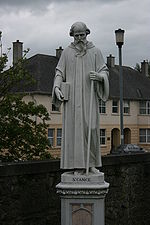 Cainnech was born in 515 or 516, at Glengiven, near Dungiven
in Ireland. He died and was reposed at Aghaboe
in 599/600. His real name was Cainnech moccu Dalánn.
Cainnech's father Lughadh Leithdhearg was descended from the CorcoDalann or Ui Dalainn, a tribe whose ancestor, Dalann, is traced back to Fergus (King of Ulster
), son of Ross, son of Rudhraighe.
The Corco-Dalann were from an island referred to as "Insula Nuligi", and is usually identified with Inis-Doimhle or Inis-Uladh, which is now the Little Island, in the River Suir, south-east of Waterford
.
Lughadh was a distinguished bard
,a professional highly trained, learned poet. As with many men of the bard class, Lughadh travelled and wandered throughout the country at the time. Lughadh settled at Glengiven, in what is now County Londonderry
. Lughadh ended up under the favour and protection of the chief of Cianachta. Lughadh became the tutor of the chieftain's son, Geal Breagach.
Cainnech's mother was called Maul or Mella. She attained an eminent degree of sanctity. The church of Thompleamoul or Capella Sanctae Maulae seu Mellae, beside Kilkenny city, was dedicated to God under her invocation.
 Cainnech spent his early years watching his chieftain's flocks.
In early Christian Ireland the druid tradition collapsed, with the spread of the new faith. Study of Latin
learning and Christian theology in monasteries flourished. In 543 sensing a higher calling, Cainnech became a pupil at the monastic school at Clonard
. During the sixth century, some of the most significant names in the history of Irish Christianity
studied at the Clonard monastery. It is said that the average number of scholars under instruction at Clonard was 3,000. Twelve students who studied under St. Finian
became known as the Twelve Apostles of Ireland
, Cainnech was one of these. It was at Clonard that Cainnech became a friend and companion of St Colmcille.
In 544 he was studying in the school of Glasnevin
, with St. Kieran of Clonmacnoise
and St. Comgall of Bangor
, under the tuition of St. Mobhi.
When plague scattered that community, he went as a monk to the monastery of Llancarfan
in Glamorganshire in Wales
, under Saint Cadoc. He was ordained a priest there in 545.
He left for Rome
to obtain the blessing of the reigning pontiff. In 550 he had returned to Glengiven, where he converted his foster-brother, Geal-Breagach, who afterwards assisted him in founding Drumachose, in nearby Limavady
.
Cainnech was known as St. Kenneth, and was closely associated with St. Columba's missionary work.
Adamnan tells of the arrival of Cainnech, on Iona. St. Columba had a prophecy of a "certain holy and excellent man, who will arrive here among us before evening." God had provided Cainnech with a safe and calm crossing, even though the sea was perilous and stormy that day. St. Columba received him that evening with all honour and hospitality.
Cainnech built a church in the place now known as Saint Andrews. Cainnech's name is still recalled in the ruins of an ancient church, Kil-Chainnech on Tiree
Island, in a burial ground, Kil-Chainnech, in Iona
and Inch Kenneth
off Mull
.
Cainnech built monastic cells on the island of Ibdon and Eninis, an oratory called Lagan-Kenny on the shores of Loch Laggan
(the remains of which are marked on the OS map), and a monastery in Fife
on the banks of the Eden.
and Ossory
in what is now County Laois
. In Ossory he had a good repute with the king, Colmann son of Feradach. Colman gave him grants of land including Aghaboe("the field of the Ox") which became his principle monastery. He founded a monastery and Abbey of Aghaboe
. Aghaboe grew in importance, and in the 7th century it sent St Feargal as a missionary to the church of Salzburg. Aghaboe become for a time the site of the bishop's see until under Norman influence in the twelfth century the see transferred from Aghaboe to Kilkenny. In 1346 Diarmaid Mac Giollaphádraig burned the town of Aghaboe and the cemetery and church, and completely destroyed Cainnech's shrine along with Cainnech's bones and relics.
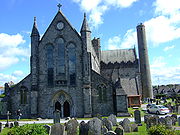 Kilkenny
(Irish: Cill Chainnigh "The Church of Cainnech") was originally the name of a church erected by or dedicated to Cainnech, but was afterwards extended to the townland and parish. Kilkenny was one of the last parts of Ireland to be converted to Christianity
. Tradition asserts that in 597, Cainnech led a Christian force to Kilkenny to eliminate the last bastion of Druidic rule in Ireland. The last Archdruid of Ireland had retired with his Council to a mound in Kilkenny for safety. Cainnech led an army there and overcame them. He founded a monastery near what is now the Church of Ireland's
St. Canice's Cathedral. St Cainnech of Aghaboe is the secondary patron of Kilkenny.
of St Cainnech.
In honour thou dost rank with Ireland's Enlightener,
O Lover of the Desert, Composer of sacred verse,
Father of Monks and Founder of Monasteries, O Father Cainnech.
Labouring for Christ, both in thy native land and in Scotland,
thou art a tireless intercessor for the faithful.
Pray for us who hymn thee, that despite our frailty we may be granted great mercy.
Ireland
Ireland is an island to the northwest of continental Europe. It is the third-largest island in Europe and the twentieth-largest island on Earth...
, Saint Kenneth in Scotland
Scotland
Scotland is a country that is part of the United Kingdom. Occupying the northern third of the island of Great Britain, it shares a border with England to the south and is bounded by the North Sea to the east, the Atlantic Ocean to the north and west, and the North Channel and Irish Sea to the...
, Saint Kenny and in Latin
Latin
Latin is an Italic language originally spoken in Latium and Ancient Rome. It, along with most European languages, is a descendant of the ancient Proto-Indo-European language. Although it is considered a dead language, a number of scholars and members of the Christian clergy speak it fluently, and...
Saint Canicus, was a gaelic
Gaels
The Gaels or Goidels are speakers of one of the Goidelic Celtic languages: Irish, Scottish Gaelic, and Manx. Goidelic speech originated in Ireland and subsequently spread to western and northern Scotland and the Isle of Man....
abbot, monastic founder, priest and missionary during the early medieval period
Early Middle Ages
The Early Middle Ages was the period of European history lasting from the 5th century to approximately 1000. The Early Middle Ages followed the decline of the Western Roman Empire and preceded the High Middle Ages...
. Cainnech is one of the Twelve Apostles of Ireland
Twelve Apostles of Ireland
The Twelve Apostles of Ireland were twelve early Irish monastic saints of the sixth century who studied under St Finian at his famous monastic school Clonard Abbey at Cluain-Eraird , now Clonard in County Meath.-Dá apstol décc na hÉrenn:The twelve saints are grouped together as such in the text Dá...
and preached Christianity
Christianity
Christianity is a monotheistic religion based on the life and teachings of Jesus as presented in canonical gospels and other New Testament writings...
across Ireland and to the Picts in Scotland. He wrote a commentary on the Gospel
Gospel
A gospel is an account, often written, that describes the life of Jesus of Nazareth. In a more general sense the term "gospel" may refer to the good news message of the New Testament. It is primarily used in reference to the four canonical gospels of Matthew, Mark, Luke, and John...
s, which for centuries was known as the Glas-Choinnigh or the Chain of Cainnech.
Most of what is written about Cainnech's life is based on tradition, however he was considered a man of virtue, great eloquence and learning. His feast day is commemorated on 11 October in the Roman Catholic Church
Roman Catholic Church
The Catholic Church, also known as the Roman Catholic Church, is the world's largest Christian church, with over a billion members. Led by the Pope, it defines its mission as spreading the gospel of Jesus Christ, administering the sacraments and exercising charity...
and on the 1 or 14 August in the Eastern Orthodox Church
Eastern Orthodox Church
The Orthodox Church, officially called the Orthodox Catholic Church and commonly referred to as the Eastern Orthodox Church, is the second largest Christian denomination in the world, with an estimated 300 million adherents mainly in the countries of Belarus, Bulgaria, Cyprus, Georgia, Greece,...
.
Introduction
A lot of what we know of Cainnech comes from legend. However, he is documented by Saint Adomnán (also known as Eunan), the ninth the abbot of IonaIona
Iona is a small island in the Inner Hebrides off the western coast of Scotland. It was a centre of Irish monasticism for four centuries and is today renowned for its tranquility and natural beauty. It is a popular tourist destination and a place for retreats...
who died in 704. Adomnán was a hagiographer and his greatest work Vita Columbae or Life of St. Columba contains references to Cainnech. His commentary on the Gospel
Gospel
A gospel is an account, often written, that describes the life of Jesus of Nazareth. In a more general sense the term "gospel" may refer to the good news message of the New Testament. It is primarily used in reference to the four canonical gospels of Matthew, Mark, Luke, and John...
s, was known for centuries as the Glas-Choinnigh or the Chain of Cainnech.
Cainnech's background
Dungiven
Dungiven is a small town and townland in County Londonderry, Northern Ireland. It is on the main A6 Belfast to Derry road. It lies where the rivers Roe, Owenreagh and Owenbeg meet at the foot of the Benbradagh. Nearby is the Glenshane Pass, where the road rises to over...
in Ireland. He died and was reposed at Aghaboe
Aghaboe
Aghaboe is a village and parish in County Laois, Ireland. It is located on the R434 regional road in the rural hinterland west of the town of Abbeyleix....
in 599/600. His real name was Cainnech moccu Dalánn.
Cainnech's father Lughadh Leithdhearg was descended from the CorcoDalann or Ui Dalainn, a tribe whose ancestor, Dalann, is traced back to Fergus (King of Ulster
Kings of Ulster
The Kings of Ulster were of the Ulaid, and up till about AD 450, ruled as over-kings of the ancient cóiced of Ulster. Ptolemy's map shows them as the Voluntii and adjacent Darini. They were joined in the kingship by the later attested Cruithne...
), son of Ross, son of Rudhraighe.
The Corco-Dalann were from an island referred to as "Insula Nuligi", and is usually identified with Inis-Doimhle or Inis-Uladh, which is now the Little Island, in the River Suir, south-east of Waterford
Waterford
Waterford is a city in the South-East Region of Ireland. It is the oldest city in the country and fifth largest by population. Waterford City Council is the local government authority for the city and its immediate hinterland...
.
Lughadh was a distinguished bard
Bard
In medieval Gaelic and British culture a bard was a professional poet, employed by a patron, such as a monarch or nobleman, to commemorate the patron's ancestors and to praise the patron's own activities.Originally a specific class of poet, contrasting with another class known as fili in Ireland...
,a professional highly trained, learned poet. As with many men of the bard class, Lughadh travelled and wandered throughout the country at the time. Lughadh settled at Glengiven, in what is now County Londonderry
County Londonderry
The place name Derry is an anglicisation of the old Irish Daire meaning oak-grove or oak-wood. As with the city, its name is subject to the Derry/Londonderry name dispute, with the form Derry preferred by nationalists and Londonderry preferred by unionists...
. Lughadh ended up under the favour and protection of the chief of Cianachta. Lughadh became the tutor of the chieftain's son, Geal Breagach.
Cainnech's mother was called Maul or Mella. She attained an eminent degree of sanctity. The church of Thompleamoul or Capella Sanctae Maulae seu Mellae, beside Kilkenny city, was dedicated to God under her invocation.
Early life
In early Christian Ireland the druid tradition collapsed, with the spread of the new faith. Study of Latin
Latin
Latin is an Italic language originally spoken in Latium and Ancient Rome. It, along with most European languages, is a descendant of the ancient Proto-Indo-European language. Although it is considered a dead language, a number of scholars and members of the Christian clergy speak it fluently, and...
learning and Christian theology in monasteries flourished. In 543 sensing a higher calling, Cainnech became a pupil at the monastic school at Clonard
Clonard Abbey
Clonard Abbey was an early medieval monastery situated on the River Boyne, just beside the traditional boundary line of the northern and southern halves of Ireland in modern County Meath...
. During the sixth century, some of the most significant names in the history of Irish Christianity
Christianity
Christianity is a monotheistic religion based on the life and teachings of Jesus as presented in canonical gospels and other New Testament writings...
studied at the Clonard monastery. It is said that the average number of scholars under instruction at Clonard was 3,000. Twelve students who studied under St. Finian
Finnian of Clonard
Saint Finnian of Clonard , or Finian, 'Fionán' or 'Fionnán' in Irish, was one of the early Irish monastic saints, who founded Clonard Abbey in modern-day County Meath. The Twelve Apostles of Ireland studied under him...
became known as the Twelve Apostles of Ireland
Twelve Apostles of Ireland
The Twelve Apostles of Ireland were twelve early Irish monastic saints of the sixth century who studied under St Finian at his famous monastic school Clonard Abbey at Cluain-Eraird , now Clonard in County Meath.-Dá apstol décc na hÉrenn:The twelve saints are grouped together as such in the text Dá...
, Cainnech was one of these. It was at Clonard that Cainnech became a friend and companion of St Colmcille.
In 544 he was studying in the school of Glasnevin
Glasnevin
Glasnevin is a largely residential neighbourhood of Dublin, Ireland.-Geography:A mainly residential neighbourhood, it is located on the Northside of the city of Dublin . It was originally established on the northern bank of the River Tolka...
, with St. Kieran of Clonmacnoise
Ciarán of Clonmacnoise
Saint Ciarán of Clonmacnoise was one of the early Irish monastic saints and Irish bishop. He is sometimes called Ciarán the Younger to distinguish him from Saint Ciarán of Saighir. He was one of the Twelve Apostles of Ireland....
and St. Comgall of Bangor
Bangor, County Down
Bangor is a large town in County Down, Northern Ireland. It is a seaside resort on the southern side of Belfast Lough and within the Belfast Metropolitan Area. Bangor Marina is one of the largest in Ireland, and holds Blue Flag status...
, under the tuition of St. Mobhi.
When plague scattered that community, he went as a monk to the monastery of Llancarfan
Llancarfan
Llancarfan is a rural village and community in the Vale of Glamorgan, Wales. The village, located west of Barry near Cowbridge, has a pub and a well-known parish church, the site of Saint Cadoc's 6th-century abbey, famed for its learning...
in Glamorganshire in Wales
Wales
Wales is a country that is part of the United Kingdom and the island of Great Britain, bordered by England to its east and the Atlantic Ocean and Irish Sea to its west. It has a population of three million, and a total area of 20,779 km²...
, under Saint Cadoc. He was ordained a priest there in 545.
He left for Rome
Rome
Rome is the capital of Italy and the country's largest and most populated city and comune, with over 2.7 million residents in . The city is located in the central-western portion of the Italian Peninsula, on the Tiber River within the Lazio region of Italy.Rome's history spans two and a half...
to obtain the blessing of the reigning pontiff. In 550 he had returned to Glengiven, where he converted his foster-brother, Geal-Breagach, who afterwards assisted him in founding Drumachose, in nearby Limavady
Limavady
Limavady is a market town in County Londonderry, Northern Ireland, with Binevenagh as a backdrop. It lies east of Derry and south west of Coleraine. It had a population of 12,135 people in the 2001 Census, an increase of some 17% compared to 1991...
.
Scotland
Cainnech went to Scotland in 565. In ScotlandScotland
Scotland is a country that is part of the United Kingdom. Occupying the northern third of the island of Great Britain, it shares a border with England to the south and is bounded by the North Sea to the east, the Atlantic Ocean to the north and west, and the North Channel and Irish Sea to the...
Cainnech was known as St. Kenneth, and was closely associated with St. Columba's missionary work.
Adamnan tells of the arrival of Cainnech, on Iona. St. Columba had a prophecy of a "certain holy and excellent man, who will arrive here among us before evening." God had provided Cainnech with a safe and calm crossing, even though the sea was perilous and stormy that day. St. Columba received him that evening with all honour and hospitality.
Cainnech built a church in the place now known as Saint Andrews. Cainnech's name is still recalled in the ruins of an ancient church, Kil-Chainnech on Tiree
Tiree
-History:Tiree is known for the 1st century BC Dùn Mòr broch, for the prehistoric carved Ringing Stone and for the birds of the Ceann a' Mhara headland....
Island, in a burial ground, Kil-Chainnech, in Iona
Iona
Iona is a small island in the Inner Hebrides off the western coast of Scotland. It was a centre of Irish monasticism for four centuries and is today renowned for its tranquility and natural beauty. It is a popular tourist destination and a place for retreats...
and Inch Kenneth
Inch Kenneth
Inch Kenneth is a small grassy island in the parish of Kilfinichen and Kilvickeon, Argyllshire. The island is situated at the entrance of Loch Na Keal, off the west coast of the Isle of Mull, Scotland, to the south-southeast of Ulva...
off Mull
Mull
-Places:*Isle of Mull, Scottish island in the Inner Hebrides*Sound of Mull, between the island and the rest of Scotland*Mull , Anglicisation of Gaelic Maol, hill or promontory**Mull of Galloway, Scotland**Mull of Kintyre, Scotland...
.
Cainnech built monastic cells on the island of Ibdon and Eninis, an oratory called Lagan-Kenny on the shores of Loch Laggan
Loch Laggan
Loch Laggan is a freshwater loch situated east of Fort William, in Lochaber, Highland, Scotland. The A86 road from Spean Bridge to Kingussie follows along its north bank...
(the remains of which are marked on the OS map), and a monastery in Fife
Fife
Fife is a council area and former county of Scotland. It is situated between the Firth of Tay and the Firth of Forth, with inland boundaries to Perth and Kinross and Clackmannanshire...
on the banks of the Eden.
Ireland
Cainnech spent a good deal of his time in County MeathCounty Meath
County Meath is a county in Ireland. It is part of the Mid-East Region and is also located in the province of Leinster. It is named after the ancient Kingdom of Mide . Meath County Council is the local authority for the county...
and Ossory
Kingdom of Osraige
The Kingdom of Osraighe , anglicized as Ossory, was an ancient kingdom of Ireland. It formed the easternmost part of the kingdom and province of Munster until the middle of the 9th century, after which it attached itself to Leinster...
in what is now County Laois
County Laois
County Laois is a county in Ireland. It is part of the Midlands Region and is also located in the province of Leinster. It was formerly known as Queen's County until the establishment of the Irish Free State in 1922. The county's name was formerly spelt as Laoighis and Leix. Laois County Council...
. In Ossory he had a good repute with the king, Colmann son of Feradach. Colman gave him grants of land including Aghaboe("the field of the Ox") which became his principle monastery. He founded a monastery and Abbey of Aghaboe
Aghaboe
Aghaboe is a village and parish in County Laois, Ireland. It is located on the R434 regional road in the rural hinterland west of the town of Abbeyleix....
. Aghaboe grew in importance, and in the 7th century it sent St Feargal as a missionary to the church of Salzburg. Aghaboe become for a time the site of the bishop's see until under Norman influence in the twelfth century the see transferred from Aghaboe to Kilkenny. In 1346 Diarmaid Mac Giollaphádraig burned the town of Aghaboe and the cemetery and church, and completely destroyed Cainnech's shrine along with Cainnech's bones and relics.
Kilkenny
Kilkenny is a city and is the county town of the eponymous County Kilkenny in Ireland. It is situated on both banks of the River Nore in the province of Leinster, in the south-east of Ireland...
(Irish: Cill Chainnigh "The Church of Cainnech") was originally the name of a church erected by or dedicated to Cainnech, but was afterwards extended to the townland and parish. Kilkenny was one of the last parts of Ireland to be converted to Christianity
Christianity
Christianity is a monotheistic religion based on the life and teachings of Jesus as presented in canonical gospels and other New Testament writings...
. Tradition asserts that in 597, Cainnech led a Christian force to Kilkenny to eliminate the last bastion of Druidic rule in Ireland. The last Archdruid of Ireland had retired with his Council to a mound in Kilkenny for safety. Cainnech led an army there and overcame them. He founded a monastery near what is now the Church of Ireland's
Church of Ireland
The Church of Ireland is an autonomous province of the Anglican Communion. The church operates in all parts of Ireland and is the second largest religious body on the island after the Roman Catholic Church...
St. Canice's Cathedral. St Cainnech of Aghaboe is the secondary patron of Kilkenny.
Chain of Cainnech
In his old age Cainnech retired to an island in Loch Cree, since drained, and wrote a commentary on all four Gospels. This became known as Glass Kinnich (Glas-Chainnigh) or Chain of Cainnech, This was long preserved in his church and became a continuous commentary in the Middle Ages).Places bearing his name
- An ancient church, Kil-Chainnech on Tiree Island, Scotland.
- A burial ground, Kil-Chainnech, in Iona, Scotland
- An oratory called Lagan-Kenny on the shores of Lough Lagan, Scotland.
- KilkennyKilkennyKilkenny is a city and is the county town of the eponymous County Kilkenny in Ireland. It is situated on both banks of the River Nore in the province of Leinster, in the south-east of Ireland...
(Irish: Cill Chainnigh "The Church of Cainnech"), Ireland. - Kilchenzie in Cantyre.
- The remains of St Kenneth's Church (shown on OS maps) near Loch LagganLoch LagganLoch Laggan is a freshwater loch situated east of Fort William, in Lochaber, Highland, Scotland. The A86 road from Spean Bridge to Kingussie follows along its north bank...
, in ScotlandScotlandScotland is a country that is part of the United Kingdom. Occupying the northern third of the island of Great Britain, it shares a border with England to the south and is bounded by the North Sea to the east, the Atlantic Ocean to the north and west, and the North Channel and Irish Sea to the... - St. Canice Church, Roslyn Street- Sydney, Australia
- St. Canice Church, Nevada City, California
- St. Kenneth Church, Plymouth, Michigan
- St Canice's Church and St Canice's School in Westport, New ZealandWestport, New Zealand-Economy:Economic activity is based around fishing, coal mining and dairy farming. Historically, gold mining was a major industry, and coal mining was much more extensive than today . However, the region still is home to New Zealand's largest opencast mining operation in Stockton...
Troparion of St Cainnech (tone 8)
This is a TroparionTroparion
A troparion in Byzantine music and in the religious music of Eastern Orthodox Christianity is a short hymn of one stanza, or one of a series of stanzas. The word probably derives from a diminutive of the Greek tropos...
of St Cainnech.
In honour thou dost rank with Ireland's Enlightener,
O Lover of the Desert, Composer of sacred verse,
Father of Monks and Founder of Monasteries, O Father Cainnech.
Labouring for Christ, both in thy native land and in Scotland,
thou art a tireless intercessor for the faithful.
Pray for us who hymn thee, that despite our frailty we may be granted great mercy.
External links
- A hymn to Columcille attributed to Cainnech, original Irish text from Rawlinson B 505 at Thesaurus Linguae Hibernicae
- A poem in praise of Cainnech attributed to Columcille, original Irish text from Royal Irish Academy MS 23 N 1023 N 10Dublin, Royal Irish Academy, MS. 23 N 10, formerly Betham 145, is a Gaelic-Irish medieval manuscript.-Overview:MS 23 N 10 is a late sixteenth-century Irish manuscript currently housed in the Library of the Royal Irish Academy, Dublin...
at Thesaurus Linguae Hibernicae - Catholic Forum