

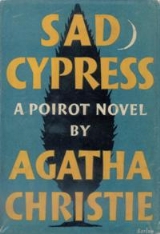
Sad Cypress

Encyclopedia
Sad Cypress is a work of detective fiction
by Agatha Christie
and first published in the UK by the Collins Crime Club
in March 1940
and in the US by Dodd, Mead and Company
later in the same year. The UK edition retailed at eight shillings and threepence
(8/3) – the first price rise for a UK Christie edition since her 1921 debut
- and the US edition retailed at $2.00.
The novel is notable for being the first courtroom drama in the Poirot series.
Twelfth Night which is printed as an epigraph
to the novel.
of the subsequent defendant, Elinor Carlisle, of the death of her aunt, Laura Welman, and the subsequent death of the victim, Mary Gerrard; secondly an account of Poirot's investigation; and, thirdly, a sequence in court, again mainly from Elinor's dazed perspective.
In the first part, distant cousins Elinor Carlisle and Roddy Welman are happily engaged to be married when they receive an anonymous letter claiming that someone is "sucking up" to their wealthy aunt, Laura Welman, from whom Elinor and Roddy expect to inherit a sizeable fortune. Elinor immediately suspects Mary Gerrard, the lodgekeeper's daughter, to whom their aunt has taken a considerable liking. They go down to visit their aunt: partly to see her and partly to protect their interests.
Mrs. Welman is helpless after a stroke and speaks of a desire to die, most notably to Peter Lord, her physician. After a second stroke, she asks Elinor to ask the family solicitor to prepare a will under which it is clear that Mary is to be a beneficiary. Roddy has fallen in love with Mary, provoking Elinor's jealousy. Mrs. Welman dies intestate
during the night and her estate goes to Elinor outright as her only surviving blood relative.
Subsequently, Elinor releases Roddy from the engagement and makes moves to settle money on him (which he refuses) and two thousand pounds on Mary (which Mary accepts). At an impromptu tea party thrown by Elinor for Mary and Nurse Hopkins, Mary dies of poison that had supposedly been put into a fish-paste sandwich. Elinor (who has been behaving suspiciously) is put on trial. Worse, when the body of her aunt is exhumed it is discovered that both women died of morphine poisoning. Elinor had easy access to morphine from a bottle that apparently went missing from Nurse Hopkins’s bag.
In the second part of the novel, Poirot is persuaded to investigate the case by Peter Lord, who is in love with Elinor and wants her to be acquitted at all costs. Poirot's investigation focuses on a small number of elements. Was the poison in the sandwiches, which everyone ate, or something else, such as the tea that was prepared by Nurse Hopkins and drunk by only Mary and herself? What is the secret of Mary Gerrard's birth, which everyone seems so keen to conceal? Is there any significance in the scratch of a thorn on Nurse Hopkins's wrist? Is Peter Lord right to draw Poirot's attention to evidence that someone watching through the window might have poisoned the sandwich, thinking that it would be eaten by Elinor? In the third part of the novel, the case appears to go badly for Elinor, until her Defence unveils three theories that might exonerate her. The first (that Mary committed suicide) is difficult for anyone to really believe, and the second (Peter Lord's theory of the killer outside the window) is unconvincing. But the third theory is Poirot's.
A torn pharmaceutical label that the Prosecution supposed to have held morphine hydrochloride
, the poison, had in fact held apomorphine hydrochloride
, an emetic. This was revealed because on an ampoule, the M in Morphine would be capital; Poirot finds a lowercase M - thus it isn't morphine. The capitalized prefix "Apo" had been carefully torn off. Nurse Hopkins had injected herself with this emetic, apomorphine, in order to vomit the poison that she had ingested in the tea, which explains her quick departure from the table as soon as the tea was consumed that fateful day. Her claim to have scratched herself on a thorn is disproved when it is revealed that the rose tree in question was a thornless variety: Zephyrine Drouhin.
If the means were simple, the motive is complex. Mary Gerrard is not the daughter of Eliza and Bob Gerrard. Instead—as Poirot has discovered from Nurse Hopkins in the course of the investigation—she is the illegitimate daughter of Laura Welman and Sir Lewis Rycroft, which made her the heiress to Mrs. Welman's estate since she was actually a closer relative than Elinor. When Nurse Hopkins encouraged Mary to write a will, Mary was prompted to name as beneficiary the woman that she supposed to be her aunt, Mary Riley (Eliza Gerrard's sister), in New Zealand. Mary Riley's married name is Mary Draper. Mary Draper is none other than Nurse Hopkins as two witnesses of the defence (Amelia Mary Sedley and Edward John Marshall, both from New Zealand), confirm in court.
Poirot ends the novel by rebuking Peter Lord for his clumsy efforts to implicate the hypothetical killer outside the window. He has planted evidence and led Poirot to it in a desperate bid to free Elinor. Lord's momentary embarrassment is presumably alleviated by Poirot's assurance that it is to him, and not to her former love Roddy, that Elinor is now likely to become married.
The Victims:
Suspects:
Characters in the courtroom:
gave a positive review to the book in the issue of 9 March, 1940: "In recent years the detective story-reading public has been so profusely drenched with thrills, 'wisecracks' and perverted psychology that one sometimes wonders whether there is still room for the old-fashioned straight-forward problem in detection. There are, however, a few first-class exponents of this art with us - though now that Miss Sayers
has, for the moment at any rate, turned moralist and others have entered the easier field of thriller writing there seem to be increasingly few. Mrs. Christie in particular remains true to the old faith; and it is pleasant to be able to record that her hand has not lost its cunning". The reviewer regretted that Poirot had lost some of his 'foibles' and Hastings
no longer featured in the plots but he ended on a high note: "Like all Mrs Christie's work, it is economically written, the clues are placed before the reader with impeccable fairness, the red herrings are deftly laid and the solution will cause many readers to kick themselves. Some occasional readers of detective stories are wont to criticize Mrs Christie on the ground that her stories are insufficiently embroidered, that she includes, for instance, no epigrams over the college port. But is it not time to state that in the realm of detective fiction proper, where problems are fairly posed and fairly solved, there is no one to touch her?"
In The New York Times Book Review
of 15 September, 1940, Kay Irvin concluded, "The cast of characters is small, the drama is built up with all this author's sure, economical skill. Sad Cypress is not the best of the Christie achievements, but it is better than the average thriller on every count."
In reviewing several crime novels in The Observer
s issue of 10 March, 1940, Maurice Richardson began, "An outstanding crime week. Not only is Agatha Christie shining balefully on her throne, but the courtiers have made an unusually neat artistic arrangement of corpses up and down the steps." Concentrating on Sad Cypress specifically, Richardson concluded, "Characterisation brilliantly intense as ever. In fact, Agatha Christie has done it again, which is all you need to know."
The Scotsman
s review in its issue of 11 March, 1940 concluded, "Sad Cypress is slighter and rather less ingenious than Mrs Christie's stories usually are, and the concluding explanation is unduly prolonged. But it is only with reference to Mrs Christie's own high level that it seems inferior. By ordinary standards of detective fiction it is a fascinating and skilfully related tale."
E.R. Punshon in The Guardian
s issue of 2 April, 1940 concluded, "The story is told with all and even more of Mrs. Christie's accustomed skill and economy of effect, but it is a pity that the plot turns upon a legal point familiar to all and yet so misconceived that many readers will feel the tale is deprived of plausibility."
Robert Barnard
: "A variation on the usual triangle theme and the only time Christie uses the lovely-woman-in-the-dock-accused-of-murder ploy. Elegiac, more emotionally involving than is usual in Christie, but the ingenuity and superb clueing put it among the very best of the classic titles. Her knowledge of poison is well to the fore, but the amateur will also benefit from a knowledge of horticulture and a skill in close reading."
reprised his role of Poirot. The serial was broadcast weekly from Thursday, 14 May to Thursday, 11 June at 10.00am to 10.30pm. All five episodes were recorded in the week of 16 to 20 March, 1992.
Adaptor: Michael Bakewell
Producer: Enyd Williams
Cast:
Eric Allan
Jonathan Adams
Barbara Atkinson as Mrs. Welman
Margot Boyd as Mrs. Bishop
John Church
Susannah Corbett
as Mary Gerrard
Alan Cullen as the Judge
Keith Drinkel
John Evitts
Emma Fielding as Elinor Carlisle
Eamonn Fleming as Ted Bigland
David King
Pauline Letts as Nurse Hopkins
Peter Penry-Jones
David McAlister as Dr. Lord
John Moffatt as Hercule Poirot
Joanna Myers as Nurse O'Brien, and as the singer of the title song
Gordon Reid
Charles Simpson as Roddy Welman
David Thorpe
Gudrun Ure
John Webb as Mr.Gerrard
Ann Windsor
as a one hundred-minute drama and transmitted on ITV in the UK on Friday 26 December, 2003 as a special episode in their series Agatha Christie's Poirot
. Adaptation was quite faithful to the novel, though some minor changes were made, such as time (1937, around the time of Gershwin's death) and setting (the adaptation took place in the Welman household, whereas the book took place in criminal court).
Adaptor: David Pirie
Director: David Moore
Cast:
David Suchet
as Hercule Poirot
Elisabeth Dermot-Walsh
as Elinor Carlisle
Rupert Penry-Jones
as Roddy Winter
Kelly Reilly as Mary Gerrard
Paul McGann
as Dr. Peter Lord
Phyllis Logan
as Nurse Hopkins
Marion O'Dwyer as Nurse O'Brien
Diana Quick
as Mrs. Laura Welman
Stuart Laing as Ted Horlick
Jack Galloway
as Marsden
Geoffrey Beevers
as Seddon
Alistair Findlay as Prosecuting Counsel
Linda Spurrier as Mrs. Bishop
Timothy Carlton as Judge
Louise Callaghan as Hunterbury maid
Ian Taylor as Turner
Sad Cypress was filmed on location
at Dorney Court
, Buckinghamshire
The book was first serialised in the US in Collier's Weekly
in ten parts from 25 November, 1939 (Volume 104, Number 22) to 27 January, 1940 (Volume 105, Number 4) with illustrations by Mario Cooper.
The UK serialisation was in nineteen parts in the Daily Express
from Saturday, 23 March to Saturday, 13 April, 1940. The accompanying illustrations were uncredited. This version did not contain any chapter divisions.
Detective fiction
Detective fiction is a sub-genre of crime fiction and mystery fiction in which an investigator , either professional or amateur, investigates a crime, often murder.-In ancient literature:...
by Agatha Christie
Agatha Christie
Dame Agatha Christie DBE was a British crime writer of novels, short stories, and plays. She also wrote romances under the name Mary Westmacott, but she is best remembered for her 66 detective novels and 14 short story collections , and her successful West End plays.According to...
and first published in the UK by the Collins Crime Club
Collins Crime Club
The Collins Crime Club was an imprint of UK book publishers William Collins & Co Ltd and ran from May 6, 1930 to April 1994. Customers registered their name and address with the club and were sent a newsletter every three months which advised them of the latest books which had been or were to be...
in March 1940
1940 in literature
The year 1940 in literature involved some significant events and new books.-Events:*Aldous Huxley is a screenwriter for the movie adaptation of Pride and Prejudice.*Jean-Paul Sartre is taken prisoner by the Germans....
and in the US by Dodd, Mead and Company
Dodd, Mead and Company
Dodd, Mead and Company was one of the pioneer publishing houses of the United States, based in New York City. Under several names, the firm operated from 1839 until 1990. Its history properly began in 1870, with the retirement of its founder, Moses Woodruff Dodd. Control passed to his son Frank...
later in the same year. The UK edition retailed at eight shillings and threepence
British Threepence coin
The threepence or thrupenny bit was a denomination of currency used by various jurisdictions in England, Ireland, Scotland and Wales, until decimalisation of the pound sterling and Irish pound in 1971...
(8/3) – the first price rise for a UK Christie edition since her 1921 debut
The Mysterious Affair at Styles
The Mysterious Affair at Styles is a detective novel by Agatha Christie. It was written in 1916 and was first published by John Lane in the United States in October 1920 and in the United Kingdom by The Bodley Head on January 21, 1921. The U.S...
- and the US edition retailed at $2.00.
The novel is notable for being the first courtroom drama in the Poirot series.
Explanation of the novel's title
The title comes from a song from Act II, Scene IV of Shakespeare'sWilliam Shakespeare
William Shakespeare was an English poet and playwright, widely regarded as the greatest writer in the English language and the world's pre-eminent dramatist. He is often called England's national poet and the "Bard of Avon"...
Twelfth Night which is printed as an epigraph
Epigraph (literature)
In literature, an epigraph is a phrase, quotation, or poem that is set at the beginning of a document or component. The epigraph may serve as a preface, as a summary, as a counter-example, or to link the work to a wider literary canon, either to invite comparison or to enlist a conventional...
to the novel.
- Come away, come away, death,
- And in sad cypress let me be laid;
- Fly away, fly away breath;
- I am slain by a fair cruel maid.
- My shroud of white, stuck all with yew,
- O, prepare it!
- My part of death, no one so true
- Did share it.
Plot summary
The novel is written in three parts: in the first place an account, largely from the perspectivePoint of view (literature)
The narrative mode is the set of methods the author of a literary, theatrical, cinematic, or musical story uses to convey the plot to the audience. Narration, the process of presenting the narrative, occurs because of the narrative mode...
of the subsequent defendant, Elinor Carlisle, of the death of her aunt, Laura Welman, and the subsequent death of the victim, Mary Gerrard; secondly an account of Poirot's investigation; and, thirdly, a sequence in court, again mainly from Elinor's dazed perspective.
In the first part, distant cousins Elinor Carlisle and Roddy Welman are happily engaged to be married when they receive an anonymous letter claiming that someone is "sucking up" to their wealthy aunt, Laura Welman, from whom Elinor and Roddy expect to inherit a sizeable fortune. Elinor immediately suspects Mary Gerrard, the lodgekeeper's daughter, to whom their aunt has taken a considerable liking. They go down to visit their aunt: partly to see her and partly to protect their interests.
Mrs. Welman is helpless after a stroke and speaks of a desire to die, most notably to Peter Lord, her physician. After a second stroke, she asks Elinor to ask the family solicitor to prepare a will under which it is clear that Mary is to be a beneficiary. Roddy has fallen in love with Mary, provoking Elinor's jealousy. Mrs. Welman dies intestate
Intestacy
Intestacy is the condition of the estate of a person who dies owning property greater than the sum of their enforceable debts and funeral expenses without having made a valid will or other binding declaration; alternatively where such a will or declaration has been made, but only applies to part of...
during the night and her estate goes to Elinor outright as her only surviving blood relative.
Subsequently, Elinor releases Roddy from the engagement and makes moves to settle money on him (which he refuses) and two thousand pounds on Mary (which Mary accepts). At an impromptu tea party thrown by Elinor for Mary and Nurse Hopkins, Mary dies of poison that had supposedly been put into a fish-paste sandwich. Elinor (who has been behaving suspiciously) is put on trial. Worse, when the body of her aunt is exhumed it is discovered that both women died of morphine poisoning. Elinor had easy access to morphine from a bottle that apparently went missing from Nurse Hopkins’s bag.
In the second part of the novel, Poirot is persuaded to investigate the case by Peter Lord, who is in love with Elinor and wants her to be acquitted at all costs. Poirot's investigation focuses on a small number of elements. Was the poison in the sandwiches, which everyone ate, or something else, such as the tea that was prepared by Nurse Hopkins and drunk by only Mary and herself? What is the secret of Mary Gerrard's birth, which everyone seems so keen to conceal? Is there any significance in the scratch of a thorn on Nurse Hopkins's wrist? Is Peter Lord right to draw Poirot's attention to evidence that someone watching through the window might have poisoned the sandwich, thinking that it would be eaten by Elinor? In the third part of the novel, the case appears to go badly for Elinor, until her Defence unveils three theories that might exonerate her. The first (that Mary committed suicide) is difficult for anyone to really believe, and the second (Peter Lord's theory of the killer outside the window) is unconvincing. But the third theory is Poirot's.
A torn pharmaceutical label that the Prosecution supposed to have held morphine hydrochloride
Morphine
Morphine is a potent opiate analgesic medication and is considered to be the prototypical opioid. It was first isolated in 1804 by Friedrich Sertürner, first distributed by same in 1817, and first commercially sold by Merck in 1827, which at the time was a single small chemists' shop. It was more...
, the poison, had in fact held apomorphine hydrochloride
Apomorphine
Apomorphine is a non-selective dopamine agonist which activates both D1-like and D2-like receptors, with some preference for the latter subtypes. It is historically a morphine decomposition product by boiling with concentrated acid, hence the -morphine suffix...
, an emetic. This was revealed because on an ampoule, the M in Morphine would be capital; Poirot finds a lowercase M - thus it isn't morphine. The capitalized prefix "Apo" had been carefully torn off. Nurse Hopkins had injected herself with this emetic, apomorphine, in order to vomit the poison that she had ingested in the tea, which explains her quick departure from the table as soon as the tea was consumed that fateful day. Her claim to have scratched herself on a thorn is disproved when it is revealed that the rose tree in question was a thornless variety: Zephyrine Drouhin.
If the means were simple, the motive is complex. Mary Gerrard is not the daughter of Eliza and Bob Gerrard. Instead—as Poirot has discovered from Nurse Hopkins in the course of the investigation—she is the illegitimate daughter of Laura Welman and Sir Lewis Rycroft, which made her the heiress to Mrs. Welman's estate since she was actually a closer relative than Elinor. When Nurse Hopkins encouraged Mary to write a will, Mary was prompted to name as beneficiary the woman that she supposed to be her aunt, Mary Riley (Eliza Gerrard's sister), in New Zealand. Mary Riley's married name is Mary Draper. Mary Draper is none other than Nurse Hopkins as two witnesses of the defence (Amelia Mary Sedley and Edward John Marshall, both from New Zealand), confirm in court.
Poirot ends the novel by rebuking Peter Lord for his clumsy efforts to implicate the hypothetical killer outside the window. He has planted evidence and led Poirot to it in a desperate bid to free Elinor. Lord's momentary embarrassment is presumably alleviated by Poirot's assurance that it is to him, and not to her former love Roddy, that Elinor is now likely to become married.
Characters in “Sad Cypress”
- Hercule PoirotHercule PoirotHercule Poirot is a fictional Belgian detective created by Agatha Christie. Along with Miss Marple, Poirot is one of Christie's most famous and long-lived characters, appearing in 33 novels and 51 short stories published between 1920 and 1975 and set in the same era.Poirot has been portrayed on...
, the Belgian detective
The Victims:
- Mrs. Laura Welman, a widow
- Mary Gerrard, her protégée
Suspects:
- Elinor Carlisle, Mrs. Welman's niece
- Roddy Welman, Mrs. Welman's nephew by marriage
- Dr. Peter Lord, Mrs. Welman's doctor
- Nurse Jessie Hopkins, the District NurseDistrict nurseDistrict Nurses are senior nurses who manage care within the community, leading teams of community nurses and support workers. Typically much of their work involves visiting house-bound patients to provide advice and care, for example, palliative care, wound management, catheter and continence...
- Nurse Eileen O'Brien, Mrs. Welman's nurse
- Mr Seddon, Mrs. Welman's solicitor
- Mrs Bishop, Mrs. Welman's housekeeper
- Horlick, the gardener
- Bob Gerrard, the lodge keeper and Mary's ostensible father
- Ted Bigland, a farmer's son
Characters in the courtroom:
- The Judge
- Sir Edwin Bulmer, Counsel for the Defence
- Sir Samuel Attenbury, Counsel for the Prosecution
- Dr. Alan Garcia, expert witness for the Prosecution
- Inspector Brill, the investigating officer
- Mr. Abbott, a grocer
- Alfred James Wargrave, a rose-grower
- James Arthur Littledale, a chemist
- Amelia Mary Sedley, a witness from New Zealand
- Edward John Marshall, a witness from New Zealand
Literary significance and reception
Maurice Percy Ashley in The Times Literary SupplementThe Times Literary Supplement
The Times Literary Supplement is a weekly literary review published in London by News International, a subsidiary of News Corporation.-History:...
gave a positive review to the book in the issue of 9 March, 1940: "In recent years the detective story-reading public has been so profusely drenched with thrills, 'wisecracks' and perverted psychology that one sometimes wonders whether there is still room for the old-fashioned straight-forward problem in detection. There are, however, a few first-class exponents of this art with us - though now that Miss Sayers
Dorothy L. Sayers
Dorothy Leigh Sayers was a renowned English crime writer, poet, playwright, essayist, translator and Christian humanist. She was also a student of classical and modern languages...
has, for the moment at any rate, turned moralist and others have entered the easier field of thriller writing there seem to be increasingly few. Mrs. Christie in particular remains true to the old faith; and it is pleasant to be able to record that her hand has not lost its cunning". The reviewer regretted that Poirot had lost some of his 'foibles' and Hastings
Arthur Hastings
Captain Arthur Hastings, OBE, is a fictional character, the amateur sleuthing partner and best friend of Agatha Christie's Belgian detective, Hercule Poirot...
no longer featured in the plots but he ended on a high note: "Like all Mrs Christie's work, it is economically written, the clues are placed before the reader with impeccable fairness, the red herrings are deftly laid and the solution will cause many readers to kick themselves. Some occasional readers of detective stories are wont to criticize Mrs Christie on the ground that her stories are insufficiently embroidered, that she includes, for instance, no epigrams over the college port. But is it not time to state that in the realm of detective fiction proper, where problems are fairly posed and fairly solved, there is no one to touch her?"
In The New York Times Book Review
The New York Times Book Review
The New York Times Book Review is a weekly paper-magazine supplement to The New York Times in which current non-fiction and fiction books are reviewed. It is one of the most influential and widely read book review publications in the industry. The offices are located near Times Square in New York...
of 15 September, 1940, Kay Irvin concluded, "The cast of characters is small, the drama is built up with all this author's sure, economical skill. Sad Cypress is not the best of the Christie achievements, but it is better than the average thriller on every count."
In reviewing several crime novels in The Observer
The Observer
The Observer is a British newspaper, published on Sundays. In the same place on the political spectrum as its daily sister paper The Guardian, which acquired it in 1993, it takes a liberal or social democratic line on most issues. It is the world's oldest Sunday newspaper.-Origins:The first issue,...
s issue of 10 March, 1940, Maurice Richardson began, "An outstanding crime week. Not only is Agatha Christie shining balefully on her throne, but the courtiers have made an unusually neat artistic arrangement of corpses up and down the steps." Concentrating on Sad Cypress specifically, Richardson concluded, "Characterisation brilliantly intense as ever. In fact, Agatha Christie has done it again, which is all you need to know."
The Scotsman
The Scotsman
The Scotsman is a British newspaper, published in Edinburgh.As of August 2011 it had an audited circulation of 38,423, down from about 100,000 in the 1980s....
s review in its issue of 11 March, 1940 concluded, "Sad Cypress is slighter and rather less ingenious than Mrs Christie's stories usually are, and the concluding explanation is unduly prolonged. But it is only with reference to Mrs Christie's own high level that it seems inferior. By ordinary standards of detective fiction it is a fascinating and skilfully related tale."
E.R. Punshon in The Guardian
The Guardian
The Guardian, formerly known as The Manchester Guardian , is a British national daily newspaper in the Berliner format...
s issue of 2 April, 1940 concluded, "The story is told with all and even more of Mrs. Christie's accustomed skill and economy of effect, but it is a pity that the plot turns upon a legal point familiar to all and yet so misconceived that many readers will feel the tale is deprived of plausibility."
Robert Barnard
Robert Barnard
Robert Barnard is an English crime writer, critic and lecturer.- Life and work :Born in Essex, Barnard was educated at the Colchester Royal Grammar School and at Balliol College in Oxford....
: "A variation on the usual triangle theme and the only time Christie uses the lovely-woman-in-the-dock-accused-of-murder ploy. Elegiac, more emotionally involving than is usual in Christie, but the ingenuity and superb clueing put it among the very best of the classic titles. Her knowledge of poison is well to the fore, but the amateur will also benefit from a knowledge of horticulture and a skill in close reading."
BBC Radio 4 Adaptation
The novel was adapted as a five-part serial for BBC Radio 4 in 1992. John MoffattJohn Moffatt (actor)
John Moffatt is an English actor and playwright, perhaps best known for his portrayal of Hercule Poirot on BBC Radio....
reprised his role of Poirot. The serial was broadcast weekly from Thursday, 14 May to Thursday, 11 June at 10.00am to 10.30pm. All five episodes were recorded in the week of 16 to 20 March, 1992.
Adaptor: Michael Bakewell
Michael Bakewell
Michael Bakewell is a British television producer. He is best known for his work during the 1960s, when he was the first Head of Plays at the BBC after Sydney Newman divided the drama department into separate series, serials and plays divisions in 1963...
Producer: Enyd Williams
Cast:
Eric Allan
Jonathan Adams
Barbara Atkinson as Mrs. Welman
Margot Boyd as Mrs. Bishop
John Church
Susannah Corbett
Susannah Corbett
Susannah Corbett is an English actress and author. Her acting career began in 1991 and she has performed on television, film and radio. As an author she writes children's books.-Early life:...
as Mary Gerrard
Alan Cullen as the Judge
Keith Drinkel
Keith Drinkel
Keith Drinkel is a British actor, born in York on 14 November 1944. He was educated at St Michael's College, Leeds and is now based in Brighton....
John Evitts
Emma Fielding as Elinor Carlisle
Eamonn Fleming as Ted Bigland
David King
Pauline Letts as Nurse Hopkins
Peter Penry-Jones
Peter Penry-Jones
Peter David Penry-Jones was a Welsh actor.-Career:His television credits include: Colditz, The Professionals, To the Manor Born, Bergerac, Howards' Way, Kavanagh QC and Midsomer Murders...
David McAlister as Dr. Lord
John Moffatt as Hercule Poirot
Joanna Myers as Nurse O'Brien, and as the singer of the title song
Gordon Reid
Gordon Reid (actor)
James Gordon Reid was a Scottish actor.Reid was born in Hamilton, Lanarkshire, Scotland. Educated at the former Hamilton Academy he then trained at the Royal Scottish Academy of Music and Drama, graduating in 1962 with the Silver Medal for Acting.His extensive acting credits included the chemist...
Charles Simpson as Roddy Welman
David Thorpe
Gudrun Ure
Gudrun Ure
Gudrun Ure is a Scottish actress, most famous for her portrayal of the titular character in Super Gran. She also starred in the pilot of a series called Life After Life, written by Yes Minister creator Jonathan Lynn...
John Webb as Mr.Gerrard
Ann Windsor
Agatha Christie's Poirot
The book was adapted by London Weekend TelevisionLondon Weekend Television
London Weekend Television was the name of the ITV network franchise holder for Greater London and the Home Counties including south Suffolk, middle and east Hampshire, Oxfordshire, south Bedfordshire, south Northamptonshire, parts of Herefordshire & Worcestershire, Warwickshire, east Dorset and...
as a one hundred-minute drama and transmitted on ITV in the UK on Friday 26 December, 2003 as a special episode in their series Agatha Christie's Poirot
Agatha Christie's Poirot
Agatha Christie's Poirot is a British television drama that has aired on ITV since 1989. It stars David Suchet as Agatha Christie's fictional detective Hercule Poirot. It was originally made by LWT and is now made by ITV Studios...
. Adaptation was quite faithful to the novel, though some minor changes were made, such as time (1937, around the time of Gershwin's death) and setting (the adaptation took place in the Welman household, whereas the book took place in criminal court).
Adaptor: David Pirie
Director: David Moore
Cast:
David Suchet
David Suchet
David Suchet, CBE, is an English actor, known for his work on British television. He is recognised for his RTS- and BPG award-winning performance as Augustus Melmotte in the 2001 British TV mini-drama The Way We Live Now, alongside Matthew Macfadyen and Paloma Baeza, and a 1991 British Academy...
as Hercule Poirot
Elisabeth Dermot-Walsh
Elisabeth Dermot-Walsh
Elisabeth Dermot Walsh is an English actress, known for portraying Elizabeth in Falling for a Dancer and Dr Zara Carmichael in Doctors.-Background:...
as Elinor Carlisle
Rupert Penry-Jones
Rupert Penry-Jones
Rupert William Penry-Jones is an English actor, best known for his role as Adam Carter in the British television series Spooks, also broadcast under the title MI-5.-Family life:Penry-Jones was born in London on September 22, 1970...
as Roddy Winter
Kelly Reilly as Mary Gerrard
Paul McGann
Paul McGann
Paul McGann is an English actor who made his name on the BBC serial The Monocled Mutineer, in which he played the lead role...
as Dr. Peter Lord
Phyllis Logan
Phyllis Logan
-Education:Logan was educated at Johnstone High School in Johnstone, Renfrewshire, Scotland. After school, she graduated from the Royal Scottish Academy of Music and Drama with the James Bridie Gold Medal in 1977.-Career:...
as Nurse Hopkins
Marion O'Dwyer as Nurse O'Brien
Diana Quick
Diana Quick
-Life:Quick was born in London, England. She grew up in Dartford, Kent, the third of a dentist's four children. She was educated at Dartford Grammar School for Girls, Kent. She was greatly aided by her English teacher, Miss Davis, who encouraged her to pursue acting...
as Mrs. Laura Welman
Stuart Laing as Ted Horlick
Jack Galloway
Jack Galloway
Jack Galloway is a British actor.His television credits include: Thriller, Mackenzie, Codename Icarus, Doctor Who , Three Up, Two Down, Bergerac, The Mistress, Maigret, The Paradise Club, Boudica and Casualty.-External links:...
as Marsden
Geoffrey Beevers
Geoffrey Beevers
Geoffrey Beevers is a British actor who has appeared in many different television roles.Beevers has worked extensively at the Orange Tree Theatre in Richmond upon Thames, both as an actor ; and as an adaptor/director of George Eliot's novel Adam Bede , for which he won a Time Out Award, and Balzac's...
as Seddon
Alistair Findlay as Prosecuting Counsel
Linda Spurrier as Mrs. Bishop
Timothy Carlton as Judge
Louise Callaghan as Hunterbury maid
Ian Taylor as Turner
Sad Cypress was filmed on location
On location
On location can refer to:*Filming location, a place where some or all of a film or television series is produced*On Location , a name of an HBO special series*Adobe OnLocation, computer software for direct to disk recording....
at Dorney Court
Dorney Court
Dorney Court is an early Tudor manor house, dating from around 1440, located in the village of Dorney, Buckinghamshire. It is owned and lived in by the Palmer family.-Early history:...
, Buckinghamshire
Buckinghamshire
Buckinghamshire is a ceremonial and non-metropolitan home county in South East England. The county town is Aylesbury, the largest town in the ceremonial county is Milton Keynes and largest town in the non-metropolitan county is High Wycombe....
Publication history
- 1940, Collins Crime Club (London), March 1940, Hardcover, 256 pp
- 1940, Dodd Mead and Company (New York), 1940, Hardcover, 270 pp
- 1946, Dell Books, Paperback, 224 pp (Dell number 172 [mapbackMapbackMapback is a term used by paperback collectors to refer to the earliest paperback books published by Dell Books, beginning in 1943. The books are known as mapbacks because the back cover of the book contains a map that illustrates the location of the action. Dell books were numbered in series...
]) - 1959, Fontana Books (Imprint of HarperCollinsHarperCollinsHarperCollins is a publishing company owned by News Corporation. It is the combination of the publishers William Collins, Sons and Co Ltd, a British company, and Harper & Row, an American company, itself the result of an earlier merger of Harper & Brothers and Row, Peterson & Company. The worldwide...
), Paperback, 191 pp - 1965, Ulverscroft Large-print Edition, Hardcover, 239 pp
- 2008, Poirot Facsimile Edition (Facsimile of 1940 UK First Edition), HarperCollins, 1 April, 2008, Hardback, ISBN 0-00-727459-9
The book was first serialised in the US in Collier's Weekly
Collier's Weekly
Collier's Weekly was an American magazine founded by Peter Fenelon Collier and published from 1888 to 1957. With the passage of decades, the title was shortened to Collier's....
in ten parts from 25 November, 1939 (Volume 104, Number 22) to 27 January, 1940 (Volume 105, Number 4) with illustrations by Mario Cooper.
The UK serialisation was in nineteen parts in the Daily Express
Daily Express
The Daily Express switched from broadsheet to tabloid in 1977 and was bought by the construction company Trafalgar House in the same year. Its publishing company, Beaverbrook Newspapers, was renamed Express Newspapers...
from Saturday, 23 March to Saturday, 13 April, 1940. The accompanying illustrations were uncredited. This version did not contain any chapter divisions.
International titles
- Dutch: Schuldig in eigen ogen (Guilty in her own eyes)
- French: Je ne suis pas coupable (I am not guilty)
- German: Morphium (Morphine)
- Hungarian: Vádol a rózsa! (The Rose Is Accusing!), Cipruskoporsó (Cypress Coffin)
- Italian: La parola alla difesa (The Words of Defence)
- Russian: Печальный кипарис (=Pechal'ny kiparis, Sad Cypress)
- Spanish: Un Triste Ciprés (A sad Cypress)
- Portuguese: Poirot salva o criminoso (Poirot saves the criminal)
- Swedish: Samvetskval (Remorse)
- Turkish: Esrarengiz Sanık (Mysterious Suspect)
- Indonesian: Mawar Tak Berduri (Thornless Rose)
External links
- Sad Cypress at the official Agatha Christie website