
All Topics  
Space Shuttle Columbia disaster


   Email Print
   Bookmark   Link


Space Shuttle Columbia disaster


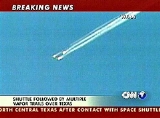
The Space Shuttle Columbia disaster occurred on February 1, 2003, when the Space Shuttle ColumbiaFacts About Space Shuttle Columbia

Space Shuttle Columbia was the first space shuttle in NASA's orbital fleet....
 disintegrated over TexasTexas

Texas is a state in both the Southern and Western region of the United States of America....
 during re-entryRe-Entry

Re-Entry is the second album by UK R&B / Hip Hop collective Big Brovaz....
 into the Earth's atmosphereEarth's atmosphere

Earth's atmosphere is a layer of gases surrounding the planet Earth and retained by the Earth's gravity....
, with the loss of all seven crew members, shortly before it was scheduled to conclude its 28th mission, STS-107STS-107

STS-107 was a space shuttle mission by NASA using the Space Shuttle Columbia, launched January 16, 2003....
.

The loss of Columbia was a result of damage sustained during launch when a piece of foam insulation the size of a small briefcase broke off the Space Shuttle external tankSpace Shuttle external tank

The Space Shuttle External Tank contains the liquid hydrogen fuel and liquid oxygen oxidizer and supplies them under pressur...
 (the main propellant tank) under the aerodynamic forces of launch. The debris struck the leading edgeLeading edge

The leading edge is a line connecting the forward-most points of a wing's profile....
 of the left wing, damaging the Shuttle's thermal protection system (TPS)Space shuttle thermal protection system

The space shuttle thermal protection system is the barrier that protects the space shuttle during the searing 3000 F heat of...
. While Columbia was still in orbit, some engineers suspected damage, but NASANASA

The National Aeronautics and Space Administration is an agency of the United States Government, responsible for the nation'...
 managers limited the investigation on the grounds that little could be done even if problems were found.

NASA's Shuttle safety regulations stated that external tank foam shedding and subsequent debris strikes upon the Shuttle itself were safety issues that needed to be resolved before a launch was cleared, but launches were often given the go-ahead as engineers unsuccessfully studied the foam shedding problem.


Discussion
Ask a question about 'Space Shuttle Columbia disaster'
Start a new discussion about 'Space Shuttle Columbia disaster'
Answer questions from other users
Full Discussion Forum


Timeline

2003   Died


Encyclopedia


The Space Shuttle Columbia disaster occurred on February 1, 2003, when the Space Shuttle ColumbiaFacts About Space Shuttle Columbia

Space Shuttle Columbia was the first space shuttle in NASA's orbital fleet....
 disintegrated over TexasTexas

Texas is a state in both the Southern and Western region of the United States of America....
 during re-entryRe-Entry

Re-Entry is the second album by UK R&B / Hip Hop collective Big Brovaz....
 into the Earth's atmosphereEarth's atmosphere

Earth's atmosphere is a layer of gases surrounding the planet Earth and retained by the Earth's gravity....
, with the loss of all seven crew members, shortly before it was scheduled to conclude its 28th mission, STS-107STS-107

STS-107 was a space shuttle mission by NASA using the Space Shuttle Columbia, launched January 16, 2003....
.

The loss of Columbia was a result of damage sustained during launch when a piece of foam insulation the size of a small briefcase broke off the Space Shuttle external tankSpace Shuttle external tank

The Space Shuttle External Tank contains the liquid hydrogen fuel and liquid oxygen oxidizer and supplies them under pressur...
 (the main propellant tank) under the aerodynamic forces of launch. The debris struck the leading edgeLeading edge

The leading edge is a line connecting the forward-most points of a wing's profile....
 of the left wing, damaging the Shuttle's thermal protection system (TPS)Space shuttle thermal protection system

The space shuttle thermal protection system is the barrier that protects the space shuttle during the searing 3000 F heat of...
. While Columbia was still in orbit, some engineers suspected damage, but NASANASA

The National Aeronautics and Space Administration is an agency of the United States Government, responsible for the nation'...
 managers limited the investigation on the grounds that little could be done even if problems were found.

NASA's Shuttle safety regulations stated that external tank foam shedding and subsequent debris strikes upon the Shuttle itself were safety issues that needed to be resolved before a launch was cleared, but launches were often given the go-ahead as engineers unsuccessfully studied the foam shedding problem. The majority of Shuttle launches recorded such foam strikes and thermal tile scarring in violation of safety regulations. During re-entry of STS-107, the damaged area allowed the hot gases to penetrate and destroy the internal wing structure, eventually causing the in-flight breakup of the vehicle. A massive ground search in parts of Texas, LouisianaLouisiana

cellpadding="2" cellspacing="2"> Louisiana is a Southern state of the United States of America. ...
 and ArkansasArkansas

Arkansas is a Southern state in the United States. ...
 recovered crew remains and many vehicle fragments.

The Columbia Accident Investigation BoardColumbia Accident Investigation Board

The Columbia Accident Investigation Board was convened by NASA to investigate the loss of the Space Shuttle Columbia on...
's recommendations addressed both technical and organizational issues. The Space Shuttle programSpace Shuttle program

NASA's Space Shuttle, officially called Space Transportation System , is the United States government's current manned...
 was set back over two years by the disaster, a delay comparable only to that resulting from the Challenger disasterSpace Shuttle Challenger disaster

The Space Shuttle Challenger accident occurred on the morning of January 28 1986, at 11:39 EST, when Space Shuttle Cha...
. Concurrently, construction of the International Space StationInternational Space Station

The International Space Station is a manned research space facility that is being assembled in orbit around the Earth....
 was put on hold, and the station relied entirely on the Russian Federal Space AgencyRussian Federal Space Agency

s:Rusk kosmick agentura]]...
 for resupply and crew rotation until STS-114STS-114

STS-114 was the first "Return to Flight" Space Shuttle mission following the Space Shuttle Columbia disaster....
.

Crew


  • Commander: Rick D. Husband, a US Air ForceUnited States Air Force Summary

    The United States Air Force is the aerospace branch of the United States armed forces and one of the seven uniformed servic...
     colonelFacts About Colonel

    Colonel is a military rank of a commissioned officer, with the corresponding ranks existing in nearly every country in the w...
     and mechanical engineerMechanical engineering

    Mechanical engineering is a professional engineering discipline that involves the application of principles of physics for a...
    , who piloted a previous shuttle during the first docking with the International Space StationInternational Space Station

    The International Space Station is a manned research space facility that is being assembled in orbit around the Earth....
    .
  • Pilot: William C. McCoolWilliam C. McCool

    William Cameron "Willie" McCool was an United States Navy Commander, NASA astronaut and the Space Shuttle pilot of Columbi...
    , a US NavyUnited States Navy

    The United States Navy is the branch of the United States armed forces responsible for conducting naval operations....
     commanderCommander Overview

    Commander is a military rank used in many navies but not generally in armies or air forces....
  • Payload Commander: Michael P. Anderson, a US Air ForceUnited States Air Force

    The United States Air Force is the aerospace branch of the United States armed forces and one of the seven uniformed servic...
     lieutenant colonelColonel

    Colonel is a military rank of a commissioned officer, with the corresponding ranks existing in nearly every country in the w...
     and physicistPhysicist

    A physicist is a scientist who studies or practices physics....
     who was in charge of the science mission.
  • Payload Specialist: Ilan RamonFacts About Ilan Ramon

    Ilan Ramon was a combat pilot in the Israeli Air Force and later the first Israeli astronaut....
    , a colonel in the Israeli Air ForceIsraeli Air Force

    The Israeli Air Force is the air force of the Israel Defense Forces and currently operates around 900 aircraft....
     and the first IsraelIsrael

    Israel , officially the State of Israel, is a country in Western Asia on the southeastern edge of the Mediterranean Se...
    i astronaut.
  • Mission Specialist: Kalpana ChawlaKalpana Chawla

    Kalpana Chawla, was an Indian-born American astronaut and space shuttle mission specialist....
    , an IndiaIndia

    India , officially the Republic of India, is a country in South Asia....
    n-born aerospace engineerFacts About Aerospace engineering

    Aerospace engineering is the branch of engineering that concerns aircraft, spacecraft, and related topics....
     on her second space mission.
  • Mission Specialist: David M. Brown, a US NavyUnited States Navy

    The United States Navy is the branch of the United States armed forces responsible for conducting naval operations....
     captainCaptain Summary

    This article concerns the rank and title of Captain....
     trained as an aviator and flight surgeonFlight surgeon

    A flight surgeon is a specialised medical officer in the military, typically the air force....
    . Brown worked on a number of scientific experiments.
  • Mission Specialist: Laurel Clark, a US NavyUnited States Navy

    The United States Navy is the branch of the United States armed forces responsible for conducting naval operations....
     captain and flight surgeon. Clark worked on a number of biological experiments.

Debris strike during launch

]

Approximately 82 seconds after launch, a suitcase-size piece of thermal insulationThermal insulation

Insulation cannot stop heat energy from flowing; it can only reduce the rate of heat flow....
 foam broke off the External Tank (ET), striking Columbia's left wing Reinforced Carbon-CarbonReinforced carbon-carbon

Reinforced Carbon-Carbon is a composite material consisting of carbon fiber reinforcement in a matrix of graphite, often wit...
 (RCC) panels. This likely created a 6 to 10 inch (15 to 25 cm) diameter hole, allowing hot gases to enter the wing when Columbia later reentered the atmosphere. At the time of the foam strike, the orbiter was at an altitude of about 66,000 feet (20,115 meters), traveling at Mach 2.46 (1,870 mph, or 837 meters per second). The foam fragment was about 1.2 pounds (0.54 kg) in mass and impacted the wing at roughly 800 feet per second (244 meters per second).

The Left Bipod Foam Ramp is an approximately three-foot (one-meter) piece made entirely of foam, as opposed to being a metal structure coated with foam. As such, the foam, not normally considered to be a structural material, is required to bear some aerodynamic loads. Because of these special requirements, the casting-in-place and curing of the ramps may be performed only by a senior technician. The shuttle's main fuel tankSpace Shuttle external tank Overview

The Space Shuttle External Tank contains the liquid hydrogen fuel and liquid oxygen oxidizer and supplies them under pressur...
 is covered in foam as an insulator, to avoid ice forming on it when full of liquid hydrogenLiquid hydrogen

Liquid hydrogen is the element hydrogen, in the liquid state....
 and oxygenLiquid oxygen

Liquid Oxygen has an expansion ratio of 860:1, and because of this, is used in commercial and military aircraft today....
, which itself could damage the shuttle when shed during lift-off.

Bipod Ramp insulation had been observed falling off, in whole or in part, on many previous flights- STS-7STS-7

colspan="2" cellspacing="0" cellpadding="2">...
 (1983), STS-27STS-27

colspan="2" cellspacing="0" cellpadding="2">...
 (1988), STS-32STS-32

STS-32 was the 33rd launch of the Space Shuttle and the 9th launch of Space Shuttle Columbia....
 (1990), STS-50STS-50 Summary

STS-50 was a United States Space Shuttle mission, the 12th mission of the Columbia orbiter, and was Columbia's first...
 (1992), plus subsequent flights showing partial losses. In addition, Protuberance Air Load (PAL) foam has also shed pieces, plus spot losses from large-area foams. At least one previous strike caused no serious damage. NASA management came to refer to this phenomenon as "foam shedding." As with the O-ring erosions that ultimately doomed the Challenger, NASA management became accustomed to these phenomena when no serious consequences resulted from these earlier episodes. This phenomenon was termed "normalization of deviance" by sociologist Diane Vaughan in her book on the Challenger launch decision processFacts About Space Shuttle Challenger launch decision

The Space Shuttle Challenger launch decision was the decision-making process that led to the launch of the Space Shuttle C...
.

Video taken during lift-off of STS-107 was routinely reviewed two hours later and revealed nothing unusual. The following day, higher-resolution film that had been processed overnight revealed the foam debris striking the left wing, potentially damaging the thermal protection on the Space Shuttle. At the time, the exact location where the foam struck the wing could not be determined due to the low resolution of the tracking camera footage.

Mission STS-107STS-107

STS-107 was a space shuttle mission by NASA using the Space Shuttle Columbia, launched January 16, 2003....
 was the 113th Space Shuttle launch. It had been delayed 18 times over the two years from its original launch date of 11 January 2001 to its actual launch date of 16 January 2003. A well-publicized launch delay due to cracks in the shuttle's propellant distribution system occurred one month before a 19 July 2002 launch date, but the Columbia Accident Investigation BoardColumbia Accident Investigation Board

The Columbia Accident Investigation Board was convened by NASA to investigate the loss of the Space Shuttle Columbia on...
 (CAIB) determined that this delay had nothing to do with the catastrophic failure six months later.

Flight risk management

In a risk-management scenario similar to the Challenger disaster, NASA management failed to recognize the relevance of engineering concerns for safety. Two examples were failures to honor engineer requests for imaging to inspect possible damage, and failure to respond to engineer requests about the status of astronaut inspection of the left wing. Engineering made three separate requests for Department of DefenseUnited States Department of Defense

The United States Department of Defense is the federal department charged with coordinating and supervising all agencies an...
 (DOD) imaging of the shuttle in orbit to more precisely determine damage. While the images were not guaranteed to show the damage, the capability existed for imaging of sufficient resolution to provide meaningful examination. In fact, the CAIB recommended subsequent shuttle flights be imaged while in orbit using ground-based or space-based Department of DefenseUnited States Department of Defense

The United States Department of Defense is the federal department charged with coordinating and supervising all agencies an...
 assets. NASA management did not honor the requests and in some cases intervened to stop the DOD from assisting.

NASA's chief thermal protection systemSpace shuttle thermal protection system Summary

The space shuttle thermal protection system is the barrier that protects the space shuttle during the searing 3000 F heat of...
 (TPS) engineer was concerned about left wing TPS damage and asked NASA management whether an astronaut would visually inspect it. NASA managers never responded.

Throughout the risk assessment process, senior NASA managers were influenced by their belief that nothing could be done even if damage was detected, hence this affected their stance on investigation urgency, thoroughness and possible contingency actions. They decided to conduct a parametric "what-if" scenario study more suited to determine risk probabilities of future events, instead of inspecting and assessing the actual damage. The investigation report in particular singled out NASA manager Linda HamLinda Ham

Linda Ham was the program integration manager in the National Aeronautics and Space Administration Space Shuttle Program Off...
 for exhibiting this attitude.

Much of the risk assessment hinged on damage predictions to the thermal protection system. These fall into two categories: damage to the silica tile on the wing lower surface, and damage to the reinforced carbon-carbonReinforced carbon-carbon

Reinforced Carbon-Carbon is a composite material consisting of carbon fiber reinforcement in a matrix of graphite, often wit...
 (RCC) leading-edge panels.

Damage-prediction software, known as "Crater", was used to evaluate possible tile and RCC damage. The software predicted severe penetration of multiple tiles by the impact, but engineers downplayed this, believing that results showing that the software overstated damage from small projectiles meant that the same would be true of larger Spray-On Foam Insulation (SOFI) impacts. The program used to predict RCC damage was based on small ice impacts the size of cigarette butts, not larger SOFI impacts. Under 1 of 15 predicted SOFI impact paths, the software predicted an ice impact would completely penetrate the RCC panel. Engineers downplayed this, too, believing that impacts of the less dense SOFI material would result in less damage than ice impacts. In an e-mail exchange, NASA managers questioned whether the density of the SOFI could be used as justification for reducing predicted damage. Despite engineering concerns about the energy imparted by the SOFI material, NASA managers ultimately accepted the rationale to reduce predicted damage of the RCC panels from complete penetration to slight damage to the panel's thin coating.

NASA managers felt a rescue or repair was impossible, so there was no point in trying to inspect the vehicle for damage while on orbit. However, the CAIB determined either a rescue mission or on-orbit repair, though risky, might have been possible had NASA verified severe damage within five days into the mission.

Ultimately the NASA Mission Management Team felt there was insufficient evidence to indicate that the strike was an unsafe situation, so they declared the debris strike a "turnaround" issue (not of highest importance) and denied the requests for the Department of DefenseUnited States Department of Defense

The United States Department of Defense is the federal department charged with coordinating and supervising all agencies an...
 images.

Destruction during re-entry

The following is a timeline of Columbia's re-entry. The shuttle was scheduled to land at 9:16 a.m. EST.
  • 2:30 a.m. EST, Saturday, February 1 2003 – The Entry Flight Control TeamFlight controller Overview

    Flight controllers are personnel who aid in the operations of a space flight, working in Mission Control Centers such as NAS...
     began duty in the Mission Control CenterMission Control Center

    Mission Control Center is a unit that manages aerospace flights....
    .
    The Flight Control Team had not been working on any issues or problems related to the planned de-orbit and re-entry of Columbia. In particular, the team had indicated no concerns about the debris impact to the left wing during ascent, and treated the re-entry like any other. The team worked through the de-orbit preparation checklist and re-entry checklist procedures. Weather forecasters, with the help of pilots in the Shuttle Training AircraftShuttle Training Aircraft

    The Shuttle Training Aircraft is a NASA training vehicle that duplicates the Space Shuttle's approach profile and handling q...
    , evaluated landing-site weather conditions at the Kennedy Space Center.
  • 8:00 – Mission Control Center Entry Flight Director Leroy Cain polled the Mission Control room for a GO/NO-GO decision for the de-orbit burn.
    All weather observations and forecasts were within guidelines set by the flight rules, and all systems were normal.
  • 8:10 – The Capsule Communicator notified the crew that they are GO for de-orbit burn.
  • 8:15:30 (EI-1719) – Commander Husband and Pilot McCool executed the de-orbit burn using Columbia’s two Orbital Maneuvering System engines.
    The Orbiter was upside down and tail-first over the Indian Ocean at an altitude of 175 statute milesMile

    A mile is the name of a unit of length, usually used to measure distance, in a number of different systems, including Englis...
     (282 km) when the burn was executed. The de-orbit maneuver was performed on the 255th orbit, and the 2-minute, 38-second burn slowed the Orbiter from 17,500 mph (7.8 km/s) to begin its re-entry into the atmosphere. During the de-orbit burn, the crew felt about 10% of the effects of gravity. There were no problems during the burn, after which Husband maneuvered Columbia into a right-side-up, forward-facing position, with the Orbiter's nose pitched up.
  • 8:44:09 (EI+000) – Entry Interface (EI), arbitrarily defined as the point at which the Orbiter enters the discernible atmosphere at 400,000 feet (120 km or 76 mi), occurred over the Pacific OceanPacific Ocean

    The Pacific Ocean is the world's largest body of water. ...
    .
    As Columbia descended from space into the atmosphere, the heat produced by air molecules colliding with the Orbiter typically caused wing leading-edge temperatures to rise steadily, reaching an estimated 2,500 degrees Fahrenheit (1,400 °C) during the next six minutes.
  • 8:48:39 (EI+270) – A sensor on the left wing leading edge spar showed strains higher than those seen on previous Columbia re-entries.
    This was recorded only on the Modular Auxiliary Data System, and was not telemetered to ground controllers or displayed to the crew.
  • 8:49:32 (EI+323) – Columbia executed a pre-planned roll to the right. Speed: MachMach number

    Mach number is defined as a ratio of the speed of an object or flow relative to the speed of sound in the medium through w...
     24.5.
    Columbia began a banking turn to manage lift and therefore limit the Orbiter's rate of descent and heating.
  • 8:50:53 (EI+404) – Columbia entered a 10-minute period of peak heating, during which the thermal stresses were at their maximum. Speed: Mach 24.1; altitude: 243,000 feet (74 km).


  • 8:52:00 (EI+471) – Columbia was approximately 300 miles (500 km) west of the California coastline.
    The wing leading-edge temperatures usually reached 2,650 degrees Fahrenheit (1,450 °C) at this point.
  • 8:53:26 (EI+557) – Columbia crossed the California coast west of Sacramento. Speed: Mach 23; altitude: 231,600 feet (70.6 km).


  • The Orbiter's wing leading edge typically reached more than 2,800 degrees Fahrenheit (1,540 °C) at this point.
    • 8:53:46 (EI+597) – Signs of debris being shed were sighted. Speed: Mach 22.8; altitude: 230,200 feet (70.2 km).
      The superheated air surrounding the Orbiter suddenly brightened, causing a noticeable streak in the Orbiter's luminescent trail. Observers witnessed another four similar events during the following 23 seconds.
    • 8:54:24 (EI+613) – The Maintenance, Mechanical, and Crew Systems (MMACS) officer informed the Flight Director that four hydraulic sensors in the left wing were indicating "off-scale low." In Mission Control, re-entry had been proceeding normally up to this point.
      "Off-scale low" is a reading that falls below the minimum capability of the sensor.
      The Entry Team continued to discuss the failed indicators.
    • 8:54:25 (EI+614) – Columbia crossed from California into Nevada airspace. Speed: Mach 22.5; altitude: 227,400 feet (69.3 km).
      Witnesses observed a bright flash at this point and 18 similar events in the next four minutes.
    • 8:55:00 (EI+651) – Nearly 11 minutes after Columbia re-entered the atmosphere, wing leading-edge temperatures normally reached nearly 3,000 degrees Fahrenheit (1,650 °C).
    • 8:55:32 (EI+683) – Columbia crossed from Nevada into Utah. Speed: Mach 21.8; altitude: 223,400 ft (68 km).
    • 8:55:52 (EI+703) – Columbia crossed from Utah into Arizona.
    • 8:56:30 (EI+741) – Columbia initiated a roll reversal, turning from right to left over Arizona.
    • 8:56:45 (EI+756) – Columbia crossed from Arizona to New Mexico. Speed: Mach 20.9; altitude: .
    • 8:57:24 (EI+795) – Columbia crossed just north of Albuquerque.
    • 8:58:00 (EI+831) – At this point, wing leading-edge temperatures typically decreased to 2,880 degrees Fahrenheit (1,580 °C).
    • 8:58:20 (EI+851) – Columbia crossed from New Mexico into Texas. Speed: Mach 19.5; altitude: 209,800 feet (64 km).
      At about this time, the Orbiter shed a Thermal Protection System tile, the most westerly piece of debris that has been recovered. Searchers found the tile in a field in Littlefield, TexasLittlefield, Texas Overview

      Littlefield is a city in Lamb County, Texas, United States....
      , just northwest of Lubbock.
    • 8:59:15 (EI+906) – MMACS informed the Flight Director that pressure readings had been lost on both left main landing-gear tires. The Flight Director then told the Capsule Communicator (CAPCOM) to let the crew know that Mission Control saw the messages and was evaluating the indications, and added that the Flight Control Team did not understand the crew's last transmission.
    • 8:59:32 (EI+923) – A broken response from the mission commander was recorded: "Roger, uh, bu - [cut off in mid-word] ..." It was the last communication from the crew and the last telemetry signal received in Mission Control.
    • 9:00:18 (EI+969) – Videos made by observers on the ground revealed that the Orbiter was disintegrating. In Mission Control, while the loss of signal was a cause for concern, there was no sign of any serious problem.
    • 9:05 – Residents of north central Texas reported a loud boom, a small concussion wave, smoke trails and debris in the clear skies above the counties southeast of Dallas.
    • 9:12:39 (EI+1710) – After hearing of reports of the shuttle being seen to break apart, the NASA flight director declared a contingency (events leading to loss of the vehicle) and alerted search and rescue teams in the debris area. He told the Ground ControllerFlight controller

      Flight controllers are personnel who aid in the operations of a space flight, working in Mission Control Centers such as NAS...
       to "lock the doors", and two minutes later put Mission Control contingency procedures into effect. Nobody was permitted to enter or leave the room, and flight controllerFlight controller

      Flight controllers are personnel who aid in the operations of a space flight, working in Mission Control Centers such as NAS...
      s had to preserve all the mission data for later investigation.

    Response from the President

    At 14:04 EST (19:04 UTC), President George W. BushGeorge W. Bush

    This page is monitored by many people and bots, and joke edits are removed quickly....
     addressed the United States: "This day has brought terrible news and great sadness to our country ... The Columbia is lost; there are no survivors." Despite the disaster, the President assured Americans that the space program would continue: "The cause in which they died will continue. Our journey into space will go on."

    Recovery of debris

    More than 2,000 debris fields, including human remains, were found in sparsely populated areas southeast of Dallas from NacogdochesNacogdoches, Texas

    Nacogdoches is a city in Nacogdoches County, Texas, in the United States....
     in East TexasFacts About East Texas

    East Texas is a distinct cultural and geographic area in the U.S....
    , where a large amount of debris fell, to western LouisianaLouisiana

    cellpadding="2" cellspacing="2"> Louisiana is a Southern state of the United States of America. ...
     and the southwestern counties of ArkansasArkansas

    Arkansas is a Southern state in the United States. ...
    . NASA issued warnings to the public that any debris could contain hazardous chemicals, that it should be left untouched, its location reported to local emergency services or government authorities, and that anyone in unauthorized possession of debris would be prosecuted. Because of the widespread area, volunteer amateur radioAmateur radio

    Amateur radio, often called ham radio, is a hobby and public service enjoyed by about 3 million people throughout the ...
     operators accompanied the search teams to provide communications support.

    A group of small (1 mm adult) Caenorhabditis elegansCaenorhabditis elegans

    Caenorhabditis elegans is a free-living nematode , about 1 mm in length, which lives in temperate soil environment...
    worms, living in petri dishPetri dish

    A Petri dish is a shallow glass or plastic cylindrical dish that biologists use to culture cells, which can be bacterial, an...
    es enclosed in aluminiumAluminium

    Aluminium or aluminum is the chemical element in the periodic table that has the symbol Al and atomic number 13...
     canisters, survived re-entry and impact with the ground and were recovered weeks after the disaster. The culture was verified as still alive on April 28, 2003. They were part of a Biological Research in Canisters experiment (Principal investigator: Catharine A. Conley of NASA Ames Research CenterFacts About NASA Ames Research Center

    NASA Ames Research Center is a NASA facility located at Moffett Federal Airfield, which spans the borders of the cities of ...
    ) designed to study the effect of weightlessness on physiology.

    Debris Search Pilot Jules F. Mier Jr. and Debris Search Aviation Specialist Charles Krenek died in a helicopter crash that injured three others while they were contributing to the ground search effort.

    Some Texas residents recovered some of the debris, ignoring the warnings, and attempted to sell it on the online auction siteOnline auction business model

    The online auction business model is one in which participants bid for products and services over the internet....
     eBayEBay

    eBay Inc. manages an online auction and shopping website, where people buy and sell goods and services worldwide....
    , starting at $10,000. The auction was quickly removed, but auctions for Columbia merchandise such as programs, photographs and patches, went up dramatically in value immediately following the disaster, creating a surge of Columbia-related listings.

    On May 9, 2008 it was reported that data from a disk drive on board Columbia survived the shuttleShuttle

    The word shuttle can have several meanings....
     accident.
    The drive was used to store data from an experiment on the properties of shear thinningShear thinning

    A pseudoplastic material is one in which viscosity decreases with the rate of shear....
    .
    Although part of the 340MB drive was damaged, the area that contained the data was unharmed. Because the computer using the drive on board Columbia was running a DOSDOS

    DOS commonly refers to the family of closely related operating systems which dominated the IBM PC compatible market between ...
     filesystem, all of the data had been written to the drive in sequence; whereas a modern-day operating system may have scattered the information around the drive for performance reasons.

    Onboard video


    One item recovered from the debris field was a videotape recording made by the astronauts during the start of re-entry. The video recording lasts for thirteen minutes and shows the flight crew astronauts conducting routine re-entry procedures and joking with each other, none of them giving any indication of a problem. The video shows the flight-deck crew putting on their gloves and passing the video camera around in order to take footage of plasma and flames visible outside the windows of the orbiter, and ends approximately four minutes prior to the start of the shuttle's disintegration. On normal flights, the recording would have continued through landing. According to the online introduction given by Scott AltmanScott Altman

    Scott Douglas Altman is an NASA astronaut, United States Navy Captain, and veteran of three space shuttle missions....
    , the remainder of the tape was destroyed in the accident.

    Initial investigation

    NASA Space Shuttle Program Manager Ron DittemoreRon Dittemore

    Ron D. Dittemore former shuttle program manager of NASA, is currently the president of ATK Launch Systems Group, formerly kn...
     reported that "The first indication was loss of temperature sensors and hydraulic systems on the left wing. They were followed seconds and minutes later by several other problems, including loss of tire pressure indications on the left main gear and then indications of excessive structural heating". Analysis of 31 seconds of telemetry data which had initially been filtered out because of data corruption within it showed the shuttle fighting to maintain its orientation, eventually using maximum thrust from its Reaction Control System jets.

    The investigation focused on the foam strike from the very beginning. Incidents of debris strikes from ice and foam causing damage during take-off were already well known, and had actually damaged orbiters, most noticeably during STS-45STS-45

    STS-45 was a 1992 spaceflight using Space Shuttle Atlantis. ...
    , STS-27STS-27

    colspan="2" cellspacing="0" cellpadding="2">...
    , and STS-87STS-87

    This is a mission of the United States Space Shuttle ...
    . Tile damage had also been traced to ablating insulating material from the cryogenic fuel tank in the past. The composition of the foam insulation had been changed in 1997 to exclude the use of freonHaloalkane

    The haloalkanes are a group of chemical compounds, consisting of alkanes, such as methane or ethane, with one or more haloge...
    , a chemical that is suspected to cause ozone depletionOzone depletion

    The term ozone depletion is used to describe two distinct but related observations: a slow, steady decline, of about 3% ...
    ; while NASA was exempted from legislation phasing out CFCs, the agency chose to change the foam nonetheless. This led to many accusations of environmental pressures leading to the foam strikes. STS-107 used an older "lightweight tank" where the foam was sprayed on to the larger cylindrical surfaces using the newer freon-free foam. However, the bipods were manufactured from BX-250 foam which was excluded from the EPA regulations and did use the original freonHaloalkane

    The haloalkanes are a group of chemical compounds, consisting of alkanes, such as methane or ethane, with one or more haloge...
     formula. The composition change did not contribute to the accident. In any case, the original formulation had shown frequent foam losses, as described above.

    Possible emergency procedures


    The CAIB determined a rescue mission, though risky, might have been possible provided NASA management took action soon enough.
    The CAIB determined that had NASA management acted in time, two possible contingency procedures were available: a rescue mission by shuttle AtlantisSpace Shuttle Atlantis

    Space Shuttle Orbiter Atlantis is one of the space shuttle fleet belonging to the National Aeronautics and Space Admini...
    , and an emergency spacewalk to attempt repairs to the left wing thermal protection.

    Rescue

    Normally a rescue mission is not possible, due to the time required to prepare a shuttle for launch, and the limited consumables (power, water, air) of an orbiting shuttle. However, Atlantis was well along in processing for a March 1 launch, and Columbia carried an unusually large quantity of consumables due to an Extended Duration Orbiter (EDO) package. The CAIB determined that this would have allowed Columbia to stay in orbit until flight day 30. NASA investigators determined that Atlantis processing could have been expedited with no skipped safety checks for a February 10 launch. Hence if nothing went wrong there was a five-day overlap for a possible rescue.

    Repair

    NASA investigators determined on-orbit repair by the shuttle astronauts was possible but risky, primarily due to the uncertain resiliency of the repair using available materials.

    Columbia did not carry the Canadarm, or Remote Manipulator SystemRemote Manipulator System Overview

    The Remote Manipulator System or Canadarm on the Space Shuttle, is an mechanical arm that maneuvers a payload from the...
    , which would normally be used for camera inspection or transporting a spacewalking astronaut to the wing. Therefore an unusual emergency EVAExtra-vehicular activity

    Extra-vehicular activity is work done by an astronaut away from the Earth and outside of his or her spacecraft....
     would have been required. While there was no astronaut EVA training for maneuvering to the wing, astronauts are always prepared for a similarly difficult emergency EVA – to close the external tank umbilical doors located on the orbiter underside. During launch these doors are open for the propellant feed lines from the external tank to supply the main engines in the orbiter tail. If they fail to close after jettisoning the external tank, it constitutes a thermal protection breach which would destroy the orbiter upon re-entry. This requires an emergency EVA to close them manually. Similar methods could have reached the shuttle left wing for inspection or repair.

    For the repair, the CAIB determined the astronauts would have to use tools and small pieces of titanium, or other metal, scavenged from the crew cabin. These heavy metals would help protect the wing structure and would be held in place during re-entry by a water-filled bag that had turned into ice in the cold of space. The ice and metal would help restore wing leading edge geometry, preventing a turbulent airflow over the wing and therefore keeping heating and burn-through levels low enough for the crew to survive re-entry and bail out before landing. Because the NASA team could not verify that the repairs would survive even a modified re-entry, the rescue option had a considerably higher chance of bringing Columbias crew back alive.

    Columbia Accident Investigation Board


    Following protocols established after the loss of ChallengerSpace Shuttle Challenger

    Space Shuttle Challenger was NASA's second Space Shuttle orbiter to be put into service, after Columbia....
    , an independent investigating board was created immediately following the accident. The Columbia Accident Investigation Board, or CAIB, consisted of expert military and civilian analysts who investigated the accident in great detail.

    Columbia's flight data recorder was found near Hemphill, TexasHemphill, Texas Summary

    Hemphill is a city in Sabine County, Texas, United States....
     on March 20, 2003. Unlike commercial jet aircraft, the space shuttles do not have flight data recorders intended for after-crash analysis. Rather the vehicle data is transmitted in real time to the ground via telemetryTelemetry

    Telemetry is a technology that allows the remote measurement and reporting of information of interest to the system designer...
    . However, since Columbia was the first shuttle, it had a special flight data OEX (Orbiter EXperiments) recorder, designed to help engineers better understand vehicle performance during the first test flights. After the initial Shuttle test-flights were completed, the recorder was never removed from Columbia and was still functioning on the crashed flight. It records many hundreds of different parameterParameter

    In mathematics, statistics, and the mathematical sciences, parameters are quantities that define certain characteristics of...
    s and contained very extensive logs of structural and other data which allowed the CAIB to reconstruct many of the events during the process leading to breakup. Investigators could often use the loss of signals from sensors on the wing to track how the damage progressed. This was correlated with forensic debris analysis conducted at Lehigh UniversityLehigh University

    Lehigh University is a private, co-educational university located in Bethlehem, Pennsylvania, in the Lehigh Valley region of...
     and other tests to obtain a final conclusion about the probable events.

    On July 7, 2003 foam impact tests were performed by Southwest Research InstituteSouthwest Research Institute

    Southwest Research Institute, headquartered in San Antonio, Texas, is one of the oldest and largest independent, nonprofit, ...
    , which used a foam block of similar size, mass and speed to that which struck Columbia. It created a hole 41 cm by 42.5 cm (16.1 inches by 16.7 inches) in the protective RCCReinforced carbon-carbon

    Reinforced Carbon-Carbon is a composite material consisting of carbon fiber reinforcement in a matrix of graphite, often wit...
     panel. The tests clearly demonstrated that a foam impact of the type Columbia sustained could seriously breach the protective RCC panels on the wing leading edge.

    On August 26, the CAIB issued its report on the accident. The report confirmed the immediate cause of the accident was a breach in the leading edge of the left wing, caused by insulating foam shed during launch. The report also delved deeply into the underlying organizational and cultural issues that led to the accident. The report was highly critical of NASA's decision-making and risk-assessment processes. It concluded the organizational structure and processes were sufficiently flawed that compromise of safety was expected no matter who was in the key decision-making positions. An example was the position of Shuttle Program Manager, where one individual was responsible for achieving safe, timely launches and acceptable costs, which are often conflicting goals. The CAIB report found that NASA had accepted deviations from design criteria as normal when they happened on several flights and did not lead to fatal consequences. One of those was the conflict between a design specification stating the thermal protection systemSpace shuttle thermal protection system

    The space shuttle thermal protection system is the barrier that protects the space shuttle during the searing 3000 F heat of...
     was not designed to withstand significant impact damage and the common occurrence of impact damage to it during flight. The board made recommendations for significant changes in processes and culture.

    Sociocultural aftermath

    Fears of terrorism

    Despite some initial fears after announcement in the news that Columbia suffered explosion over Palestine, Texas and that the addition of the first IsraelIsrael

    Israel , officially the State of Israel, is a country in Western Asia on the southeastern edge of the Mediterranean Se...
    i astronautAstronaut

    An astronaut, cosmonaut , spationaut or taikonaut is a person who travels into space, or who makes a car...
     to the crew had made the Columbia a more likely target for terrorists, there is no evidence to support any theory that terrorism was involved. In any case, security surrounding the launch and landing of the space shuttle had been increased to ward off any potential terroristTerrorism

    Terrorism is the systematic use, or threatened use, of violence to intimidate a population or government and thereby effect ...
     attack. The Merritt Island launch facility, like all sensitive government areas, had increased security measures put in place in the wake of the September 11 attack. Gordon Johndroe, spokesman for the United States Department of Homeland SecurityUnited States Department of Homeland Security

    The United States Department of Homeland Security , commonly known as Homeland Security, is a Cabinet department of th...
    , stated: "There is no information at this time that this was a terrorist incident."

    "Purple streak" image

    The San Francisco ChronicleSan Francisco Chronicle

    Today's San Francisco Chronicle was founded in 1865 as "The Daily Dramatic Chronicle" by teenage brothers Charles de You...
    reported that an amateur astronomer had taken a five-second exposure that appeared to show "a purplish line near the shuttle" during re-entry. The CAIB report concluded that image was the result of "camera vibrations during a long-exposure".

    Film hoax

    In a hoax inspired by the destruction of Columbia, some images that were purported to be satellite photographs of the shuttle's explosion turned out to be screen captures from the opening scene of the 1998 science fiction film Armageddon, where the shuttle Atlantis is destroyed by asteroid fragments. In reality, Columbia disintegrated rather than exploded. In response to the disaster, FX pulled Armageddon from that night's schedule. It was replaced with Aliens instead. Several commercials as well as a re-run of a SimpsonsThe Simpsons Overview

    The Simpsons is an Emmy and Peabody-winning American animated sitcom created by Matt Groening for the Fox Network, becom...
    episode were also pulled.

    Memorials

    On February 4, 2003, President George W. BushGeorge W. Bush Summary

    This page is monitored by many people and bots, and joke edits are removed quickly....
     and his wife LauraLaura Bush

    Laura Lane Welch Bush is the wife of U.S....
     led a memorial service for the astronauts' families at the Lyndon B. Johnson Space CenterLyndon B. Johnson Space Center

    The Lyndon B. Johnson Space Center is NASA's center for human spaceflight located in southeast Houston, Texas....
    . Two days later, Vice President Dick CheneyDick Cheney

    Richard Bruce "Dick" Cheney is the 46th and current Vice President of the United States, serving under President George W....
     and his wife LynneLynne Cheney

    Lynne Ann Vincent Cheney is the wife of Vice President Richard B....
     led official Washington and the rest of the nation in paying tribute at a similar service at Washington National CathedralWashington National Cathedral

    The Cathedral Church of Saint Peter and Saint Paul in the City and Diocese of Washington, known as the Washington Nationa...
    . During that service, singer Patti LaBellePatti LaBelle Summary

    Patti LaBelle is an R&B/soul singer who fronted two moderately successful groups before achieving success as a solo artist i...
     sang "Way up There".

    On March 26 the United States House of RepresentativesUnited States House of Representatives

    The United States House of Representatives is one of the two chambers of the United States Congress, the other being the Se...
    ' Science Committee approved funds for the construction of a memorial at Arlington National CemeteryArlington National Cemetery

    Arlington National Cemetery, in Arlington, Virginia, is an American military cemetery established during the American Civil ...
     for the STS-107 crew. A similar memorial was built at the cemetery for the last crew of Space Shuttle ChallengerSpace Shuttle Challenger

    Space Shuttle Challenger was NASA's second Space Shuttle orbiter to be put into service, after Columbia....
    . On October 28, 2003, the names of the astronauts were added to the Space Mirror Memorial at the Kennedy Space Center Visitor Complex.

    The Houston AstrosHouston Astros

    The Houston Astros are a Major League Baseball team based in Houston, Texas....
    , who reside in the same city as Johnson Space Center and whose team name honors the U.S. space program, honored the crew on 1 April 2003, the Opening DayOpening Day

    Opening Day is warmly regarded in North American tradition as the beginning of a new Major League Baseball season....
     of the season, by having seven simultaneous first pitchesCeremonial first pitch

    The ceremonial first pitch is longstanding ritual of American baseball....
     thrown by family and friends of the Columbia crew. For the National AnthemThe Star-Spangled Banner

    "The Star-Spangled Banner" is the national anthem of the United States of America, with lyrics written in 1814 by Francis S...
    , 107 NASA personnel, including flight controllers and others involved in Columbia’s final mission, carried a U.S. flag onto the field. In addition, the Astros wore the mission patch on their sleeves and replaced all dugout advertising with the mission patch logo for the entire season.

    NASA named several places in honor of Columbia and her crew. Seven asteroidAsteroid

    Asteroid, minor planet, and planetoid are synonyms, and are used to indicate a diverse group of small celestial bodies that ...
    s discovered in July 2001 at the Mount Palomar observatory were officially given the names of the seven astronauts: 51823 Rickhusband51823 Rickhusband

    51823 Rickhusband is an asteroid named for astronaut Rick Husband, who was killed in the STS-107 space shuttle reentry dis...
    , 51824 Mikeanderson51824 Mikeanderson

    51824 Mikeanderson is an asteroid named for astronaut Mike Anderson, who was killed in the STS-107 space shuttle reentry d...
    , 51825 Davidbrown51825 Davidbrown

    51825 Davidbrown is an asteroid named for astronaut David Brown, who was killed in the STS-107 space shuttle reentry disas...
    , 51826 Kalpanachawla51826 Kalpanachawla

    51826 Kalpanachawla is an asteroid named for Indian-born astronaut Kalpana Chawla, who was killed in the STS-107 space shutt...
    , 51827 Laurelclark51827 Laurelclark

    51827 Laurelclark is an asteroid named for astronaut Laurel Clark, who was killed in the STS-107 space shuttle reentry dis...
    , 51828 Ilanramon51828 Ilanramon

    51828 Ilanramon is an asteroid named for astronaut Ilan Ramon, who was killed in the STS-107 space shuttle reentry disaste...
    , 51829 Williemccool51829 Williemccool

    51829 Williemccool is an asteroid named for astronaut Willie McCool, who was killed in the STS-107 space shuttle reentry d...
    .
    On MarsMars

    Mars is the fourth planet from the Sun in our solar system and is named after Mars, the Roman god of war....
    , the landing site of the rover Spirit was named Columbia Memorial Station, and included a memorial plaque to the Columbia crew mounted on the back of its high gain antenna. A complex of seven hills east of the Spirit landing site was dubbed the Columbia Hills; each of the seven hills was individually named for a member of the crew, and Husband HillHusband Hill

    Husband Hill is one of the Columbia Hills in Gusev crater, Mars....
     in particular was ascended and explored by the rover. Back on Earth, NASA's National Scientific Balloon Facility was renamed the Columbia Scientific Balloon FacilityColumbia Scientific Balloon Facility Summary

    The Columbia Scientific Balloon Facilty) is a NASA facilty responsible for deploying and recovering scientific high altitude...
    .

    Other tributes included the decision by Amarillo, TexasFacts About Amarillo, Texas

    Amarillo is a city in the U.S. state of Texas and the county seat of Potter County....
     to rename its airport Rick Husband Amarillo International AirportFacts About Rick Husband Amarillo International Airport

    |-Rick Husband International Airport is a public airport located just east of Amarillo, Texas in the United States....
    , after its native son and commander of STS-107. State Route 904 was renamed Lt. Michael P. Anderson Memorial Highway, as it runs through Cheney, WashingtonCheney, Washington

    Cheney is a city in Spokane County, Washington, United States....
     - the town where he graduated from high school. A mountain peak near Kit Carson PeakKit Carson Peak

    Kit Carson Mountain, or Kit Carson Peak, is one of the 54 fourteeners in the state of Colorado and lies in the Sangre ...
     and Challenger PointChallenger Point

    Challenger Point is a fourteener in the Sangre de Cristo range, located in the southern part of the US state of Colorado....
     in the Sangre de Cristo RangeSangre de Cristo Range

    The Sangre de Cristo Range is a narrow mountain range of the Rocky Mountains running north and south along the east side of ...
     was renamed Columbia PointColumbia Point Summary

    For Columbia Point in Boston see Columbia Point ...
    , and a dedication plaque was placed on the point in August 2003. Buildings or classrooms were named in honor of Columbia crewmembers at the Florida Institute of TechnologyFlorida Institute of Technology

    name =Florida Institute of Technology...
    , Creighton UniversityCreighton University

    name =Creighton University|native_name =...
    , The University of Texas at Arlington, and the Columbia Elementary school in the Brevard County School DistrictBrevard County School District

    The Brevard County School District, also known as Brevard Public Schools serves Brevard County, Florida....
    . The Huntsville City Schools in Huntsville, AlabamaHuntsville, Alabama Overview

    Huntsville is the county seat of Madison County, Alabama....
    , a city strongly associated with NASA, named their most recent high school Columbia High School as a memorial to the crew. A Department of Defense school in Guam was re-named Commander William C. McCool Elementary School. The City of PalmdalePalmdale, California

    |-| align="center" colspan="2" | City nickname:"Aerospace Capital of America"...
    , the birthplace of the entire shuttle fleet, renamed a major thoroughfare Avenue M to Columbia Way after the disaster in honor of the lost shuttle and its crew.

    NASA later named a supercomputer "Columbia"Columbia (supercomputer)

    Columbia is a supercomputer built by Silicon Graphics for NASA....
     in the crew's honor.

    A US Navy compound at a major coalition military base in Afghanistan is named Camp McCool in honor of Pilot William C. McCool.

    Impact for space programs

    Following the loss of Columbia, the space shuttle programSpace Shuttle program

    NASA's Space Shuttle, officially called Space Transportation System , is the United States government's current manned...
     was suspended. The further construction of the International Space StationInternational Space Station

    The International Space Station is a manned research space facility that is being assembled in orbit around the Earth....
     was also delayed, as the space shuttles were the only available delivery vehicle for station modules. The station was supplied using RussiaRussia

    Russia , also the Russian Federation , is a country that stretches over a vast expanse of Eurasia....
    n unmanned ProgressProgress spacecraft

    The Progress is a Russian expendable unmanned freighter spacecraft; it was derived from the Soyuz spacecraft, and is launche...
    ships, and crews were exchanged using Russian-manned Soyuz spacecraftSoyuz spacecraft

    Soyuz is a series of spacecraft designed by Sergey Korolyov for the Soviet Union's space program....
    , and forced to operate on a skeleton crew of two.

    In late July 2003, an Associated PressAssociated Press

    Associated Press, or AP, is an American news agency, the world's largest such organization....
     poll revealed that Americans' support for the space program remained strong. Two-thirds believed the space shuttle should continue to fly and nearly three-quarters said that the space program was a good investment. On the question of sending humans to Mars, 49% thought it was a good idea, while 42% opposed it. For sending civilians like teachers into space, 56% supported the idea and 38% opposed.

    Less than a year after the accident, President Bush announced the Vision for Space ExplorationVision for Space Exploration

    The Vision for Space Exploration is the United States space policy announced on January 14, 2004 by President George W....
    , calling for the retirement of the space shuttle fleet following the completion of the International Space StationInternational Space Station

    The International Space Station is a manned research space facility that is being assembled in orbit around the Earth....
     and the development of the Crew Exploration VehicleCrew Exploration Vehicle

    The Crew Exploration Vehicle was the conceptual component of the Vision for Space Exploration that later became known as th...
    . NASA planned to return the space shuttle to service around September 2004. That date was pushed back to July 2005. On July 26, 2005, at 10:39 a.m. EST, Space Shuttle Discovery cleared the tower, marking NASA's return to space. Overall the STS-114STS-114

    STS-114 was the first "Return to Flight" Space Shuttle mission following the Space Shuttle Columbia disaster....
     flight was highly successful, but a similar piece of foam from a different portion of the tank was shed, although the debris did not strike the Orbiter. Due to this, NASA once again grounded the shuttles until the problem was solved. After delaying their re-entry by two days due to adverse weather conditions, the shuttle safely returned to Earth on August 9, 2005.

    Later that same month, the external tankSpace Shuttle external tank

    The Space Shuttle External Tank contains the liquid hydrogen fuel and liquid oxygen oxidizer and supplies them under pressur...
     construction site, Michoud Assembly FacilityMichoud Assembly Facility

    The Michoud Assembly Facility is an 832-acre site owned by the United States' National Aeronautics and Space Administration ...
     located in New Orleans, LouisianaFacts About New Orleans, Louisiana

    New Orleans is a major United States port city and historically the largest city in the U.S....
     was damaged by Hurricane KatrinaHurricane Katrina

    Hurricane Katrina was the costliest and one of the deadliest hurricanes in the history of the United States....
    , with all work shifts cancelled up to September 26, 2005. At the time, there was concern that this would set back further Shuttle flights by at least two months and possibly more.

    The second "Return to Flight" mission, STS-121STS-121

    STS-121 was a flight of the Space Shuttle Discovery to the International Space Station....
    , launched on July 4, 2006, at 2:37:55 PM (EDT), after two previous launches were scrubbed because of lingering thunderstorms and high winds around the launch pad and the launch took place despite objections from its chief engineer and safety head. This mission increased the ISS crew to three. A five-inch (127 mm) crack in the foam insulation of the external tank gave cause for concern; however, the Mission Management Team gave the go for launch. Space Shuttle Discovery touched down successfully on July 17, 2006 at 9:14:43 AM (EDT) on Runway 15 at the Kennedy Space CenterFacts About Kennedy Space Center

    The John F. Kennedy Space Center is the NASA space vehicle launch facility near Cape Canaveral on Merritt Island in Florid...
    .

    On August 13, 2006, NASA announced STS-121 had shed more foam than they expected. While this did not delay the launch for the next mission, STS-115STS-115

    STS-115 was the first Space Shuttle assembly mission to the International Space Station after the Columbia disaster, fol...
    , originally set to lift off on August 27, the weather and other technical glitches did, with a lightning strike, Hurricane ErnestoHurricane Ernesto (2006)

    Hurricane Ernesto was the fifth named storm and first hurricane of the 2006 Atlantic hurricane season....
     and a faulty fuel tank sensor combining to delay the launch until September 9. On September 19, landing was delayed an extra day to examine Atlantis after objects were found floating near the shuttle in the same orbit. When no damage was detected, Atlantis landed successfully on September 21.

    See also

    • Insect HabitatInsect Habitat

      The Insect Habitat was a science payload intended for the International Space Station as part of the Space Station Biologica...
    • Space Shuttle Challenger disasterFacts About Space Shuttle Challenger disaster

      The Space Shuttle Challenger accident occurred on the morning of January 28 1986, at 11:39 EST, when Space Shuttle Cha...
    • Apollo 1Apollo 1 Summary

      Apollo One is the official name given retroactively to the Apollo/Saturn 204 spacecraft, destroyed by fire during a t...


    External links

    • - February 4, 2003
    • - a discussion of the Columbia disaster