

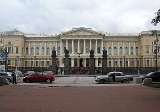
Russian Museum

Encyclopedia
The State Russian Museum (formerly the Russian Museum of His Imperial Majesty Alexander III) is the largest depository of Russia
n fine art in St Petersburg.
The museum
was established on April 13, 1895, upon enthronement of Nicholas II
to commemorate his father, Alexander III
. Its original collection was composed of artworks taken from the Hermitage Museum
, Alexander Palace
, and the Imperial Academy of Arts
. After the Russian Revolution of 1917
, many private collections were nationalized
and relocated to the Russian Museum. These included Kazimir Malevich
's Black Square.
The main building of the museum is the Mikhailovsky Palace, a splendid Neoclassical
residence of Grand Duke Michael Pavlovich
, erected in 1819-25 to a design by Carlo Rossi
on Square of Arts in St Petersburg. Upon the death of the Grand Duke the residence was named after his wife
as the Palace of the Grand Duchess Elena Pavlovna, and became famous for its many theatrical presentations and balls.
Some of the halls of the palace retain the Italianate opulent interiors of the former imperial residence. Other buildings assigned to the Russian museum include the Summer Palace of Peter I (1710–14), the Marble Palace
of Count Orlov (1768–85), St Michael's Castle of Emperor Paul (1797-1801), and the Rastrelliesque Stroganov Palace
on the Nevsky Prospekt
(1752–54).
The Ethnographic
Department was originally set up in a building specially designed by Vladimir Svinyin in 1902. The museum soon housed gifts received by Emperor's family from representatives of peoples inhabiting various regions of the Russian Empire. Further exhibits were purchased by Nicholas II and other members of his family as State financing was not enough to purchase new exhibits. In 1934, the Ethnographic Department was given the status of an independent museum: the Russian Museum of Ethnography
.
Russia
Russia or , officially known as both Russia and the Russian Federation , is a country in northern Eurasia. It is a federal semi-presidential republic, comprising 83 federal subjects...
n fine art in St Petersburg.
The museum
Museum
A museum is an institution that cares for a collection of artifacts and other objects of scientific, artistic, cultural, or historical importance and makes them available for public viewing through exhibits that may be permanent or temporary. Most large museums are located in major cities...
was established on April 13, 1895, upon enthronement of Nicholas II
Nicholas II of Russia
Nicholas II was the last Emperor of Russia, Grand Prince of Finland, and titular King of Poland. His official short title was Nicholas II, Emperor and Autocrat of All the Russias and he is known as Saint Nicholas the Passion-Bearer by the Russian Orthodox Church.Nicholas II ruled from 1894 until...
to commemorate his father, Alexander III
Alexander III of Russia
Alexander Alexandrovich Romanov , historically remembered as Alexander III or Alexander the Peacemaker reigned as Emperor of Russia from until his death on .-Disposition:...
. Its original collection was composed of artworks taken from the Hermitage Museum
Hermitage Museum
The State Hermitage is a museum of art and culture in Saint Petersburg, Russia. One of the largest and oldest museums of the world, it was founded in 1764 by Catherine the Great and has been opened to the public since 1852. Its collections, of which only a small part is on permanent display,...
, Alexander Palace
Alexander Palace
The Alexander Palace is a former imperial residence at Tsarskoye Selo, on a plateau around 30 minutes by train from St Petersburg. It is known as the favourite residence of the last Russian Emperor, Nicholas II, and his family and their initial place of imprisonment after the revolution that...
, and the Imperial Academy of Arts
Imperial Academy of Arts
The Russian Academy of Arts, informally known as the St. Petersburg Academy of Arts, was founded in 1757 by Ivan Shuvalov under the name Academy of the Three Noblest Arts. Catherine the Great renamed it the Imperial Academy of Arts and commissioned a new building, completed 25 years later in 1789...
. After the Russian Revolution of 1917
Russian Revolution of 1917
The Russian Revolution is the collective term for a series of revolutions in Russia in 1917, which destroyed the Tsarist autocracy and led to the creation of the Soviet Union. The Tsar was deposed and replaced by a provisional government in the first revolution of February 1917...
, many private collections were nationalized
Nationalization
Nationalisation, also spelled nationalization, is the process of taking an industry or assets into government ownership by a national government or state. Nationalization usually refers to private assets, but may also mean assets owned by lower levels of government, such as municipalities, being...
and relocated to the Russian Museum. These included Kazimir Malevich
Kazimir Malevich
Kazimir Severinovich Malevich was a Russian painter and art theoretician, born of ethnic Polish parents. He was a pioneer of geometric abstract art and the originator of the Avant-garde Suprematist movement.-Early life:...
's Black Square.
The main building of the museum is the Mikhailovsky Palace, a splendid Neoclassical
Neoclassicism
Neoclassicism is the name given to Western movements in the decorative and visual arts, literature, theatre, music, and architecture that draw inspiration from the "classical" art and culture of Ancient Greece or Ancient Rome...
residence of Grand Duke Michael Pavlovich
Grand Duke Michael Pavlovich of Russia
Grand Duke Michael Pavlovich of Russia was the tenth child and fourth son of Paul I of Russia and Sophie Dorothea of Württemberg.-Marriage and issue:In St...
, erected in 1819-25 to a design by Carlo Rossi
Carlo Rossi (architect)
Carlo di Giovanni Rossi, was an Italian architect, who worked the major portion of his life in Russia. He was the author of many classical buildings and architectural ensembles in Saint Petersburg and its environments...
on Square of Arts in St Petersburg. Upon the death of the Grand Duke the residence was named after his wife
Elena Pavlovna of Württemberg
Princess Charlotte of Württemberg was, as Grand Duchess Elena Pavlovna of Russia, the wife of Grand Duke Michael Pavlovich of Russia...
as the Palace of the Grand Duchess Elena Pavlovna, and became famous for its many theatrical presentations and balls.
Some of the halls of the palace retain the Italianate opulent interiors of the former imperial residence. Other buildings assigned to the Russian museum include the Summer Palace of Peter I (1710–14), the Marble Palace
Marble Palace
Marble Palace is one of the first Neoclassical palaces in Saint Petersburg, Russia. It is situated between the Field of Mars and Palace Quay, slightly to the east from New Michael Palace....
of Count Orlov (1768–85), St Michael's Castle of Emperor Paul (1797-1801), and the Rastrelliesque Stroganov Palace
Stroganov Palace
The Stroganov Palace is a Late Baroque palace at the intersection of the Moika River and Nevsky Prospekt in Saint Petersburg, Russia. The palace was built to Bartolomeo Rastrelli's designs for Baron Sergei Grigoriyevich Stroganov in 1753-1754...
on the Nevsky Prospekt
Nevsky Prospekt
Nevsky Avenue |Prospekt]]) is the main street in the city of St. Petersburg, Russia. Planned by Peter the Great as beginning of the road to Novgorod and Moscow, the avenue runs from the Admiralty to the Moscow Railway Station and, after making a turn at Vosstaniya Square, to the Alexander...
(1752–54).
The Ethnographic
Ethnography
Ethnography is a qualitative method aimed to learn and understand cultural phenomena which reflect the knowledge and system of meanings guiding the life of a cultural group...
Department was originally set up in a building specially designed by Vladimir Svinyin in 1902. The museum soon housed gifts received by Emperor's family from representatives of peoples inhabiting various regions of the Russian Empire. Further exhibits were purchased by Nicholas II and other members of his family as State financing was not enough to purchase new exhibits. In 1934, the Ethnographic Department was given the status of an independent museum: the Russian Museum of Ethnography
Russian Museum of Ethnography
The Russian Museum of Ethnography is a museum in St. Petersburg that houses a collection of about 500,000 items relating to the ethnography, or cultural anthropology, of peoples of the former Russian Empire and the Soviet Union.The museum was set up in 1902 as the ethnographic department of the...
.
See also
- Collections of the Russian MuseumCollections of the Russian MuseumAmong the collections of the Russian Museum in St Petersbugh in Russia are some of the greatest pieces of Russian art in the world.The Museum houses collections of sculpture, objets d'art, drawings and paintings including the famous picture gallery....
- Russian Museum of EthnographyRussian Museum of EthnographyThe Russian Museum of Ethnography is a museum in St. Petersburg that houses a collection of about 500,000 items relating to the ethnography, or cultural anthropology, of peoples of the former Russian Empire and the Soviet Union.The museum was set up in 1902 as the ethnographic department of the...
- Art Culture MuseumArt Culture MuseumThe Art Culture Museum was a museum in Saint Petersburg, Russia. It opened in 1921 in the former Myatlev family's house at 9 St.Isaac’s Square. It was founded by left-wing artists with the intention to demonstrate artistic culture such as painting techniques, materials and processing methods. Based...