


Stromness

Encyclopedia
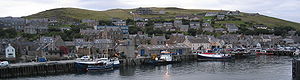
Stromness (ˈstrɒmnəs) is the second-biggest town in Orkney, Scotland
. It is in the south-west of Mainland Orkney. It is also a parish, with the town of Stromness as its capital.
Straumsnes. Straum refers to the strong tides that rip past the Point of Ness through Hoy Sound to the south of the town. Nes means "headland". Stromness thus means "headland protruding into the tidal stream ". In Viking times the anchorage where Stromness now stands was called Hamnavoe, meaning "peaceful" or "safe harbour".
First recorded as the site of an inn in the 16th century, Stromness became important during the late 17th century, when England
was at war with France
and shipping was forced to avoid the English Channel
. Ships of the Hudson's Bay Company
were regular visitors, as were whaling
fleets. Large numbers of Orkneymen, many of whom came from the Stromness area, served as traders, explorers and seamen for both. Stromness Museum reflects these aspects of the town's history (displaying for example important collections of whaling relics, and Inuit
artefacts brought back as souvenirs by local men from Greenland
and Arctic Canada). An unusual aspect of the town's character is the large number of buildings decorated with displays of whale bones outside them.
Stromness plays host to the Pier Art Gallery
, an outstanding collection of twentieth century British art.
Writer George Mackay Brown
was born and lived most of his life in the town, and is buried in the town's cemetery overlooking Hoy Sound.
Stromness is referenced in the title of Sir Peter Maxwell Davies
's popular piano piece Farewell to Stromness, a piano interlude from The Yellow Cake Revue
, which was written to protest at plans to open a uranium
mine in the area. (The title refers to yellowcake
, the powder produced in an early stage of the processing of uranium
ore.) The Revue was first performed by the composer at the Stromness Hotel on 21 June 1980 as part of the St Magnus Festival
; the uranium mine was cancelled later that year.
Stromness is also the title of a 2009 novel by Herbert Wetterauer
.
and Graemsay
and a tract of about 5 miles by 3¾ on Mainland. The main part is bounded on the west by the Atlantic, on the south and the south-east by Hoy Sound, on the north-east by the Loch of Stenness
.
Antiquities include Breckness House, erected in 1633 by George Graham
, bishop of Orkney at the west entrance of Hoy Sound; and an ancient cemetery, with ruined church, and remains of a monastery, between Breckness House and Stromness town.
, The Footprints of the Creator or The Asterolepsis of Stromness (1850).
Scotland
Scotland is a country that is part of the United Kingdom. Occupying the northern third of the island of Great Britain, it shares a border with England to the south and is bounded by the North Sea to the east, the Atlantic Ocean to the north and west, and the North Channel and Irish Sea to the...
. It is in the south-west of Mainland Orkney. It is also a parish, with the town of Stromness as its capital.
Etymology
The name "Stromness" comes from the NorseOld Norse
Old Norse is a North Germanic language that was spoken by inhabitants of Scandinavia and inhabitants of their overseas settlements during the Viking Age, until about 1300....
Straumsnes. Straum refers to the strong tides that rip past the Point of Ness through Hoy Sound to the south of the town. Nes means "headland". Stromness thus means "headland protruding into the tidal stream ". In Viking times the anchorage where Stromness now stands was called Hamnavoe, meaning "peaceful" or "safe harbour".
Town
A long-established seaport, it has a population of approximately 2,190 residents. The old town is clustered along the characterful and winding main street, flanked with houses and shops built from local stone, with narrow lanes and alleys branching off it. There is a ferry link from Stromness to Scrabster on the north coast of mainland Scotland.First recorded as the site of an inn in the 16th century, Stromness became important during the late 17th century, when England
England
England is a country that is part of the United Kingdom. It shares land borders with Scotland to the north and Wales to the west; the Irish Sea is to the north west, the Celtic Sea to the south west, with the North Sea to the east and the English Channel to the south separating it from continental...
was at war with France
France
The French Republic , The French Republic , The French Republic , (commonly known as France , is a unitary semi-presidential republic in Western Europe with several overseas territories and islands located on other continents and in the Indian, Pacific, and Atlantic oceans. Metropolitan France...
and shipping was forced to avoid the English Channel
English Channel
The English Channel , often referred to simply as the Channel, is an arm of the Atlantic Ocean that separates southern England from northern France, and joins the North Sea to the Atlantic. It is about long and varies in width from at its widest to in the Strait of Dover...
. Ships of the Hudson's Bay Company
Hudson's Bay Company
The Hudson's Bay Company , abbreviated HBC, or "The Bay" is the oldest commercial corporation in North America and one of the oldest in the world. A fur trading business for much of its existence, today Hudson's Bay Company owns and operates retail stores throughout Canada...
were regular visitors, as were whaling
Whaling
Whaling is the hunting of whales mainly for meat and oil. Its earliest forms date to at least 3000 BC. Various coastal communities have long histories of sustenance whaling and harvesting beached whales...
fleets. Large numbers of Orkneymen, many of whom came from the Stromness area, served as traders, explorers and seamen for both. Stromness Museum reflects these aspects of the town's history (displaying for example important collections of whaling relics, and Inuit
Inuit
The Inuit are a group of culturally similar indigenous peoples inhabiting the Arctic regions of Canada , Denmark , Russia and the United States . Inuit means “the people” in the Inuktitut language...
artefacts brought back as souvenirs by local men from Greenland
Greenland
Greenland is an autonomous country within the Kingdom of Denmark, located between the Arctic and Atlantic Oceans, east of the Canadian Arctic Archipelago. Though physiographically a part of the continent of North America, Greenland has been politically and culturally associated with Europe for...
and Arctic Canada). An unusual aspect of the town's character is the large number of buildings decorated with displays of whale bones outside them.
Stromness plays host to the Pier Art Gallery
Pier Art Gallery
The Pier Art Gallery in Stromness, Orkney, was opened to the public in 1979. The art collector Margaret Gardiner first visited Orkney in the 1950s and converted the old quayside building to house her collection of modern paintings and sculpture. It began as a personal collection of her friends'...
, an outstanding collection of twentieth century British art.
Writer George Mackay Brown
George Mackay Brown
George Mackay Brown , was a Scottish poet, author and dramatist, whose work has a distinctly Orcadian character...
was born and lived most of his life in the town, and is buried in the town's cemetery overlooking Hoy Sound.
Stromness is referenced in the title of Sir Peter Maxwell Davies
Peter Maxwell Davies
Sir Peter Maxwell Davies, CBE is an English composer and conductor and is currently Master of the Queen's Music.-Biography:...
's popular piano piece Farewell to Stromness, a piano interlude from The Yellow Cake Revue
The Yellow Cake Revue
The Yellow Cake Revue is a musical composition for a speaker and pianist by the English composer Peter Maxwell Davies.-Background:...
, which was written to protest at plans to open a uranium
Uranium
Uranium is a silvery-white metallic chemical element in the actinide series of the periodic table, with atomic number 92. It is assigned the chemical symbol U. A uranium atom has 92 protons and 92 electrons, of which 6 are valence electrons...
mine in the area. (The title refers to yellowcake
Yellowcake
Yellowcake is a kind of uranium concentrate powder obtained from leach solutions, in an intermediate step in the processing of uranium ores. Yellowcake concentrates are prepared by various extraction and refining methods, depending on the types of ores...
, the powder produced in an early stage of the processing of uranium
Uranium
Uranium is a silvery-white metallic chemical element in the actinide series of the periodic table, with atomic number 92. It is assigned the chemical symbol U. A uranium atom has 92 protons and 92 electrons, of which 6 are valence electrons...
ore.) The Revue was first performed by the composer at the Stromness Hotel on 21 June 1980 as part of the St Magnus Festival
St Magnus Festival
The St Magnus Festival is an annual 6-day arts festival which takes place on the islands of Orkney off the north coast of mainland Scotland.-History and Management:...
; the uranium mine was cancelled later that year.
Stromness is also the title of a 2009 novel by Herbert Wetterauer
Herbert Wetterauer
Herbert Wetterauer is a German painter, sculptor and author. He is known for his drawings with paintbrushes and life-sized figures made of paperboard, for which he developed his own technique....
.
Parish
The parish of Stromness includes the islands of HoyHoy
Hoy is an island in Orkney, Scotland. With an area of it is the second largest in the archipelago after the Mainland. It is connected by a causeway called The Ayre to South Walls...
and Graemsay
Graemsay
Graemsay is an island in the western approaches to Scapa Flow, in the Orkney Islands of Scotland. The island has two lighthouses.-Geography and geology:...
and a tract of about 5 miles by 3¾ on Mainland. The main part is bounded on the west by the Atlantic, on the south and the south-east by Hoy Sound, on the north-east by the Loch of Stenness
Loch of Stenness
The Loch of Stenness together with the Loch of Harray are the two largest freshwater lochs of Mainland, Orkney. In Old Norse their names are Steinnesvatn and Heraðvatn...
.
Antiquities include Breckness House, erected in 1633 by George Graham
George Graham
- Politics :*George Graham , 18th-century governor of Newfoundland*George Graham , former political activist*George Perry Graham , Canadian MP from Ontario*George Graham...
, bishop of Orkney at the west entrance of Hoy Sound; and an ancient cemetery, with ruined church, and remains of a monastery, between Breckness House and Stromness town.
Geology
It presents to the Atlantic a range of cliffs from 100–500 ft high, to Hoy Sound a band of fertile lowlands; and it elsewhere consists mainly of bleak, sterile heights. The rocks possess great geological interest, and were made well-known by the publication of the evangelical geologist Hugh MillerHugh Miller
Hugh Miller was a self-taught Scottish geologist and writer, folklorist and an evangelical Christian.- Life and work :Born in Cromarty, he was educated in a parish school where he reportedly showed a love of reading. At 17 he was apprenticed to a stonemason, and his work in quarries, together with...
, The Footprints of the Creator or The Asterolepsis of Stromness (1850).
External links
- Stromness Harbour webcam
- Stromness Museum
- Ballantine's Midnight Cup at Stromness Golf Club, stv feature, 19 June 2007.
- Stromness Royal British Legion Pipe Band
- Orkney's local paper
- Pier Art GalleryPier Art GalleryThe Pier Art Gallery in Stromness, Orkney, was opened to the public in 1979. The art collector Margaret Gardiner first visited Orkney in the 1950s and converted the old quayside building to house her collection of modern paintings and sculpture. It began as a personal collection of her friends'...
An important collection of British fine art