

Robinia

Encyclopedia
Robinia is a genus
of flowering plants in the family Fabaceae
, subfamily Faboideae
, native to North America
and northern Mexico
. Commonly known as "locusts", they are deciduous
trees and shrubs growing 4-25 m tall. The leaves are pinnate
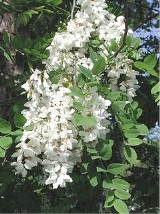
with 7-21 oval leaflets. The flowers are white or pink, in usually pendulous raceme
s. Many species have thorny shoots, and several have sticky hairs on the shoots.
The genus is named after the royal French gardeners Jean Robin and his son Vespasian Robin, who introduced the plant to Europe
in 1601.
The number of species is disputed between different authorities, with as few as four recognised by some authors, while others recognise up to ten species. There are also several natural hybrids.
Some species of Robinia are used as food by larva
e of Lepidoptera
, including Brown-tail
, Buff-tip
, The Engrailed
and Giant Leopard Moth
.
Genus
In biology, a genus is a low-level taxonomic rank used in the biological classification of living and fossil organisms, which is an example of definition by genus and differentia...
of flowering plants in the family Fabaceae
Fabaceae
The Fabaceae or Leguminosae, commonly known as the legume, pea, or bean family, is a large and economically important family of flowering plants. The group is the third largest land plant family, behind only the Orchidaceae and Asteraceae, with 730 genera and over 19,400 species...
, subfamily Faboideae
Faboideae
Faboideae is a subfamily of the flowering plant family Fabaceae or Leguminosae. One acceptable alternative name for the subfamily is Papilionoideae....
, native to North America
North America
North America is a continent wholly within the Northern Hemisphere and almost wholly within the Western Hemisphere. It is also considered a northern subcontinent of the Americas...
and northern Mexico
Mexico
The United Mexican States , commonly known as Mexico , is a federal constitutional republic in North America. It is bordered on the north by the United States; on the south and west by the Pacific Ocean; on the southeast by Guatemala, Belize, and the Caribbean Sea; and on the east by the Gulf of...
. Commonly known as "locusts", they are deciduous
Deciduous
Deciduous means "falling off at maturity" or "tending to fall off", and is typically used in reference to trees or shrubs that lose their leaves seasonally, and to the shedding of other plant structures such as petals after flowering or fruit when ripe...
trees and shrubs growing 4-25 m tall. The leaves are pinnate
Pinnate
Pinnate is a term used to describe feather-like or multi-divided features arising from both sides of a common axis in plant or animal structures, and comes from the Latin word pinna meaning "feather", "wing", or "fin". A similar term is pectinate, which refers to a comb-like arrangement of parts...
with 7-21 oval leaflets. The flowers are white or pink, in usually pendulous raceme
Raceme
A raceme is a type of inflorescence that is unbranched and indeterminate and bears pedicellate flowers — flowers having short floral stalks called pedicels — along the axis. In botany, axis means a shoot, in this case one bearing the flowers. In a raceme, the oldest flowers are borne...
s. Many species have thorny shoots, and several have sticky hairs on the shoots.
The genus is named after the royal French gardeners Jean Robin and his son Vespasian Robin, who introduced the plant to Europe
Europe
Europe is, by convention, one of the world's seven continents. Comprising the westernmost peninsula of Eurasia, Europe is generally 'divided' from Asia to its east by the watershed divides of the Ural and Caucasus Mountains, the Ural River, the Caspian and Black Seas, and the waterways connecting...
in 1601.
The number of species is disputed between different authorities, with as few as four recognised by some authors, while others recognise up to ten species. There are also several natural hybrids.
Some species of Robinia are used as food by larva
Larva
A larva is a distinct juvenile form many animals undergo before metamorphosis into adults. Animals with indirect development such as insects, amphibians, or cnidarians typically have a larval phase of their life cycle...
e of Lepidoptera
Lepidoptera
Lepidoptera is a large order of insects that includes moths and butterflies . It is one of the most widespread and widely recognizable insect orders in the world, encompassing moths and the three superfamilies of butterflies, skipper butterflies, and moth-butterflies...
, including Brown-tail
Brown-tail
The brown-tail is a moth of the family Lymantriidae. It is distributed throughout Europe.The wings of this species are pure white, as is the body, apart from a tuft of brown hairs at the end of the abdomen. The brown coloration extends along most of the back of the abdomen in the male...
, Buff-tip
Buff-tip
The Buff-tip is a moth of the family Notodontidae. It is found throughout Europe.This is a fairly large, heavy bodied species with a wingspan of 55-68 mm. The forewings are grey with a large prominent buff patch at the apex. As the thoracic hair is also buff, the moth looks remarkably like a...
, The Engrailed
Engrailed
The Engrailed and Small Engrailed are moths of the family Geometridae. They are distributed across most of Europe. There is an on-going debate as to whether they make up one species, or whether E. crepuscularia actually refers only to the Small Engrailed, with the Engrailed proper being separable...
and Giant Leopard Moth
Giant Leopard Moth
The Giant Leopard Moth or Eyed Tiger Moth is a moth of the family Arctiidae. It is distributed throughout the Southern and Eastern United States from New England to Mexico. The obsolete name Ecpantheria scribonia is still occasionally encountered.This species has a wingspan of 3 inches...
.
Species
(*: not accepted as distinct by all authorities)- Robinia boyntonii *
- Robinia elliottii *
- Robinia hartwegii * (R. viscosa var. hartwegii)
- Robinia hispida - Bristly locustBristly locustRobinia hispida, known as the Bristly Locust, Rose acacia, or Rose locust, is a shrub or small tree in the subfamily Faboideae of the pea family Fabaceae, native to the southeastern United States....
- Robinia kelseyi *
- Robinia luxurians *
- Robinia nana *
- Robinia neomexicana - New Mexican locustNew Mexican locustRobinia neomexicana, the New Mexican Locust, New Mexico, Southwest, Desert, Pink, or Rose Locust), is a shrub or small tree in the subfamily Faboideae of the pea family Fabaceae.-Distribution:...
- Robinia pseudoacacia - Black locust, False Acacia
- Robinia viscosa - Clammy locust
Hybrids
- Robinia × ambigua - R. pseudoacacia × R. viscosa (Idaho locust)
- Robinia × holdtii - R. neomexicana × R. pseudoacacia
- Robinia × longiloba - R. hispida × R. viscosa
- Robinia × margarettiae - R. hispida × R. pseudoacacia