


River Neath

Encyclopedia
Wales
Wales is a country that is part of the United Kingdom and the island of Great Britain, bordered by England to its east and the Atlantic Ocean and Irish Sea to its west. It has a population of three million, and a total area of 20,779 km²...
running south west from its source in the Brecon Beacons National Park to its mouth at Baglan Bay
Baglan Bay
Baglan Bay is a part of the Swansea Bay coastline and a district of Neath Port Talbot county borough, Wales. The area currently has no inhabitants and is entirely occupied by industrial and commercial developments. Baglan Bay is also the name of a local government community coterminous with the...
below Briton Ferry
Briton Ferry
Briton Ferry is a town and community in the county borough of Neath Port Talbot, Wales. The town encompasses the electoral wards of Briton Ferry East and Briton Ferry West....
on the east side of Swansea Bay
Swansea Bay
Swansea Bay is a bay on the Bristol Channel on the South Wales coast. Places on the bay include Mumbles, Swansea and Port Talbot. The River Neath, River Tawe, River Afan and Blackpill stream flow into the bay....
.
Several minor rivers rise on the southern slopes of Fforest Fawr
Fforest Fawr
Fforest Fawr is the name given to an extensive upland area in the county of Powys, Wales. Formerly known as the 'Great Forest of Brecknock' in English, it was a royal hunting area for several centuries but is now used primarily for sheep grazing, forestry, water catchment and recreation...
. These include the Afon Hepste
Afon Hepste
The Afon Hepste is a river in Powys, Wales and wholly within the Brecon Beacons National Park.Its headwaters, the Afon y Waun, Nant y Cwrier and Nant Hepste Fechan, rise on the Old Red Sandstone dip-slopes of Fforest Fawr and combine to form the Afon Hepste near the farmstead of Hepste Fechan...
, Afon Sychryd
Afon Sychryd
The Afon Sychryd is a small river in Powys, Wales. Although it is a small river, with a total length of just 3 miles, it is notable for the two spectacular waterfalls which it flows over.-Course:...
, Afon Pyrddin
Afon Pyrddin
The Afon Pyrddin is a river forming the boundary between the county of Powys and the county borough of Neath Port Talbot in south Wales, Great Britain. It also forms a part of the boundary of the Brecon Beacons National Park...
, Nedd Fechan
Nedd Fechan
The Nedd Fechan or 'Little Neath' is a river in the county of Powys, south Wales, Great Britain. It rises on the eastern slopes of Fan Gyhirych in the Fforest Fawr section of the Brecon Beacons National Park and flows south for 12km / 7 mi to join with the Afon Mellte at Pontneddfechan, their...
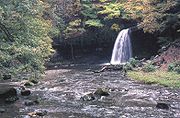
and Afon Mellte, the latter two converging at Pontneddfechan to form the River Neath. Upstream from these confluences is the area known as Waterfall Country
Waterfall Country (Wales)
Waterfall Country is the name given to an area around the head of the Vale of Neath in South Wales where an unusually large number of spectacular and publicly accessible falls are to be found...
, where the rivers plunge over a series of spectacular cataracts.
The river flows through the Vale of Neath, a long straight valley developed along the Neath Disturbance
Neath Disturbance
The Neath Disturbance is a geological structure which stretches across south Wales from Swansea Bay northeastwards as far as Hereford in western England. It comprises a series of both faults and associated folds which were active during the mountain-building period known as the Variscan orogeny...
and which carried a major glacier during the ice ages. Downstream of Pontneddfechan the river has few significant tributaries. Those that do join include the Melincwrt Brook and the Clydach Brook.
The only major tributary to join is the River Dulais
River Dulais
River Dulais is a river of Wales which has its source at Mynydd y Drum. It joins the River Neath after flowing over Aberdulais Falls.-External links:*...
which has its source north of Seven Sisters
Seven Sisters, Wales
Seven Sisters Dulais) is a village in the Dulais Valley, Wales, UK. It lies north-east of Neath. Seven Sisters falls within the Seven Sisters ward of Neath Port Talbot county borough.-History:...
. As the Dulais nears the Neath it descends a spectacular waterfall
Waterfall Country (Wales)
Waterfall Country is the name given to an area around the head of the Vale of Neath in South Wales where an unusually large number of spectacular and publicly accessible falls are to be found...
: the Dulais Falls
Aberdulais Falls
The Aberdulais Falls are found on the River Dulais at Aberdulais, near Neath in the county borough of Neath Port Talbot, South Wales. The falls are formed as the river plunges over beds of hard Lower Pennant Sandstone just before meeting the River Neath flowing down the Vale of Neath...
, a popular tourist attraction owned and managed by the National Trust
National Trust for Places of Historic Interest or Natural Beauty
The National Trust for Places of Historic Interest or Natural Beauty, usually known as the National Trust, is a conservation organisation in England, Wales and Northern Ireland...
and the site of old iron workings. Close by the river flows past the once grand estate of Ynysygerwn. A smaller tributary, the River Clydach
River Clydach
The Lower Clydach River is a river in South Wales which rises on the slopes of Mynydd Betws west of Cwmgors and flows for around 10km through Cwm Clydach to its confluence with the River Tawe at Clydach. It runs through the RSPB's Cwm Clydach Nature Reserve just to the north of Clydach. -...
, flows southward through the village of Bryn-coch to join the Neath in Neath
Neath
Neath is a town and community situated in the principal area of Neath Port Talbot, Wales, UK with a population of approximately 45,898 in 2001...
town centre.
The River Neath provides water to two canals, the Neath Canal and the Tennant Canal. At Aberdulais
Aberdulais
Aberdulais or mouth & Dulais) is a village in Neath Port Talbot, Wales, lying on the River Neath.- History, amenities & attractions:...
basin, both canals meet, the Tennant Canal crossing the River Neath with a fine aqueduct. Also crossing the river here is the Vale of Neath Railway line and the A465 road
A465 road
The A465 is a major road in south Wales. It is more commonly known as the Heads of the Valleys Road because it joins together the north ends of the South Wales Valleys...
.As it approaches the town of Neath the river passes the ancient church of Saint Illtud at Llantwit. Further on it loops around the former workhouse at Llety Nedd and skirts Penydre.Here it passes close to the Norman castle, visited by King Henry II
Henry II of England
Henry II ruled as King of England , Count of Anjou, Count of Maine, Duke of Normandy, Duke of Aquitaine, Duke of Gascony, Count of Nantes, Lord of Ireland and, at various times, controlled parts of Wales, Scotland and western France. Henry, the great-grandson of William the Conqueror, was the...
, King John and King Edward I.
As it meanders around the town of Neath it passes the remains of the Roman fort Nidum
Nidum
Nidum is a Roman fort found near the town of Neath, in Wales. Artifacts from the site are on permanent exhibition in the Neath Museum.-External links:*...
at Court Herbert and the Cistercian abbey of Neath Abbey
Neath Abbey
Neath Abbey was a Cistercian monastery, located near the present-day town of Neath in southern Wales, UK.It was once the largest abbey in Wales. Substantial ruins can still be seen, and are in the care of Cadw...
. Here the monks of the Middle Ages used their access to the river to challenge the trading rights of the burgesses of the town of Neath
Neath
Neath is a town and community situated in the principal area of Neath Port Talbot, Wales, UK with a population of approximately 45,898 in 2001...
.
The estuary of the River Neath extends from Neath
Neath
Neath is a town and community situated in the principal area of Neath Port Talbot, Wales, UK with a population of approximately 45,898 in 2001...
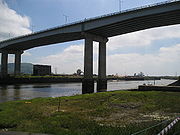
town down past Briton Ferry to the sea next to Jersey Marine Beach. The estuary is partly industrialised with a ship breaking yard, a large local authority waste disposal site and wharves
Wharf
A wharf or quay is a structure on the shore of a harbor where ships may dock to load and unload cargo or passengers.Such a structure includes one or more berths , and may also include piers, warehouses, or other facilities necessary for handling the ships.A wharf commonly comprises a fixed...
at Melincryddan, Briton Ferry
Briton Ferry
Briton Ferry is a town and community in the county borough of Neath Port Talbot, Wales. The town encompasses the electoral wards of Briton Ferry East and Briton Ferry West....
and Neath Abbey
Neath Abbey
Neath Abbey was a Cistercian monastery, located near the present-day town of Neath in southern Wales, UK.It was once the largest abbey in Wales. Substantial ruins can still be seen, and are in the care of Cadw...
. Where it remains undisturbed, there are areas of salt marsh stretching from Neath to Baglan Bay
Baglan Bay
Baglan Bay is a part of the Swansea Bay coastline and a district of Neath Port Talbot county borough, Wales. The area currently has no inhabitants and is entirely occupied by industrial and commercial developments. Baglan Bay is also the name of a local government community coterminous with the...
and Crymlyn Burrows
Crymlyn Burrows
Crymlyn Burrows is an area of land in Wales, UK to the east of Swansea city centre, and south of Crymlyn Bog. It is bounded by Jersey Marine Beach to the south and the River Neath to the east...
which are of great ecological value.